From Borges to 12th Century Persia

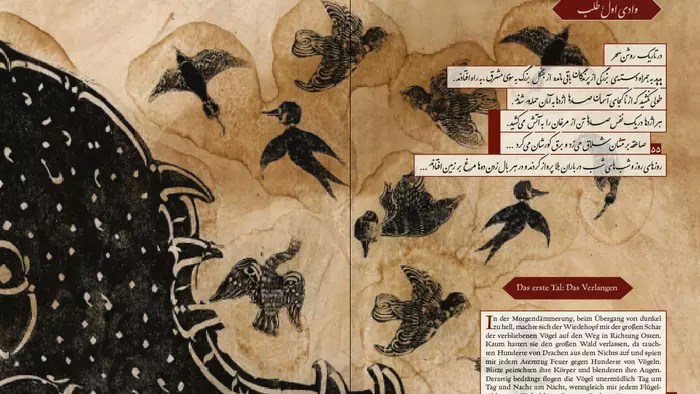
It all started over half a century ago when I discovered the books of the Argentinean writer Jorge Luis Borges. At two places within his Other Inquisitions: 1937-52, I saw intriguing references to a medieval Persian work, Farid-Ud-Din Attar. In “Note on Walt Whitman,” he wrote: “Attar, a twelfth-century Persian, sings of the arduous pilgrimage of the birds in search of their king, the Simurg; many of them perish in the seas, but the survivors discover that they are the Simurg and that the Simurg is each one of them and all of them.”

In the same volume, in the essay entitled “The Enigma of Edward FitzGerald,” Borges writes:

From the study of Spanish [FitzGerald] he has progressed to the study of Persian; he has begun a translation of the Mantiq-al-Tayr, that mystical epic about the birds who are looking for their king, the Simurg. They finally reach his palace, situated in back of seven seas, only to discover that they are the Simurg and that the Simurg is all of them and each one of them.

I was fascinated by this brief summary, which lay fallow, but unforgotten, in my memory for more than five long decades.

Quite unexpectedly, when I attended the Los Angeles Times Festival of Books at the University of Southern California campus on Saturday, by chance I listened to a reading by a local Persian poet, Sholeh Wolpé, who had translated Attar’s Mantiq-al-Tayr into English as The Conference of the Birds, as well as another work of Attar’s called The Invisible Sun. I was ecstatic that I could not only buy both works but have them signed by the translator.

Jorge Luis Borges has been, for me, a gateway to world literature. Through him I discovered G. K. Chesterton, Hilaire Belloc, Chuang-tze, Thomas De Quincey, the Icelandic sagas, W. H. Hudson, Blaise Pascal, and Emanuel Swedenborg. I quickly found that any name mentioned by Borges was worth following up on. Farid-Ud-Din Attar is one of them: I am currently reading Sholeh Wolpé’s translation of The Conference of the Birds with great pleasure. (You will see it mentioned in some future blog posts I am contemplating.)

And I am by no means finished with Borges. There are still some avenues which I hope I can follow, if I had but world enough and time.

“One With Nineveh and Tyre”

Yesterday, I took the bus to the Getty Villa rather than pay the $20 parking fee. The museum had several exhibits about the civilizations of ancient Persia. The above gypsum relief is typical of the art of the Palace of Ashurbanipal in Assyrian Nineveh.

I have always been interested in ancient Persia. It’s not a subject typically taught to American students. The impression I came away with is that virtually all the art is in glorification of the existing monarchy. Comparing it to the literature and art of ancient Greece, I find that in the latter there is more in it for the people. I will always remember the philosophical dialogues of Plato, the tragedies of Sophocles and Euripides, and Greek statuary.

As for ancient Persia, I am reminded of these lines from Rudyard Kipling’s “Recessional”:

 Far-called, our navies melt away;
   On dune and headland sinks the fire:
Lo, all our pomp of yesterday
   Is one with Nineveh and Tyre!
Judge of the Nations, spare us yet,
Lest we forget—lest we forget!

When nothing is left of an ancient civilization is the dusty memory of its regal pomp, there is not much for succeeding generations to hold on to. Still, I plan to learn more about the Assyrians and the Persians that followed in their wake. Greece and Rome spent centuries fighting the Persian menace; and today we are only endangering ourselves when we fail to understand other civilizations.

Politics in Tabriz, 1953

Image of Old Tabriz, Persia, by Eugène Flandin

I am reading a great travel classic written in the 1950s about two Swiss who drove a ratty old Fiat from Yugoslavia to the Khyber Pass on the Afghanistan/Pakistan border. Nicolas Bouvier’s The Way of the World describes Persian politics in Tabriz in 1953, when Muhammad Musaddeq’s government was overthrown by a Royalist coup. Wonderful stuff! BTW, is this where we’re headed?

The Musaddeq trial, which had just opened in Tehran, led to fears of skirmishes in Tabriz. They didn’t take place because that very morning the Governor demonstrated to the town that he was in full control: five armoured cars, several mortars and twenty trucks, carrying troops whose numbers had been increased for the occasion.

The Governor was a wily old man, a cruel jester, oddly esteemed even by opponents of the government he represented. He was forgiven much because everyone knew he had no political convictions and had entirely devoted his rule to building up his personal fortune, with a skill that had won him many admirers. Tabriz had always been a recalcitrant town, but it recognized ‘fair play’, and well-aimed shots. That unexpected parade, for example, which had the town by the scruff of the neck when it woke up, was absolutely in the style of the man to whom the town referred familiarly by his first name. A despot, of course, whose disappearance would have been welcomed with relief, and who was intently watched in case he should slip up. Meanwhile, informed, bland, pitiless and efficient, he was impressive. The town, familiar with despotism, granted his talent.

Wild Geese and Eagles

The following passage appears in the Res Gestae (The Later Roman Empire A.D. 354-378) of the 4th century Roman historian Ammianus Marcellinus. This appears in a chapter about the Emperor Constantius’s attempts to head off a powerful Persian invasion. I cannot help but think that eagles don’t exactly key on their prey’s screams of fear.

When wild geese, in their migration from east to west [?] to escape the heat, approach the Taurus mountains, where eagles are common, their fear of these formidable birds leads them to stop up their beaks with small stones, to prevent a cry from escaping them, however hard-pressed But when they have passed over these hills in rapid flight they let the stones fall, and so pursue their way free from fear.