
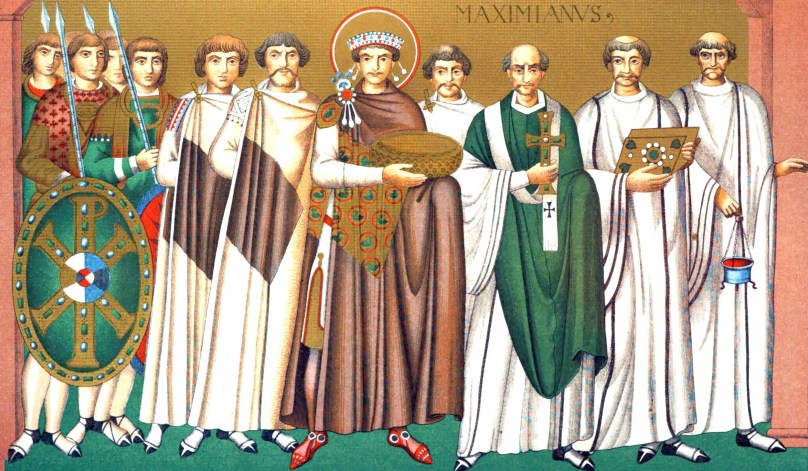
The Byzantine Emperor Justinian and His Court
If you pick up a world history textbook, you will find that history begins with the pharaohs of Egypt, moves on to Classical Greece, followed hard by the Roman Republic and Empire. Then we have the various barbarian invasions, particularly the Attila and his Huns. Things slow to a crawl with Muhammad, the Middle Ages, then speed up with the Renaissance, the Reformation, the French Revolution, Communism, and the two World Wars.
All along, the assumption is made that only the history of Western Europe really counts. Latin America? Zilch. Asia? Other than a blip for Islam, nada. Africa? After the pyramids, nothing. Russia before Lenin? Nope, didn’t exist.
One of the periods of world history that is missing from the textbooks are the Hellenistic kingdoms after the death of Alexander the Great. I am currently reading Philip Matyszak’s The Rise of the Hellenistic Kingdoms 336-250 BC. It covers a two hundred year period about which most people know nothing. It’s as if, immediately upon the untimely death of Alexander, the Greeks just said to themselves, “Oh, well, let’s go back home to Greece and drink some retsina.”
That didn’t happen. I guess that Alexander’s conquests were too far east and south to interest the Western European history crowd.
Equally puzzling is to them is the Byzantine Empire. The Roman Empire did not end abruptly on September 4, AD 476. It struggled on in Byzantium (later Constantinople) for another thousand years. Only in AD 1453 did Mehmet II and his Turkish army conquer Constantinople.
Probably more serious is the almost total silence on China and India, the Abbasid and Umayyad Caliphates, Al-Andalus in Spain, the Ottoman Empire, and Russia under the Czars.
My approach to world history is a process I refer to as “in-betweening.” The term comes from animated cartoons: It is the process of getting from one point to another in a logical sequence. I have often found the periods that have been skipped altogether shed an interesting light on the Western European mainstream.


You must be logged in to post a comment.