For the entire month of July, Southern California has been enduring not only a heat wave, but a humid heat wave. Granted that the temperature farther inland has been much worse than what I have had to endure living a scant two miles from the beach as I do. When it’s 80° Fahrenheit here (27° Celsius), it’s well over 100° Fahrenheit (38° Celsius) in the valleys and deserts.
My brother Dan lives in the Coachella Valley, where the mercury has topped 117° Fahrenheit (47° Celsius) at times. No wonder that he is considering a move to Northern California.
In the sixty years I have lived in Southern California, I have never experienced anything like this. It is quite evident that the entire world is in the grip of some strange weather conditions. The fires in France and Spain are like nothing I have ever seen in Europe. And the constant humidity from tropical storms wending westward from Mexico have sent waves of humid air circulating over the Southwest.
Every day, the weather forecast is virtually the same, even looking forward for the next seven days.
I don’t know where all this is heading over the next ten or twenty years. Certainly no place good. We seem to have left the Little Ice Age that began in the 14th century in the rearview mirror. Maybe the earth has decided to give us up as a bad lot and condemned the human race to become crispy critters. No doubt we had it coming to us.
One of my favorite French poems is Arthur Rimbaud’s “Le Bateau Ivre,” translated as “The Drunken Boat.” The reader gets a feeling of strangeness floating down the various waters of this world. My favorite line in the original French is:
Et ravie, un noyé pensif parfois descend
My translation:
And, rapt, a pensive drowned body at times floats by
Here is “The Drunken Boat” in its entirety:
The Drunken Boat
As I was going down impassive Rivers, I no longer felt myself guided by haulers: Yelping redskins had taken them as targets And had nailed them naked to colored stakes.
I was indifferent to all crews, The bearer of Flemish wheat or English cottons When with my haulers this uproar stopped The Rivers let me go where I wanted.
Into the furious lashing of the tides More heedless than children’s brains the other winter I ran! And loosened Peninsulas Have not undergone a more triumphant hubbub
The storm blessed my sea vigils Lighter than a cork I danced on the waves That are called eternal rollers of victims, Ten nights, without missing the stupid eye of the lighthouses!
Sweeter than the flesh of hard apples is to children The green water penetrated my hull of fir And washed me of spots of blue wine And vomit, scattering rudder and grappling-hook
And from then on I bathed in the Poem Of the Sea, infused with stars and lactescent, Devouring the azure verses; where, like a pale elated Piece of flotsam, a pensive drowned figure sometimes sinks;
Where, suddenly dyeing the blueness, delirium And slow rhythms under the streaking of daylight, Stronger than alcohol, vaster than our lyres, The bitter redness of love ferments!
I know the skies bursting with lightning, and the waterspouts And the surf and the currents; I know the evening, And dawn as exalted as a flock of doves And at times I have seen what man thought he saw!
I have seen the low sun spotted with mystic horrors, Lighting up, with long violet clots, Resembling actors of very ancient dramas, The waves rolling far off their quivering of shutters!
I have dreamed of the green night with dazzled snows A kiss slowly rising to the eyes of the sea, The circulation of unknown saps, And the yellow and blue awakening of singing phosphorous!
I followed during pregnant months the swell, Like hysterical cows, in its assault on the reefs, Without dreaming that the luminous feet of the Marys Could constrain the snout of the wheezing Oceans!
I struck against, you know, unbelievable Floridas Mingling with flowers panthers’ eyes and human Skin! Rainbows stretched like bridal reins Under the horizon of the seas to greenish herds!
I have seen enormous swamps ferment, fish-traps Where a whole Leviathan rots in the rushes! Avalanches of water in the midst of a calm, And the distances cataracting toward the abyss!
Glaciers, suns of silver, nacreous waves, skies of embers! Hideous strands at the end of brown gulfs Where giant serpents devoured by bedbugs Fall down from gnarled trees with black scent!
I should have liked to show children those sunfish Of the blue wave, the fish of gold, the singing fish. —Foam of flowers rocked my drifting And ineffable winds winged me at times.
At times a martyr weary of poles and zones, The sea, whose sob created my gentle roll, Brought up to me her dark flowers with yellow suckers And I remained, like a woman on her knees…
Resembling an island tossing on my sides the quarrels And droppings of noisy birds with yellow eyes And I sailed on, when through my fragile ropes Drowned men sank backward to sleep!
Now I, a boat lost in the foliage of caves, Thrown by the storm into the birdless air I whose water-drunk carcass would not have been rescued By the Monitors and the Hanseatic sailboats;
Free, smoking, topped with violet fog, I who pierced the reddening sky like a wall, Bearing, delicious jam for good poets Lichens of sunlight and mucus of azure,
Who ran, spotted with small electric moons, A wild plank, escorted by black seahorses, When Julys beat down with blows of cudgels The ultramarine skies with burning funnels;
I, who trembled, hearing at fifty leagues off The moaning of the Behemoths in heat and the thick Maelstroms, Eternal spinner of the blue immobility I miss Europe with its ancient parapets!
I have seen sidereal archipelagos! and islands Whose delirious skies are open to the sea-wanderer: —Is it in these bottomless nights that you sleep and exile yourself, Million golden birds, o future Vigor? –
But, in truth, I have wept too much! Dawns are heartbreaking. Every moon is atrocious and every sun bitter. Acrid love has swollen me with intoxicating torpor O let my keel burst! O let me go into the sea!
If I want a water of Europe, it is the black Cold puddle where in the sweet-smelling twilight A squatting child full of sadness releases A boat as fragile as a May butterfly.
No longer can I, bathed in your languor, o waves, Follow in the wake of the cotton boats, Nor cross through the pride of flags and flames, Nor swim under the terrible eyes of prison ships.
The last few years have been tough on independent restaurants. It seems there are fewer every year. In a way, I can understand it. To work at running a full-service restaurant means surrendering to a life of drudgery. Managing a staff of cooks, waiters, busboys, cashiers, and maintenance personnel requires the skills of a military leader plus that of a chief executive officer, or CEO.
This last week, I have been studying a Lonely Planet guide to Singapore, which gave me some ideas. There are, of course, full service restaurants on the island; but they are mostly for the well-to-do who are likely to order a variety of dishes accompanied by wine or liquor. A certain number of these will continue to exist.
But for most people in Singapore, all the excitement is in the various “hawker centers” scattered throughout the city-state. These are largish dining halls with booths specializing in one or more dishes. An effort is made to have a variety of dishes represented. It wouldn’t work if everyone were selling pizza or hamburgers. To see how this might work, check out this influencer video on YouTube:
In it, you will visit a number of hawker centers to find the best purveyors of typical Singaporean dishes. The video is about an hour long, but you’ll get the idea in the first fifteen minutes.
Imagine an American hawker centers where you might have the following food stalls: hamburgers, pizza, tacos, desserts, sub sandwiches, soups, salads, pasta, chicken, hot dogs, barbecue, deli sandwiches, omelets, pancakes, souvlaki, Indian curries, hummus and moutabal, Greek mezze, gyro sandwiches, vegetarian and vegan foods, Korean foods, teriyaki, and so on ad infinitum.
In a space the size of a shopping mall food court, you could have a larger variety of foods. No longer would friends and families dining out have to sacrifice their tastes because the the loudest, most insistent member of the party insisted on having his/her way.
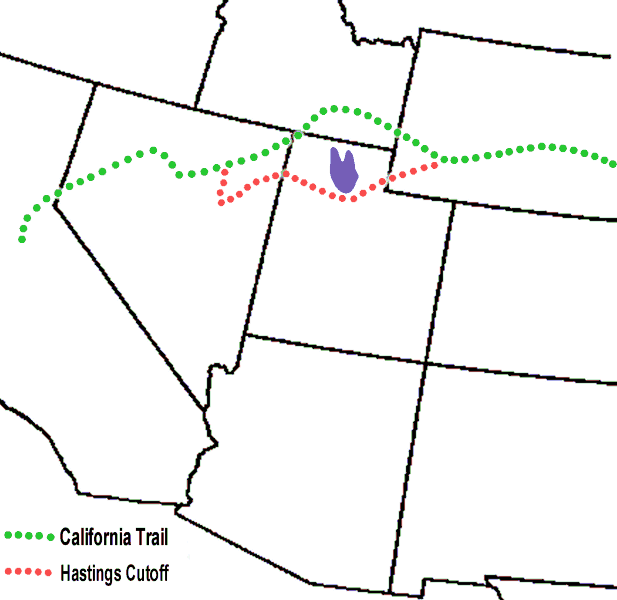
One of the greatest villains of the Old West was not a robber or a cutthroat. He was the author of a book entitled The Emigrant’s Guide to Oregon and California, published in 1845. In it, the author. one Lansford Hastings, recommended an improved route for wagon trains headed to California:
The most direct route, for the California emigrants, would be to leave the Oregon route, about two hundred miles east from Fort Hall; thence bearing West Southwest, to the Salt Lake; and thence continuing down to the bay of St. Francisco, by the route just described.
The only problem was that the author did not know what he was talking about. According to Wikipedia,
The cutoff left the Oregon Trail at Fort Bridger in Wyoming, passed through the Wasatch Range, across the Great Salt Lake Desert, an 80-mile nearly water-less drive, looped around the Ruby Mountains, and rejoined the California Trail about seven miles west of modern Elko (also Emigrant Pass).
Unfortunately, the Donner Party followed Hastings’s advice as published, although he himself never took that route through the Great Salt Lake Desert. What is more, he passed on to emigrants the fake news that Mexican authorities would stop them if they took the safer route through what is now Southern Idaho.
The result: The Donner party did not reach the Sierra Nevada Mountains in California until winter had set in. They were snowbound near Truckee Lake (now Donner Lake) at an altitude of 7,088 feet (2,160 meters). A number of the party died in the savage winter of 1846, and there was some cannibalism before rescue parties reached the survivors.
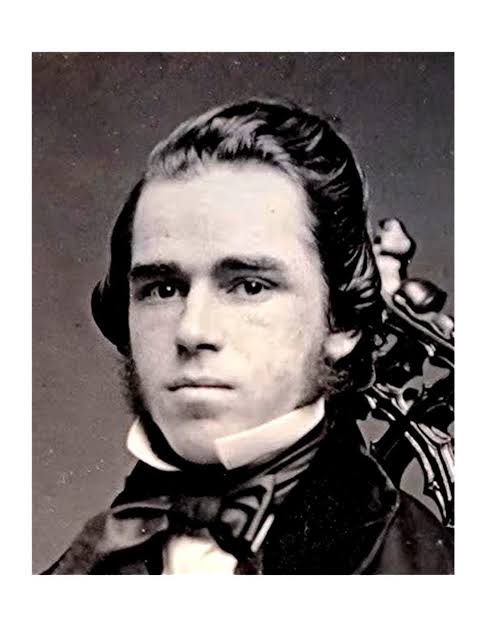
Below is a picture of Lansford Hastings around the time his guide was published:
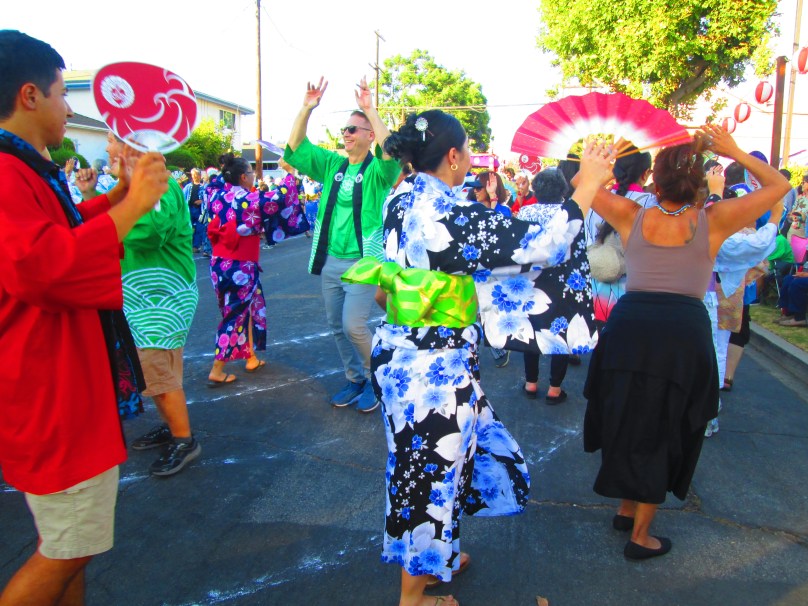
Line Dancing at the West L.A. Buddhist Temple Obon Festival
For a ceremony that honors one’s departed ancestors, the Obon festivals that I have seen tend to be pretty lively affairs. In Los Angeles, the various Buddhist temples take turns hosting the festival, and typically church members travel from one Obon celebration to another wearing happi coats identifying their congregation.
In the above photo, the red happi coat worn by the figure at the far left identifies him as belonging to the West L.A. Buddhist Temple. The figure in the center background wearing a green happi coat is from the San Fernando Valley Hongwanji. On Sunday, there were dancers from Gardena, Venice, Senshin, Nishin, and others that I could not identify.
Women dancing at the festival frequently wear elegant kimonos, though there is no strict dress code. In general, the atmosphere is non-judgmental.
This year, the festival was well attended. There were booths offering Japanese and American food, as well as games offering prizes.
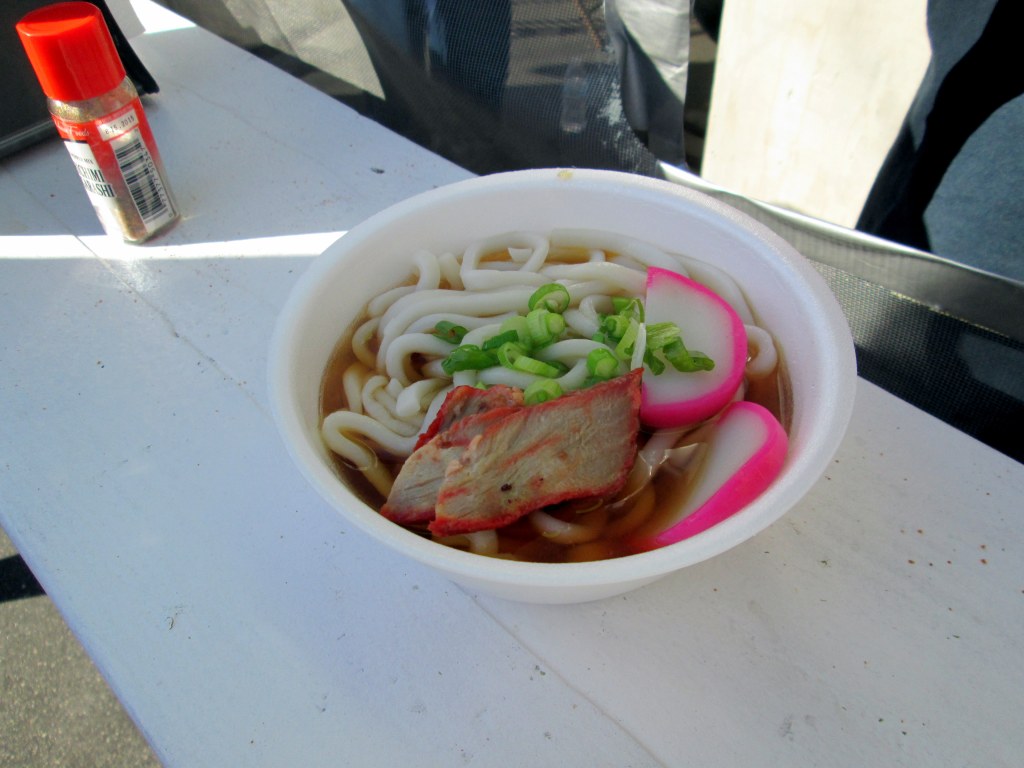
The real reason that I like to attend is the udon soup cooked by the temple’s men’s club. It is top quality stuff, better than the udon offered by by any Japanese restaurant I have ever visited. There is a nice piece of pork in the soup with the usual thick noodles, chopped green onions, and sliced fish cake; and the broth is top notch. It only cost $5.00. I seriously considered ordering a second bowl, but I held back. On the counter was the Japanese chile powder (Shichimi Togarashi) which I liberally sprinkle on my soup.
Bowl of Udon and Shichimi Togarashi (2015)
Martine and I have been attending the Obon festival at the West L.A. Buddhist Temple for over 30 years—during which the udon soup never failed to satisfy my culinary longings.
Although I had read his essay entitled “Walking” before, upon re-reading I was struck by this passage about going west rather than going east. Henry David Thoreau never made it out west, unless you include Minnesota. And Thoreau was a sick man by that time.
When I go out of the house for a walk, uncertain as yet whither I will bend my steps, and submit myself to my instinct to decide for me, I find, strange and whimsical as it may seem, that I finally and inevitably settle southwest, toward some particular wood or meadow or deserted pasture or hill in that direction. My needle is slow to settle—varies a few degrees, and does not always point due southwest, it is true, and it has good authority for this variation, but it always settles between west and south-southwest. The future lies that way to me, and the earth seems more unexhausted and richer on that side. The outline which would bound my walks would be, not a circle, but a parabola, or rather like one of those cometary orbits which have been thought to be non-returning curves, in this case opening westward, in which my house occupies the place of the sun. I turn round and round irresolute sometimes for a quarter of an hour, until I decide, for a thousandth time, that I will walk into the southwest or west. Eastward I go only by force; but westward I go free. Thither no business leads me. It is hard for me to believe that I shall find fair landscapes or sufficient wildness and freedom behind the eastern horizon. I am not excited by the prospect of a walk thither; but I believe that the forest which I see in the western horizon stretches uninterruptedly toward the setting sun, and there are no towns nor cities in it of enough consequence to disturb me. Let me live where I will, on this side is the city, on that the wilderness, and ever I am leaving the city more and more, and withdrawing into the wilderness. I should not lay so much stress on this fact, if I did not believe that something like this is the prevailing tendency of my countrymen. I must walk toward Oregon, and not toward Europe
If you pick up a world history textbook, you will find that history begins with the pharaohs of Egypt, moves on to Classical Greece, followed hard by the Roman Republic and Empire. Then we have the various barbarian invasions, particularly the Attila and his Huns. Things slow to a crawl with Muhammad, the Middle Ages, then speed up with the Renaissance, the Reformation, the French Revolution, Communism, and the two World Wars.
All along, the assumption is made that only the history of Western Europe really counts. Latin America? Zilch. Asia? Other than a blip for Islam, nada. Africa? After the pyramids, nothing. Russia before Lenin? Nope, didn’t exist.
One of the periods of world history that is missing from the textbooks are the Hellenistic kingdoms after the death of Alexander the Great. I am currently reading Philip Matyszak’s The Rise of the Hellenistic Kingdoms 336-250 BC. It covers a two hundred year period about which most people know nothing. It’s as if, immediately upon the untimely death of Alexander, the Greeks just said to themselves, “Oh, well, let’s go back home to Greece and drink some retsina.”
That didn’t happen. I guess that Alexander’s conquests were too far east and south to interest the Western European history crowd.
Equally puzzling is to them is the Byzantine Empire. The Roman Empire did not end abruptly on September 4, AD 476. It struggled on in Byzantium (later Constantinople) for another thousand years. Only in AD 1453 did Mehmet II and his Turkish army conquer Constantinople.
Probably more serious is the almost total silence on China and India, the Abbasid and Umayyad Caliphates, Al-Andalus in Spain, the Ottoman Empire, and Russia under the Czars.
My approach to world history is a process I refer to as “in-betweening.” The term comes from animated cartoons: It is the process of getting from one point to another in a logical sequence. I have often found the periods that have been skipped altogether shed an interesting light on the Western European mainstream.
He was a British writer who spent little of his life in England. Lawrence Durrell was born in India and lived most of his life around Greece and the Greek Isles. In addition to being a novelist (especially the four novels of The Alexandria Quartet), Durrell was a great travel writer. I am currently reading his Sicilian Carousel (1977) in which he travels around Sicily in a tour bus and, wonder of wonders, makes it interesting. He was also a poet:
Delos
For Diana Gould
On charts they fall like lace, Islands consuming in a sea Born dense with its own blue: And like repairing mirrors holding up Small towns and trees and rivers To the still air, the lovely air: From the clear side of springing Time, In clement places where the windmills ride, Turning over grey springs in Mykonos, In shadows with a gesture of content.
The statues of the dead here Embark on sunlight, sealed Each in her model with the sightless eyes: The modest stones of Greeks, Who gravely interrupted death by pleasure. And in harbours softly fallen The liver-coloured sails – Sharp-featured brigantines with eyes – Ride in reception so like women: The pathetic faculty of girls To register and utter desire In the arms of men upon the new-mown waters, Follow the wind, with their long shining keels Aimed across Delos at a star.
You’ve no doubt heard of a film called The Seven-Year Itch. Well, my life could be titled The Eighty-One Year Itch. There isn’t a part of my body which, at one time or another, been subject to intense itching. Right now, it’s my right leg below the knee, my back, and my “naughty bits.”
In the middle of last night, my right leg itched so hard that I had to sit up and scratch it. When I woke up, I found several trails of dried blood and some new little scabs. Whenever I scratch, the itching is always bound to get worse. Maybe it will occur hours later, even the better part of a day later, but it will certainly afflict me again.
My doctor said the itching on my leg is due to my Type 2 Diabetes, so I have to spread some salve on it. Unfortunately, it doesn’t help in the short run.
The back has always been itchy. At several strategic locations around my apartment, I have Chinese back scratchers. Alas, my broken collarbone has limited the reach of my right arm, so I have to enlist Martine to help me, which she usually does.
The only itch that I can stop dead within twenty minutes is my “naughty bits” itch. What works is an application of Triamcinalone Acetonide, also known as Kenalog, which is a prescription drug.
Perhaps the ultimate solution is that I shall have to shed all my skin like a snake.
Martine and I are very different persons, yet we seem to get along well in our relationship. For instance, after I broke my collarbone in the beginning of June, she took good care of me, helping me to dress and clean myself and driving me around even though she hates driving in L.A. traffic. One doesn’t forget things like that.
Although I read incessantly, around 150-175 books a year, Martine only reads one book: The Bible. And within the Bible, she reads (and re-reads) mainly one book, the Psalms.
For years, Martine preferred the Good News Bible, a clear and simple translation first published by the American Bible Society in 1976. After a few years, she literally read my hardbound copy to pieces. When I suggested she read the King James Version, she demurred. There was something about all those “thees” and “thous” that she couldn’t tolerate.
Recently she tried the Revised Standard Version, but it still had too many “thees” and “thous.” Recently, during one of her walks, she found a paperback New International Version that she liked and is now reading.
I’ve never read the Psalms. One psalm I read in public was Psalm 23, at my mother’s funeral. Her cousin Baksa Sandor, the Hungarian Reformed bishop of London, Ontario, was to give the graveside service, but he was a no-show. So, with tears in my eyes, I read Psalm 23 from my mother’s bible to the people attending the funeral.
One of these days, I will read the Book of Psalms in their entirety. It seems to help Martine quite a bit; maybe it will help me, too.











You must be logged in to post a comment.