Parable of the Palace

The Forbidden City in Beijing

This short tale by Jorge Luis Borges (1899-1986) is, to my mind, the most incredible tale ever told about the power of poetry. It is told here in its entirety. It and many equally wonderful poems and stories can be found in Dreamtigers (in Spanish, El Hacedor).

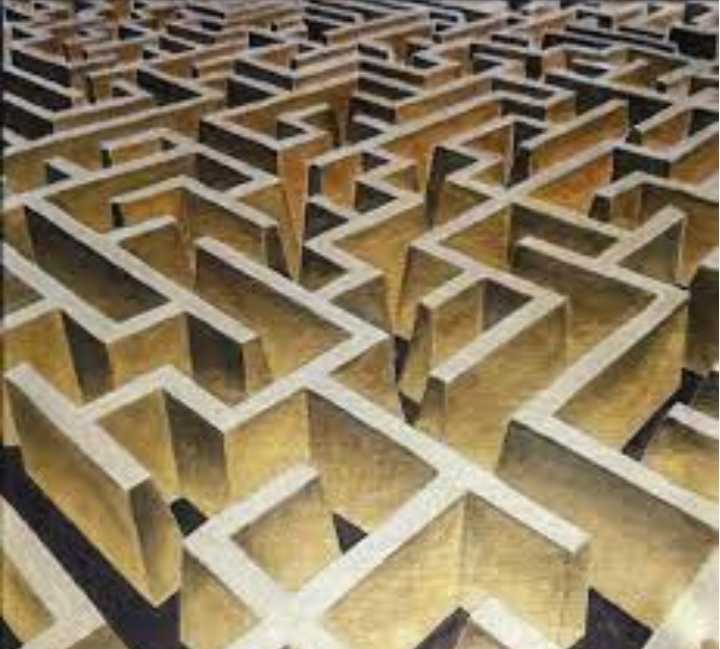
That day, the Yellow Emperor showed the poet his palace. They left behind, in long succession, the first terraces on the west which descend, like the steps of an almost measureless amphitheater, to a paradise or garden whose metal mirrors and intricate juniper hedges already prefigured the labyrinth. They lost themselves in it, gaily at first, as if condescending to play a game, but afterwards not without misgiving, for its straight avenues were subject to a curvature, ever so slight, but continuous (and secretly those avenues were circles). Toward midnight observation of the planets and the opportune sacrifice of a turtle permitted them to extricate themselves from that seemingly bewitched region, but not from the sense of being lost, for this accompanied them to the end. Foyers and patios and libraries they traversed then, and a hexagonal room with a clepsydra, and one morning from a tower they descried a stone man, whom they then lost sight of forever. Many shining rivers did they cross in sandalwood canoes, or a single river many times. The imperial retinue would pass and people would prostrate themselves. But one day they put in on an island where someone did not do it, because he had never seen the Son of Heaven, and the executioner had to decapitate him. Black heads of hair and black dances and complicated golden masks did their eyes indifferently behold; the real and the dreamed became one, or rather reality was one of dream’s configurations. It seemed impossible that earth were anything but gardens, pools, architectures, and splendrous forms. Every hundred paces a tower cleft the air; to the eye their color was identical, yet the first of all was yellow, and the last, scarlet, so delicate were the gradations and so long the series.

It was at the foot of the next-to-last tower that the poet—who was as if untouched by the wonders that amazed the rest—recited the brief composition we find today indissolubly linked to his name and which, as the more elegant historians have it, gave him immortality and death. The text has been lost. There are some who contend it consisted of a single line; others say it was a single word. The truth, the incredible truth, is that in the poem stood the enormous palace, entire and minutely detailed, with each illustrious porcelain and every sketch on every porcelain and the shadows and the light of the twilights and each unhappy or joyous moment of the glorious dynasties of mortals, gods, and dragons who had dwelled in it from the interminable past. All fell silent, but the Emperor exclaimed, “You have robbed me of my palace!” And the executioner’s iron sword cut the poet down.

Others tell the story differently. There cannot be any two things alike in the world; the poet, they say, had only to utter the poem to make the palace disappear, as if abolished and blown to bits by the final syllable. Such legends, of course, amount to no more than literary fiction. The poet was a slave of the Emperor and as such he died. His composition sank into oblivion and his descendants still seek, nor will they find, the one word that contains the universe.

History of the Night

Argentinian poet Jorge Luis Borges was well acquainted with the night, especially when he lost his sight in the 1950s. It is best to remember that fact as one reads his poem “History of the Night.”

History of the Night

Throughout the course of the generations
men constructed the night.
At first she was blindness;
thorns raking bare feet,
fear of wolves.
We shall never know who forged the word
for the interval of shadow
dividing the two twilights;
we shall never know in what age it came to mean
the starry hours.
Others created the myth.
They made her the mother of the unruffled Fates
that spin our destiny,
they sacrificed black ewes to her, and the cock
who crows his own death.
The Chaldeans assigned to her twelve houses;
to Zeno, infinite words.
She took shape from Latin hexameters
and the terror of Pascal.
Luis de Leon saw in her the homeland
of his stricken soul.
Now we feel her to be inexhaustible
like an ancient wine
and no one can gaze on her without vertigo
and time has charged her with eternity.


And to think that she wouldn't exist
except for those fragile instruments, the eyes.

Epiphanies: Chesterton’s Man Who Was Thursday

I first started listing the books I read in 1972 and continued, with a six month lacuna around 1992, to the present day. Of one thing I am sure: It was Jorge Luis Borges who pointed the way to G. K. Chesterton. Though what I discovered from reading him is slightly different from what Borges discovered.

First of all, there was in Chesterton’s fiction what I call moral landscape, in which the natural environment in the scene takes place is affected by the feeling conveyed by the narrator. Take, for instance, this paragraph from the first chapter of The Man Who Was Thursday:

This particular evening, if it is remembered for nothing else, will be remembered in that place for its strange sunset. It looked like the end of the world. All the heaven seemed covered with a quite vivid and palpable plumage; you could only say that the sky was full of feathers, and of feathers that almost brushed the face. Across the great part of the dome they were grey, with the strangest tints of violet and mauve and an unnatural pink or pale green; but towards the west the whole grew past description, transparent and passionate, and the last red-hot plumes of it covered up the sun like something too good to be seen. The whole was so close about the earth, as to express nothing but a violent secrecy. The very empyrean seemed to be a secret. It expressed that splendid smallness which is the soul of local patriotism. The very sky seemed small.

If I were designing a cover for a new edition of the book, the scene described in this paragraph is what I would attempt to depict.

Thursday was my first Chesterton. There were lines in the novel that affected me strongly. In the same opening chapter, the poet Gabriel Syme is made to say:

“All the same,” replied Syme patiently, “just at present you only see the tree by the light of the lamp. I wonder when you would ever see the lamp by the light of the tree.”

What went through my mind at this point was, “Wow!” That line is forever emblazoned in my memory as the absolute height of imagination. I went on to read all of Chesterton’s fiction, then moved over to his essays and even his religious works. Curiously, although Chesterton is perhaps most famous for his father Brown stories, I did not read those until relatively recently.

But I have read The Man Who Was Thursday four or five times. As a matter of fact, I should re-read it again soon.

Epiphanies: Borges’ Labyrinths

Jorge Luis Borges Story “Tlon, Uqbar, Orbis Tertius”

This is the first of a series of posts about literary works that got ,e started in becoming the person I am today. It all started with a New Yorker article around 1970 which introduced me to Latin American magical realism. I was enthralled, so I hunted up the two Jorge Luis Borges (1899-1986) books it mentioned: Labyrinths and Ficciones.

Borges really got me started on a quest that is still going strong more than half a century later. The first book I read was Labyrinths, and the first story in that collection was “Tlon, Uqbar, Orbis Tertius.” As soon as I read the following, I was on my way:

From the remote depths of the corridor, the mirror spied on us. We discovered (such a discovery is inevitable in the late hours of the night) that mirrors have something monstrous about them. Then [Argentinian writer Adolfo] Bioy Casares recalled that one of the heresiarchs of Uqbar had declared that mirrors and copulation are abominable, because they increase the numbers of men.

It turns out that Bioy Casares was quoting from a strange encyclopedia that the two of them decide to look up, but have difficulty finding, because different editions of the Anglo-American Cyclopedia have different articles.

I now own everything that Borges ever wrote that has been translated into English, and several in the original Spanish. Borges sent me in many directions. The next time, I will talk about how he turned me on to G. K. Chesterton.

The Labyrinth

I keep returning to the poems of Jorge Luis Borges in the labyrinthine journey of my life. For over half a century, his writings have shone a strong light on my path forward. Several years after Borges died, John Updike translated his poem “The Labyrinth” and had it published in The New Yorker.

The Labyrinth

Zeus, Zeus himself could not undo these nets
Of stone encircling me. My mind forgets
The persons I have been along the way,
The hated way of monotonous walls,
Which is my fate. The galleries seem straight
But curve furtively, forming secret circles
At the terminus of years. And the parapets
Have been worn smooth by the passage of days.
Here, in the tepid alabaster dust,
Are tracks that frighten me. The hollow air
Of evening sometimes brings a bellowing,
Or the echo, desolate, of bellowing.
I know that hidden in the shadows there
Lurks another, whose task is to exhaust
The loneliness that braids and weaves this hell,
To crave my blood, and fatten on my death.
We seek each other. Oh, if only this
Were the last day of our antithesis!