About Those Eyebrows

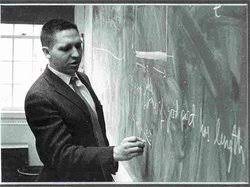
Hazleton “Terry” Mirkil III, Associate Professor of Mathematics at Dartmouth

In the Winter Trimester of my freshman year at Dartmouth College, I took the second of my two math courses, which were required of part of the college’s “distributive requirements.” The term refers to courses in fields that don’t interest you so that you could become a well-rounded person. The course was called something like “Introduction to Probability and Statistics,” though it was mostly the former.

There are only two things I remember about the course. The first is that in any random group of thirteen people, there is an even chance that two of the party share the same birthday. (That was more than I can recall about my previous math course on Calculus.)

The other thing I remember were Professor Hazleton Mirkil’s wild eyebrows. In profile, they stood out like wild antennae reaching up to an inch from his brow. His eyebrows come to mind because I seem to have developed the same antenna-like eyebrows. When I get a haircut, my barber trims them for me, though they always grow back thrusting in all directions.

Thinking about Professor Mirkil’s eyebrows, I decided to see what I could find out about him on the Internet. What I found was not much, inasmuch as he had committed suicide in 1967, the year after I graduated from Dartmouth. According to the West Lebanon Valley News:

Hazelton Mirkil III, 44, associate professor of mathematics at Dartmouth College, was found dead Wednesday afternoon in the woods back of Chase Field. Dr. I. A. Dinerman of Canaan Grafton County medical referee attributed death to suicide by shooting. He said that Prof. Mirkil, was “dead at least a month or two,” was shot through the head and found with a revolver in his hand.

Prof. Mirkil was on leave from Dartmouth for the current academic year and had been at the Veterans Hospital at Northampton, Mass. Having obtained leave from the hospital and not having returned,
he was reported missing March 17.

Very likely, my Math prof received a bad diagnosis from the VA Hospital. The above photo was the only one I could find except for a tiny picture in uniform during WW2. That’s typical for people whose lives have ended well before the advent of the Internet.

I never was much good in math. I received a C+ in both Calculus and Probability. I am certainly not a graduate that the Math Department at Dartmouth would be proud of. (Nor the English Department, as I ended that last sentence with a preposition.)

If you fear that I, too, would blow my brains out because of my unruly eyebrows, don’t worry. I am too funny-looking on a number of counts to worry solely about my eyebrows.

Welcome to HallowThanksMas

Display at the Grier Musser Museum (2015)

It didn’t used to be this way, but now Halloween is now a portal to a ten week holiday season that includes Halloween, the Day of the Dead (All Souls Day), Thanksgiving, Christmas, New Years Day, Martine’s birthday, and my birthday. Fortunately, I don’t take it as seriously as most people do; and I even try to enjoy bits and pieces of it.

In past years, I spent much of October reading horror stories and watching horror films. This year, I’ve not been feeling well, thanks to a hideous attack of bronchitis and asthma. Fortunately, I am feeling better now. And the only horror stories I’ve read were in a collection by Robert Aickman entitled The Wine Dark Sea. I particularly recommend the short story of the same name that opens the collection.

Tomorrow I get my Covid and flu shots, to be followed in two weeks by a vaccination for RSV. I know that the whole issue of vaccinations has become politicized, but I just don’t feel like dying of negligence.

Anyhow, I wish you well during he upcoming HallowThanksMas season. Just don’t let it weigh you down.

The Road Not Taken

When you get to a certain age, you may well decide (like me) to pick and choose from new technologies, new music, and new trends. For instance, I do not own a Smart Phone and especially distrust the notion of using one for economic transactions. I didn’t work at an accounting office for more than twenty years without closely reconciling accounts so that I had a good idea of what I was spending.

As far as new music is concerned, I consider rap to be little better than noise. In fact, the same goes for much current pop music. I like current jazz and even current classical and folk music.

But what I particularly want to talk about are touch screens. There’s something about the imprecision of selecting options that drives me up the wall. That particularly goes for small screens. You hit an option, and it as often as not doesn’t take at first, requiring multiple attempts. Even on my Amazon Kindle, various screens pop up that I did not select.

Perhaps the very worst touch screen activity is using a touch screen keyboard, especially where there is not enough space between characters on the keyboard.

No Way, José!

Fortunately, larger touch screen displays are not quite so objectionable. For instance, the screens one must fill out for an airline boarding pass or upon returning from a foreign country are okay.

I think that, past a certain age, one gets to the point that newer technologies are trickier to manipulate. Younger people who live all day with their small screens develop the proper tiny sharp finger data entry skills. As for myself, I’ll stick to my caveman existence.

Hiding from the Gazpacho Police

The Infamous Mug Shot of a Notorious Felon

Donald J. Trump is not the only problem we face. Its not even the biggest problem we face. The voters who support the ex-president are the major problem. Over the last several decades, the American people have grown progressively more stupid, aided and abetted by the lies of social media content providers. It’s gotten to the point that voters take a position (without thinking it through) and prepare to defend it against all comers, even if it’s as stupid as Jewish space lasers and the “gazpacho police.”

At present, the Republican Party controls the House of Representatives. I have no idea what is going to happen in 2024 with Congress. Will an increasing number of voters wake up after their drunken decades-long reactionary orgy and vote for representatives whose minds are not in the Asteroid Belt? Who knows?

I just know what I’m going to do. As always, I will vote for candidates whom I think will continue the American tradition of democracy. I have nothing in common with people who like to wave the flag at the same time they are ripping the guts out of what it stands for.

Pedestrians Are Always Suspect

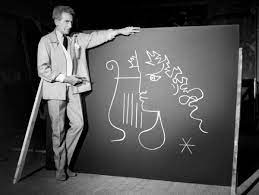
Jean Cocteau (1889-1963) with Drawing of Orpheus

He was, to quote Wikipedia:

French poet, playwright, novelist, designer, filmmaker, visual artist and critic. He was one of the foremost artists of the surrealist, avant-garde, and Dadaist movements and an influential figure in early 20th century art.

He was, to quote one newspaper essay, a Renaissance man.

In the United States, he is probably best known for his films La Belle et la Bête (1946) and Orphée (1950). Although he created some paintings, he is probably better known for his line drawings, many referring to Greek myths such as the drawing of Orpheus illustrated above and used in the titles of his film on Orpheus.

“The Birth of Pegasus” (1953)

With his surrealist and Dada experience, Cocteau’s work is sometimes underestimated because the artist never took himself that seriously. I love the scene in Le Testament d’Orphée (1960) where the poet (played by Cocteau himself) is arrested by motorcycle cops who, when asked what the charge was, say, “Pedestrians are always suspect!”

There is no lack of artists who take themselves very seriously. Even his film masterpiece Orphée is not only profound, but profoundly funny in spots.

In Love with Moominland

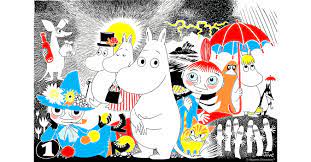
Some of the Inhabitants of Moominland

Other than Lewis Carroll and L. Frank Baum (author of The Wizard of Oz), my favorite children’s literature author is Tove Jansson of Finland. Beginning in 1945, she created a world called Moominland, inhabited by a variety of engaging non-human characters. Chief among them is the Moomintroll family, consisting of Moominmamma, Moominpappa, the Snork Maiden, and Moomintroll himself (itself?).

It has been a few decades since I picked up one of the volumes of the Moominland saga. Today, I just finished reading Moominland Midwinter (1957). I found myself falling in love with the weird, utterly engaging world of a valley inhabited by lovable weird creatures.

One of my favorites is a philosopher called Too-Ticky. At one point, she muses:

I’m thinking about the aurora borealis. You can’t tell if it really does exist or if it just looks like existing. All things are so very uncertain, and that’s exactly what makes me feel reassured.

A true Scandinavian, she also ponders the following: “One has to discover everything for oneself. And get over it all alone.” Too true!

For an annotated list of all of Jansson’s Moominlit, click here.

“The Absence”

From French surrealist poet Paul Éluard comes this lovely poem called “The Absence.”

The Absence

I speak to you across cities
I speak to you across plains 

My mouth is upon your pillow 

Both faces of the walls come meeting
My voice discovering you 

I speak to you of eternity 

O cities memories of cities
Cities wrapped in our desires
Cities come early cities come lately
Cities strong and cities secret
Plundered of their master’s builders
All their thinkers all their ghosts 

Fields pattern of emerald
Bright living surviving
The harvest of the sky over our earth
Feeds my voice I dream and weep
I laugh and dream among the flames
Among the clusters of the sun 

And over my body your body spreads
The sheet of is bright mirror.

Favorite Films: Orphée (1950)

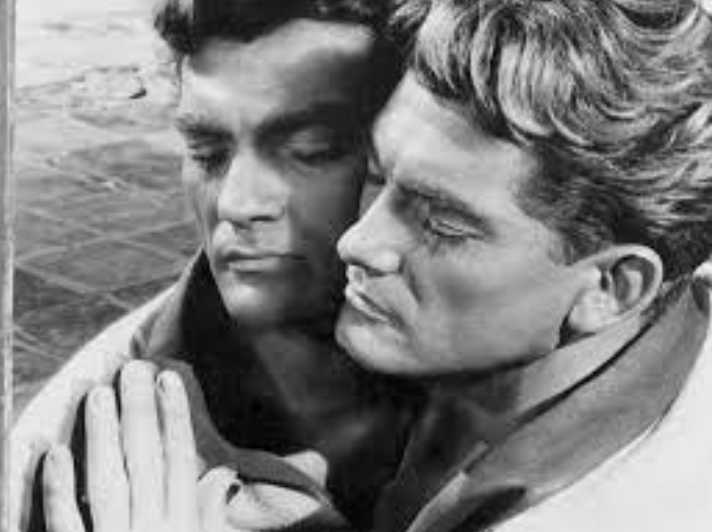
Jean Marais as Orpheus in Jean Cocteau’s Orphée

This is a film I have loved for upwards of sixty years, ever since I first saw it screened by the Dartmouth Film Society. It is the only film I have ever seen that makes a stab at showing us what happens after death—without looking totally silly.

The story is based on the Greek myth of Orpheus the poet and his wife Eurydice, variously mentioned by such authors as Plato, Plutarch, Apollonius of Rhodes, and others. Eurydice dies, and Orpheus, while still alive, goes to the Underworld to get her back. The gods agree, but with the condition that he must never look upon her face again. If he did, her spirit would be instantly wafted back to the Underworld.

Jean Cocteau places the tale in postwar France and adds some interesting touches. Death is personified as “The Princess.” Played by the lovely and elegant Maria Casares, who falls madly in love with Orpheus. Among hr assistants are François Périer as Heurtebise and Édouard Dermit as Cégeste. One enters the underworld by walking through a mirror wearing special rubber gloves, which convert the mirrors to a waterlike substance. The ruins of Saint Cyr Military Academy serve as the Underworld, where Orpheus and Heurtebise go to negotiate with a tribunal in a grimy meeting room.

The Last Shot: The Princess and Heurtebise Go to Meet Their Fate

I have seen Orfée at least a dozen times, and each time was as magical and striking as the first viewing. Along with the same director’s La Belle et la Bête (1946), it is one of the glories of the French cinema, indeed of world cinema.

Saints and Angels

The Archangel Michael Vanquishing Satan

I suppose I was always something of an unbeliever. Even when I was twelve years old and had to choose a confirmation name at St. Henry, instead of picking Michael or Joseph like all my classmates, I selected Alexander. When asked who was St. Alexander by my friends, I said it referred to Alexander VI, the notorious Borgia pope who was possibly the worst of the so called bad popes.

This evening, I was reading an amusing review of a book by Eliot Weinberger entitled Angels and Saints. Among the angels described are:

  • Nadiel, the angel of migration
  • Memuneh, the dispenser of dreams
  • Maktiel, who rules over trees
  • Taliahad, the angel of water
  • Hanum, the angel of Monday

The saints could be even more outrageous. Anne Enright’s review in the New York Review of Books includes the following tidbit:

Many of the beatified were early Christian martyrs who were hard to kill, and the details of their deaths receive more space than the manner of their lives. (I will never find again those two Roman martyrs who died by being turned upside down while milk and mustard were put up their noses, nor check through the multiple volumes [of Butler’s The Lives of the Saints] to see if I dreamed this, which surely I did not.)

One saint to whom I regularly pray is …

Genesius of Arles
(France, d. 303 or 308)
A decapitated martyr, his body was buried in France but his head was transported “in the hands of angels” to Spain, where he is invoked as a protection against dandruff.

To this day, I wish I still had my collection of holy pictures of saints, which the pious Dominican sisters of St. Henry handed out to good students. (I was sometimes good.)

Saving the Day

Crows in a Tree

Apparently Robert Frost liked crows as much as I do. His poem, which follows, is called “Dust of Snow”:

Dust of Snow

The way a crow
Shook down on me
The dust of snow
From a hemlock tree

Has given my heart
A change of mood
And saved some part
Of a day I had rued.

Simple and elegant. One of the reasons I love Frost.