Taking Hawai’i Seriously

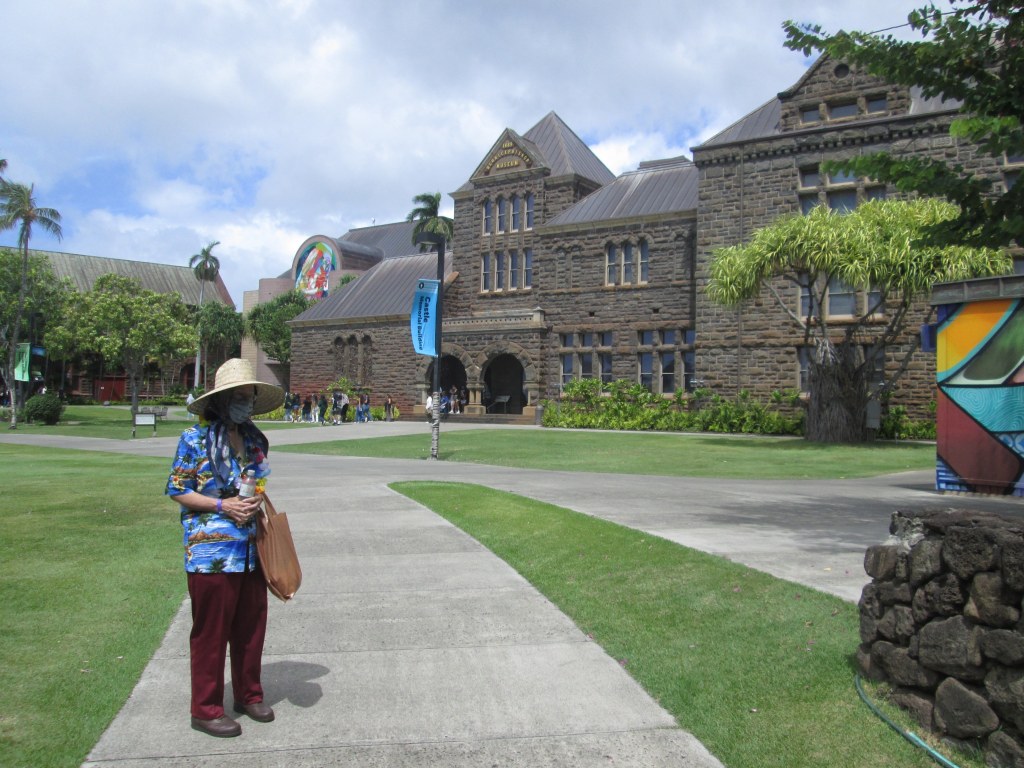
Martine at the Grace Pauahi Bishop Museum in Honolulu

For most visitors, Hawaii is a playground symbolized by the hedonistic hordes of Waikiki. If you want to take a serious look not only at Hawaii, but also Polynesia as a whole, the place to go is the Grace Pauahi Bishop Museum on the Ewa (i.e., West of Waikiki and Diamond Head) side of Honolulu.

It’s in a big old 19th century stone building, originally used by the Kamehameha Schools for native Hawaiian children (also founded by Grace Pauahi Bishop, who, incidentally, was the last legal heir of the Kamehameha dynasty that had ruled the Kingdom of Hawai’i for most of the 19th century).

The Bishop Museum is not on the route of the trolleys that run up and down Waikiki heading for the big tourist attractions of the city. That’s because it’s for serious tourists only, who really want to know about the cultures of Hawaii and Polynesia. And it’s not just a museum: It is also a scholarly research institution that sponsors and publishes studies. It has been designated by the state government as the Hawaiʻi State Museum of Natural and Cultural History.

Just because the building looks old and stuffy doesn’t imply that that the place is in any sense boring. If you spend two or three hours there, you will learn something about the islands, their ecology, history, and anthropology. There is even a planetarium on the premises.

The #2 Honolulu bus goes from Waikiki to within two blocks of the entrance at Bernice Street and Kapalama Avenue.

Crônicas: Part of the Game

Brazilian Writer Hélio Pellegrino

Yes, I am still reading Clarice Lispector’s Too Much of Life: The Complete Crônicas, which runs to almost 800 pages. Tody, I am quoting a writer that Lispector in turn quotes in her Jornal do Brasil column for September 4, 1971, namely Hélio Pellegrino:

Living—ah, that difficult delight. Living is a game, a risk. Whoever plays can win or lose. The beginning of wisdom consists in accepting that losing is also part of the game. When that happens, we gain something extremely precious: we gain the possibility of winning. If I know how to lose, then I know how to win. If I don’t know how to lose, I win nothing, and I will always go away empty-handed. The eyes of someone who doesn’t know how to lose eventually grow rusty and blind, blind with resentment. When we come to accept with true and deep humility the rules of the existential game, living becomes more than good: it becomes fascinating. To live well is to consume oneself; it is to burn the coals of time from which we are made. We are made up of time, and this means we are a passing thing, movement without respite, finitude. The quota of eternity allotted to us is embedded in time. We need to search it out with ceaseless courage so that the taste of gold may shine upon our lips. If this happens, then we are joyful and good, and our life has meaning.

Sonnet 129

The Waikiki Malia Hotel in Waikiki

It was our second night in Honolulu. We had a room on the 12th floor of the Waikiki Malia Hotel’s Malia Tower. The next room away from the elevator was occupied by a couple of young women who were entertaining young male guests. Because the two rooms were connectable by a locked door, we could hear pretty much everything that was said.

Martine and i were pretty tired by 10 pm, because that was the same as 1 am Los Angeles time. Still we were entertained by the goings-on next door. All four were obviously on on liquor and possibly worse, and the girls were doing a major snow job on the guys. After three quarters of an hour, all four left to go out; but before long one of the couples returned to have very noisy sex.

After about ten minutes, the sounds from the other room were of conflict. The guy was complaining that his driver’s license was missing. After the act, there appeared to be no love lost between the two. As I lay in bed, I could easily have predicted this. After the guy left in a huff, everything went quiet; and we dropped off to sleep.

I was reminded of Shakespeare’s famous Sonnet #129 on the subject of lust:

Th’ expense of spirit in a waste of shame
Is lust in action; and, till action, lust
Is perjured, murd’rous, bloody, full of blame,
Savage, extreme, rude, cruel, not to trust;
Enjoyed no sooner but despisèd straight;
Past reason hunted, and no sooner had,
Past reason hated as a swallowed bait
On purpose laid to make the taker mad,
Mad in pursuit and in possession so;
Had, having, and in quest to have, extreme;
A bliss in proof and proved a very woe;
Before, a joy proposed; behind, a dream.
    All this the world well knows, yet none knows well
    To sun the heaven that leads men to this hell.


Our Favorite Honolulu Eatery

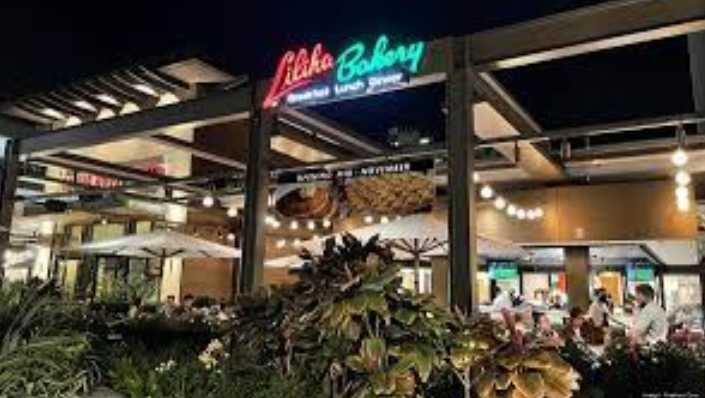
The Liliha Bakery at Waikiki’s International Marketplace

Generally speaking, Martine and i do not agree when it comes to food. She likes rich pastries and American food with meat, potatoes, and vegetables all neatly separated on the plate. I, on the other hand, go in for ethnic dining experiences, with or without meat.

One rare point of agreement was the Liliha Bakery chain in Honolulu. Most mornings (the weekends were always too crowded), we would walk the three blocks from our hotel to the International Marketplace and eat breakfast at the Liliha Bakery on the mall’s third level.

It is a uniquely Hawaiian experience. Martine was drawn mainly by the extensive selection of yummy baked goods, while I liked the Hawaiian touches to their meals. For instance, you wouldn’t catch me drinking iced tea on the mainland if it had been flavored with raspberry or passion fruit; but Liliha’s Plantation Iced Tea with pineapple or guava is delicious and uniquely thirst-quenching.

There are five locations of the bakery/restaurant around the Honolulu area, with the original one located at Kuakini and Liliha Streets about three blocks north of the H1 freeway. Curiously, the bakery is most famous for their coco puffs, which don’t do anything for me. But just about everything else of theirs that I’ve had in our last two trips to Hawaii were strictly top notch.

Rain Rain Go Away

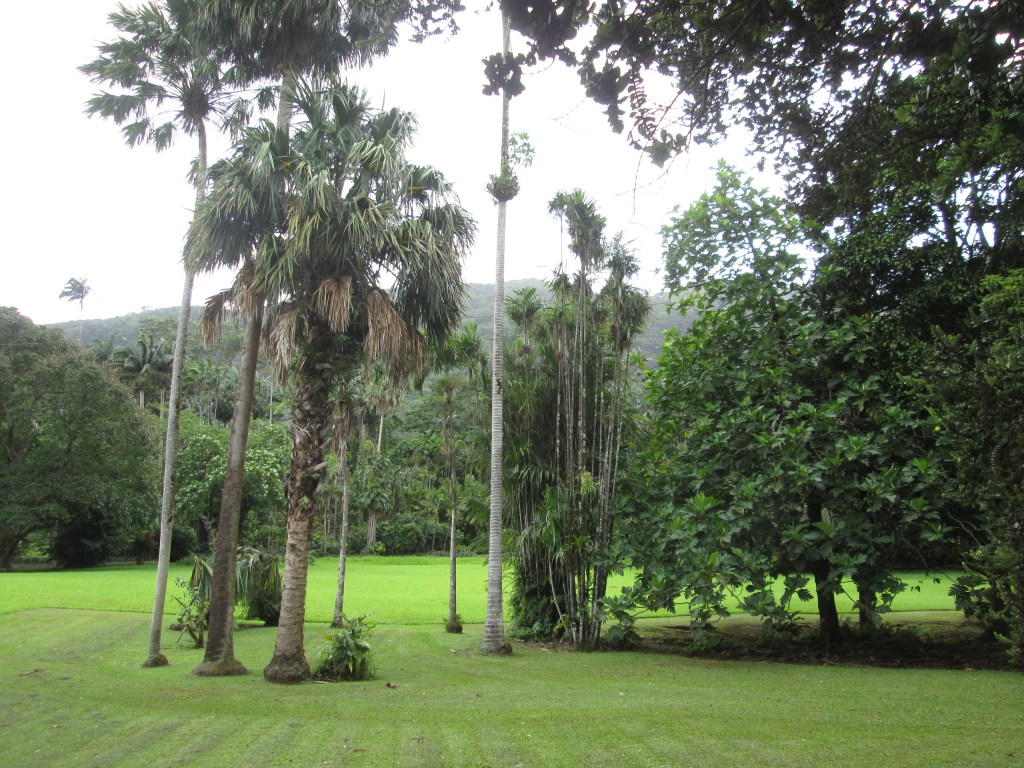
Trees at the Lyon Arboretum Near Honolulu

Our first full day in Hawaii was not a big hit with Martine. I wanted to go to the Lyon Arboretum, a large botanical garden in the mountains above Manoa run by the University of Hawaii. We could have taken a bus to a street about 0.8 miles downhill from the arboretum, but Martine did not like walking uphill that far. So we took a taxi from the Ala Moana Shopping Center.

On the way to the Arboretum, it started to drizzle; and Martine started to feel anxiety over not having her umbrella or raincoat with her. When we got to our destination, I arranged for the taxi to pick us up at 2 PM. It continued to rain on and off, so Martine did not want to walk about in the rain. So she sat down inside while I walked around.

The Arboretum is high enough in the mountains that it not only rains every day, but it rains on and off constantly. While Martine was sitting down by the gift shop, I walked around until just before the cab was due. It was beautiful. Though I had no protection against the rain, it was warm and gentle and intermittent enough not to wet me through. In the end, I wound up taking one of the trails to its end and returned to Martine, who was stewing in her chair.

To make matters worse, the cab never came. I gave the driver a generous tip; but for some unexplained reason, he shined us off. And that despite his calling me on my cell phone to say that he was coming! The park closed at 3 PM, so at that point we started walking downhill toward the #5 bus layover stop, still intending to take the cab should it arrive. Alas, it never did.

Unexpected things can happen on a trip. I believe one has to be flexible. I had researched where the bus stop was, and we eventually made it in about an hour (including several rest stops). The bus came in time and took us back to Ala Moana, where we ate dinner before returning by the #20 to Waikiki.

It’s a pity that Martine couldn’t enjoy the Arboretum. I did, even at the cost of a nasty blister on my right foot from the steep downhill grade. Such is life.