
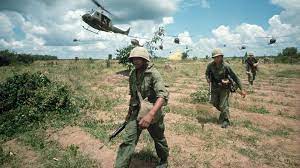
U.S. Troops in Vietnam
“Pinkville” is the name that the soldiers who fought on the ground gave to the villages around My Lai, site of the 1968 massacre in which hundreds of Vietnamese civilians were killed in 1968. It is an area well described by Tim O’Brien, whose books on the Vietnam War from the point of view of the troops on the ground are probably the best books to read about the war as it was fought.
O’Brien started in 1975 with his own experiences in the war, set forth in a book entitled If I Die in a Combat Zone, Box Me Up and Ship Me Home. He asks “Can the foot soldier teach anything important about war, merely from having been there? I think not. He can tell war stories.”
And that’s exactly what O’Brien does. The stories are all true in his first book, with only the names of characters being changed.
Then, in 1978, he wrote Going After Cacciato, the first of two fictional works about the war. This was followed in 1990 by The Things They Carried, which is my favorite of his books.
Whether writing fiction or straight memoir, O’Brien is a powerful writer. In If I Die in a Combat Zone, there is a chapter entitled “Step Lightly” about the different kinds of land mines used by the Viet Cong. The most horrifying of these is the Bouncing Betty:
The Bouncing Betty is feared most. It is a common mine. It leaps out of its nest in the earth, and when it hits its apex, it explodes, reliable and deadly. If a fellow is lucky and if the mine is in an old emplacement, having been exposed to the rains, he may notice its three prongs sticking out of the clay. The prongs serve as the Bouncing Betty’s firing device. Step on them, and the unlucky soldier will hear a muffled explosion ; that’s the initial charge sending the mine on its one-yard leap into the sky. The fellow takes another step and begins the next and his backside is bleeding and he’s dead. We call it “ol’ step and a half.”
Yipes!
 Tarnmoor
You must be logged in to post a comment.