Epiphanies: Chesterton’s Man Who Was Thursday

I first started listing the books I read in 1972 and continued, with a six month lacuna around 1992, to the present day. Of one thing I am sure: It was Jorge Luis Borges who pointed the way to G. K. Chesterton. Though what I discovered from reading him is slightly different from what Borges discovered.

First of all, there was in Chesterton’s fiction what I call moral landscape, in which the natural environment in the scene takes place is affected by the feeling conveyed by the narrator. Take, for instance, this paragraph from the first chapter of The Man Who Was Thursday:

This particular evening, if it is remembered for nothing else, will be remembered in that place for its strange sunset. It looked like the end of the world. All the heaven seemed covered with a quite vivid and palpable plumage; you could only say that the sky was full of feathers, and of feathers that almost brushed the face. Across the great part of the dome they were grey, with the strangest tints of violet and mauve and an unnatural pink or pale green; but towards the west the whole grew past description, transparent and passionate, and the last red-hot plumes of it covered up the sun like something too good to be seen. The whole was so close about the earth, as to express nothing but a violent secrecy. The very empyrean seemed to be a secret. It expressed that splendid smallness which is the soul of local patriotism. The very sky seemed small.

If I were designing a cover for a new edition of the book, the scene described in this paragraph is what I would attempt to depict.

Thursday was my first Chesterton. There were lines in the novel that affected me strongly. In the same opening chapter, the poet Gabriel Syme is made to say:

“All the same,” replied Syme patiently, “just at present you only see the tree by the light of the lamp. I wonder when you would ever see the lamp by the light of the tree.”

What went through my mind at this point was, “Wow!” That line is forever emblazoned in my memory as the absolute height of imagination. I went on to read all of Chesterton’s fiction, then moved over to his essays and even his religious works. Curiously, although Chesterton is perhaps most famous for his father Brown stories, I did not read those until relatively recently.

But I have read The Man Who Was Thursday four or five times. As a matter of fact, I should re-read it again soon.

Epiphanies: Borges’ Labyrinths

Jorge Luis Borges Story “Tlon, Uqbar, Orbis Tertius”

This is the first of a series of posts about literary works that got ,e started in becoming the person I am today. It all started with a New Yorker article around 1970 which introduced me to Latin American magical realism. I was enthralled, so I hunted up the two Jorge Luis Borges (1899-1986) books it mentioned: Labyrinths and Ficciones.

Borges really got me started on a quest that is still going strong more than half a century later. The first book I read was Labyrinths, and the first story in that collection was “Tlon, Uqbar, Orbis Tertius.” As soon as I read the following, I was on my way:

From the remote depths of the corridor, the mirror spied on us. We discovered (such a discovery is inevitable in the late hours of the night) that mirrors have something monstrous about them. Then [Argentinian writer Adolfo] Bioy Casares recalled that one of the heresiarchs of Uqbar had declared that mirrors and copulation are abominable, because they increase the numbers of men.

It turns out that Bioy Casares was quoting from a strange encyclopedia that the two of them decide to look up, but have difficulty finding, because different editions of the Anglo-American Cyclopedia have different articles.

I now own everything that Borges ever wrote that has been translated into English, and several in the original Spanish. Borges sent me in many directions. The next time, I will talk about how he turned me on to G. K. Chesterton.

Pitocchetto

Giacomo Ceruti’s “The Beggar at Rest”

Yesterday, I decided to escape the summer heat by visiting the Getty Center and reveling in some great works of art. One of my favorite discoveries was a whole gallery full of paintings by the Italian Giacomo Ceruti (1698-1767). He was known as Pitocchetto, which means “The Little Beggar,” probably because so many of his paintings highlighted beggars, the poor, and people in humble occupations.

It’s a nice change from all the magnificent kings, princes, and nobles resplendent in gold and silk. One art critic, Mira Pajes Merriman, writes that Ceruti’s paintings confront us with

the detritus of the community; the displaced and homeless poor; the old and the young with their ubiquitous spindles, eloquent signs of their situationless poverty and unwanted labor; orphans in their orderly, joyless asylums plying their unpaid toil; urchins of the streets eking out small coins as porters, and sating them in gambling; the diseased, palsied, and deformed; lonely vagabonds; even a stranger from Africa—and all in tatters and filthy rags, almost all with eyes that address us directly…

And yet, confronted with one of his paintings, one is arrested by a different vision of the baroque era, not so different from our own tent encampments of the homeless.

“The Dwarf” by Giacomo Ceruti

One thing that sets Ceruti apart is that he allows his subjects their dignity, irrespective of the lowliness of their social status. He is above all a compassionate artist who is not above showing us an alternative picture of his times.

Orcs

Halfway through my re-reading of The Lord of the Rings trilogy, I have come to realize that orcs really do exist. They are capable of only one feeling: Rage. And they meekly do the bidding of the Dark Lord, who is squirming in frustration at Mordor-a-Lago as further indictments attempt to break his power forever. They are distributed across the land, but most particularly in what has been referred to as the Red States.

Am I perhaps being too simple-minded? Perhaps. But the peace of Middle-Earth is in danger of being shattered forever. The land in which I was raised is being threatened by dark hordes who, while waving the same flag to which I pay allegiance, are quite satisfied to stomp on and destroy everything it stands for.

Somehow, over the last few decades, we have been nurturing a generation of thugs who have declared unending enmity with the elves and other libtards whom they feel have been sneering at them.

Oh, where is that ring of power now that I want to throw it into a white-hot dumpster fire?

Clarity and Emptiness

Lute Player (After Frans Hals)

From time to time, I love to read books of original source material on Eastern Religions. The following is taken from the Visuddhi Maga as quoted in a collection edited by Anne Bancroft entitled The Pocket Buddha Reader (Boston: Shambhala, 2001):

When a lute is played, there is no previous store of playing that it comes from. When the music stops, it does not go anywhere else. It came into existence by way of the structure of the lute and the playing of the performer. When the playing ceases, the music goes out of existence.

In the same way all the components of being, both material and nonmaterial, come into existence, play their part, and pass away.

That which we call a person is the bringing together of components and their actions with one another. It is impossible to find a permanent self there. And yet there is a paradox. For there is a path to follow and there is walking to be done, and yet there is no walker. There are actions but there is no actor. The air moves, but there is no wind. The idea of a specific self is a mistake. Existence is clarity and emptiness.

Sea Breeze

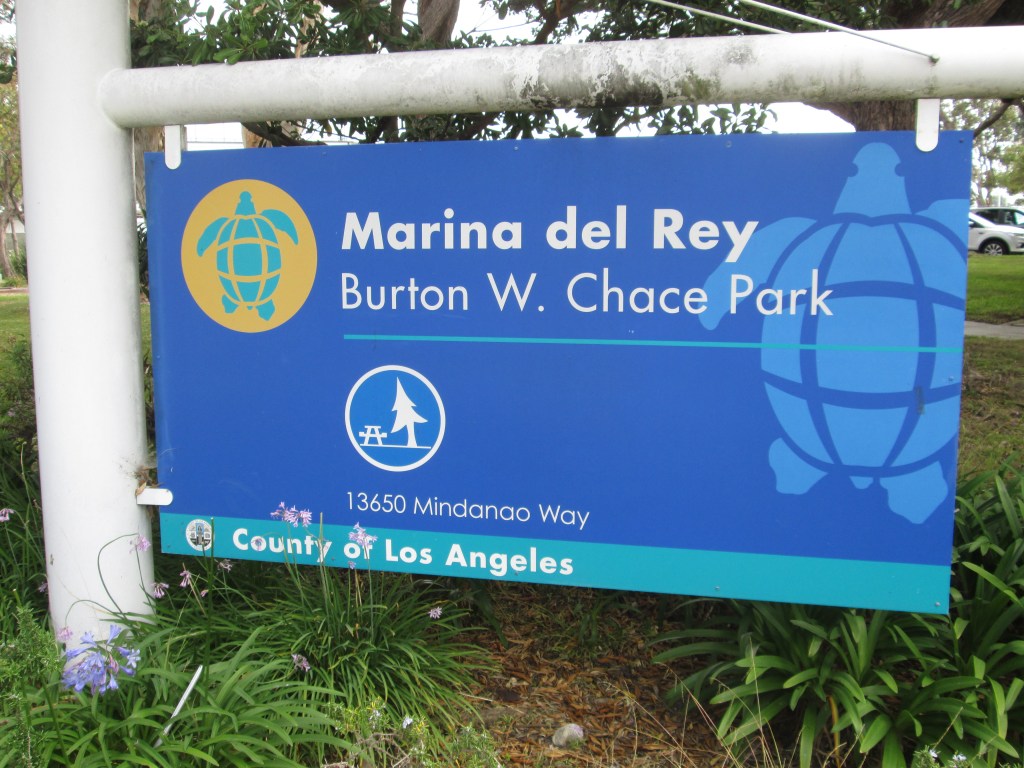
Whenever it gets too beastly hot, I frequently head to Burton W. Chace Park in Marina del Rey. On most days—the sole exception being times when there is a Santa Ana wind, bringing hot desert air from the Mohave Desert—it is always more comfortable there. Not only is the temperature at least five degrees cooler, but if one finds a spot to sit within a couple hundred feet of the shore, there is always a cooling sea breeze.

Today, I tested this as I walked inland to my parked car. By the time I was 300-500 feet from the shore, the breeze started breaking up. By the time I reached my car, it was nonexistent. Yet while I sat reading in the shade in Picnic Shelter A (the one closest to the shore), the cooling breeze was steady.

I don’t understand why this is so. The beaches to the north and south of the Marina aren’t all that comfortable, perhaps because of the heat radiated by the sun beating on the sand.

The park was full of small squirrels who were constantly chasing one another. I guess there was too much competition for the scarce food resources. At any given time, I could see as many as ten squirrels.

“This Kind of Fire”

This has been a month for re-reads. Today, I finished reading Charles Bukowski’s The Continual Condition, a posthumous collection of his unpublished poetry. I love Buk’s poetic voice. Here is a poem entitled “This Kind of Fire.”

This Kind of Fire

sometimes I think the gods
deliberately keep pushing me
into the fire
just to hear me
yelp
a few good
lines.

they just aren’t going to
let me retire
silk scarf about neck
giving lectures at
Yale.

the gods need me to 
entertain them.

they must be terribly
bored with all
the others

and I am too.

and now my cigarette lighter
has gone dry.
I sit here
hopelessly 
flicking it.

this kind of fire
they can’t give
me.

Drosophila Part Deux

Fruit Flies (Drosophila melanogaster)

Let me say at the outset that I hate fruit flies. And they appear to hate me. I love to eat lots of fresh fruit through the Los Angeles summer, but my apartment becomes infested with the damnable bugs. I have several traps filled with apple cider vinegar in which to drown the unwary. Alas, they seem to have caught on and—except for a about 10-12 weaklings per day—avoid falling into the vinegar.

Several times each day, I venture into the kitchen to squash a few dozen of the invasive Drosophila. They retaliate by flying around my head while I am sitting at the computer and playing the insect equivalent of “chicken.” That only annoys me more, so I go and kill a few dozen more.

Last year’s infestation ended when I purchased a kitchen wastebasket with a top, but I think the new generation has figured out a way to sneak through the cracks. I have to now make daily visits to the dumpster with my garbage.

(Excuse me. I am tired of having my head buzzed by fruit flies. I will go into the kitchen and wreak as much havoc as I can on the surviving population.)

There, I have dispatched another bunch to insect Valhalla. But these bugs are getting smarter. When I walk into the kitchen, they start flying, knowing that I have little chance of catching them in mid-air. It is only when they land that I have any chance of crushing them.

Pah, I almost just swallowed one of the little monsters!

Fuge, late, tace

Big Sur Coastline, Central California

The last two days, I was revisiting one of my favorite authors, Honoré de Balzac. In his novel The Country Doctor (Le Médecin de Campagne), Doctor Benassis visits 5the Grande Chartreuse monastery in the French Alps and finds the following inscription left by one of the monks in an empty cell:

Fuge, late, tace

This is Latin for “Flee, hide, be silent.”

Which reminds me of Stephen Dedalus’s “Silence, exile, and cunning” from James Joyce’s Portrait of the Artist as a Young Man. It also makes me think of Russian poet Joseph Brodsky’s “If one’s fated to be born in Caesar’s empire, let him live aloof, provincial, by the seashore.”

I embrace this advice (except for the part about being silent, of which this post is a clear violation). At my advanced age, I have no hope of—or even desire for—success.

To quote the old antique dealer in Balzac’s The Fatal Skin (Le Peau de Chagrin):

Man depletes himself by two instinctive acts that dry up the sources of his existence. Two words express all the forms taken by these two causes of death: DESIRE and POWER. Between these two poles of human action, there is another principle seized upon by the wise, to which I owe my happiness and my longevity [the speaker is 102 years old]. Desire sets us afire and Power destroys us; but KNOWLEDGE leaves our fragile organism in a state of perpetual calm.

Alas, Balzac wasn’t able to follow his own advice. He burned through his life in 51 years, yearning for years to marry the Polish Countess Evelina Hanska. No sooner did he get his wish and return to Paris with his bride than he took sick and died.

The Great Book Giveaway

Today I took another walk to the (on weekends, anyway) deserted office park. In my bag were three books I donated to the Little Free Library box at 26th and Broadway in Santa Monica. Then I sat down at a park bench and read the last forty pages of Georges Simenon’s The Hotel Majestic, in which Superintendent Maigret of the Paris Police Judiciaire solves a double murder that takes place in the cellars of the Hotel Majestic. When I finished the last page, I donated that book as well.

While I was reading, a very bossy young male voice emanated from the nearby tennis courts where Pickle Ball was being played. Somebody was carrying on a running commentary on the game with frequent snatches of advice. I cannot believe that the voice’s opponent enjoyed the outing.

Although much of the country is mired in a heat wave, there was a delightful sea breeze the whole time which was quite comfortable.

Let me see: At the rate of 10-12 books a week, it will take upwards of ten years to donate all my books. And I haven’t even gotten to the heart of the collection yet. Let’s face it, I probably never will as I am still buying books. I am totally incorrigible, On the other hand, I am living the bookworm’s dream that I dreamed from my earliest years. Never mind that it is not a dream shared by most of my fellow Americans, but it means a lot to me.