Jidaigeki

Posters for The Seven Samurai (1954) and Harakiri (1962)

When I first came to Los Angeles in 1967, it didn’t take long for me to fall in love with everything Japanese. That included Japanese films, Japanese food, Japanese literature, and Japanese women. My first long RTD (Rapid Transit District) ride was on the old #83 Wilshire Boulevard route from West L.A. to La Brea Boulevard, where the Toho LaBrea theater was located a couple blocks south. I even remember the film: It was Part One of Hiroshi Inagaki’s Samurai trilogy.

Here I was, a Hungarian kid from Cleveland, finding a kind of home in the Japanese community of L.A. I even moved to Mississippi Avenue in the Sawtelle Japanese district, where there were two Japanese restaurants, the O-Sho and the Futaba Café. They were my first introduction to the cuisine. I was pretty raw at the time: When I had my first cubes of tofu in miso soup, I thought, “I’ll bet these are cut-up shark fins!”

I used to hate seafood. I thought the fish there was picked up from floating debris atop polluted Lake Erie. Now on my own in Southern California, I found myself trying (and loving) sushi after five short years.

What I loved most, however, were Japanese jidaigeki (period films), particularly those set in the samurai era. My friends Alain Silver and Jim Ursini (who collaborated on the first book on samurai films to be published in the U.S.) and I would regularly go to one of the five Japanese movie theaters then existing in Los Angeles:

  • The Toho LaBrea screened films from the Toho Studio
  • The Kokusai and Sho Tokyo theaters played Daiei films—probably my favorite
  • The Kabuki played films from Shochiku
  • The Linda Lea (my least favorite) played films from Tohei

They are all gone now. It’s all part of the growing Americanization of Japanese-Americans.

The Kokusai Theater on Crenshaw South of Adams

In fact, Alain, Jim, an I wrote a column for the UCLA Daily Bruin called “The Exotic Filmgoer.” The articles were all signed Tarnmoor (which, curiously, is the name I go under for this blog). We wrote about the Japanese and other ethnic cinemas that existed back around 1970.

I still love jidaigeki, though they’re not usually to be found around town playing in movie theaters. I have a large collection of DVDs of samurai films, and watch the Japanese films on the Turner Classic Movies (TCM) channel when they are playing.

And I still love Japanese food, though sushi is getting to be priced beyond my means.

On Ranting

The Opposite of Conversations

I have a friend who has been pretty much out of circulation for a quarter century. On an average of once a week, I give him a call. When I do, I have to brace myself for a series of rants on various subjects that are currently galling him. I would say he does about 90% or more of the talking, deftly segueing from one subject to another. He is capable of going on for hours if not stopped, usually by me—I am not overly fond of long telephone conversations.

At the same time, he is my best and oldest friend; so there is a reason why I continue calling him. Fortunately, this behavior mostly manifests itself over the phone. In person, surrounded by his family, the conversation is more of the give-and-take variety, which I prefer.

One of the dangers of living an isolated life is a tendency to go off into rants. If I did it, Martine would tell me in no uncertain terms to shove it. I guess he feels I am a safe person on whom to vent his grievances. And, as we age, the number of those grievances only increases.

I will continue to call him and listen—but not uncritically—to his rants. As soon as he mentions some subjects, such as artificial intelligence, or AI, I just ask him not to go there. He has nothing to say that he has not said a hundred times or more. But, as long as the grievance sticks in his craw, it will attempt to migrate to my ears as well.

Perhaps that’s just in the nature of friendship.

Mister Care Wack Dreams About Girls

New York Bathing Beauties Circa 1960

I am enjoying a collection of the miscellaneous writings by Jack Kerouac during his 63 days atop Desolation Peak in Washington State’s Northern Cascades. I have particularly enjoyed the chapters he wrote for a projected (but never completed) novel called Ozone Park in the “Duluoz Legend” series of slightly fictionalized autobiography. Here is a quote from a deleted chapter from a work that Kerouac (called Mister Care Wack by a hobo friend named Slim) abandoned.

O Kerouac, you poor fool, wandering the streets of night in search of romance in the golden nothingness of existence! Foolish as men are, they’re never more foolish than when they’re 21 years old and actually think that they do exist to be loved somehow either by a personal God who bends over them like a Guardian Angel with those wings of a loving destiny (mayhap I still believe that) or by a woman and women He sends to soul-soothe their sad predestined hugeness of being (“I am Jack Kerouac, there’s something about me that never happened before, she will notice it”) and so they sit at the windows of night smoking Frank Sinatra cigarettes, vain as veritable d’Annunzios, beautiful as the sea, mistaken as lost angels, lovable as God, misunderstood as secret saints, yearny as young girls, masculine as rocks and immovable as self-faith. And this is the reason why they eventually do get loved, but not for the reason they imagine to be foremost, their melancholy which they take to be the penalty is really the reward and is gained. A woman sees a man wrapped in self-torture, and when he smiles there’s already no need for smiles and come-ons.

Thoughts of a lonely young man stuck on a mountaintop.

Tim Conway and Me

Carol Burnett with Tim Conway

Although I hail from Cleveland, Ohio, I am not a big fan of what I and many of my friends call “The Mistake on the Lake.” There I one Clevelander I have always admired. No, not Halle Berry, though I find her incredibly beautiful. And not Paul Newman, who I admit was a talented film actor.

My choice is Tim Conway, who, although born eleven years earlier than me, had a childhood that curiously paralleled my own. Just as I was born to a family that spoke only Hungarian in the home, Tim spoke only Romanian. (Funny, he doesn’t look Romanian—but he was born Toma Conway to an Irish father and a Romanian mother, Sophia, who bore the Romanian equivalent to my mother’s Hungarian name, Zsófi.)

Like my mother, Sophia was born in the United States but taken to be raised in Europe. Like my Slovak father Elek, Daniel Conway adopted his wife’s language in the family circle. Thus, when Tim first attended school, he spoke mostly Romanian, just as I spoke only Magyar.

The parallels stop there. Toma had his name changed to Tim when he started in show business, as there was already a well-known British actor named Tom Conway. Whether playing in McHale’s Navy or The Carol Burnett Show, Tim Conway was one of the funniest men on television. I still watch The Carol Burnett Show on MeTV up to six times a week. Great stuff!

On Desolation Peak

The Fire Watch Tower Atop Desolation Peak

In the summer of 1956, when I was 11 years old, Jack Kerouac spent 63 days manning a fire watch tower in Washington’s North Cascades, atop Desolation Peak. On the Road, which was to be the main source of his fame, followed by The Dharma Bums, were not yet published. The recently published Desolation Peak is a collection of Kerouac’s many writing projects—many of them fragmentary—while he scanned the horizon for fires during those 63 days.

Jack was desperately poor having spent all his money to get to Washington from Mill Valley. He began his job as a fire watcher with a total of 2¢.

This year I have become entranced by Kerouac. Like most of the members of my generation, I read On the Road while I was still in high school, and then stopped there. I have become newly fascinated by his work and am resolved to read all his work that I can find. That assumes I will live long enough, as Jack was a busy boy.

Below is a selection of what Kerouac called his “Desolation Pops.” In form, they resemble traditional Japanese haiku, but they do not adhere to the genre strict rules concerning the number of syllables per line. They’re still interesting. After all, English is a very different language than Japanese.

Jack Kerouac (1922-1969)

(7)
A stump with sawdust
     —a place
To meditate

(11)
The clouds assume
     as I assume,
Faces of hermits

(24)
There’s nothing there
     because
I don’t care

(36)
Poor gentle flesh—
     there is
No answer

(42)
Wednesday blah
     blah blah—
My mind hurts

(55)
Rig rig rig—
     that’s the rat
On the roof

(59)
I called Hanshan            | A Zen Buddhist recluse
     in the fog—
Silence, it said

(60)
I called—Dipankara        | One of the Buddhas of the past
     instructed me
By saying nothing

(70)
Aurora borealis
     over Mount Hozumeen—
The world is eternal

The Tea Drinker

Iced Tea with Lemon

For many years now, I have begun each morning making a pot of Indian black tea, which I drink with a bit of honey (usually Mexican mesquite honey) and a squeeze of lime. By afternoon, what remains in the pot becomes iced tea—up to three glasses full. I try not to drink the entire contents of the pot every day, because tea acts as a diuretic. But in hot weather, I violate this rule of thumb.

Usually, I drink my iced tea without anything added. Sometimes, especially when there is company, I will fill a pitcher with iced tea and add artificial sweetener, the juice of a whole lemon, and a jigger of high quality dark rum, preferably Ron Zacapa Edición Negra from Guatemala or Myers’s Original Dark Rum from Jamaica. The rum is for flavor only and is not enough for intoxication.

My mother has told me that, as a baby, I used to sip from her coffee. Now I will not touch coffee, and do not even like coffee-flavored ice creams or candies. And when it comes to carbonated sodas, I rarely drink more than one glass every couple of weeks, usually at a restaurant.

That doesn’t quite make me a man of one beverage, but it comes close. I also like unsweetened mineral water, fruit juices, tomato juice, and lemonade. Put everything else I drink against hot and iced tea, however, and the tea I drink outweighs all my other options, except maybe for plain water, and that only during heat waves. (Too much tea, and I pretty much have to live in the bathroom.)

What is it about Indian black tea that appeals to me so much? It’s difficult o find the exact words, but good tea has a clarity of flavor that satisfies without causing satiety. For years, I have been buying Ahmad of London loose teas by the pound, usually:

  • Darjeeling, the best Indian black tea
  • Ceylon from Sri Lanka
  • Assam, Baruti and Ghalami varieties mostly in cold weather

Occasionally, when traveling, I will drink an English Breakfast or Irish Breakfast tea from tea bags. In Asian restaurants, I drink end enjoy green tea. But thank you, no Earl Grey please!

“A Kind of Solution”

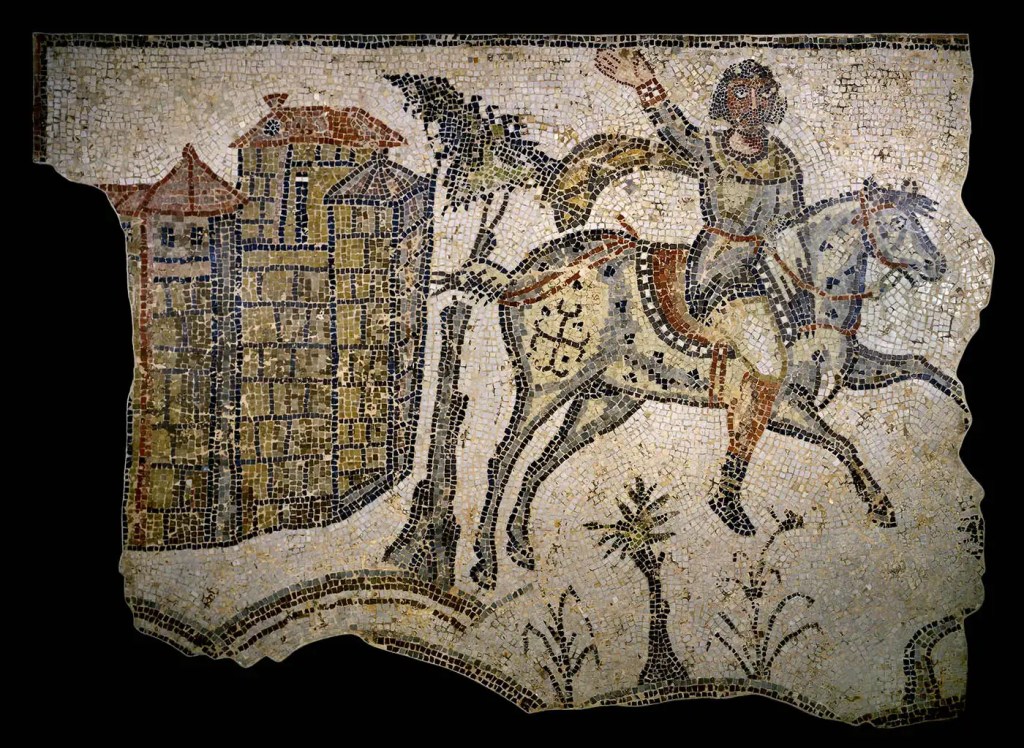
Invading Vandal Horseman

I have just finished reading Volume II of Thomas Hodgkin’s monumental Italy and Her Invaders, which tells of the Hun and Vandal invasions and the Herulian Mutiny that unseated the last of the Western Roman Emperors in CE 476. In essence, it tells of the painful last twenty-five years of the Empire, during which most of the emperors were murdered in a year or two.

There was no benefit to wearing the imperial purple in those last few years. A couple of days ago, I posted a blog in which Apollinaris Sidonius explained why it was no fun in being chosen as emperor.

Those last years of the empire were no fun. Not only were the invading Huns and Vandals brutal, but the empire itself was brutal to its own citizens, taxing them to death to pay for the huge military required to protect the borders.

It makes me think about our own situation. Our problem is not barbarian invasions (unless you don’t particularly like Canadians or Latin Americans), but our seemingly unbridgeable political divisions. The insurrection of January 6, 2021, was, to me, very like Gaiseric and the Vandals’ sack of Rome in CE 455. They may have been barbarians in the end, but they were our very own native-born barbarians. The result, in the end, is no better than the sad end of Rome.

I keep thinking of a poem by the Greek poet Constantine P. Cavafy entitled:

Waiting for the Barbarians

What are we waiting for, assembled in the forum?

      The barbarians are due here today.


Why isn’t anything going on in the senate?
Why are the senators sitting there without legislating?

      Because the barbarians are coming today.
      What’s the point of senators making laws now?
      Once the barbarians are here, they’ll do the legislating.


Why did our emperor get up so early,
and why is he sitting enthroned at the city’s main gate,
in state, wearing the crown?

      Because the barbarians are coming today
      and the emperor’s waiting to receive their leader.
      He’s even got a scroll to give him,
      loaded with titles, with imposing names.


Why have our two consuls and praetors come out today
wearing their embroidered, their scarlet togas?
Why have they put on bracelets with so many amethysts,
rings sparkling with magnificent emeralds?
Why are they carrying elegant canes
beautifully worked in silver and gold?

      Because the barbarians are coming today
      and things like that dazzle the barbarians.


Why don’t our distinguished orators turn up as usual
to make their speeches, say what they have to say?

      Because the barbarians are coming today
      and they’re bored by rhetoric and public speaking.


Why this sudden bewilderment, this confusion?
(How serious people’s faces have become.)
Why are the streets and squares emptying so rapidly,
everyone going home lost in thought?

      Because night has fallen and the barbarians haven't come.
      And some of our men just in from the border say
      there are no barbarians any longer.


Now what’s going to happen to us without barbarians?
Those people were a kind of solution.

The Long Retreat

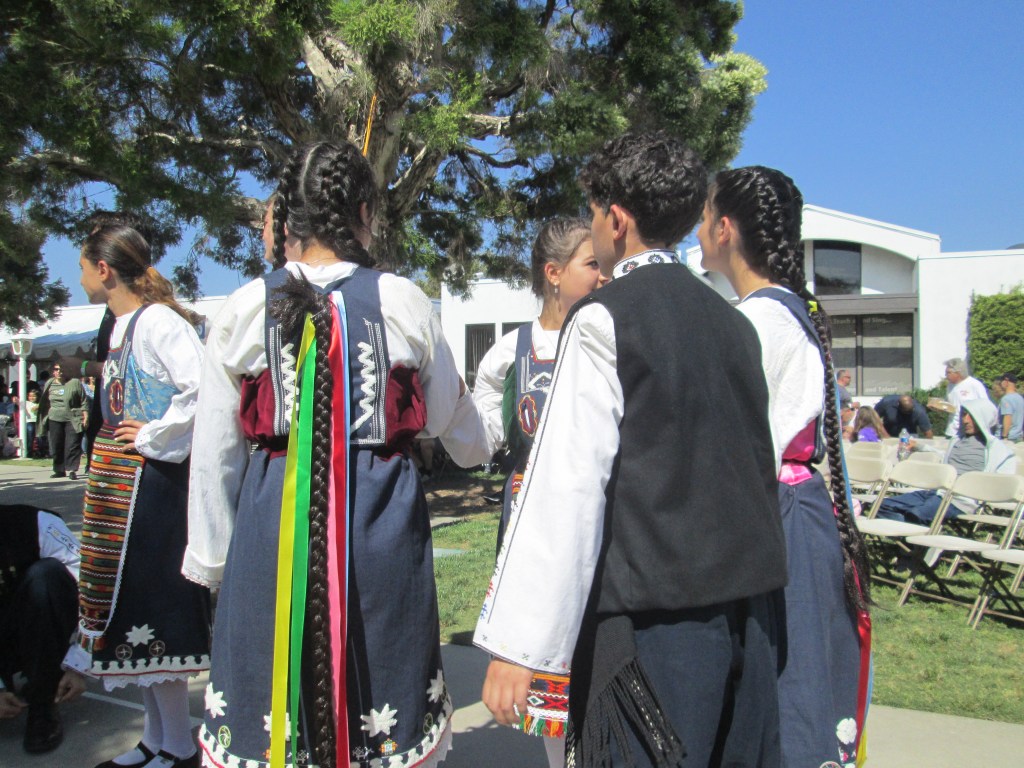
Middle School Greek Dancers at St Nicholas Greek Orthodox Church

I remember a time when most foreign-born Americans were of European ethnicity. My father, Elek Paris, was born in what is now the Republic of Slovakia; and my mother, who was actually born in Ohio, was taken to Hungary to be raised by her grandparents. For the first five or six years of my life, I thought that Hungarian was the language of the United States.

What inevitably happens has happened. The children of European-born immigrants see their parents’ culture, religion, and language as something quaint which they are being reluctantly marshaled into accepting. The three-year Covid-19 lockdown has brought this tendency into sharper focus.

Yesterday, Martine and I attended the annual Greek Festival at St Nicholas in Northridge for the first time since 2019. Sure enough, the tours of the church were more perfunctory; the calamari was more breading than squid; and there were fewer people able to do the traditional dance steps. I noticed much the same at the two Hungarian festivals we attended this month. Only the Grace Hungarian Reform Church in Reseda had anything like the same quality of food and entertainment as before the lockdown.

Our neighbors downstairs are refugees from Putin’s Ukrainian invasion. I notice that their two little daughters are addressing their mother in English instead of Ukrainian.

When I first came to Los Angeles, there were at least half a dozen Hungarian restaurants. Now there are none. If I want real Hungarian food, I’ll either have to cook it myself or visit my brother more often. (He’s a far better cook than I am.)

If Martine and I expect to find more authentic ethnic events, we will have to concentrate on the Asian and Latin American ethnic events, as they have arrived in this country more recently.

Is the Emperor Happy?

Solidus of the Emperor Petronius Maximus (Mar-May455)

I am greatly enjoying the second volume of The Barbarian Invasions of the Roman Empire, written by Thomas Hodgkin (1798-1866). This is the volume that tells of the Huns and the Vandals. More and more, I am fascinated by classic 19th century British and American historians.

The following excerpt is from Apollinaris Sidonius, a fifth century Roman poet, diplomat, and bishop. He is writing about the emperor that followed Valentinian III, who was assassinated for his part in the murder of Aetius, the last great Roman general, who defeated Attila and the Huns at Chalons in CE 451.

I received your letter … dedicated to the praises of your patron the emperor Petronius Maximus. I think, however, that either affection or a determination to support a foregone conclusion has carried you away from the strict truth when you call him most happy because he passed through the highest offices of the state and died an emperor. I can never agree with the opinion that those men should be called happy who cling to the steep and slippery summits of the state. For words cannot describe how many miseries are hourly endured in the lives of men who, like [the Roman dictator] Sulla, claim to be called Felix [fortunate] because they have clambered over the limits of law and right assigned to the rest of their fellow citizens. They think that supreme power must be supreme happiness, and do not perceive that they have, by the very act of grasping dominion, sold themselves to the most wearisome of all servitudes; for, as kings lord it over their fellow men, so the anxiety to retain power lords it over kings.

Folk Art: Myrlande Constant

Haitian Hero Toussaint Louverteur

This afternoon, I once again took a walk on the UCLA campus and visited the Fowler Museum. There were two new exhibits that fascinated me, particularly the work of Myrlande Constant of Haiti. It was a strangely satisfying mix of Hieronymus Bosch and Haitian vodou (aka voodoo). On her website, the artist talks about the influence of vodou flags on her work:

Within the vodou community the flag is a sacred ritual object that identifies the hounfour and honors the spirits with whom it is associated. The sparkle of the sequin or mirror used to capture the attention of the iwa started in the temples. Drapo voudou (sequined sacred flags) are unfurled at the beginning of a ceremony. They are power points that are used for both identification and transformation. When the flag is unfurled it signals the congregants to come to order -the sacred is about to come home to roost. The spirits will soon walk next to (or in) the market woman.

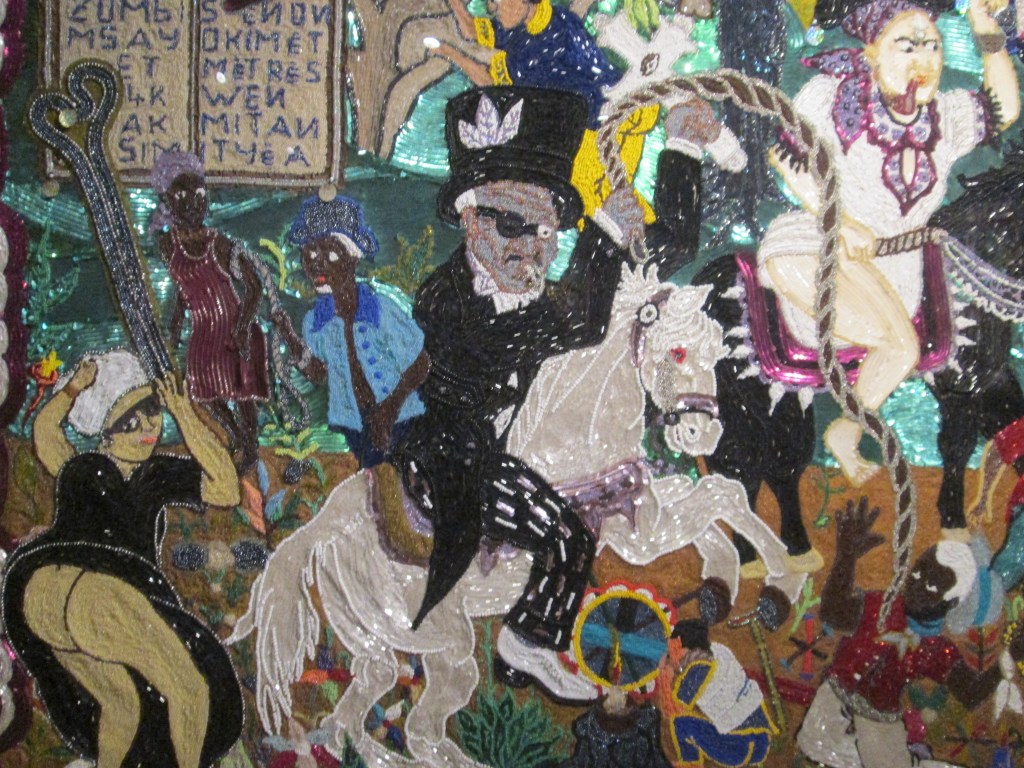
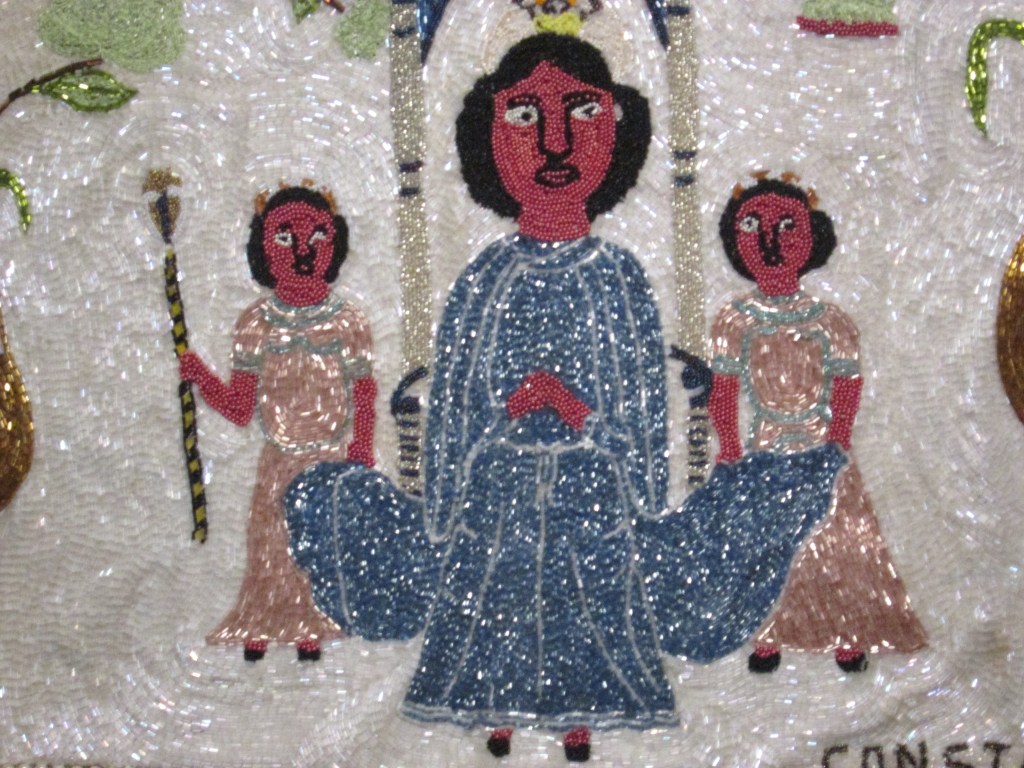
As I looked around the exhibit, I found myself drawn to details rather than to the overall design, which in any case I could ill understand as I am not a practitioner of vodou. Here are a couple of examples:

Like all the works on display, the art was covered with sequins, beads, and other shiny objects. The result was that I found myself immersed in detail. Is that Baron Samedi or Papa Legba on horseback? I don’t know, now why that woman at the lower left is exposing her buttocks.

Making frequent appearances were Catholic saints and angels, though in the world of vodou, everything has a different meaning.

Sometimes, it is useful to immerse oneself in a culture one doesn’t understand. The mysteries have a role to play in our lives—a role which, I believe, is ultimately benign.