The Tooth, the Whole Tooth, and Nothing But the Tooth

Uh oh! A couple days ago, I felt a sharp pain in one of my upper molars. Plus, when I drank anything cold, I felt the same pain. My last dental siege involved a new crown for one of my bicuspids, which couldn’t stay on. That was followed by two root canals of the bicuspid and an adjacent tooth, which had to be scrapped by having the tooth pulled. Total cost: about $4,500.

That sort of sequence is not exactly balm to someone like me on a fixed income. After that adventure, I did something I had never really done before. I purchased an electric toothbrush and did a thorough brushing of the gums and all tooth surfaces (fore, aft, and sides) for two full minutes—timed—before going to bed.

Today, I saw my dentist and had the sore tooth x-rayed. Apparently, the problem was caused by the molar next to the extracted bicuspid sticking out a little too far. So my dentist carefully measured my bite and trimmed the tooth so it wouldn’t receive too much pressure from my normal chewing of food.

The good news: It seems to be holding up for now.

Protective Detachment

Brush Fire About Five Miles from My Front Door

There I was, siting and reading the essays in Joan Didion’s After Henry, when I suddenly found a perfect phrase to summarize the sang-froid Californians feel about earthquakes and wildfires:

The notion that land will be worth more tomorrow than it is worth today has been a real part of the California experience, and remains deeply embedded in the California mentality, but this seemed extreme, and it occurred to me that the buying and selling of houses was perhaps one more area in which the local capacity for protective detachment had come into play, that people capable of compartmentalizing the Big One [that is, earthquake] might be less inclined than others to worry about getting their money out of [a real estate investment].

People in other parts of the country have told me scores of times that California is going to “fall into the ocean,” as if we were all living on a thin shelf of unsteady earth stretched out over the Pacific Ocean. In actuality, our part of the state will, instead of falling into the ocean, slowly head north to Alaska—over a period of millions of years. No matter, I won’t be around to have to buy heavy parkas.

When growing up in Cleveland, I had a deathly fear of tornadoes. They frequently featured in my nightmares. Finally, on June 8, 1953, a large tornado tore through the West Side. As an eight-year-old, we visited a family friend whose two-story house was half a block from utter devastation. At the time, we lived on the East Side and suffered no damage; but that didn’t help my dreams any.

Freeway Damage from the Northridge Quake of 1994

Because I live on a large heavily populated plain just south of the Santa Monica Mountains, I have no reason to fear wildfires. But earthquakes are a different matter. The Sylmar Quake of 1971 scared the Bejeezus out of me, and the Northridge Quake of 1994 didn’t help matters. Perhaps I don’t feel Didion’s protective detachment because I wasn’t born in California as she was.

When He Was Cool

A Young Donald Trump With First Wife Ivana

Now that his karma is finally catching up with him, my thoughts have turned to the young Donald Trump, when he was actually considered to be cool. I am thinking of Trump at Studio 54 being kowtowed as a celebrity. Here was a real estate mogul married to an exotic Czech model named Ivana. He still had a reasonable amount of hair and even looked sort of handsome. This was in the period before he became a reality TV star on The Apprentice in 2004. And definitely before he took aim at the presidency.

The moment Trump came down that gold-plated escalator of the Trump Tower on June 16, 2015, everything turned into a brown and murky covfefe. After ex-wife Ivana died last year, she was interred at the Trump National Golf Club in Bedminster, NJ as part of an elaborate tax dodge. In fact, the golf course had to be consecrated so that the Catholic Ivana could be buried there. As a certain ex-president would say in its nightly tweets, SAD!

As time goes by, there will be a lot more to be SAD about. The current indictment is only the beginning of the ex-president’s troubles. Whatever you may think about him, you wouldn’t like to be in his shoes.

Where the Streets Have No Name

David Hockney’s “Pearblossom Highway, 11-18 April 1986, #2”

This the way I remember it: the way it was decades ago. Yesterday, Martine and I took a road trip to Littlerock, California. Why? We were looking for smoked Hungarian sausage (füstölt kolbász) which was no longer available from our usual source, as the Alpine Village Market in Torrance was no more. I had a distant memory of the Valley Hungarian Sausage & Meat Company in Littlerock, where I had purchased some good kolbász years ago, when my mother was still alive. Then I heard from my brother Dan of a place called Tibor’s that sold kolbász somewhere in the Antelope Valley.

So I took a chance and drove along California 14 (the Antelope Valley Freeway) with its vanishing lanes past the Vasquez Rocks where Captain Kirk battled the reptilian Gorn on Cestus III, past the Red Rover Mine Road and Acton, until we got yo California 138, the Pearblossom Highway, which runs from the 14 all the way to the I-15 at Victorville.

“Where did all those people come from?” I wondered as I saw all the suburban developments that have sprung up in what is now called Canyon Country. I continued asking the same question as I saw how the Pearblossom Highway was no longer “Where the Streets Have No Name,” as Bono and the U2 sang.

Well, the Streets Now Have Names

On the way to Tibor’s, we stopped at Charlie Brown Farms—also in Littlerock—to have lunch and browse around. We quickly realized several characteristics common to the people who now lived in the area:

  1. Everyone was at least thirty pounds overweight, even the kiddies
  2. If they had any discretionary income, it was spent at the local tattoo parlor
  3. To a man, woman, and child, they looked liked bad ass wannabes

We located Tibor’s easily: It was the same as the old Valley Hungarian Sausage & Meat Company. Unfortunately, it was not well stocked. When asked for füstölt kolbász, they said they didn’t have any in stock. That’s kind of like finding no tortillas in a Mexican food store or pasta in an Italian deli. We bought some other kolbász, which turned out to be good. But it was an awfully long drive for slim pickings.

Still, it got Martine out of the house, and she enjoyed the drive to an area she had never seen before. And the California poppies along the road were like golden explosions of faerie light.

Yamaraja

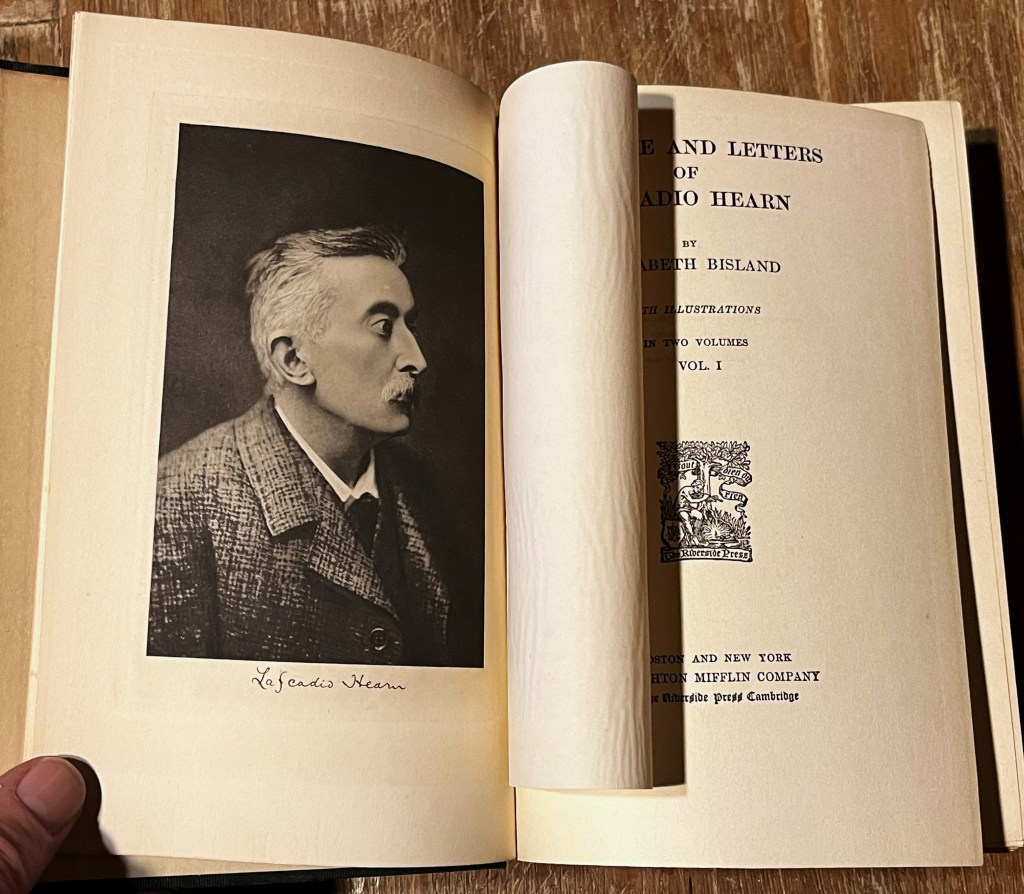
He Always Hid His Damaged Left Eye When Being Photographed

Lafcadio Hearn (1850-1904) was a true exotic. Born in Lefkada, Greece, he came to the United States and published several charming works of folklore, of which his Stray Leaves from Strange Literature (1884) was one title. And then he went to Japan, married a local woman, and published his best known works. These were collections of Japanese folktales in English. Masaki Kobayashi’s gorgeous color horror film anthology, Kwaidan (1964), was based on three of Hearn’s tales. Hearn changed his name to Koizumi Yakumo. Today he is revered by the Japanese for his works.

The following excerpt is from Stray Leaves from Strange Literature from the tale of “Yamaraja,” about a Brahmin who attempts to visit the Hindu god of the dead, who is called Yamaraja, to plead to bring his dead son back to life. It is this god who speaks:

“Verily thou hast not been fitted to seek the supreme wisdom, seeing that in the winter of thine age thou dost still mourn by reason of a delusion. For the stars die in their courses, the heavens wither as leaves, the worlds vanish as the smoke of incense. Lives are as flower-petals opening to fade; the works of man as verses written upon water. He who hath reached supreme wisdom mourneth existence only…. Yet, that thou mayst be enlightened, we will even advise thee. The kingdom of Yama thou mayst not visit, for no man may tread the way with mortal feet. But many hundred leagues toward the setting of the sun, there is a valley, with a city shining in the midst thereof. There no man dwells, but the gods only, when they incarnate themselves to live upon earth. And upon the eighth day of each month Yamaraja visits them, and thou mayst see him. Yet beware of failing a moment to practice the ceremonies, to recite the Mantras, lest a strange evil befall thee! …Depart now from us, that we may reenter into contemplation!”

Atmospheric Rivers

The Engine That Created California’s Storms This Year

Climate change is giving us a whole new language to describe the giant rain/snowstorms that have pummeled California since November 2022. Originally, there were the Pineapple Expresses which dumped large amounts of precipitation. There were maybe one or two in a rainy season, and just as likely none. Now the term Atmospheric River is used by the National Oceanic and Atmospheric Administration (NOAA). And then there are the Bomb Cyclones, fast-developing storms that occur when atmospheric pressure drops at least 24 millibars over a 24-hour period. Sometimes, all three terms are used to describe the same storm.

This year, California has experienced thirteen Atmospheric River storms this rainy season, dumping a record amount of precipitation in the form of rain and snow. I was watching a news report from Mammoth Lakes today which claimed that over 700 inches of snow have fallen in the area so far.That’s over 58 feet in all. Fortunately, it didn’t all fall at one time.

I suspect that we are probably at or near the end of these storms for this rainy season. These events have convinced me that there is risk entailed by siting a house in a low river valley or by a non-rocky hillside. Or by living in a trailer park.

The good news is that California agriculture will probably recover stronger than ever, except for those crops that don’t like too much water.

Mullah Nasruddin

Islam Is Not All Fundamentalist

Originally, there was a historical Mullah Nasruddin. He was born in Turkey and lived between 1208 and 1284. Stories multiplied about him, and eventually he was widely known between the Balkans and China. In the 20th Century, Idries Shah published a charming series of books featuring anecdotes about the Mullah. Here are two of them:

TWO IN ONE

Nasruddin was taking a shortcut home through the cemetery, where a burial was in progress. As he walked past the group of mourners, he overheard one of them saying: “Today is a sad day for us all. We have buried an honest man and a politician.”

A sad day indeed, Nasruddin thought to himself. I didn’t realise that the situation was so dire that they are now compelled to bury two people in the same grave!

GOD’S WISDOM

One hot summer’s day, Nasruddin was relaxing in an orchard under the shade of an apricot tree. Looking around him, and marvelling at nature’s bounty, he wondered why apples, cherries, and other small fruit grew on trees, while large melons and pumpkins grew on vines at ground level.

Sometimes it is hard to understand god’s ways, he pondered. Imagine letting apricots, cherries, and apples grow on tall trees while large melons and pumpkins grow on delicate vines!

At that precise moment, the mullah’s reverie was interrupted by an unripe apricot falling from the tree and bouncing off his bald head. Roused from his musings, Nasruddin stood up, raised his hands and face towards heaven, and said humbly: “Forgive me, god, for questioning your wisdom. You are all-knowing and all-powerful. I would have been in a sorry state now if melons grew on trees.”

You can find out more about Idries Shah at the website for The Idries Shah Foundation, which contains a list of his books.

The News from Ankh-Morpork

Sir Terry Pratchett, the Creator of Discworld (Image: Penguin Books)

I made a major discovery in 1998 when I read Terry Pratchett’s Feet of Clay, about a golem who joins the police force of Ankh-Morpork, a large, ancient, and very disreputable city on the Discworld. According to the Wikipedia entry for Discworld:

The Discworld is the fictional setting for all of Terry Pratchett’s Discworld fantasy novels. It consists of a large disc (complete with edge-of-the-world drop-off and consequent waterfall) resting on the backs of four huge elephants which are in turn standing on the back of an enormous turtle, named Great A’Tuin (similar to Chukwa or Akupara from Hindu mythology) as it slowly swims through space. The Disc has been shown to be heavily influenced by magic and, while Pratchett gave it certain similarities to planet Earth, he also created his own system of physics for it.

Sir Terry wrote some 41 novels set in his fictional Discworld, until Alzheimer’s caught up with him and carried him off at the age of 66 in 2015. Although the last novels in the series are not his best work, he wrote a number of novels that brought cheer and guffaws into my life, specifically:

  • Mort (1987), featuring Death, who speaks in all caps
  • Pyramids (1989), set in Djelibeybi (the Discworld equivalent of ancient Egypt)
  • Guards! Guards! (1989), the first of the novels about the Watch (A-M’s police force)
  • Small Gods (1992), in which Sir Terry takes on organized religions
  • Feet of Clay (1996), another novel about the Watch

I would not recommend any of the Discworld novels written after 2000. But before then, I have read most of the works and enjoyed most of them, particularly the titles listed above.

Casa de los Venados

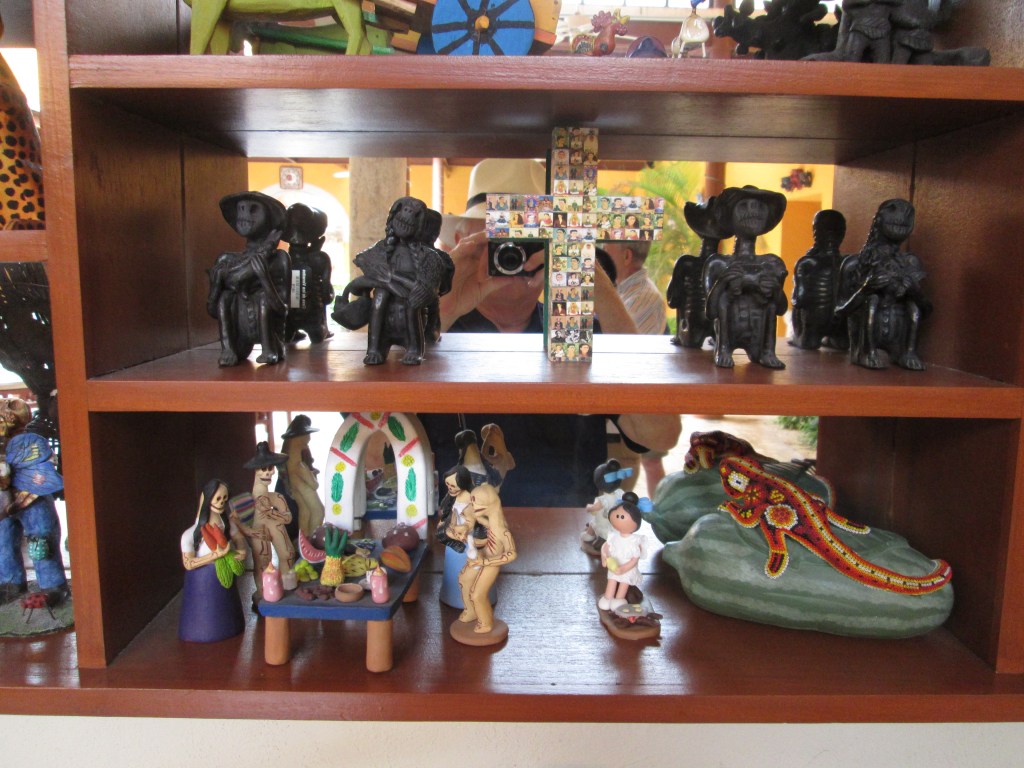
Mexican Folk Art from the Casa de los Venados in Valladolid, Yucatán

Perhaps the largest collection of Mexican folk art in private hands is on display at the Casa de los Venados in Valladolid, Yucatán, about a block off the Zócalo. The collection contains 3,000+ pieces of high-quality folk art. If you should ever find yourself in Yucatán, you should consider paying a visit. Not only is the museum an eye-opener, but the city of Valladolid is worth spending several days touring.

A Friendly Demon

You Can See Me Taking the Picture to the Left of the Cross

The Casa de los Venados is probably the best museum of Mexican folk art I have ever seen.

An Attractive Fanaticism

The following paragraph from from a 1949 British mystery novel by Edmund Crispin entitled Buried for Pleasure. In the novel Oxford Professor Gervase Fen is running for parliament, but gets sidetracked by a number of murders and other crimes in Sanford Angelorum. So instead of telling his constituents he no longer wants the job, he delivers the following speech the night before the polling. By the way, he wins.

I shall now tell you the reason why fanaticism of this sort is so attractive to humankind. A contemporary French writer—whose name I shall not mention, since you are probably too stupid either to recognize it or to remember it—has pointed out with unanswerable logic that men adopt ideas not because it seems to them that those ideas are true, or because it seems to them that those ideas are expedient, but because those ideas satisfy a basic emotional need of their nature. Now what emotion—I ask you—provides the chief motive power of the politically obsessed? You do not answer, because you have never given the matter a moment’s thought. But were you to do so, even you might dimly perceive that the reply to my question is the monosyllable hate. Never forget that political zealots are people who are over-indulging their emotional need of hatred. They have, of course, their ‘constructive’ programmes, but it is not these which supply the fuel for their squalid engines; it is the concomitant attacks, upon a class, a system, a personality; it is the lust to defame and destroy. Let no such men be trusted. That they have landed themselves, here and hereafter, in the most arid of all hells as a circumstance which I must confess does not greatly distress me, and with that spiritual aspect of the matter I do not propose to deal.