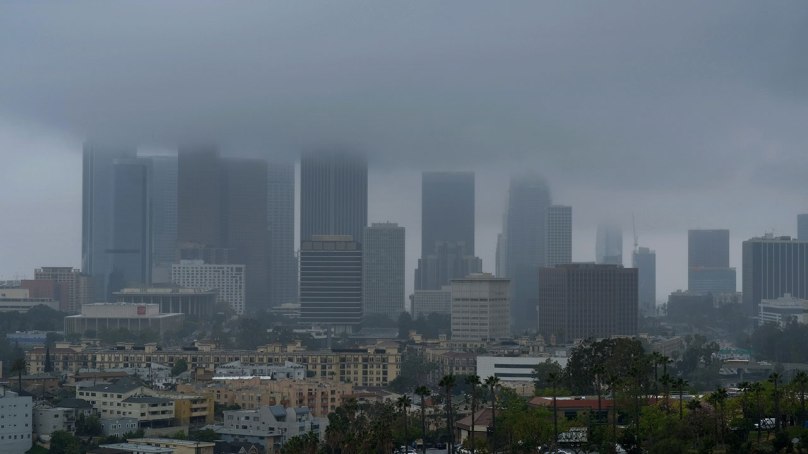
Downtown Los Angeles in the Rain
We are waiting for the first sizeable rain of the current rainy season. Of course, it is being referred to at this early stage—before the first raindrop falls—as an “atmospheric river.” Weather forecasters love to exaggerate.
The rain is scheduled to hit on Wednesday night and continue on into Thursday. Will it be raining all over Southern California at that time? Most likely not. There may even be parts of L.A. where only a few droplets will fall. On the other hand, the mountains in the county over 6,000 feet (1,829 meters) will probably be blanketed in snow.
Although people think of Los Angeles as a plain attached to a seashore, the county is actually criss-crossed by several mountain ranges, most notably the San Gabriels. There are also the Santa Monicas, the Santa Susanas, the Sierra Pelonas, the Verdugos, and the Tehachapis. The ranges and the valleys they enclose are distinctly separate climate zones with different forecasts.
For instance, West Los Angeles, where I live, typically gets far less rain than the mountains and most of the inland valleys. The news stations show projected radar images of rain clouds so that Angelinos can decide for themselves whether to take an umbrella and rain gear when they venture forth.
Unfortunately, Thursday is when I like to go downtown to the Central Library and sit in on one of the guided mindful meditation sessions held there. If the rain downtown seems to be tapering off on Thursday morning, I’ll go as usual. If, on the other hand, a major inundation continues into the afternoon, I would just as rather stay home and read a book.
I wouldn’t want to drown in an “atmospheric river.”


You must be logged in to post a comment.