It’s amusing to think that Slab City exists primarily because the military lawyers who drew up the papers for deeding the land Camp Dunlap was situated on to the State of California made a slight error. According to Wikipedia:
As of October 6, 1961, a quitclaim deed conveying the land to the State of California was issued by the Department of Defense as it was determined the land was no longer required. The deed did not contain any restrictions, recapture clauses, or restoration provisions. All of the former Camp Dunlap buildings had been removed. The remaining slabs were not proposed for removal. Later, legislation required that revenue generated from this property would go to the California State Teachers’ Retirement System.
But was there ever any revenue generated from the Camp Dunlap property? Who would be so imprudent as to spend good money buying land occupied by squatters, tweakers, snowbirds, religious freaks, people hiding out from the law, and other non-solid citizens?
If the bronze plaque above looks weirdly shaped, it’s because it is shaped like Imperial County.
Bombay Beach was only an appetizer. For real off-the-grid living, there’s no place like Slab City, several miles inland from Niland, California, along a fast deteriorating paved road.
Once upon a time, this used to be the Marine Corps’ Camp Dunlap, used for artillery training during World War Two and also as a bombing range for planes flying out of Marine Corps Air Station El Centro. Around 1950, the USMC started closing up shop. They took away all the buildings and tents, leaving only the slabs. Due to an interesting legal error, which I will discuss in tomorrow’s post, the area was left open for whoever wanted to squat on the premises.
It didn’t take long before the squatters starting showing up. Billing itself as “the last free place,” Slab City started taking off in the 1980s after articles in trailer and Recreational Vehicle (RV) magazines wrote articles featuring it.
Do You See Any Power Lines? Nope
Unlike Bombay Beach, the subject of yesterday’s post, there is neither running water nor electrical power nor trash pickup in Slab City. I imagine that water has to be trucked in from elsewhere in Imperial County. As for power, there are a lot of solar panels and probably not many air conditioners. During the summer, the mean daily maximum temperature is between 102° and 107° Fahrenheit (39° and 42° Celsius). Being in the middle of the desert, the precipitation is mostly nonexistent, and the wind can be wicked, bringing with it chemicals from the polluted Salton Sea shore.
On the other hand, there is no cost to live in Slab City. In addition to about 150 year-round residents, during the winter months thousands of snowbirds from around the US. and Canada park their RVs in an empty spot along the road and prepare to enjoy a life of doing not much.
Apparently there is a nearby hot spring where people can bathe and even shower. As Slab City is situated along the San Andreas fault, one can count on a number of natural hot springs along its length. (And one can also count on earthquakes from time to time.)
For an interesting picture of what it is like to visit Slab City, check out the Wiki Voyage page. And don’t forget to drink lots and lots of water.
You cannot find a more low-down community in the United States. Literally. That’s because the unincorporated town of Bombay Beach is 223 feet (68 meters) below sea level. It used to be larger, but each successive census has shown a drop in population, in 2020 down to 231. And that number is a little dicey because of the large number of snowbirds who winter there.
In 1999, Huell Howser did an episode of his show “Visiting” in a Bombay Beach which is hardly recognizable today. Back then most of the residents appeared to be senior citizens. At some point since then, the hipsters moved in, and the whole place became something of an art installation.
As such, it’s a fun place to visit. My bother and I spent a couple hours there last Saturday.
Art Installation in Bombay Beach
The beach itself is no beauty. At times, the town of Bombay Beach floods when the sea, which has no outlet, rises in an unusually wet year. Part of the town is now isolated from the beach by a protective berm. In any case, the sea frequently smells bad because of all the fish die-offs. In fact, the Huell Howser video shows him walking noisily on the bones of dead fish that line the shore.
Art Along the Beach
Many of the current residents of the town are living off the grid, using solar panels to provide electricity. There is water service provided by the Coachella Valley Water District. I rather doubt that sewage is piped out of town, as the next populated place is Niland, California, some 18 miles (29 kilometers) south. There is no gas station in town, and only one bar/restaurant and possibly one convenience store.
Beginning tomorrow, we will visit a place that is really off the grid.
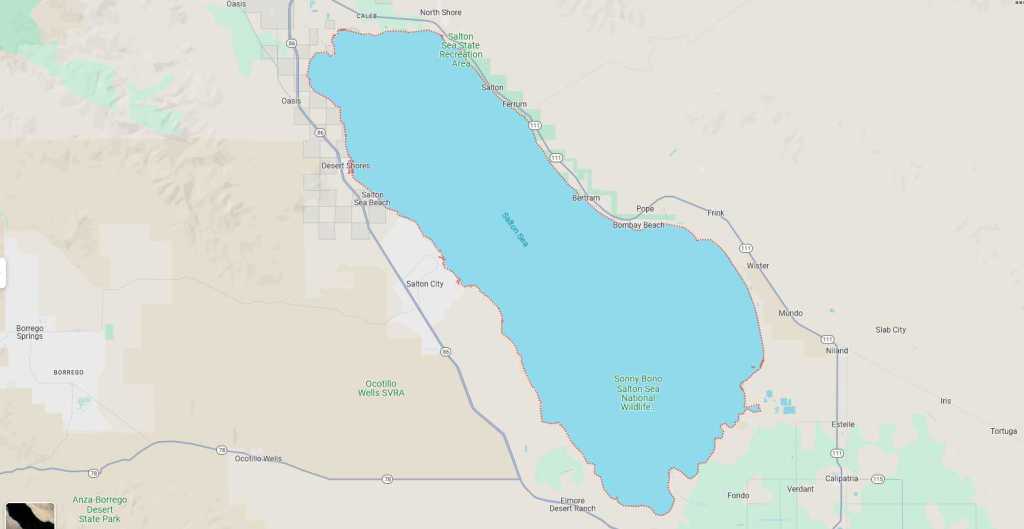
When I was still in college trying to decide where I would go to graduate school, I kept studying maps of California because it looked like I would attend UCLA (which I did). The one thing that arrested my attention was that Southern California had a sea entirely within the state. It was called the Salton Sea, and it did not seem to have any major population centers along its banks. Why, I wondered.
It seems that the Salton Sea was created by accident in 1905-1906 when the Colorado River was diverted to flow into a low-lying basin that had been dry since the late 16th century. For a while, particularly in the 1950s and 1960s, it was a major tourist draw—but not in the summer, when the temperature frequently exceeded 120° Fahrenheit (49° Celsius). Hollywood stars swam and boated in the waters, and there were a number of resort towns along the banks.
During the 1970s, the Sea’s increasing salinity and pollution resulted in large-scale fish and bird deaths; and, suddenly, the Salton Sea was deemed an environmental disaster. Plus, it was shrinking due to evaporation. The roads to the north ran through land that was white with salt. People started to remember that the San Andreas Fault ran right through the middle.
Last Saturday, my brother and I drove along the eastern shore of the Sea to view a stark landscape that was staging a weird comeback, first as a major lithium extraction site, and secondly as a magnet for people who wanted to live off the grid.
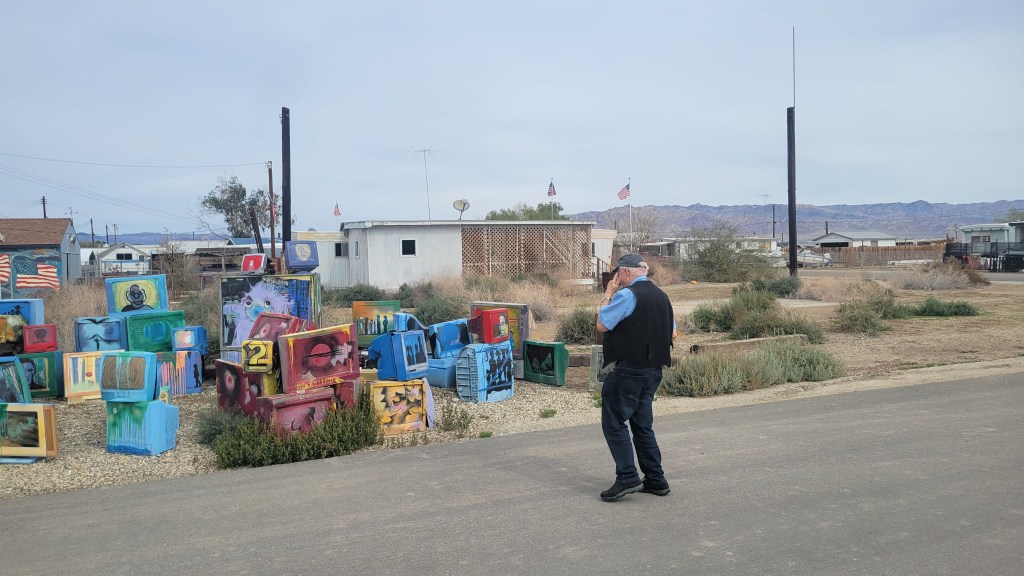
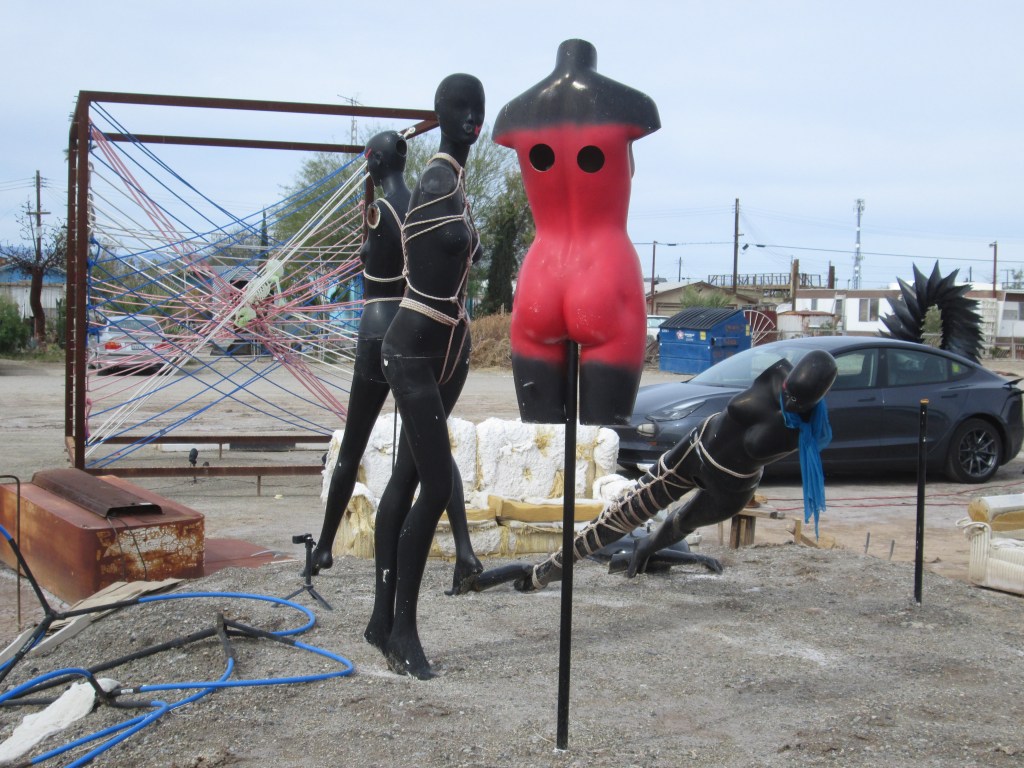
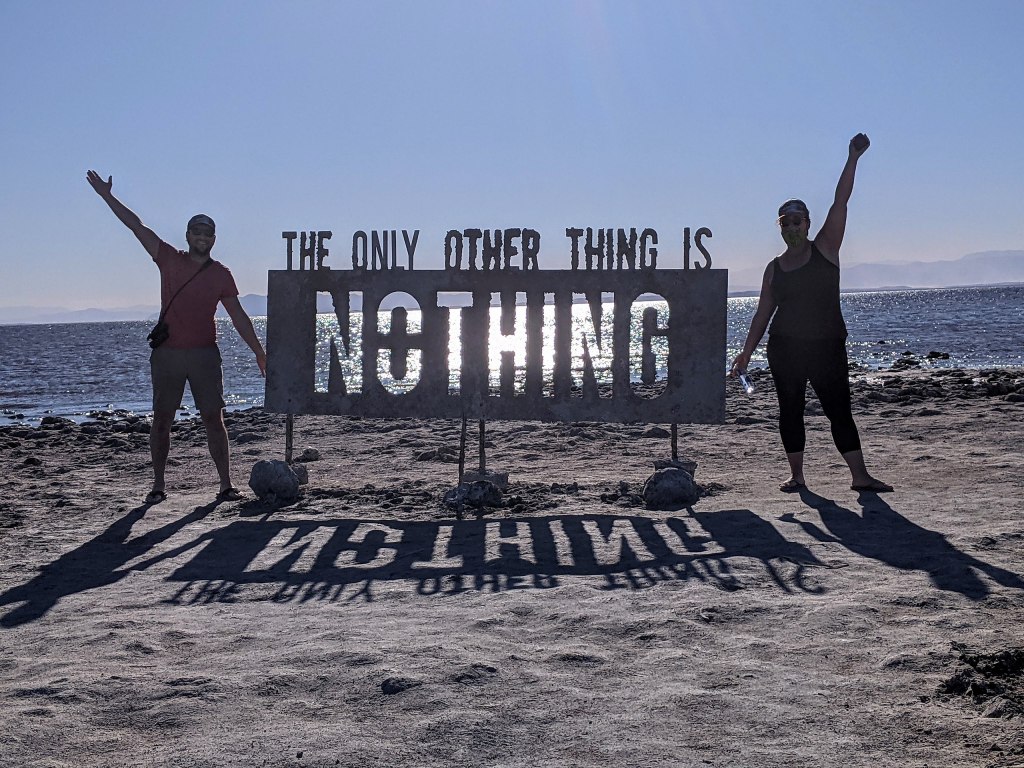
For the next several days, I will be posting blogs in a series I call “Off the Grid,” about our visit to the rogue communities of Bombay Beach, Slab City, Salvation Mountain, and East Jesus. None of them are incorporated cities, but all are alive with a kind of ferment that lends them a certain glow.
I will not be posting this weekend because I am off to the desert to visit my brother. It’s been months since I’ve seen him, so I’m looking forward to it.
Expect to see some new desert photos when I return on Monday.
Is it time to turn on the news yet? And when it is, what do you expect to hear? I don’t know about you, but I have come to the conclusion that the purpose of the news is to sell advertising by making the viewers fearful, such that they will want to be “informed” on the latest developments and continue to come back for more.
I have been asked by several friends outside of California whether I have “survived” the rainstorms that have hit the state this month. Evidently, I have, as I am writing this blog.
Southern California weather news can be illustrated by the following Venn diagram:
The blue circle indicates that “there has been too much rain”; the yellow circle, that “there has not been enough rain.” And what about the pale green zone where the two circles intersect? That’s when some weather reports are saying “there has been too much rain” and some others are saying that “there has not been enough rain”—at the same time!
At the same time we have been bombarded by reports of too much rain, there have been numerous stories that now a La Nina weather pattern is being established and that soon we will not be getting enough rain.
Apparently, there is no such thing as “just the right amount of rain.” It’s always a case of too much or not enough.
My suggestion for all of you: Try not to turn on the news just before going to bed. It will play havoc with your sleep.
This puzzle is from the Futility Closet website. According to the description:
One other notable problem from Sam Loyd’s Cyclopedia of 5000 Puzzles: A father left to his four sons this square field, with the instruction that they divide it into four pieces, each of the same shape and size, so that each piece of land contained one of the trees. How did they manage it?
Here is a poem by Jorge Luis Borges of Argentina that mentions the butterfly dream by Zhuangzi that I wrote about in yesterday’s post.
Signs
for Susana Bombal
Around 1915, in Geneva, I saw on the terrace of a museum a tall bell with Chinese characters. In 1976 I write these lines:
Undeciphered and alone, I know in the vague night I can be a bronze prayer or a saying in which is encoded the flavor of a life or of an evening or Chuang Tzu’s dream, which you know already, or an insignificant date or a parable or a great emperor, now a few syllables, or the universe or your secret name or that enigma you investigated in vain for so long a time through all your days. I can be anything. Leave me in the dark.
About that last line: Remember that for the last thirty or forty years of his life, Borges was blind.
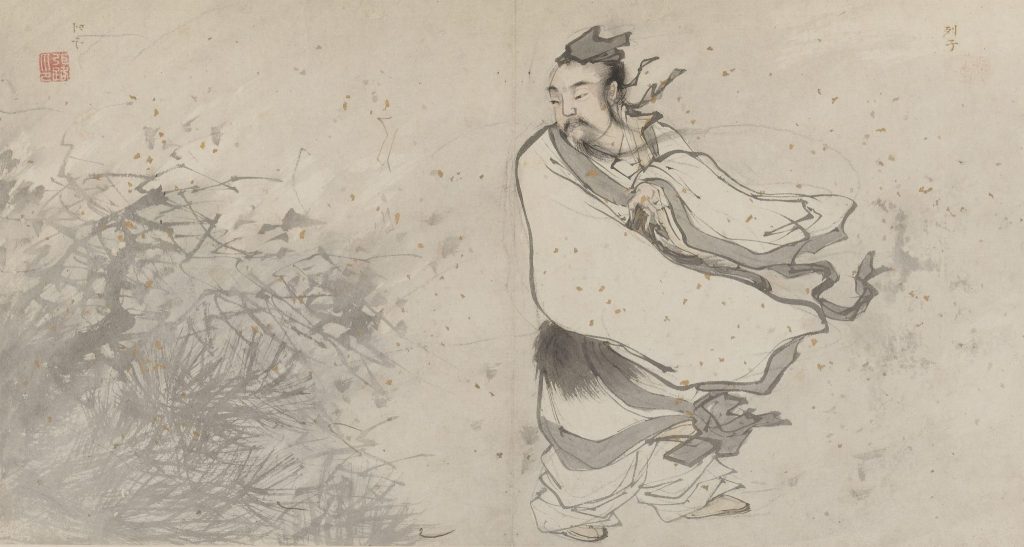
Zhuangzi, also known as Chuang Tzu, was a Chinese sage who lived around the 4th Century BC. There is a famous parable of his in which he talks about dreaming he was a butterfly. It is a simple parable that requires no explanation:
Zhuangzi’s Butterfly Dream Parable
Once upon a time, I, Zhuangzi, dreamt I was a butterfly, fluttering hither and thither, to all intents and purposes a butterfly.
I was conscious only of my happiness as a butterfly, unaware that I was Zhuangzi.
Soon I awakened, and there I was, veritably myself again.
Now I do not know whether I was then a man dreaming I was a butterfly, or whether I am now a butterfly, dreaming I am a man.
Between a man and a butterfly, there is necessarily a distinction.
The transition is called the transformation of material things.
Probably the only line that requires an explanation is the last one. I rather like the translation of the last line shown on this website: “This is called ‘Things Change.´”
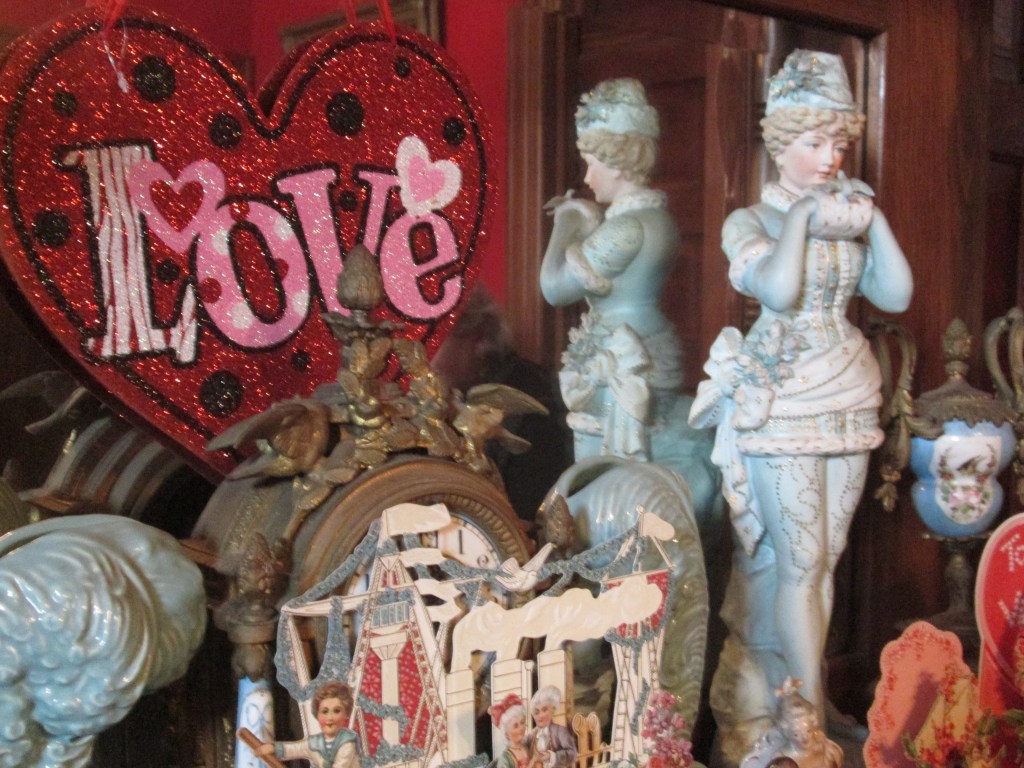
I know that Valentine’s Day was three days ago, but Martine and I decided to commemorate it anew with a visit to Susan and Rey Tejada’s Grier-Musser Museum. There we saw the elegant collection of figurines, greeting cards, and other antiques honoring the holiday.
There is an elegance, even a sense of formality, to the way our forefathers saw the rites of love-making in the 19th cntury. One could see a change in the way the subject was treated after the First World War. The flappers of the 1920s appeared to be more in charge, an impression that was underlined by the newfound power of Hollywood.
The Grier-Musser Museum brings us almost up to the present day. Sue and Rey are big-time movie junkies and spend a lot of time with their fingers on the pulse of popular culture. Their holiday exhibits, particularly around Halloween and Christmas, are a great way to see how the culture has changed and continues changing.




 Tarnmoor
You must be logged in to post a comment.