I am in the middle of reading a great novel by British author John Cowper Powys, namely Wolf Solent (1929). In 1960, he added a preface to the Macdonald & Company edition which summarizes what I am coming to see as one of the preeminent works of the last century:
What might be called the purpose and essence and inmost being of this book is the necessity of opposites. Life and Death, Good and Evil, Matter and Spirit, Body and Soul, Reality and Appearance have to be joined together, have to be forced into one another, have to be proved dependent upon each other, while all solid entities have to dissolve, if they are to outlast their momentary appearance, into atmosphere. And all this applies to the difference between our own ego, the self within us, the being of which we are all so vividly aware as something under the bones and ribs and cells and vessels of our physical body with which it is so closely associated. Here we do approach the whole mysterious essence of human life upon earth, the mystery of consciousness. To be conscious: to be unconscious: yes! the difference between these is the difference between life and death for the person, the particular individual, with whom, whether it be ourself or somebody else, we are especially concerned.
It was a strange experience for me to relive the few hours my brother and I spent Visiting Bombay Beach and Slab City, those strange communities along the eastern edge of the Salton Sea. I keep wondering to myself what it would be like to live there, and I’ve come to the conclusion that I couldn’t survive there.
What if there were an emergency? And, with my lack of a pituitary gland as the result of a long-ago tumor, I do occasionally have emergencies. Would I be able to get my hands on Hydrocortisone HCL or Prednisone in time for me to avoid sinking slowly and lethargically into the boundary between our world and what, if anything, lies after?
And that’s only one thing. What about making the daily trip to Niland to get the necessary 5 gallons (or 19 liters) of water required for drinking, cooking, and washing? What about starting from scratch because some mentally unbalanced or drugged neighbor decides to set my encampment on fire?
I imagine that life in a place like Slab City has its moments, but it also has its anxieties and moments of outright fear. Check out this video about the Slabs from a visitor from abroad:
Ruhi Cenet’s Negative Take on Slab City
Sometimes there is a high price to pay for the type of freedom that Slab City represents. Whether it is “the last free place in America,” as it calls itself, or just one of the circles of hell in Dante’s Inferno remains to be seen.
I thought I would have negative feelings about the residents we met in Bombay Beach and Slab City, but I don’t. What I felt was compassion.
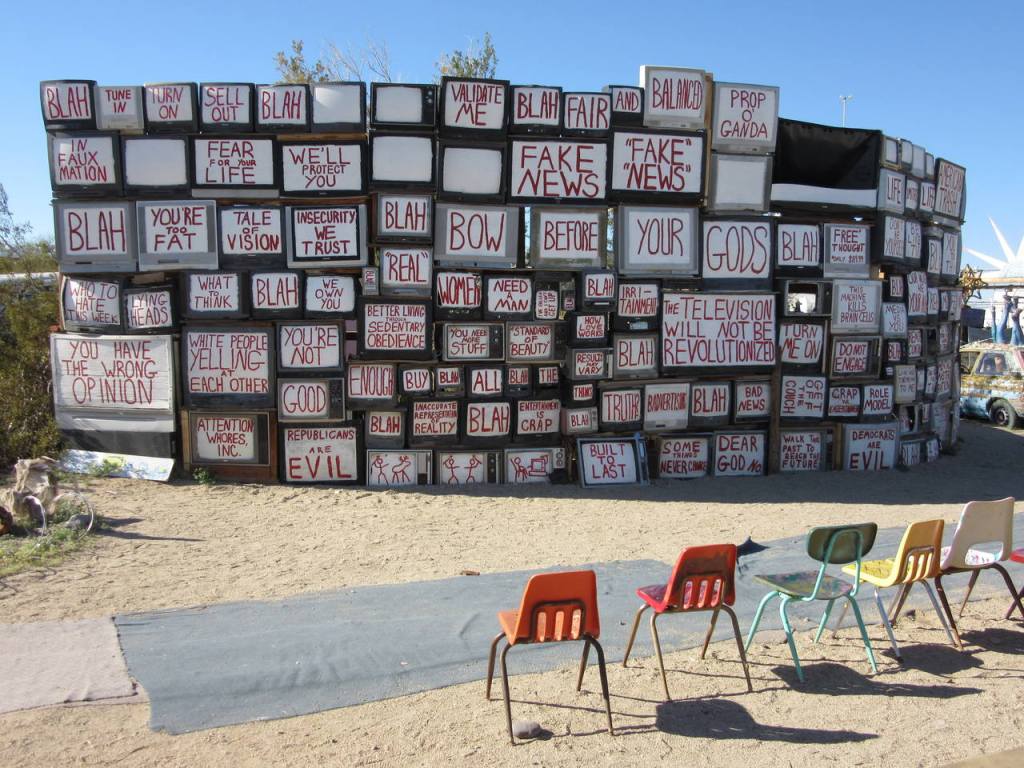
Somewhere in Slab City there is a 30-acre (12-hectare) area dedicated to large scale art installations and going under the name of East Jesus. There is no knowing where East Jesus begins and Slab City ends: Boundaries are not a big thing here. There seems to be more of a structure to EJ as it is run by a 501c3 Nonprofit Organization called the Chasterus Foundation.
East Jesus is an experimental, sustainable, habitable art installation started by Charlie Russel in 2006. East Jesus is a sprawling 30 acre museum dedicated to large-scale art. We charge no admission and rely solely upon small donations that fund our mission to preserve, protect, and continue the work of Charlie Russell. Our artist residency program gives up to a dozen low-income artists at time the space, tools, and supplies to create permanent large scale works using reclaimed materials. A member of the California Association of Museums and the only registered art museum in Imperial County, we welcome thousands of guests per week to see the possibilities of a world without waste where every action has the potential for self expression.
In 2014, we formed the Chasterus Foundation, a 501c3 nonprofit; in 2016 we purchased our land from the state of California with the intent to keep Charlie’s dream alive and to inspire others to see a life for their waste beyond the landfill.
Together, the inhabitants of East Jesus and offsite members provide a refuge for artists, musicians, survivalists, writers, scientists, laymen and other wandering geniuses.
We are dedicated to providing a working model of an improbable improvised community at the edge of the world. We are most interested in low-tech solutions, unresolved theories, non-linear advancement, and creative reuse.
We strive to document the results of these endeavors, sometimes simply by their existence. Our documents are sometimes nails, concrete, and sweat. We are partially an exhibition space for those problematic projects taking up your warehouse space, partially a build space for those problematic projects taking up the desert.
One of our guiding philosophies is “do as thou wilt”; another is “do no harm”.
What intrigued me about the organization’s website was a page called “East Jesus Survival Guide” in which we find the following tidbits:
By visiting East Jesus, you do so AT YOUR OWN RISK and assume all liability for any property damage, injury, illness, or death that occurs. By setting foot here, you and your heirs release all claims into perpetuity.
-0.5) WITH AN EVER-INCREASING NUMBER OF VISITORS, the expense of keeping shop is growing. If you ask to come camp out for a night or two, we ask that you please give us a CASH donation (or paypal, or venmo.) This helps pay for the peat moss, water, food, and helps defray the cost of all the little things you probably take for granted, like wireless internet, One Jillion Megawatts of power in the middle of fucking nowhere, and that spoon of mine you forgot to return that one time. Buying a t-shirt is so last year, but there are still a few I need to unload. $20 each. But don’t forget to stick some cash in the donation box or help out while you’re here. We are watching. Bringing a warm beer or some piece of rusty iron covered with dog shit you found in the desert and thought was “cool” does not exempt you from this.
0) RULE ZERO IS: DO NOT PISS US OFF. Any questions? Refer to Rule Zero.
0.5) PACK IT IN, PACK IT OUT / LEAVE NO TRACE. Be prepared to take everything you brought back out with you. The surrounding area, where you may be camping, is pretty trashy, but this does not magically give you permission to leave more trash. In fact, I expect you to leave your campground a tad neater and cleaner than you found it. Don’t leave plastic bottles and tampons in the fire pits, kids. Hell, do you live in a county with comprehensive recycling? Consider taking some souvenir trash home with you!
I don’t think I would survive long in East Jesus. If it isn’t the desert heat, it is having to rub shoulders with people who are at the frayed edge of acceptability.
Right in the middle of Slab City is a gaudy hillside painted in neon colors with all the Christian mottos you can think of. It is primarily the work of Leonard Knight (1931-2014). After his demise, however, volunteers have stepped in to maintain the giant art installation—and they’ve done a good job of it. Former U.S. Senator Barbara Boxer once paid tribute to it as “a unique and visionary sculpture… a national treasure… profoundly strange and beautifully accessible, and worthy of the international acclaim it receives.”
Although my brother and I are about as far from Evangelical Christianity as it is possible to be, we were both awed by the mountain’s primitive beauty and evident sincerity.
The Star Attraction of Slab City
It’s worth a trip to Slab City if for no other reason than to look around Salvation Mountain. There’s no admission charge or any pressure to donate, but it’s worth contributing to the upkeep of such a fascinating work. As the Folk Art Society of America stated, it is “a folk art site worthy of preservation and protection.”
If you’re interested in reading more about the place, you can check out the Salvation Mountain website.




 Tarnmoor
You must be logged in to post a comment.