“The City”

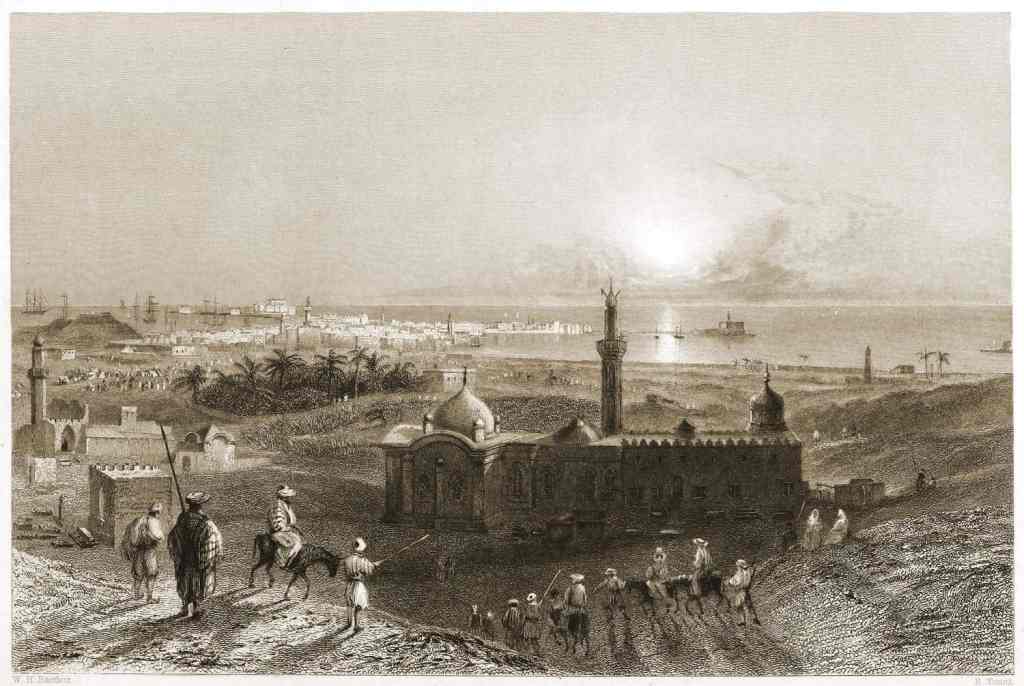
Alexandria, Egypt in the 19th Century

Every once in a while, when I’m feeling restless, I think of the poet of Alexandria, Egypt: Constantine P.Cavafy (1863-1933). I first learned about him from reading Lawrence Durrell’s The Alexandria Quartet, where he is referred to as “the poet of the city.” Appropriately, here is one of his best poems, which is called, simply:

The City

You said: “I’ll go to another country, go to another shore,
find another city better than this one.
Whatever I try to do is fated to turn out wrong
And my heart lies buried like something dead.
How long can I let my mind moulder in this place?
Wherever I turn, wherever I look,
I see the black ruins of my life, here,
where I’ve spent so many years, wasted them, destroyed them totally.”

You won’t find a new country, won’t find another shore.
This city will always pursue you.
You’ll walk the same streets, grow old
in the same neighborhoods, turn gray in these same houses.
You’ll always end up in this city. Don’t hope for things elsewhere:
there’s no ship for you, there’s no road.
Now that you’ve wasted your life here, in this small corner,
you’ve destroyed it everywhere in the world.

On Being a Slave to Technology

Something happened to me as I approached retirement age. I mean besides getting old. What I mean is that I began to feel highly critical about several technologies that were beginning to assume a dominant position in our society.

Touch Screen

Although I use an Amazon Kindle to read several books a month, I do not like the imprecision of touch screen interfaces—especially when I have to enter data without a large-sized keyboard. I do not have fingers that measure five millimeters across, so an onscreen keyboard is as difficult for me as using tweezers to move an anvil.

Smartphones

In addition to my dislike of touch screen interfaces, I find smartphones irritating in the extreme. I have a flip cellphone, but I don’t carry it around with me everywhere I go. For one thing, I will not answer the phone while driving, as I wish to continue living and operating an unwrecked car. My cellphone is for outcalling only, except by prior arrangement. Most of the time, it is powered off and sits comfortably on my computer desk.

The other thing is that I already have to carry around a number of things in my pockets:

  • An eyeglass case with reading glasses
  • A ballpoint pen
  • My wallet
  • My keys
  • Change for parking meters
  • Selected medications, including insulin for diabetes

E-Scooters

Why was this ever invented? I have already seen a half dozen nasty accidents involving e-scooters. And besides, I’ve always thought people looked silly operating them.

Artificial Intelligence (AI)

I know that we are living in a world where artificial intelligence is regarded as the coming thing. In my opinion, AI is a way of sacrificing truth for convenience. Please accept my assurance that I do not use AI in producing my blog posts. We have enough half truths and lies all around us without my adding any more to the mix.

GPS

Here I admit I’m on shaky ground. I do not have any GPS device in my car because I do not like to be distracted while driving. Also, I am still a bit skeptical about their accuracy, particularly while traveling in foreign countries. I suppose that for people who don’t know where they’re going, GPS can be a blessing of sorts.

The nice thing about being my age is that I can pick and choose which technologies to adopt. I do not have to turn myself into a rabid fanboy because Apple or some other tech giant is releasing a new product. I believe it was Alexander Pope who wrote the following couplet:

Be not the first by which the new are tried
Nor yet the last to lay the old aside.

“You Have To Swing”

Jack Kerouac (1922-1969)

Jack Kerouac is not best known for his poetry, but his can be fun to read, such as this short lament:

Woman

A woman is beautiful
but
you have to swing
and swing and swing
and swing like
a handkerchief in the
wind

Survival Mechanism

My father was a semi-professional athlete both in Czechoslovakia and in Cleveland, where he played in the 1930s in a nationality-based soccer league. As his firstborn, I was something of a disappointment to him. I was a bit of a shrimp, later ballooning into a short tubby boy with a broad spectrum of allergies. Plus, around the age of ten, I started getting severe frontal headaches almost daily that were constantly misdiagnosed by the physicians we saw. (It turned out to be a pituitary tumor, which was successfully operated on after I graduated from college.)

What unpromising material!

When my brother was born, my father must have breathed a sigh of relief. Dan was tall and an athlete in my father’s mold.

Where did that leave me?

Thanks to my mother’s genius for story-telling—what with dark forests and witches and princesses—I turned to books as soon as I learned to read. There was a period of adjustment of several years during which I had to switch from being an American kid who spoke only Hungarian to an English-speaker. Those dark forests and witches and princesses, luckily, could also be found in books, together with a lot of other interesting stuff.

Although I always had friends, I was left out of school sports because I was frankly somewhat sickly. That turned out to be all right in the end, as my friends were interested in the same sort of things that I was. With Richard Nelson, who was an astronomy freak, I collaborated in writing an illustrated hand-printed study of our solar system and galaxy. Richard later became a meteorologist. Then there was James Anthony, who became a gynecologist.

While I was physically weak, books made me strong in every other way. I never became a famous author or a college professor, but I held down some interesting jobs that help finance my love of books. And I always read a lot. Even today, as I approach my ninth decade, I read anywhere from twelve to sixteen books a month.

What started out as a survival mechanism has brought happiness to my life. I have no children (because I no longer have a pituitary gland), but my retirement years have been mostly contented.

I know that there will be bad times to come as Martine and I age, but I retain a mostly sunny view of life. And in an election year in which Donald Trump is running, that’s a major accomplishment.

My Cities: Edinburgh

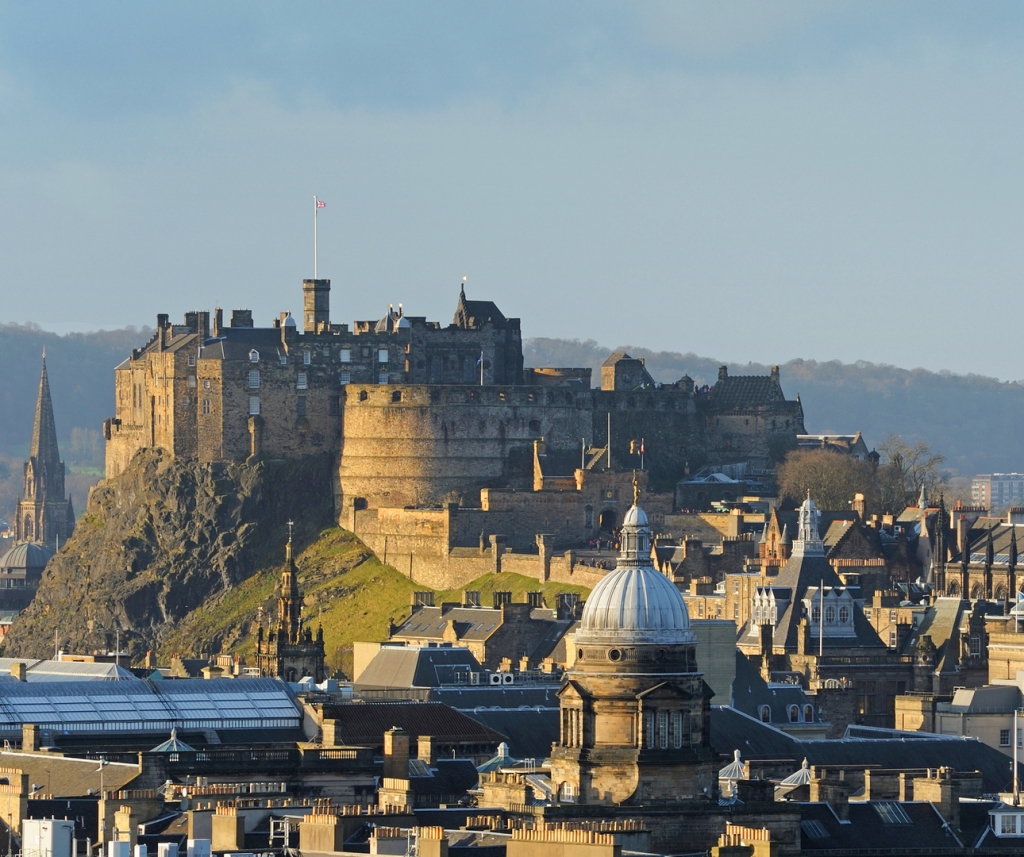
Edinburgh Castle Cityscape, Scotland, UK

The most incredible street in the British Isles has to be the Edinburgh’s Royal Mile. At one end, it is anchored by the looming hulk of Edinburgh Castle and, at the other, by the Royal Palace of Holyroodhouse. In between lies the whole pageant of Scottish history.

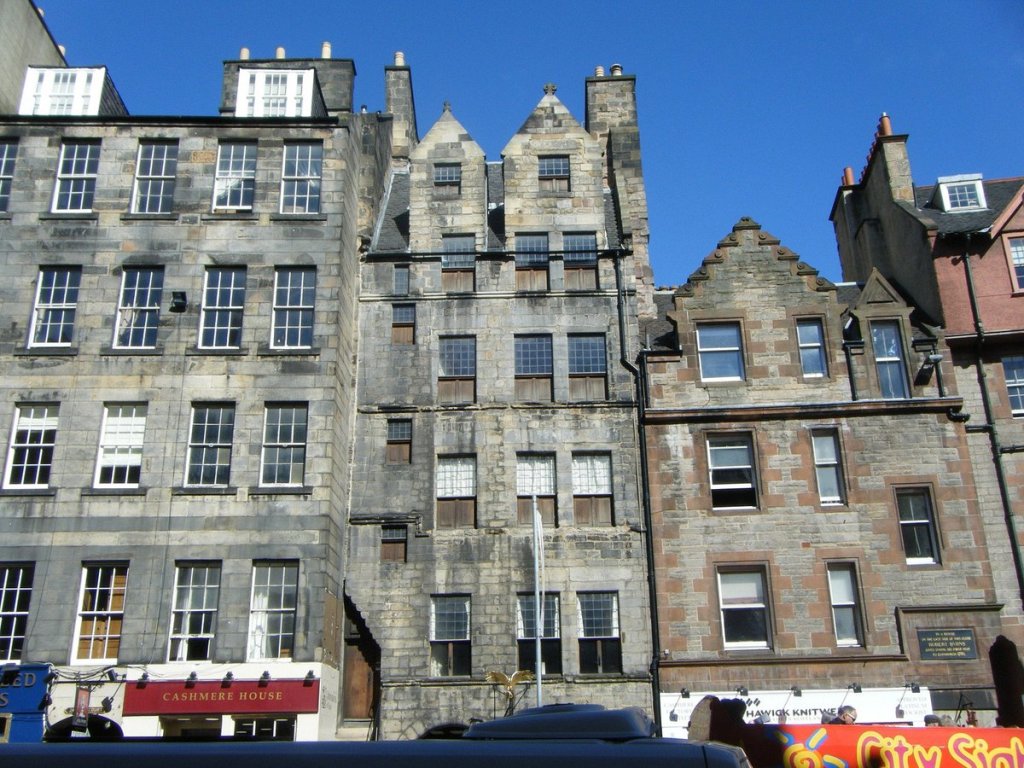
Along the way are St. Giles Cathedral, the High Kirk of Scotland; the tolbooth, or prison, described in Sir Walter Scott’s The Heart of Midlothian (1818); and the house of John Knox. Short dead-end streets known as wynds contain Europe’s first high-rises.

Gladstone’s Land, an Early High Rise Building

England, Wales, and Scotland are all rich in history; but in Scotland there is a particular awareness of history that permeates the culture and literature of the Scots. You find it in the works of Robert Louis Stevenson and the historical novels of Nigel Tranter. You can hardly step out of your hotel without finding yourself in the middle of it.

I’ve been to Edinburgh four times in all dating from 1976, the first two times alone, the second two times with Martine. If I had the money, I would dearly love to go again. There is something about reading one of Scott’s Waverly novels while eating a steaming bowl of cullen skink. And yes, I actually like a plate of haggis and neeps (mashed turnips), probably because haggis tastes like Hungarian liver sausage, or hurka.

“He Neuer Makes His Walke Outright”

The Knight in Chess

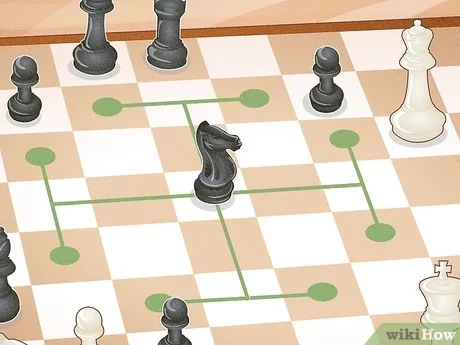
Of all the pieces on the chessboard, the most ancient is that queer duck, the knight. He is the only piece that can jump over other pieces—on his side or the enemy’s—to make a move or capture. His move can only be described as a four-square “L,” starting with one square left, right, up, or down—and then one square diagonally away from the starting point of the move. Or, look at the following illustration:

Possible Knight Moves

Just note that there could be other pieces on any of the squares that are “jumped over” and an enemy piece on the final square on which the knight lands. These are shown with green dots in the above illustration.

The following description of the knight in chess comes from Nicholas Breton’s The Chesse Play (1593):

The Knight is knowledge how to fight
against his Princes enimies,
He neuer makes his walke outright,
But leaps and skips, in wilie wise,
To take by sleight a traitrous foe,
Might slilie seek their ouerthrowe.

Over ther last several months, I have spent some time studying chess problems at Chess.Com. What I find particularly interesting is that, if the knight is in the vicinity, there is a good chance that the key move will be made by him, either checking the king or being sacrificed to allow for checkmates or winning piece grabs.

Tit for Tat

Cumulus Clouds Over Los Angeles

In terms of the calendar, summer began on Thursday; but in terms of the actual weather, it began today with high humidity (76%), relatively high temperatures (around 80° Fahrenheit or 27° Celsius), and a parade of majestic cumulus clouds.

If I were to identify the “microseason” we are entering, I would say it is Mexican Monsoon Season, where we are the recipient of the northern edges of Mexico’s summer monsoons.

That’s a fair trade, I suppose, because the united States begins sending in late autumn its nortes, or “northers,” which wreak serious havoc along the Gulf Coast of Mexico. In November 1992, I have memories of two nasty northers which led to extensive flooding in both Campeche and Mérida. I remember wading to the Campeche bus station in knee-deep water to buy tickets for the next morning’s ADO first class bus to Mérida.

When the next morning dawned, I was surprised to see that most of the flooding had subsided considerably.

My Cities: Mérida

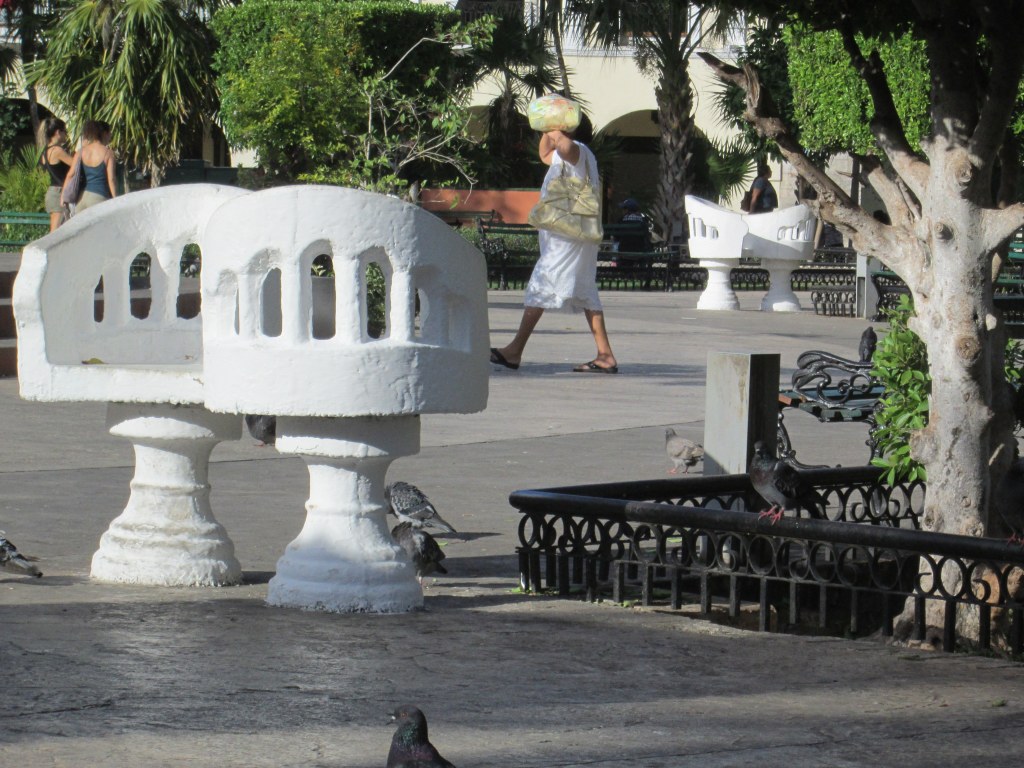
On the Plaza Grande

The first place I went to outside the United States on my own was Yucatán in 1975. I have elsewhere described my feelings about landing in a strange tropical city at night. Something happened to me: I fell in love with the place and kept coming back, maybe eight or ten times in all. There was Calle 60, the Plaza Grande with its confidenciales, the 1901 Gran Hotel, Poc Chuc at the Restaurant Express, the refreshing fruit drinks at Jugos California, the nearness to hundreds of fascinating Maya ruins. And the Gulf of Mexico was only an hour away by bus.

Oh, it was hot and humid all right; but one learned to slow down and look out through the eyes of a lizard.

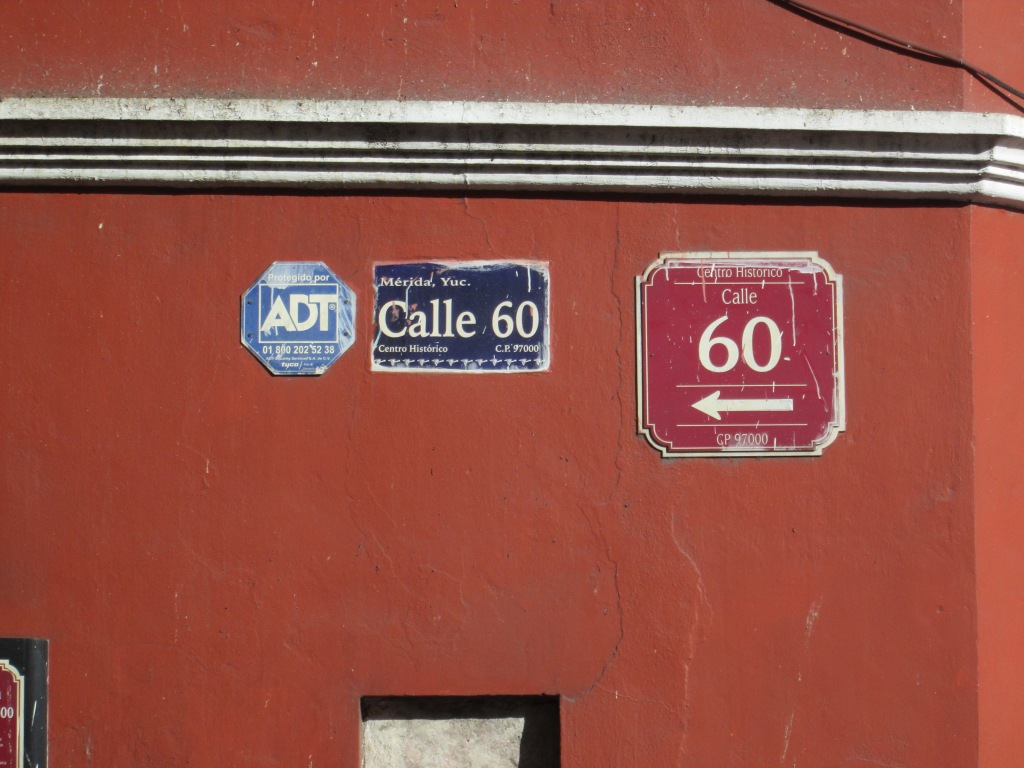
Calle 60 Street Corner Signs

Although Mérida is in Mexico, it is more of a Yucatec Maya city than a Mexican one. Most of the people are of Maya ancestry, and one frequently hears the Maya language spoken on the street. The city has fascinating museums of Maya civilization, art, and even music. You can find Mexican antojitos, but you are more likely to find Maya dishes like cochinita pibil, pavo en relleno negro, or pulpo en su tinta. You can even find hot dogs, hamburgers, and pizza.

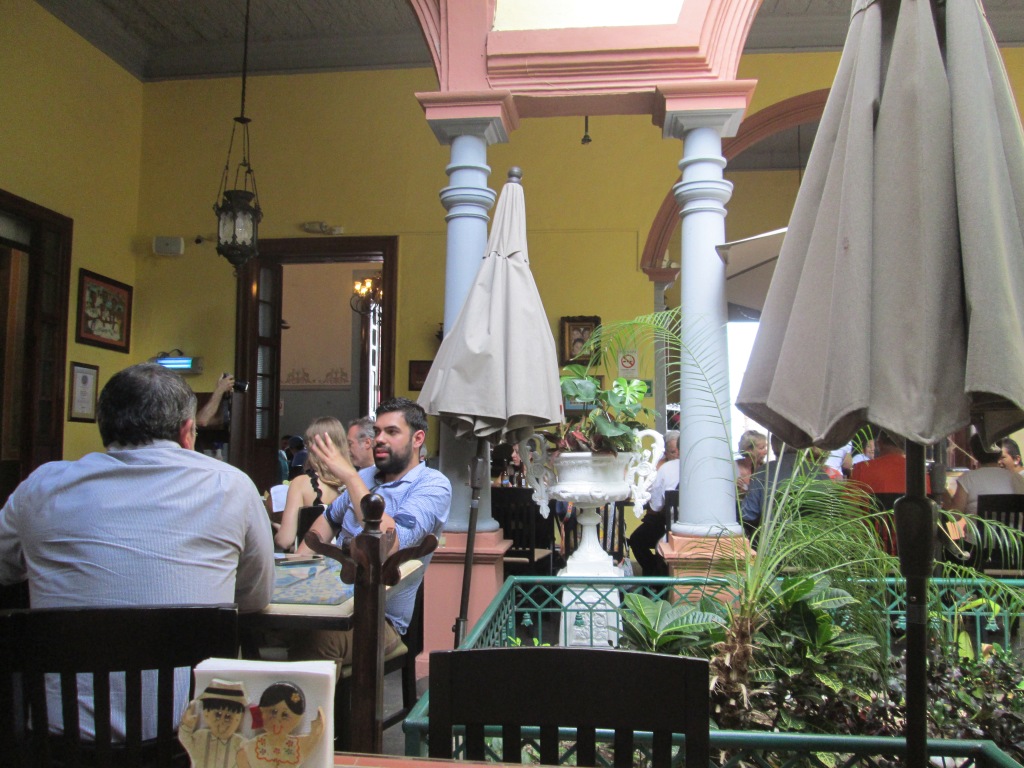
Lunch at Chaya Maya Near Parque Santa Lucia

Many of my favorite restaurants are gone, like Erik’s Mil Tortas, El Portico de Peregrino, and the Restaurant Express; but interesting new ones have opened up.

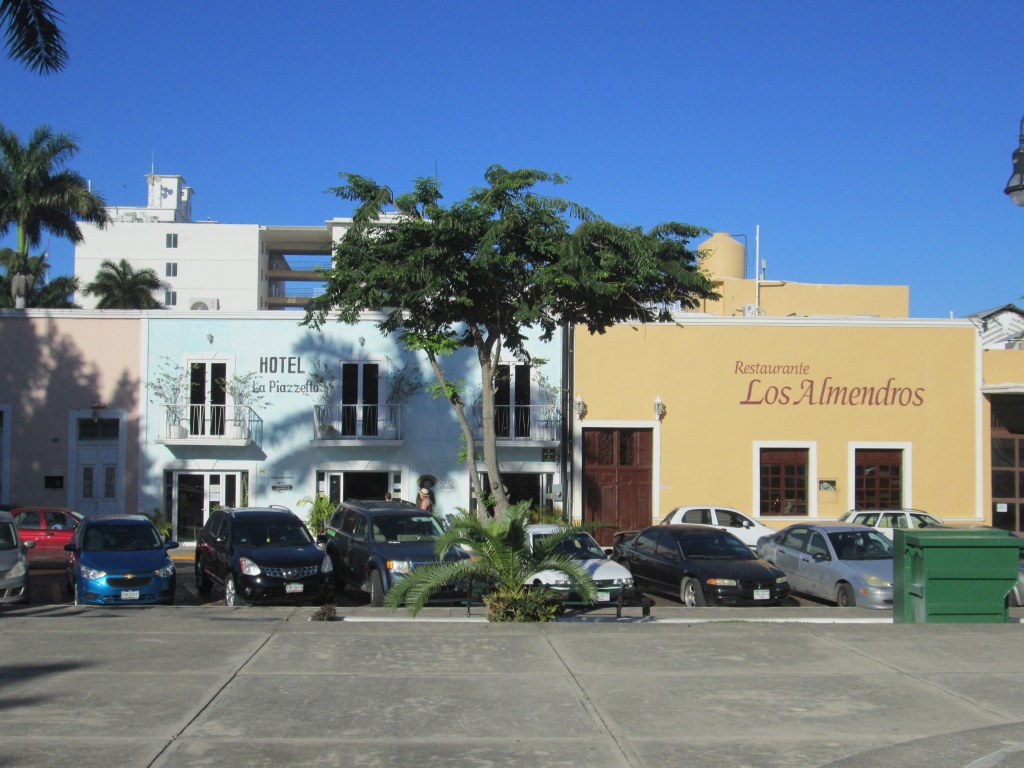
Even though the sidewalks are narrow amid the heavy auto traffic, Mérida is a great walking city. When I went last in January 2000, I walked so much that I got a horrible blister on my right foot and had to see a local doctor to clean it out and patch it up. I was in a little hotel (shown below) that was almost half a mile from the main square.

The Hotel Piazzetta at Parque de la Mejorada

When I checked out of the hotel to leave for the airport, the cute young daughter of the owner came out to the taxicab and gave me a friendly kiss. One remembers things like that in the long days, weeks, months, and years that follow.

Life and Mushrooms

Count Leo Tolstoy (1828-1910)

In the last year of his life, Count Leo Tolstoy was subjected to unusual stresses. He was frequently ill with fevers, stomach ailments, constipation, and colds. His long-time marriage to Sofia Andreyevna was characterized by hysteria and mutual recriminations. Finally, his estate at Yasnaya Polyanka was constantly besieged with friends, relatives, petitioners, crackpots, and celebrity hounds. Yet, in his Diaries, he managed to keep his eyes on the main topics, as this entry on May 1, 1910, the last year of his life attests::

One of the main causes of suicides in the European world is the false teaching of the Christian Church about heaven and hell. People don’t believe in heaven and hell, but all the same the idea that life should be either heaven or hell is so firmly fixed in their heads that it doesn’t permit of a rational understanding of life as it is—namely neither heaven nor hell, but struggle, unceasing struggle, unceasing because life consists only of struggle; only not a Darwinian struggle of creatures and individuals, but a struggle of spiritual forces against their bodily restrictions. Life is a struggle of the soul against the body. If life is understood in this way, suicide is impossible, unnecessary and senseless. The good is only to be found in life. I seek the good; how then could I leave this life in order to attain the good? I seek mushrooms. Mushrooms are only to be found in the forest. How then can I leave the forest in order to find mushrooms?

Coporaque

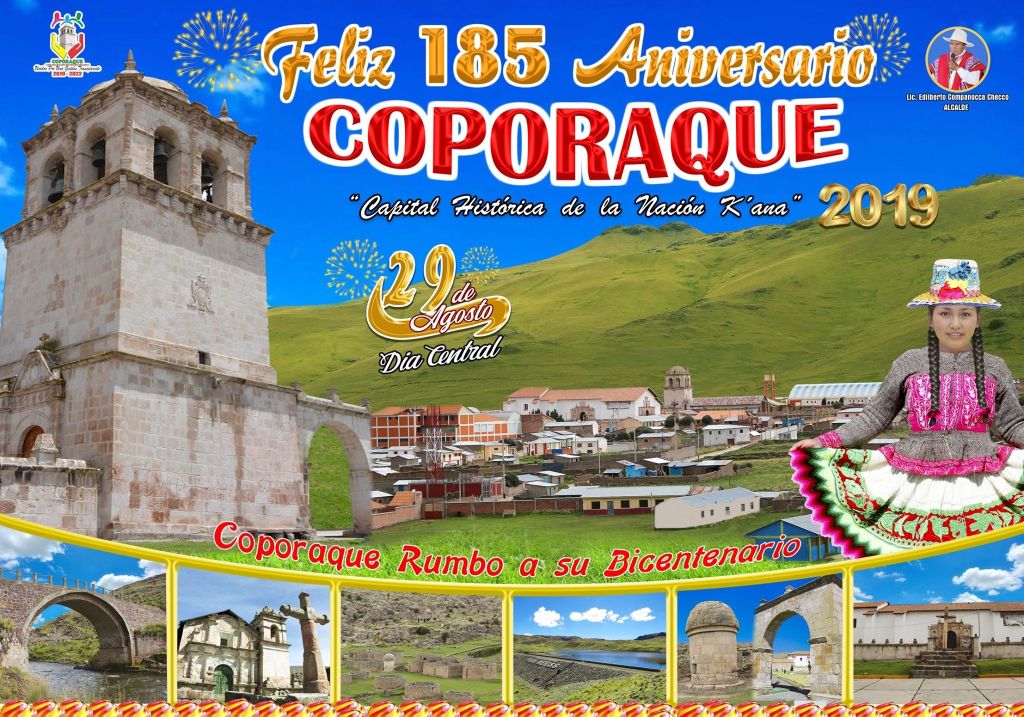
Poster Celebrating the 185th Anniversary of the Town

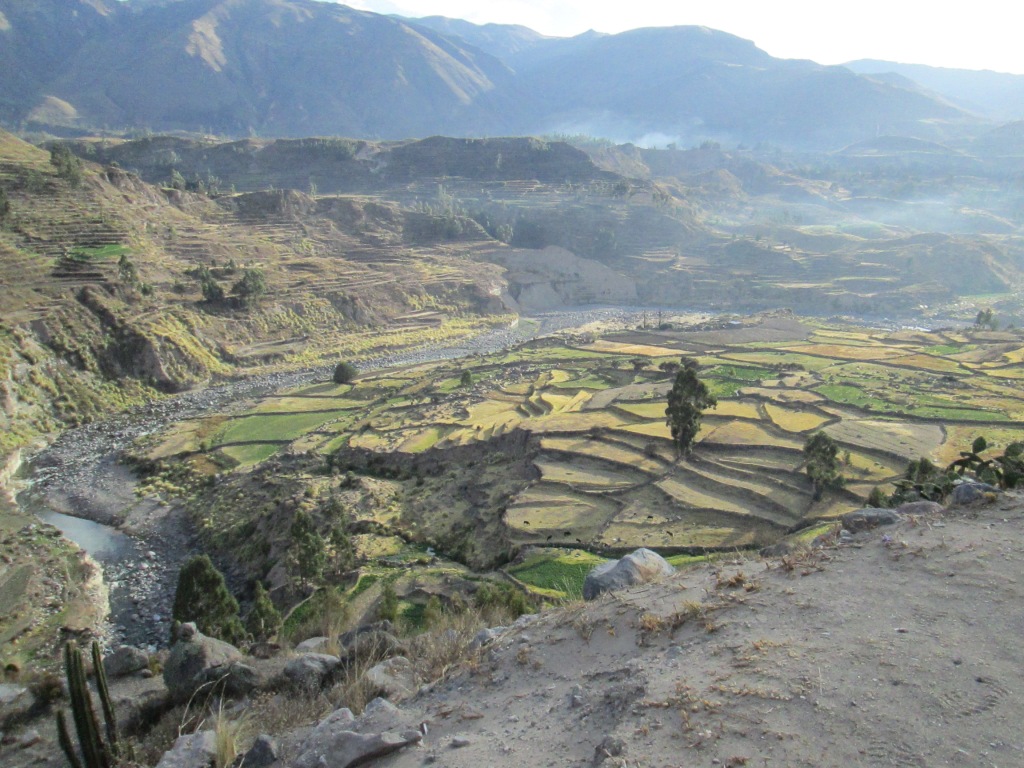
Now that I am retired and living on a fixed income, I like to remember some of the places I’ve been that impressed me. I spent only one night and part of two days in Coporaque, Peru near the north rim of Colca Canyon, but I wound up liking it more than Machu Picchu.

The area is split betweeen three ethnic groups: the Cabanas, the Kollawas (Collaguas), and the Ccaccatapay. The Canyon at its deepest point 3,400 meters or over 11,000 feet , almost twice the depth of Arizona’s Grand Canyon. Curiously, it’s not even the deepest canyon in Peru: nearby Cotahuasi Canyon wins that honor.

What comes to mind when I remember my visit to the area is that it is surrounded by volcanoes, one of which—Sabancaya—is in a permanent state of eruption. The terracing for agriculture goes back to the Incas.

Agriculture Terraces Going Back to the Incas

I wouldn’t mind going back to Colca Canyon, even though its 11,000-foot altitude requires that I chew coca leaves to avoid keeling over. En route to the canyon, we went over a mountain pass at Patapampas where the altitude was over 15,000 feet (4,572 meters). As I stepped out of the van to check out the view, I started to fall flat on my face, but was prevented from doing so by our Peruvian guide.