I spent four years at Dartmouth College in New Hampshire while suffering from a brain tumor that caused severe frontal headaches that lasted until midnight. It was then that I started my homework, not going to sleep until three or four in the morning. It was truly horrible when I had classes scheduled for 8:00 AM.
Worst of all were the morning swimming classes that I had to attend the first two years. At the time, the college had a requirement that all students be able to swim fifty yards in one minute. I was, of course, handicapped by my pituitary tumor; but I eventually passed the test. If MRIs and CAT Scans existed back in the mid-1960s, I would have been excused. But they didn’t. The doctors all thought that I was just being a pussy. It was not until I graduated in 1966 that I collapsed at home in Cleveland, just prior to leaving for graduate school at UCLA.
Still, I loved going to Dartmouth. It was everything I wanted. It was far from home at a time when my parents were undergoing a rough patch in their marriage. It was a college that challenged students to excel intellectually. And, situated in the upper Connecticut River Valley, it was a place of beauty. Most of the majestic elm trees are long gone, having succumbed to Dutch Elm Disease; but while I was there, the campus was strikingly beautiful.
When I went with Martine to re-visit the campus in 2005, I was appalled by the campus building program that was putting multi-story buildings in all the green spaces where I tossed a frisbee with my classmates. But then, I guess that that is a problem common to many campuses. It wasn’t the buildings that educated me: it was the caliber of the faculty and the students.
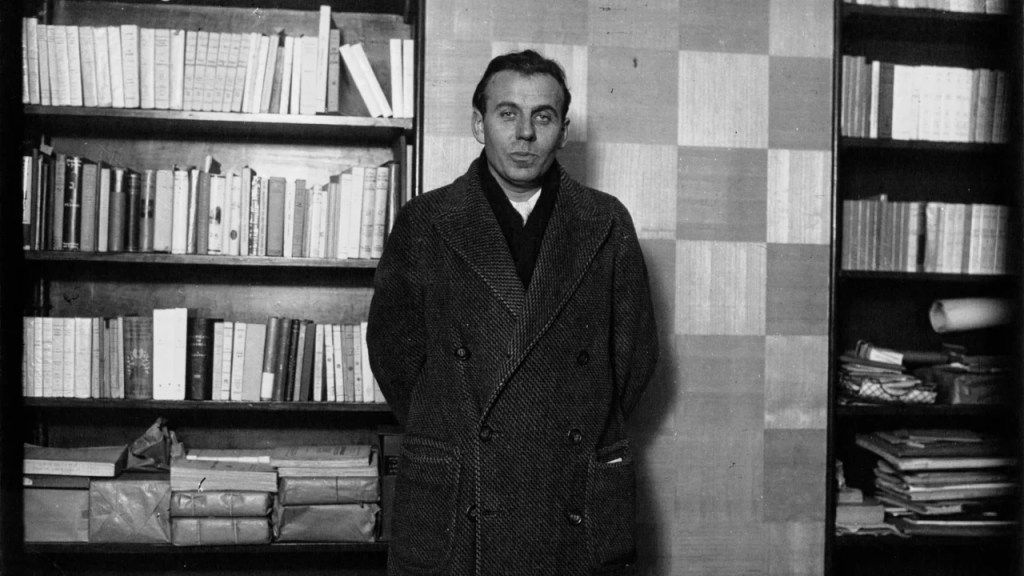
He will never win any humanitarian awards, or, for that matter, any awards, but Louis-Ferdinand Céline is one of the greatest writers of the twentieth century, an anti-Semite, a Nazi sympathizer, and probably a very decent human being otherwise. Born Louis Ferdinand Auguste Destouches in Courbevoix, France in 1894, Céline became a wounded war hero at Ypres in 1914
After the war, he became a physician and toured Africa and the Americas working for the League of Nations. In 1932, he published his greatest and most approachable novel, Journey to the End of the Night (Voyage au bout de la nuit). Unfortunately, in the early 1940s, he published several anti-Semitic books urging closer ties to Hitler’s Germany.
After the Allied invasion of France, Céline fled to Germany after having been identified by the Resistance and the British as a collaborationist. It was the beginning of a long and confused period escaping Allied bombing attacks and the Russian Army that was brilliantly described in his trilogy about being a guest of the Nazis as they were being pounded to pieces:
Castle to Castle (D’un château l’autre) 1957
North (Nord) 1960
Rigadoon (Rigadon) 1961
Years after reading the first two volumes, I have just finished reading Rigadoon and loving it. Céline and his wife are constantly being shuttled on trains from one bombed-out city to another. At one point, he escorts a group of eighteen severely retarded children from Hannover to Hamburg and manages to transfer them to a special Swedish Red Cross train taking them to safety. Unfortunately, the same train took Céline to Copenhagen, where he served a year in prison for his collaboration with the Nazis.
He died in 1961. Although his novels were a powerful influence on other novelists, Céline was never treated with the honor that his literary and medical work deserved. He spent his last years being a doctor treating poor patients in the slums of Paris.
So fair and foul a career I have not seen. I love Céline’s novels even as I detest his racial and political views. Life can be strange.
Here’s a melancholy poem to autumn by e e cummings. Here in Southern California, the trees don’t drop their leaves: They just accumulate dust or burn down. But I remember November from my days in Cleveland and New Hampshire:
cruelly, love
walk the autumn long; the last flower in whose hair, they lips are cold with songs
for which is first to wither, to pass? shallowness of sunlight falls, and cruelly, across the grass Comes the moon
love, walk the autumn love, for the last flower in the hair withers; thy hair is acold with dreams, love thou art frail
—walk the longness of autumn smile dustily to the people, for winter who crookedly care.
I am currently reading William S. Burroughs’s The Ticket That Exploded, and what a ride it is! As Anthony Burgess wrote, “Burroughs seems to revel in a new medium … a medium totally fantastic, spaceless, timeless, in which the normal sentence is fractured, the cosmic tries to push its way through the bawdry, and the author shakes the reader as a dog shakes a rat.” Here is a little sample for your delectation:
In this organization, Mr Lee, we do not encourage togetherness, esprit de corps. We do not give our agents the impression of belonging. As you know most existing organizations stress such primitive reactions as unquestioning obedience. Their agents become addicted to orders. You will receive orders of course and in some cases you will be well-advised not to carry out the orders you receive. On the other hand your failure to obey certain orders could expose you to dangers of which you can have at this point in your training no conception. There are worse things than death Mr Lee for example to live under the conditions your enemies will endeavor to impose. And the members of all existing organizations are at some point your enemy. You will learn to know where this point is if you survive. You will receive your instructions in many ways. From books, street signs, films, in some cases from agents who purport to be and may actually be members of the organization. There is no certainty. Those who need certainty are of no interest to this department. This is in point of fact a non-organization the aim of which is to immunize our agents against fear despair and death. We intend to break the birth-death cycle. As you know inoculation is the weapon of choice against virus and inoculation can only be effected through exposure … exposure to the pleasures offered under enemy conditions: a computerized Garden of Delights: exposure to the pain posed as an alternative … you remember the ovens I think … exposure to despair: ‘The end is the beginning born knowing’ the unforgivable sin of despair. You attempted to be God that is to intervene and failed utterly … Exposure to death: sad shrinking face … he had come a long way for something not exchanged born for something knowing not exchanged. He died during the night.
This will be my last election-related post for a while. Not because I am satisfied with the Trump dictatorship, but because my own personal happiness depends on a positive response to bad government. Most countries go through bad spells, and it was inevitable that, over a long lifetime like my own, I would encounter it at some point.
I am reminded of a quote from Russian Nobel Prize winning poet Joseph Brodsky: “If one is fated to be born in Caesar’s Empire, let him live aloof, provincial, by the seashore….”
Well, I am some 2 miles (3.2 kilometers) from the Pacific Ocean. I do live in the provinces, so to speak, compared to New York City or Washington, DC. And I am becoming increasingly aloof, especially when someone tries to engage me in a political discussion.
Times like these call for a more creative inner life. I will spend more time reading, meditating, and watching classic old movies. And much less time watching late night comics or news on TV. Also, most important, I will spend more time with my friends.
Above all else, DON’T WATCH THE NEWS, at least until Thursday or Friday. The way that news channels make money is by instilling fear, You don’t want that. Read a good book. If you absolutely must watch television, tune in to a channel that has no news—like Turner Classic Movies (TCM).
If you have friends who like to discuss politics, AVOID THEM until the weekend. They will be agitated and all too willing to make you feel as terrible as they do.
DON’T VOTE IN PERSON. You will be in line with hundreds of agitated people; and you may run into people who openly express contempt for your political choices.
STAY AWAY FROM SOCIAL MEDIA. It’s an instrument of the devil and his tools: Zuckerberg, Musk, et al.
Be extra good to yourself and the people you love. Eat foods you like. Once you’ve voted, just distance yourself from the whole process. And whatever you do, DON’T GIVE MONEY TO POLITICIANS. It only encourages them.
Avoid posting political signs or bumper stickers. Stay away from political rallies. Don’t wear any red baseball caps made in China.
You might just want to lock yourself in the closet. It’s going to be a rough week.
Let’s see, the celebrations this last week have come fast and furious:
Halloween (October 31)
All Saints’ Day (November 1)
All Souls’ Day (November 2)
And now:
My Mother’s Birthday (November 3)
It was Sophie Paris’s goal to make it to her 80th birthday. She admired her grandmother, my great-grandmother Lidia Toth, who made it into her mid-eighties. Unfortunately, she died several months short of her 80th birthday in the summer of 1998.
I don’t write often enough about my mother, although I owe my life and much of my happiness to her. She was abandoned by her own parents, so her grandmother and grandfather raised her. Although she was born in the United States, Daniel and Lidia Toth took her and raised her on a farm near Felcsut, Hungary in the Province of Fehérmegye. She returned to the U.S. with them in 1937 as the Nazi menace began to loom throughout Central Europe.
She met my father in Cleveland around 1943 and married him shortly thereafter. I was born in 1945, and Daniel Toth died in that year. Lidia never really liked my father, Alex Paris, and told my mother that, being his son, I should be allowed to die in my crib. In time, my brother and I developed a strong relationship with Lidia, who helped bring us up. With my father, however, it was war from start to finish.
Sophie was about 5 feet (1.525 meters) tall in her stocking feet. To compensate for her short stature, she had an oversized heart and loved my brother and me. That love has been very instrumental in Dan’s happiness and certainly mine.
Today, as Martine and I ate lunch at the Siam Chan in West L.A., we overheard two tattooed and pierced young men talking about getting up enough energy to attend an Alcoholics Anonymous (A.A.) meeting. The streets in our neighborhood are full of bums who suffering from various stages of mental illness and dependency on drugs and alcohol. I realize how lucky we are because of the love of our parents, Alex and Sophie Paris.
So Happy Birthday, Mom. You are not forgotten and never will be.
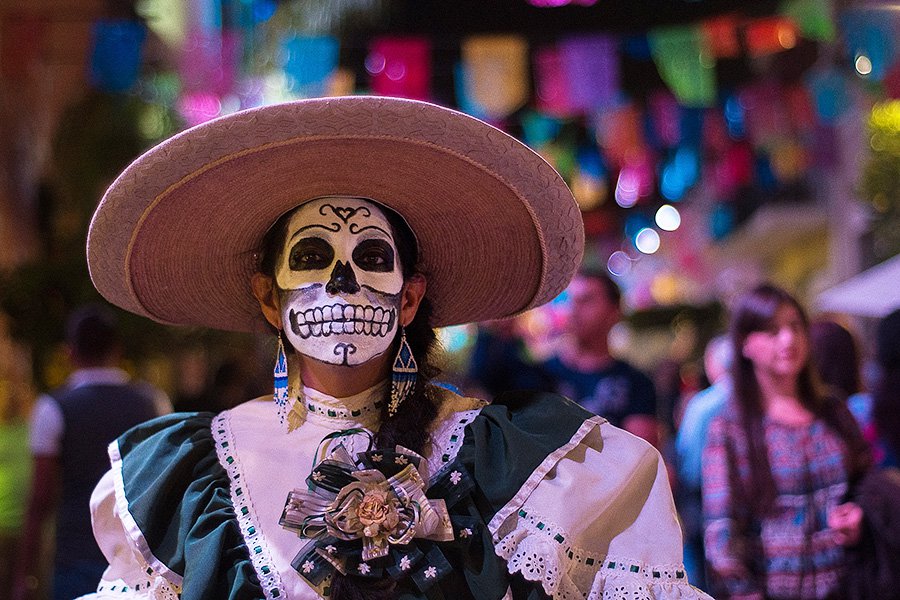
November 2 in the Catholic liturgy is All Souls’ Day, or in Mexico, El Dia de Los Muertos, the Day of the Dead. Here is a poem by Alberto Rios, a Hispanic resident of Arizona.
November 2: Día de los muertos
1
It is not simply the Day of the Dead—loud, and parties. More quietly, it is the day of my dead. The day of your dead.
These days, the neon of it all, the big-teeth, laughing skulls, The posed calacas and Catrinas and happy dead people doing funny things—
It’s all in good humor, and sometimes I can’t help myself: I laugh out loud, too. But I miss my father. My grandmother has been gone
Almost so long I can’t grab hold of her voice with my ears anymore, Not easily. My mother-in-law, she’s still here, still in things packed
In boxes, her laughter on videotape, and in conversations. Our dog died several years ago and I try to say his name
Whenever I leave the house—You take care of this house now, I say to him, the way I always have, the way he knows.
I grew up with the trips to the cemetery and pan de muerto, The prayers and the favorite foods, the carne asada, the beer.
But that was in the small town where my memory still lives. Today, I’m in the big city, and that small town feels far away.
2
The Day of the Dead—it’s really the days of the dead. All Saints’ Day, The first of November, also called the día de los angelitos—
Everybody thinks it’s Day of the Dead—but it’s not, not exactly. This first day is for those who have died a saint
And for the small innocents—the criaturas—the tender creatures Who have been taken from us all, sometimes without a name.
To die a saint deserves its day, to die a child. The following day, The second of November, this is for everybody else who has died
And there are so many, A grandmother, a father, a distant uncle or lost cousin.
It is hard enough to keep track even within one’s own family. But the day belongs to everyone, so many home altars,
So many parents gone, so many husbands, so many Aunt Normas, so many Connies and Matildes. Countless friends.
Still, by the end of the day, we all ask ourselves the same thing: Isn’t this all over yet?
3
All these dead coming after—and so close to—Halloween, The days all start to blend,
The goblins and princesses of the miniature world Not so different from the ways in which we imagine
Those who are gone, their memories smaller, their clothes brighter. We want to feed them only candy, too—so much candy
That our own mouths will get hypnotized by the sweetness, Our own eyes dazzled by the color, our noses by the smells
The first cool breath of fall makes, a fire always burning Somewhere out there. We feed our memories
And then, humans that we are, we just want to move quickly away From it all, happy for the richness of everything
If unsettled by the cut pumpkins and gourds, The howling decorations. The marigolds—cempasúchiles—
If it rains, they stink, these fussy flowers of the dead. Bread of the dead, day of the dead—it’s hard to keep saying the word.
4
The dead: They take over the town like beach vacationers, returning tourists getting into everything:
I had my honeymoon here, they say, and are always full of contagious nostalgia. But it’s all right. They go away, after a while.
They go, and you miss them all over again. The papel picado, the cut blue and red and green paper decorations,
The empanadas and coconut candy, the boxes of cajeta, saladitos, Which make your tongue white like a ghost’s—
You miss all of it soon enough, Pictures of people smiling, news stories, all the fiestas, all this exhaustion.
The coming night, the sweet breads, the bone tiredness of too much— Loud noise, loud colors, loud food, mariachis, even just talking.
It’s all a lot of noise, but it belongs here. The loud is to help us not think, To make us confuse the day and our feelings with happiness.
Because, you know, if we do think about our dead, Wherever they are, we’ll get sad, and begin to look across at each other.
Today is All Saints’ Day, which has become something of a non-event ensconced as it is between Halloween and the Dia de los Muertos (All Souls’ Day).
Growing up as a Catholic in the eastern suburbs of Cleveland, Ohio, I was very aware of the saints. As a reward for good behavior in class, the Dominican sisters at Saint Henry’s would hand out holy pictures. There were so many saints! One of my favorites was Saint Maurice and the Theban Legion. The whole legion was ordered to be put to death by the Emperor Maximian in the 3rd Century for not following his orders to kill Egyptian Christians. If the legion was at full strength, that means 5,000 martyrs for Holy Mother the Church at one fell swoop!
Even though it’s a Holy Day of Obligation (at least I think it still is) requiring attendance at Mass, I¹ve backslid. I’m not even entirely sold on the saints any more … especially after Fra Junípero Serra was canonized by Pope Francis in 2015. Not too many descendants of Indians who were forced to live at the California Missions would agree with his elevation to sainthood.
I wonder how many other saints were outright stinkers.









 Tarnmoor
You must be logged in to post a comment.