It has now been ten years since my last visit to Argentina. Cristina Kirchner was still President of the Republic. I had an itinerary that included a visit to the Foz de Iguazu by the border with Brazil, the Patagonian resort of San Carlos Bariloche, and a bus and boat trip over the Andes to Puerto Varas in Chile.
I revisited the spectacular cemetery at Recoleta where Eva Perón is buried and the port of Tigre by the delta of the Paraná River. On my way to the bus station in Retiro, a serious attempt was made to pick my pocket at a time when I was carrying $2,000 in Argentinean pesos. (I quickly sidestepped to the right and hailed a cab.)
Funerary Statue at Recoleta Cemetery
I got violently ill at a hotel by the Congreso after eating a dubious steak dinner the night before, but I managed nonetheless to catch my bus to Puerto Iguazu and got better after a 10-hour bus ride that passed hundreds of fields where yerba mate was growing.
In sum, it was a great trip. As long in the tooth as I am, I would jump at the chance to visit Argentina again. The long plane ride over the Andes could be brutal, but the country is endlessly fascinating. I especially love Patagonia and Tierra del Fuego.
At the Puerto Iguazu Bus Station
Most Americans have little or no idea of what South America is really like. Over the last twenty years, I have been to Argentina, Chile, Uruguay, Peru, and Ecuador and enjoyed just about every minute of my travels there.
It was appropriate on this Valentine’s Day to see Warner Brothers 1942 classic Casablanca for the umpteenth time. As TV host Ben Mankiewicz said when he introduced the film for tonight’s Turner Classic Movies (TCM) showing, it was the most perfect film produced by the Hollywood studio system.
As a love story, one is not sure until the end whether Rick (Humphrey Bogart) will give the letters of transit for Lisbon to Victor Laszlo (Paul Henreid) and his wife Ilsa Lund (Ingrid Bergman). And will Captain Renaud (Claude Rains) arrest Rick and turn him over to Major Strasser of the Third Reich (Conrad Veidt)?
I have seen Casablanca so many times in my life that it is almost like Holy Writ. Even when Ilsa Lund pleads, “Victor, please don’t go to the underground meeting tonight,” I forgive the clunky line because it is an integral part of a film that I love as is. I even like all the recurrences of “Here’s looking at you kid.”
Sometimes I think one of the things that makes the film great are all the actors from Mitteleuropa that were in the cast, including Peter Lorre, Conrad Veidt, Leonid Kinsky, S. Z. Sakall, Ludwig Stössel, Hans Heinrich von Twardowsky, Trude Berliner, Ilka Grünig, and Wolfgang Zilzer. And don’t forget Hungarian director Michael Curtiz and Austrian music director Max Steiner. It gives the whole “stuck refugee” theme a major boost, with the daily plane to Lisbon and freedom as its ultimate desideratum.
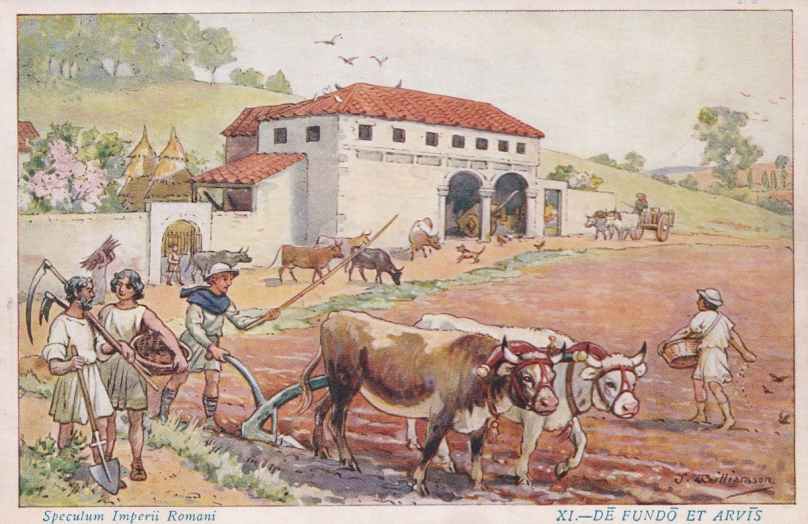
Old School Card Showing Cattle Farming in the Roman Forum
Roughly translated, the title of today’s post is “What has this to do with the cattle of Iphyclus?” or, more loosely, “Let us return tom the subject at hand.”
I am currently reading Sir Walter Scott’s Kenilworth (1821). Scott is famous for starting his novels slowly. I have just read fifty pages of densely packed plotting as Edmund Tressilian gets lost fleeing Cumnor and his horse throws a shoe. He meets up with an old scholar named Erasmus Holiday who converses mostly in Latin and who is delighted to meet anyone with even an imperfect knowledge of the old Romish tongue.
What Tressilian wants, quite simply, is the directions to the nearest blacksmith so he can continue on his way, but Erasmus is not willing to let go of him that easily. Finally, after numerous quotes from Latin classics, he deputes Hobgoblin (aka Flibbertigibbet), the son of his washerwoman, to show him the way to Wayland Smith, the local farrier.
And here we are detained still more by the rumors of said farrier being a tool of the devil as a result of his former association with a local mountebank.
Eventually Tressilian gets to his destination accompanied by Smith, who is now his servant.
There was a time when I would have been upset at the slow development of the story in Kenilworth, but now I am delighted. This is definitely a slow read, requiring frequent consultation with the notes and (yes) a detailed glossary.
In my old age, I now appreciate Scott’s divergence from the subject at hand. He is so damnably erudite and enjoys sharing it with us. Will Tressilian ever rescue the lovely Amy Robsart from the clutches of the evil Richard Varney? Eventually, I’ll find out; but, in the meantime, whether or not the cattle of Iphyclus enter the fray, I will enjoy every minute of this long and painstaking read.
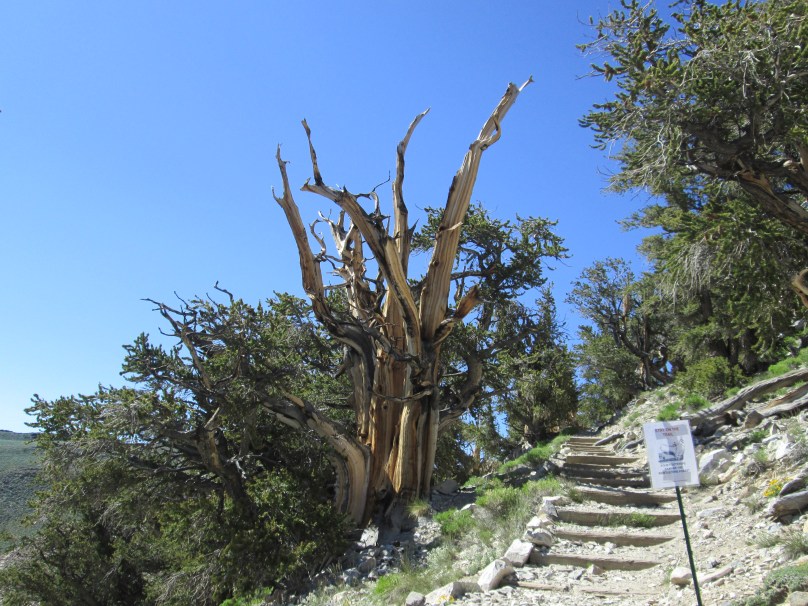
It has been said that the earliest living things on Earth are the Great Basin Bristlecone Pine trees in California’s Ancient Bristlecone Pine Forest within the Inyo National Forest. Martine and I visited the Schulman Grove (Altitude 10,100 feet or 3,078 meters) and its visitor center in 2019.
While there, we hiked along a trail (shown above) where there were numerous Great Basin Bristlecones (Pinus longaeva). Eventually, the altitude started to get to us; so we headed back down.
The most amazing thing we learned of at the visitor center is how scientists have been able, using the comparable annual rings of living and dead Bristlecones found in the same area, to calculate how long the species has been growing in the region. According to research conducted by C. W. Ferguson and D. A. Graybill of the Laboratory of Tree Ring Research at the University of Arizona, they were able to go back as far as 6700 B.C. This is a period of approximately 8,725 years when you add in the 2025 years of the Christian Era..
If you are a Young Earth Creationist who follows the teachings of James Ussher, Bishop of Armagh, who deduced in 1650 that the universe and everything in it was created at Noon on October 23, 4004 B.C., you are out of luck.
Around the time when Ferdinand and Isabella jointly ruled the Kingdoms of Aragon and Castile, there were three independent orders of knights: those of Santiago, Alcántara, and Calatrava. One of the commanders of the Knights of Calatrava, Fernán Gómez, is the feudal overlord of the village of Fuente Ovejuna (“The Well of Sheep”).
When Gómez goes on a rampage of torturing the peasants and raping the women of the village, the villagers resolve to assassinate him—first having promised not to reveal the names of the perpetrators, even under torture. When an investigative judge sent by the monarchy asks for the names of the murderers, all the villagers say, “Fuente Ovejuna did it!” Faced with a conspiracy of silence the villagers are let off the hook.
Around 1612, Spanish playwright Lope de Vega wrote a play called Fuente Ovejuna which memorializes the event.
There have been two interesting examples of similar events in which the unanimity of the populace prevented a judgment against the actual perpetrators.
In 1970, a group of Icelandic farmers took matters into their own hands when a governmental agency planned a dam that would affect a large swath of land along the Laxá River near Lake Mývatn in the north of the country. According to the Reykjavík Grapevine, this is what happened:
More than a hundred farmers officially claimed responsibility for the explosion, which annihilated a small dam in the river on August 25, 1970. The area’s inhabitants were determined to prevent the construction of a much bigger dam, which would have destroyed vast quantities of this natural area, as well as most of the surrounding farmlands.
The upshot was pretty much the same as in the Lope de Vega play:
“What makes the Laxá conflict peculiar is that those who resisted also succeeded,” Grímur says. “The planned dam was never built and the area was saved.” Four years later, parliament passed a law securing the protection of Laxá and Mývatn, contributing to the explosion’s status as “the most remarkable and powerful event in the history of environmentalism in Iceland,” as Sigurður Gizurarson, the bomber’s defence lawyer, put it.
Closer to home is the case of Ken McElroy, a small-town bully who regularly committed crimes against the inhabitants of Skidmore, Missouri, without serving time for his depredations. Until one day in 1981. The Wikipedia entry on McElroy tells the story:
On July 9, 1981, he appeared in a local bar, the D&G Tavern, armed with an M1 Garand rifle and bayonet, and later threatened to kill Bowenkamp [the local grocer].] The next day, McElroy was shot and killed in broad daylight as he sat with his wife Trena in his pickup truck on Skidmore’s main street. He was struck by bullets from at least two different firearms, in front of a crowd of people estimated as numbering between 30 and 46. Despite the many witnesses, nobody came forward to say who shot him. To date, no one has been charged in connection with McElroy’s death.
As I read Lope de Vega’s play, the other incidents came to mind. I found it interesting that they closely mirrored the Spanish events of some 500 years earlier.
British Writer and Poet Walter de la Mare (1873-1956)
I am only now beginning to appreciate the work of Walter de la Mare. As the Poetry Foundation entry on him states, “His complete works form a sustained treatment of romantic themes: dreams, death, rare states of mind and emotion, fantasy worlds of childhood, and the pursuit of the transcendent.” Here is one of my favorite poems of his:
Music
When music sounds, gone is the earth I know, And all her lovely things even lovelier grow; Her flowers in vision flame, her forest trees, Lift burdened branches, stilled with ecstasies.
When music sounds, out of the water rise Naiads whose beauty dims my waking eyes, Rapt in strange dream burns each enchanted face, With solemn echoing stirs their dwelling-place.
When music sounds, all that I was I am Ere to this haunt of brooding dust I came; While from Time’s woods break into distant song The swift-winged hours, as I hasten along.
In the summer of 1977, I joined my parents in Budapest for a visit to locations in Hungary and Czechoslovakia (as it was called then). They flew to Budapest from Hungary, while I flew first to London and bought an Austrian Airlines ticket to Budapest by way of Vienna.
After a few days in Budapest, we decided to take a train to meet my relatives in Prešov in what is now Slovakia. We made our way to the Keleti Pályudvar from where trains went to Košice, where we would be met with our cousin Miroslav driving his trusty Škoda.
This was during the days of Communist rule, when things were a bit disorganized at times. As our train was pulling into the station, we jumped into a first class compartment for six and took our seats. In a few minutes, as the train was departing, another man jumped into our compartment. As it turn out, the man was Romany, a gypsy, or in Hungarian, a cigány.
Central and Eastern Europe are strongholds for many types of racism. So it is not surprising that my father’s first instinct was to grab the interloper by the collar and throw him off the slow-moving train, all the while calling him a büdös cigány (stinking Gypsy).
I sat there shocked not quite knowing how to react. Obviously things were different in this part of the world. This was confirmed for me when we went through a border inspection as we crossed into Czechoslovakia at Čaňa and my father bribed an inspector with a pack of Marlboro cigarettes.
That was an interesting trip. It involved my pretending to be a Hungarian railway worker so that we could use a MÁV (Hungarian State Railways) hostel in Szeged. (My cousin Ilona worked for MÁV in Budapest.) Apparently I was able to carry off the impersonation by grunting whenever spoken to.
Constantinople’s Politics Were Dictated by Chariot Races
Of late, I have become fascinated by literary and historical antecedents of our present divided political situation. In the United States, we have the Blue States versus the Red States. In a post from December 9, 2022, when I wrote about Charles Dickens describing the Blues and the Buffs at a parliamentary election at Eatanswill. One of the most amazing tales on the subject comes from Edward Gibbon’s The Decline and Fall of the Roman Empire when he describes the racing factions of the Hippodrome during the reign of Justinian in the 6th Century A.D. in Constantinople:
Constantinople adopted the follies, though not the virtues, of ancient Rome; and the same factions which had agitated the circus, raged with redoubled fury in the hippodrome. Under the reign of Anastasius, this popular frenzy was inflamed by religious zeal; and the greens, who had treacherously concealed stones and daggers under baskets of fruit, massacred, at a solemn festival, three thousand of their blue adversaries. From this capital, the pestilence was diffused into the provinces and cities of the East, and the sportive distinction of two colors produced two strong and irreconcilable factions, which shook the foundations of a feeble government. The popular dissensions, founded on the most serious interest, or holy pretence, have scarcely equalled the obstinacy of this wanton discord, which invaded the peace of families, divided friends and brothers, and tempted the female sex, though seldom seen in the circus, to espouse the inclinations of their lovers, or to contradict the wishes of their husbands. Every law, either human or divine, was trampled under foot, and as long as the party was successful, its deluded followers appeared careless of private distress or public calamity. The license, without the freedom, of democracy, was revived at Antioch and Constantinople, and the support of a faction became necessary to every candidate for civil or ecclesiastical honors. A secret attachment to the family or sect of Anastasius was imputed to the greens; the blues were zealously devoted to the cause of orthodoxy and Justinian, and their grateful patron protected, above five years, the disorders of a faction, whose seasonable tumults overawed the palace, the senate, and the capitals of the East. Insolent with royal favor, the blues affected to strike terror by a peculiar and Barbaric dress, the long hair of the Huns, their close sleeves and ample garments, a lofty step, and a sonorous voice. In the day they concealed their two-edged poniards, but in the night they boldly assembled in arms, and in numerous bands, prepared for every act of violence and rapine. Their adversaries of the green faction, or even inoffensive citizens, were stripped and often murdered by these nocturnal robbers, and it became dangerous to wear any gold buttons or girdles, or to appear at a late hour in the streets of a peaceful capital. A daring spirit, rising with impunity, proceeded to violate the safeguard of private houses; and fire was employed to facilitate the attack, or to conceal the crimes of these factious rioters. No place was safe or sacred from their depredations; to gratify either avarice or revenge, they profusely spilt the blood of the innocent; churches and altars were polluted by atrocious murders; and it was the boast of the assassins, that their dexterity could always inflict a m mortal wound with a single stroke of their dagger. The dissolute youth of Constantinople adopted the blue livery of disorder; the laws were silent, and the bonds of society were relaxed: creditors were compelled to resign their obligations; judges to reverse their sentence; masters to enfranchise their slaves; fathers to supply the extravagance of their children; noble matrons were prostituted to the lust of their servants; beautiful boys were torn from the arms of their parents; and wives, unless they preferred a voluntary death, were ravished in the presence of their husbands. The despair of the greens, who were persecuted by their enemies, and deserted by the magistrates, assumed the privilege of defence, perhaps of retaliation; but those who survived the combat were dragged to execution, and the unhappy fugitives, escaping to woods and caverns, preyed without mercy on the society from whence they were expelled. Those ministers of justice who had courage to punish the crimes, and to brave the resentment, of the blues, became the victims of their indiscreet zeal; a præfect of Constantinople fled for refuge to the holy sepulchre, a count of the East was ignominiously whipped, and a governor of Cilicia was hanged, by the order of Theodora, on the tomb of two assassins whom he had condemned for the murder of his groom, and a daring attack upon his own life. An aspiring candidate may be tempted to build his greatness on the public confusion, but it is the interest as well as duty of a sovereign to maintain the authority of the laws. The first edict of Justinian, which was often repeated, and sometimes executed, announced his firm resolution to support the innocent, and to chastise the guilty, of every denomination and color. Yet the balance of justice was still inclined in favor of the blue faction, by the secret affection, the habits, and the fears of the emperor; his equity, after an apparent struggle, submitted, without reluctance, to the implacable passions of Theodora, and the empress never forgot, or forgave, the injuries of the comedian. At the accession of the younger Justin, the proclamation of equal and rigorous justice indirectly condemned the partiality of the former reign. “Ye blues, Justinian is no more! ye greens, he is still alive!”
Back when I was a toddler in my crib at 2814 East 120th Street in Cleveland, my mother used to tell me stories in Hungarian to help me drop off to sleep. When the stories were her own, they usually involved a fairy princess and a dark forest. But when she was running out of ideas, she would take out children’s story books from the city library on East 116th Street and translate the story into Hungarian while showing me the pictures.
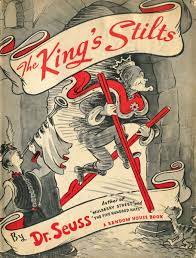
One of them I remember very clearly was Dr. Seuss’s The King’s Stilts. Picture to yourself a kingdom that was below sea level, surrounded by tall dikes covered with trees. These trees were constantly under attack by flying nizards, which went after the roots.
Fortunately, there were legions of patrol cats (P.C.s) deputed by King Birtram to keep the nizards from destroying the trees and flooding the kingdom. When not busy signing proclamations, the king delighted to whizzing around his kingdom on a pair of red stilts.
One day, wicked Lord Droon decided to have the king’s stilts buried by Eric, the royal page, because he thought it was too infra dig for the monarch to be enjoying himself so much. The king was thereupon so despondent that he no longer gave orders to the patrol cats, and the nizards’ attacks were resulting in streams of water flooding into the kingdom.
Fortunately the story has a happy ending. Here, on YouTube, is the Dr. Seuss book, complete with words and pictures:
Naturally, I own a copy of the book. It is a constant reminder of my mother’s ingenuity and love.











 Tarnmoor
You must be logged in to post a comment.