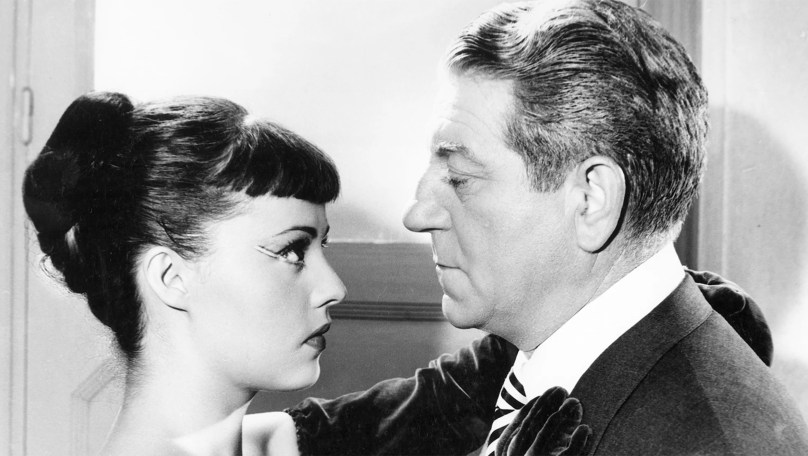
Jeanne Moreau and Jean Gabin in Touchez pas au grisbi
Last week I saw a great film on Turner Classic Movies’ “Noir Alley.” It was Jacques Becker’s 1954 film Touchez pas au grisbi starring Jean Gabin, one of the all-time great actors of the French Cinema. What made him great was the opposite of what makes most American film actors today look cheesy and fake.
It all relates to what is known in cinema as the Kuleshov Effect, an experiment made by Lev Kuleshov and other Soviet filmmakers. Here is how Wikipedia describes it:
Kuleshov edited a short film in which a shot of the expressionless face of Tsarist matinee idol Ivan Mosjoukine was alternated with various other shots (a bowl of soup, a girl in a coffin, a woman on a divan). The film was shown to an audience who believed that the expression on Mosjoukine’s face was different each time he appeared, depending on whether he was “looking at” the bowl of soup, the girl in the coffin, or the woman on the divan, showing an expression of hunger, grief, or desire, respectively. The footage of Mosjoukine was actually the same shot each time. Vsevolod Pudovkin (who later claimed to have been the co-creator of the experiment) described in 1929 how the audience “raved about the acting … the heavy pensiveness of his mood over the forgotten soup, were touched and moved by the deep sorrow with which he looked on the dead child, and noted the lust with which he observed the woman. But we knew that in all three cases the face was exactly the same.”
Kuleshov’s Experiment
In today’s Hollywood, on the other hand, actors tend to overdo the mobility of their facial expressions. Add to that the fact that, when they act the part of a tough guy, they are bearded, scraggly, and tattooed.
Compare that to the acting of Jean Gabin in Touchez pas au grisbi. He always looks the same, dapper and somewhat atone-faced. This is equally true when he is romancing dance hall girls or pumping lead into a rival gangster who wants the gold bars (the grisbi, or loot) he stole in an earlier robbery. One of the reasons, I think, for the popularity of Clint Eastwood is that he acts tough without hamming it up.
Yesterday, I drove 100 miles to the city of Temecula, midway between Riverside and San Diego on Interstate 15. My niece Jennifer Duche was being married to her boyfriend John Margolis at the Falkner Winery east of the city.
The wedding ceremony itself was short and sweet; but as we waited for the outdoor reception to begin, a cold wind from the west set us all to shivering. I was just recovering from a cold from the week before, so I decided to leave before dinner was served.
So instead of tri-tips with chimichurri, I stopped at an In-N-Out Burger in town on my way back to the motel. At least I think I was spared from a relapse.
Temecula is a weird town surrounded by picturesque wineries and neo-Spanish architecture. Most of the restaurants were from regional or national chains. My hotel was brand new, full of elegant suites; and I think I was the only tenant.
The important thing was that I was there to wish Jen and John a good start to their married life together.
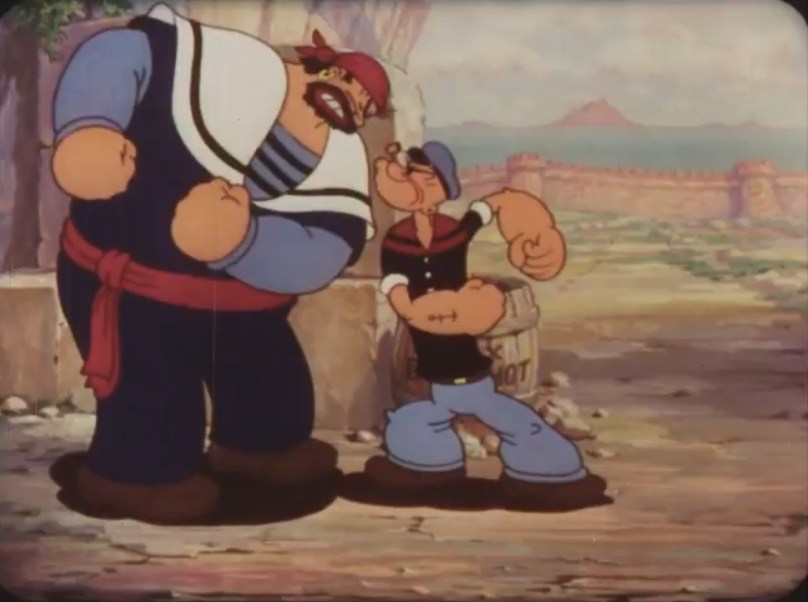
Bluto and Popeye in Popeye the Sailor Meets Sinbad the Sailor
Okay, I know it doesn’t make any sense, but I love it. There’s a sixty-ish grizzled sailor, his beanpole girlfriend, a dark muscle-bound bear of a human, and occasionally this guy who has a voracious hunger for hamburgers (but no cash). The run of the Max and Dave Fleischer Popeye cartoons includes some 108 films from 1933 to 1942.
My favorites are the following three color two-reelers, which have classical Arabian Nights settings:
Of course, I also love all the black and white one-reelers. The usual plot comes down to a fight between Popeye and Bluto, usually over the hand of Olive Oyl, which Popeye wins after he opens a can of spinach and thrusts the contents down his throat. As for Olive, she is typically torn over Popeye and Bluto; but she has no trouble accepting the winner of the fight.
Here is one of my favorite black-and-white cartoons, “The Paneless Window Washer” (1937), which features Popeye and Bluto as duelling window-washers, with Olive the usual prize to the winner:
It’s all pretty old, probably the oldest being the socks, which I bought half a century ago and are still going strong. (As you may have guessed, I am no fashion plate.)
The Archbishop’s Enclosed Garden in Mérida, Yucatán
Do you ever really use your front lawn? There you are, in full view of wandering passersby and the occasional hobo. You feel self-conscious and even slightly stupid—unless you are doing yard work.
Take a look at the above courtyard, which is surrounded on all sides by the Mérida, Yucatán archbishop’s palace. It was a hot, humid day; yet the garden was cool with comfortable benches in the shade. I took advantage of the benches before seeing the rest of the art museum that the archbishop’s palace has been turned into.
I love the Mexican houses that have no setback from the street, instead enclosing a private courtyard that is in actuality the heart of the house. Of course, there are laws that prevent such a thing in the United States. Hence all those front lawns that are thirsty for water and fertilizer and are never used for the pleasure of the family within.
Granted, the archbishop had the means to have something special built for him; but I have seen scores of small gardens in more modest Mexican houses, including many of the small hotels at which I have stayed. In many cases, they are used as bars or simple restaurants.
Sometimes I think that the water shortages in California and other desert states could be alleviated simply by getting rid of those front lawns that attempt to imitate an English country house. California is not England, nor is it the Eastern U.S.
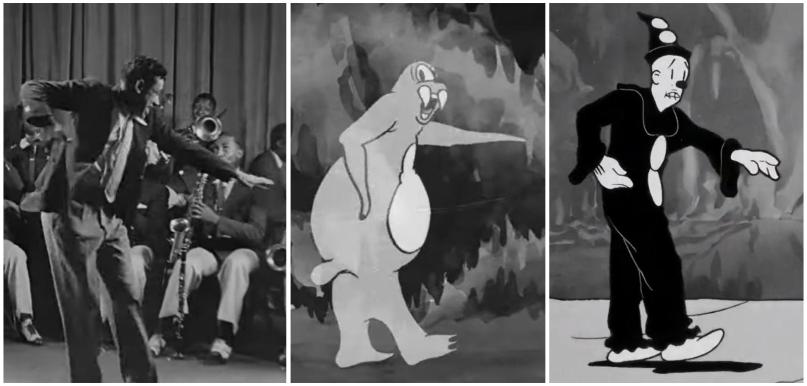
As I hinted in yesterday’s post, I am not done with posting about the cartoons of Max and Dave Fleischer. Among my favorites were the Betty Boop cartoons with music (and dancing) supplied by Cab Calloway and His Orchestra. In 1832 and 1933, Calloway worked with the Fleischers and three or four Betty Boop cartoons.
The reason I say there were three or four cartoons partnering Cab Calloway with Betty Boop was that there is a separately titled segment of Snow-White entitled St James Infirmary Blues.
None of these films could be regarded as suitable for children. (That also goes for Poor Cinderella, about which I posted yesterday, and in which Betty is in the street wearing nothing but bra and panties). In both Snow-White and St James Infirmary Blues, we see Betty in a glass coffin whose pallbearers are the seven dwarves, followed by the evil queen and Ko-Ko and Bimbo.
Even worse is The Old Man of the Mountain, whose villain is a bearded dirty old ogre who chases Betty Boop down the mountain with lascivious intent, at one point ripping off her dress.
Today we can see all the Walt Disney cartoons (except maybe Song of the South) most any time we want. The same goes for the Warner Brothers classics with Bugs Bunny, Daffy, Porky Pig, Tweety and Sylvester, and Wile E, Coyote. Even Walter Lantz (Woody Woodpecker) and Hanna-Barbera are all around us.
But the cartoons I most love to see were produced by the Fleischer brothers, Max and Dave. They were best known for their Popeye cartoons , but their work included an animated Superman, Betty Boop, Ko-Ko the Clown, and a whole host of other creations. Unlike Disney cartoons, those by the Fleischers included mostly human characters.
One of my favorites is a Betty Boop cartoon called Poor Cinderella (1934)—her only appearance in color. The cartoon was based on a hypnotic song of the same name that recurs through the cartoon. At one point, an animated Rudy Vallee is shown singing it.
Here, for your enjoyment, is the cartoon itself:
In the coming weeks, I will provide links to other Fleischer Brothers products. I have always loved them and delight in sharing them with you.
It was September 1958. I had just entered high school and been introduced to my English teacher, the Rev. Gerard R. Hageman, S.M.—a Catholic priest of the Marist order. He was incredibly strict. We had frequent quizzes in which one could only get two possible grades, 100 or 0 (Z-e-r-o). And the numerical grades were averaged out.
Father Hageman had created a one-page mimeographed summary on yellow paper of jis “Random Rules of Grammar and Style.” I will present you with two excerpts. The first are the rules which call for commas. This was abbreviated to D SAPS DT C CINQ MOC. The letters stood for: Direct address, salutation, appositives (I have since forgotten what those were), parentheticals, series, dates (city and state), titles after names, compound sentences, contrasting ideas, introductory adverbial clauses, non-restrictives, direct quotations, mild interjections, omitted words, and common sense.
Here are three random rules from the yellow sheet:
Pronouns are weak. If used, they must have clear and definite antecedents.
Introductory participles, infinitives, and gerund phrases must refer to the subject; and the subject must come immediately after.
Nouns and pronouns used as modifiers of gerunds are in the possessive case.
Imagine the impact on a thirteen-year-old boy and the threat of a zero score for any single violation of the rules.
Father Hageman was relentless. But, you know what? I still follow his rules religiously. The young student who wanted to be a nuclear physicist wound up preferring writing and, maybe, becoming an English teacher.
Unfortunately, Father Hageman returned to the Marist college in Atlanta, where he died suddenly on January 1, 1961. I wish I had a picture to show you, but that was years before the Internet.
In a 2018 interview with the then Catholic bishop of Atlanta, Joel M. Konzen, S.M., the interviewee noted:
All of us who went to Josephinum had a wonderful education there, but particularly wonderful in English. Writing and languages were highly emphasized at the Josephinum in that day. We had a wonderful teacher, Msgr. (Leonard J.) Fick. I think that anyone who went there would tell you the same thing. …
It was … kind of what they say about Father (Gerard) Hageman at Marist, that if you ever had either of those, you knew you were good to go in terms of writing and so I liked to write.









 Tarnmoor
You must be logged in to post a comment.