The Alabama Hills

Hundreds of Hollywood Films Were Shot in the Alabama Hills

If you take California 14 from Los Angeles through the Antelope Valley to the end, you will find yourself on U.S. 395 near China Lake and Ridgecrest. In another hour or so, you will pass the turn-off for Death Valley in Olancha and soon afterwards the little town of Lone Pine.

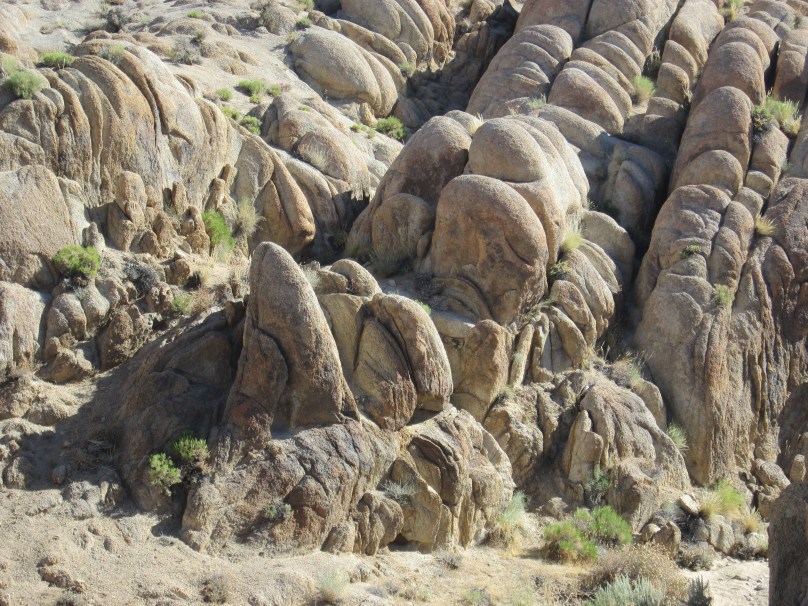
Just west of Lone Pine, along the road that takes you to the Whitney Portal, are the Alabama Hills, which if you have seen as many films as I have, may be surprisingly familiar to you. That is because literally hundreds of scenes in Hollywood films were shot there, Here is a short list:

  • Gladiator (2000)
  • Django Unchained (2012)
  • Tremors (1990)
  • The Great Race (1965)
  • Bad Day at Black Rock (1955)
  • How the West Was Won (1962)
  • Gunga Din (1939)
  • Around the World in 80 Days (1956)
  • The Ox Bow Incident (1942)
  • High Sierra (1941)
  • Greed (1924)
  • Ride Lonesome (1959)
  • Three Godfathers (1948)
  • Samson and Delilah (1949)

If you should find yourself driving up that lonely Eastern Sierra highway, you might want to spend an hour or two taking the Alabama Hills loop road and seeing the sights. You can find out more if you should eat breakfast or lunch at the Alabama Hills Cafe in Lone Pine, probably the best eatery for a radius of a hundred miles.

Also highly recommended is the town’s Museum of Western Film History, which memorializes the Westerns shot in the Alabama Hills area.

Surgery

Daily writing prompt
Have you ever had surgery? What for?

I have had surgery three times in my life. The major one was removal of my pituitary gland, which was eaten up by a benign tumor. Then I had my left hip replaced with a titanium joint due to severe osteoarthritis. Finally, I had cataract surgery in both eyes. All three procedures markedly improved my life. (It helped that I was very picky about my doctors.)

To Treasure Island

N. C. Wyeth Illustration of Blind Pew

Argentinian poet Jorge Luis Borges was a big admirer of Robert Louis Stevenson (as am I). The above illustration of the old pirate Blind Pew by N. C. Wyeth was for a 1911 edition of Stevenson’s Treasure Island. Here is a poem by Borges on the subject of the character who dominates the first chapter of the book:

Blind Pew

Far from the sea and from the lovely war
(For so love praises most what has been lost),
This blind, foot-weary pirate would exhaust
Road after English road or sodden moor.


Barked at by every dog from every farm,
Laughingstock of the young boys of the village,
He slept a poor sleep, trying to keep warm
And freezing in the black dust of the ditches.


But in the end, on far-off golden beaches,
A buried treasure would be his, he knew;
This softened some the hardness of his path.
You are like him—on other golden beaches


Your incorruptible treasure waits for you:
Immense and formless and essential death.

My Libraries

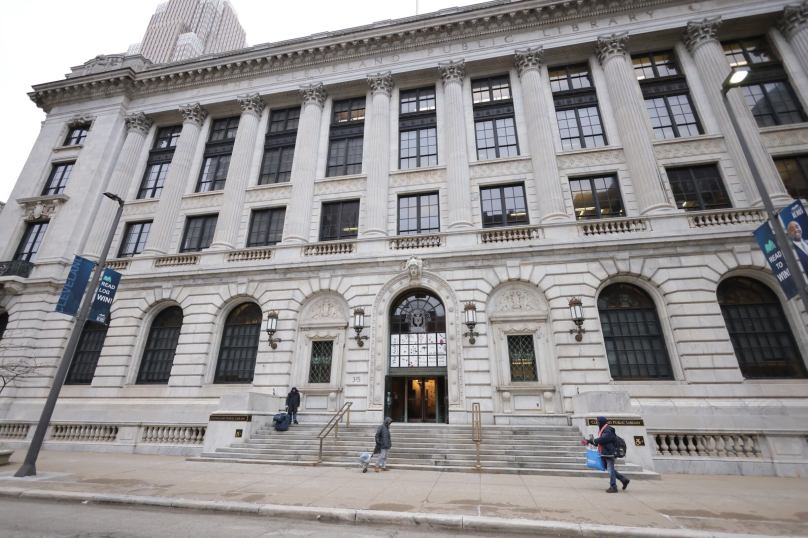
The Main Branch of the Cleveland Public Library Downtown

Books and libraries have always played an important part in my life.

When I was a toddler, my mother took me to the branch of the Cleveland Public Library on East 109th Street (now Martin Luther King Drive). Not that I could read, but I could indicate based on the illustrations the books I would be most interested in. She would check them out and read them to me in Hungarian, probably embroidering a bit. The one book I remember from that period was Dr. Seuss’s The King’s Stilts, which I now have in my collection.

In 1951, after my brother Dan was born, we moved to the Lee-Harvard Area on the East Side of Cleveland. For many years, I went to the Lee-Harvard branch which was located on Lee Road, first north of Harvard, and then south of it. The head librarian was a fellow Hungarian, Mr. Matyi, who played the oboe in the Cleveland Philharmonic Orchestra.

During my college years at Dartmouth, I spent many hours at Baker Library, which was modeled after Independence Hall in Philadelphia. What I loved most about it were the frescoes in the reserve room that were painted in the 1930s by José Clemente Orozco.

Jose Clemente Orozco, Murals at Baker Library Reading room, Dartmouth College, Hanover NH; The Machine

Once I moved to Los Angeles, I spent some time at the UCLA University Library, but I liked going to the main branch of the Santa Monica Public Library—which satisfied me until an opportunity opened up with the construction of the E (for Expo) Line of the Metro Rail. Driving and parking downtown was always a major pain. But now I was able to whiz downtown for 35 cents in three quarters of an hour.

I am now hooked on the Central Branch of the Los Angeles Public Library. Not only because of the library’s holdings, but various events sponsored by the library, especially the guided Thursday mindful meditation sessions.

The one library I forgot to mention is my own personal library of some 6,000 volumes, which I am slowly trying to thin by donations.

Bending Time and Space

It was not until I retired at the end of 2017 that I had any control over my life. First it was my parents, who exercised a mostly benign control over my life. That then shaded into my work life, where for over forty years I felt stressed working for a couple of egomaniacal bosses.

Suddenly, at the beginning of 2018 I was finally able to do what I wanted. Mostly, that entailed extra time for reading and catching up on hundreds of classic movies I had always wanted to see. It would have been perfect if I were able to travel more, but that requires money; and money is always in short supply when one is on a fixed income.

Just before retirement, I started going to the mindful meditation sessions at the L.A. Central Library. Every Thursday—except during the Covid epidemic—there was a free 30-minute mindful meditation session guided by a trained member of UCLA’s mindfulness education center.

I suddenly felt space opening up in my life. Even when I was waiting in the doctor’s office or stuck at a long traffic light, I no longer felt stressed. During these interstices in my life, I would use the time to relax totally while still being attentive to my surroundings. (Compare this to those poor souls who try to relax with a smart phone in their hands.) And I didn’t even hat to sit in some uncomfortable lotus posture.

Previously, I had been prey to insomnia. Now as soon as I slip under the covers, I take three deep breaths, inventory how relaxed I feel from the top of my head down to my toes, and slowly think about my breathing as I drop off to sleep.

At the age of eighty, I’ve never felt happier. I know very well that I am in the endgame of my life. Hard times lie ahead, but I feel stronger and more able to weather them.

Agenbite of Bookwit

I find myself rereading books more often, sometimes by design, but more often by accident. For instance, I am reading the L.A. Central Library’s copy of Lawrence Ferlinghetti’s Writing Across the Landscape: Travel Journals 1960-2010. As I started reading it yesterday, I noticed the same light pencil marks I used to mark passages. “A kindred spirit,” was the first thought that crossed my mind. Then, when I loaded Goodreads.Com, I noticed that I wrote a review of the book in 2023. The stray marks were, in fact, mine. A kindred spirit, indeed!

Here are the books that I have reread so far this year, with the ones I have accidentally reread marked with an asterisk:

  • Lawrence Durrell: Balthazar, Mountolive, and Clea (the last three volumes of The Alexandria Quartet)
  • Lope de Vega: Fuente Ovejuna
  • Tom Bissell: Chasing the Sea: Lost Among the Ghosts of Empire in Central Asia *
  • Joseph Wood Krutch: The Desert Year *
  • César Aira: The Famous Magician *
  • Clifford D Simak: A Choice of Gods *
  • Georges Simenon: Maigret and the Good People of Montparnasse
  • Carlos Castaneda: Tales of Power

The funny thing is that I have enjoyed the rereads as much as the first-time reads, even when they were accidental.

I keep a log of 99+% of the books I have read since 1972. When I choose a book to read, I don’t always check the three data files—one a PDF and the other two Excel spreadsheets—which log all several thousand books I have read in the interval. Sometimes, I notice when rereading a book that I have somehow changed in some small or large particular.

For instance, I used to be a big fan of Jules Verne, even some of his lesser-known works. But when I reread From Earth to the Moon and Round the Moon a few years ago, I was disappointed. Perhaps I’ll reread 20,000 Leagues Under the Sea—my favorite among his works—to see how it plays now.