Although the Chinese language is a formidable obstacle to understanding the poetry written in it, there are some Chinese poets whose thoughts nonetheless ring clear. Such is Du Fu (aka Tu Fu), who wrote some thirteen hundred years ago. The name of the poem in today’s blog is:
Restless Night
As bamboo chill drifts into the bedroom, Moonlight fills every corner of our Garden. Heavy dew beads and trickles. Stars suddenly there, sparse, next aren’t.
Fireflies in dark flight flash. Waking Waterbirds begin calling, one to another. All things caught between shield and sword, All grief empty, the clear night passes.
The question makes it seem as if spirituality were something apart from my life. If spirituality is a stranger to you, your life is impoverished to say the least.
The Main Square of Acanceh, Yucatán … With Pyramid
During my magical first trip to Yucatán in November 1975, I decided to hire a guide. I could have gone to a fancier tour office, but I settled on Turistica Yucateca on a Mérida side street. I wish I could remember the name of the owner who didn’t speak a word of English, just as I didn’t speak a word of Spanish. No matter, if you want to communicate, you will; and you will be understood, more or less.
The señora at Turistics Yucateca set me up with an English-speaking guide named Manuel Quiñones Moreno who had access to a car for two days of travel. Instead of going at first to the big Maya sites such as Uxmal or Chichén Itzá, I decided to “start small” by spending some time at Dzibilchaltún on the first day and then going to Mayapan the next day.
After touring Dzibilchaltún, Manuel and I sat down at the entrance to the ruins and played chess. I lost two games in quick succession to Manuel and decided he was several levels better than me.
The next day we drove to Acanceh, where we ate lunch on the zócalo in view of the pretty church and a Mayan pyramid. Then we drove to the late Maya ruins at Mayapan, when much of the peninsula was under the control of a militaristic government which was still in existence when the Spanish arrived.
When I was last in Mérida, I inquired if Manuel Quiñones Moreno was still around. Apparently, he was; and he was still a tour guide a quarter of a century later, though now based in Uxmal. I tried to contact him there, but he was not available when I called.
To begin with, I am deeply skeptical of most self-care claims. In the end, I tend not to stray too far from the middle path, going for variety more than super-foods and trendy exercise regimens.
One of the things I love most about Los Angeles are all the nationalities with their delicious cuisine. Today, Martine, my brother Dan, and I drove to the Jitlada Restaurant in East Hollywood’s Thai Town. It’s located in a downmarket L-shaped streetcorner mall with obvious parking problems. I’d been to the restaurant twice before—each time having a memorable meal.
Third time’s a charm. My spicy jungle curry with catfish and eggplant was spicy enough to burn a hole in concrete, and my brother’s scallops with eggplant was superb. Because she can’t handle spicy, Martine had chicken satay and a mango smoothie. For desert we all had different coconut ice cream preparations.
A typical Jitlada Curry
You may think you’ve had Thai food before, but owner Jazz Singsanong’s Southern Thai cuisine is the real thing. Not for nothing does the Jitlada appear year after year in all the lists of the best restaurants in Los Angeles. It now even sports a mention from the Michelin Guide. It easily deserves sit and more.
There are two menus, a green one where you can specify how spicy you want your dish, and a white menu which is spicy whether you will or not. Irrespective of your food tolerances, you can have a supremely satisfying meal at Jitlada.
If you’re interested you should take a look at the menu.
Since I was raised in a Hungarian family, I would have to say Magyar Étel (Hungarian Food), such as stuffed cabbage, stuffed peppers, cabbage noodles, kólbasz sausage, and an endless variety of fresh, delicious, homemade soups. And then there was the pastry ….
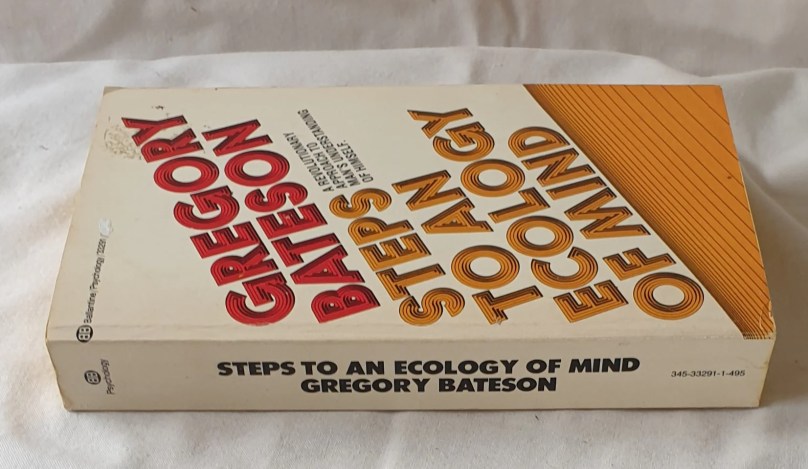
On June 15, I posted about the effect that the Whole Earth Catalog (WEC) series by Stewart Brand has had on me. And I promised that I would present a series of some of editor Brand’s more interesting comments. This is his take on Gregory Bateson’s Steps to an Ecology of Mind, which was first published in 1972. I had never read the book, but found it was influencing a number of my friends who were film historians and film critics. Now, I think I will find the book and read it.
Here is what SB (Stewart Brand) wrote about it:
Bateson has informed everything I’ve attempted since I read Steps in 1972. Through him I became convinced that much more of whole systems could be understood than I thought—that mysticism, mood, ignorance, and paradox could be rigorous, for instance, and that the most potent tool for grasping these essences—these influence nets—is cybernetics.
Bateson is responsible for a number of formal discoveries, most notably the “Double Bind” theory of schizophrenia. As an anthropologist he did pioneer work in New Guinea and (with Margaret Mead) in Bali. He participated in the Macy Foundation meetings that that founded the science of cybernetics but kept a healthy distance from computers. He has wandered thornily in and out of various disciplines—biology, ethnology,, linguistics, epistemology, psychotherapy—and left each of them altered with his passage.
The book chronicles the journey. It is a collection of his major papers, 1935-1971. In recommending the book I’ve learned to suggest that it be read backwards. Read the recent broad analyses of mind and ecology at the end of the book and then work back to see where the premises come from.
In my view Bateson’s special contribution to cybernetics is in exploring its second, more difficult realm (where the first is feedback, a process influencing itself, what Bateson calls “circuit,” and the second is the meta-realm of hierarchic levels, the domain of context, of paradox and abundant pathology, and of learning).
I was only about four or five years old when I fell hard for Joycey, like me a Hungarian in the Buckeye Road Hungarian neighborhood. Just to show you how sophisticated a lover I was at the time, I was particularly entranced by the crooks of her knees.
It was a perfect day to visit Burton Chace Park on its little peninsula in Marina del Rey. The mercury was rising, I was in the middle of an Icelandic mystery by the masterful Arnaldur Indriðason, and I missed the cool sea breezes that characterize the park, even when no one else experiences them. So I stopped first at Bay Cities Italian Deli & Bakery for one of their famous Godmother sandwiches and a soda and took them with me to the park.
On weekdays, visitors to the park could park for free for up to 90 minutes by the parking meters.
As usual, the park was full of hungry squirrels and loud crows. I’ve always liked them. They were good company for a bookworm like me, unlike the bums and spare change artists whom I avoided like the plague. Fortunately, they were not in evidence today.
After an hour and a half, I returned home feeling fresh. Martine was gone out for a walk, so I warmed up some of my potato and spinach curry and served it with a dollop of plain yogurt.
Unfortunately, some of the rich turmeric-laden sauce dripped onto my shirt. Turmeric is one stain that does not come out easily. Sigh!
At Los Arrayanes National Park in Argentina’s Lake District
It’s one of the smallest national parks in Argentina, being wholly contained within 6.77 square miles (17.53 square kilometers). I rode out there on Lago Nahuel Huapi on a beautiful Glasgow-built steamship called the Modesta Victoria and wandered for a couple of hours among the beautiful Arrayán trees (Luma apiculata) with their cinnamon-colored bark.
The Modesta Victoria on Lago Nahuel Huapi
The little national park was one of the highlights of my 2015 visit to Argentina and Chile. There is a myth that the color of the trees inspired Walt Disney in designing the look of the forest for Bambi (1942). I don’t know whether Walt traveled to Argentina or saw some pictures—or indeed whether he or any of his animators were even aware of the place.
One thing for sure, there are no Arrayán trees (aka Chilean Myrtles) naturally growing in the United States.











 Tarnmoor
You must be logged in to post a comment.