


Imagine a combination of Robert Redford and Brad Pitt. Throw in Paul Newman’s blue eyes. (He was from Cleveland like me.) Think of an exciting life of race-car driving and climbing the Southern Andes. That, in a word, is not me. I am too ordinary for words.
Monthly Archives: July 2025
Hap

English Poet and Novelist Thomas Hardy (1840-1928)
He was a great novelist, but then gave it up and became a great poet. Alas, we do not recognize him as such, but I think in time people will realize his greatness.
Hap
If but some vengeful god would call to me
From up the sky, and laugh: “Thou suffering thing,
Know that thy sorrow is my ecstasy,
That thy love’s loss is my hate’s profiting!”
Then would I bear it, clench myself, and die,
Steeled by the sense of ire unmerited;
Half-eased in that a Powerfuller than I
Had willed and meted me the tears I shed.
But not so. How arrives it joy lies slain,
And why unblooms the best hope ever sown?
—Crass Casualty obstructs the sun and rain,
And dicing Time for gladness casts a moan. . . .
These purblind Doomsters had as readily strown
Blisses about my pilgrimage as pain.
The Oldest Book in My Collection
It was September 1962. I was 13½ years old, and newly enrolled as a freshman at Chanel High School in Bedford, Ohio. The school was a Catholic school and taught by the Marist Fathers, who lived in a community on the top floor of the high school building.
Probably the strangest (to me) course in my first year was Latin 1, in which we studied Julius Caesar’s The Gallic Wars in the original Latin.
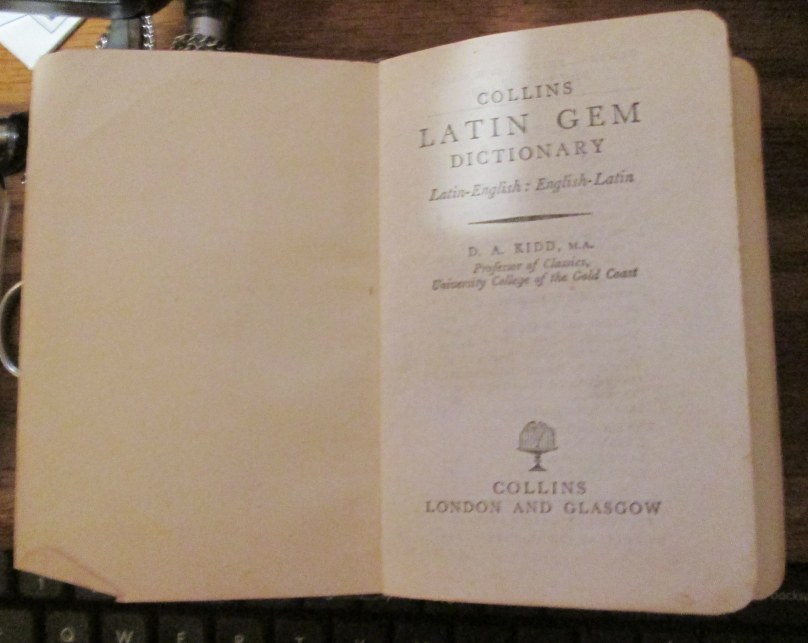
Most of the kids from wealthier families picked up a copy of Cassell’s Latin-English dictionary, but I chose instead to get the Collins Latin Gem Dictionary, which could fit in my shirt pocket. (Eventually, I also got the White’s Latin Dictionary, which looked to have been originally published in the 1800s.)
My Collins Latin Gem Dictionary is still in good condition and still eminently usable. The nice thing about Latin is that books in and about the Latin language never go out of date.
Omnia Gallia in tres partes divisa est.
Typical


I would say it was more typical of a Monday; but, as I had to drive Martine to a doctor appointment in Lakewood yesterday, my weekly schedule has shifted by one day. So I prepared a big pot of Cuban black beans and rice, which turned out delicious.
Self-Description


I’m a seeker after truth.
Honoring the Ancestors
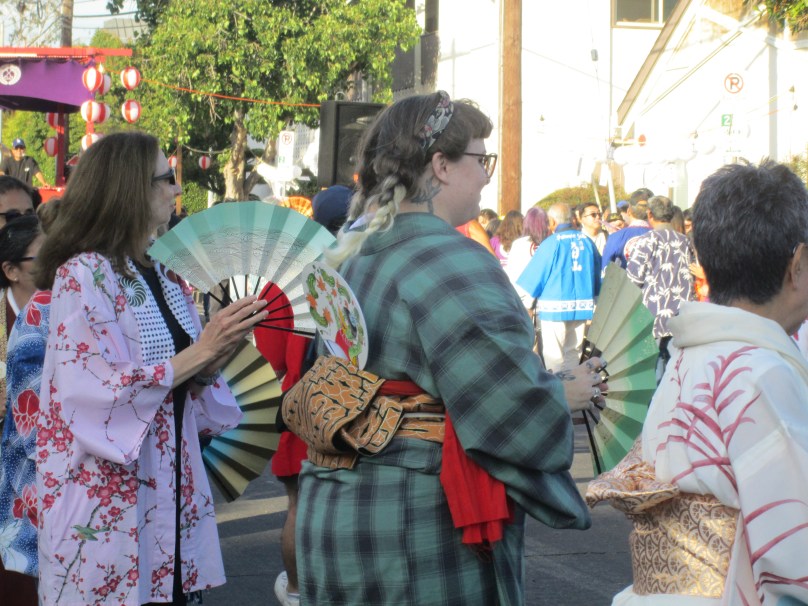
Non-Japanese Participants in the Obon Dances
For the first time since before the Covid-19 closures, Martine and I attended the West Los Angeles Buddhist Temple’s Obon celebration yesterday. In Southern California, the various Buddhist temples take turns in offering an Obon celebration. Many of the participants that we saw included families from the Venice, Nishin (downtown L.A.), Gardena, Orange County, San Fernando Valley and various other hongwanjis that spend weekends traveling from one celebration to the next—as the celebrations are designed not to interfere with one another.
Again, the Men’s Club at WLA provided their superior udon noodle soup, which I enjoyed with some Japanese chili powder (togarashi) for extra flavor. Missing was the sushi booth, which I patronized in previous years.
In many of the posts I have written about ethnic festivals, I have rued the steady decline as various ethnicities become more attenuated to the hamburger and french fry mainstream of American culture. This does not seem to be the problem with the Obon festival we attended. Many of the participants dancing and wearing kimonos and happi coats represented either mixed families or all white families.
Apparently, the WLA Buddhist temple is very attractive to refugees from some of the nastier Christian denominations. According to their website:
We are a Jodo Shinshu Pure Land Buddhist temple located in the heart of Sawtelle Japantown in the West Los Angeles area of Southern California. We are an inclusive community welcoming of all people, regardless of age, ethnicity, gender, sexual orientation, etc.
That inclusive attitude seems to have borne fruit. I’m happy, at any rate, at least as long as the Men’s Club continues cooking up their udon soup.
The Most Influential Books in My Life

The following is a re-post from ten years ago. I still feel the same way about all these titles.
These are not necessarily the greatest books I have ever read. They are, however, the ones that have most influenced me. Each of them, I have read multiple times, and I first read them all before 1985. I have presented them here in alphabetical order by author:
- Anonymous. Njals Saga. Why haven’t more Americans read this book? It tells of a time when Iceland was governed by clans, and justice was crude but effective. It’s one of two Icelandic sagas that have a museum dedicated to them. The Njals Saga museum is in Hvöllsvollur, and I have visited it twice. The other honors Egils Saga and is located in Borgarnes.
- Balzac, Honoré de. Old Goriot. How does a young man make his way through life? Balzac’s hero, Eugène de Rastignac, is one of the great heroes in fiction.
- Borges, Jorge Luis. Labyrinths. Borges has been one of my teachers, having turned me on to so many of the books, people, and places that have mattered in my life. I am re-reading it now for the fifth time.
- Chatwin, Bruce. In Patagonia. Maybe not every word that Chatwin writes is true, but even his fictions have lured me to the southern tip of Argentina twice, and soon, for the third time.
- Chesterton, G. K. The Man Who Was Thursday. Learn with Gabriel Syme how to see the lamppost from the light of the tree instead of vice versa. Here we are in the world of paradox.
- García Marquez, Gabriel. One Hundred Years of Solitude. This is a book I bought at a souvenir stand at the ruins of Chichén Itzá in Yucatán. It showed me that life was magical.
- Highet, Gilbert. The Art of Teaching. Originally, I wanted to become a college professor. I never quite made it, but Highet made me wish I had. I first read this book while I was in high school.
- Orwell, George. Keep the Aspidistra Flying. Another high school read: How does one tread the fine line between genteel poverty and selling out?
- Proust, Marcel. In Search of Lost Time. I am reading this now for the third time. I hope to live to read it several times more. Generally, it takes me a decade to re-read all seven novels in the series. When reading it, I am totally absorbed in the world of Marcel.
- Strunk, William and White, E. B. The Elements of Style. Strunk & White showed me that good writing is essentially simple and direct. Another classic from my teen years.
I could easily add more titles, but these titles keep swirling around in my head and influencing me.
Some Travelers in the Middle East

Dromedary Camel
In the heat of summer, I tend to read books written by travelers in the deserts of this world. Here are just a few of my favorites, with an emphasis on older sources.
Charles M. Doughty: Travels in Arabia Deserta (1888)
This is the gold standard. Doughty, a poet and Anglican minister, spent months on the Arabian peninsula at some considerable danger to himself. Interestingly, his book inspired one T. E. Lawrence, better known as Lawrence of Arabia, in his own travels during the First World War. In fact, Lawrence wrote the introduction to my Dover edition. By the way, this is not an easy read; but it is a rewarding one.
T. E. Lawrence: The Seven Pillars of Wisdom (1926)
Read Lawrence’s own account of his attempt at mobilizing the Arabs against the German-allied Turkish sultanate. What are the seven pillars of wisdom? Well, actually, Lawrence never made that clear. He planned to write a more massive work but used the original title for the one he finally published.
Sir Richard Francis Burton: Personal Narrative of a Pilgrimage to Al-Madina and Meccah (1855-56)
This one’s a classic. Burton successfully posed as an Afghan doctor and visited the forbidden cities of Medina and Mecca during the Haj pilgrimage, which he describes in great detail. Burton was a linguist and polymath, so he was able to beard the Arabs in their own den.
Freya Stark: Multiple Works
How was a British woman able to travel by herself through the Middle East and still live over 100 years? She wrote over twenty extremely readable books, many of which are still in print today. Check out the list of her works in Wikipedia.
Gertrude Bell: Syria, the Desert& the Sown (1907)
Yes, another of those talented and indomitable British women. This one was well connected with the Foreign Office and had some say in the region’s sad history.
Health
Daily writing prompt
What strategies do you use to maintain your health and well-being?

My main strategy is to vary my diet, being sure to include a variety of seasonal fruits and vegetables. I believe that one’s diet should be varied and healthy, with not too much meat. As a diabetic (Type 2), I try to maximize the amount of fiber in my diet.
Heyday Is Over
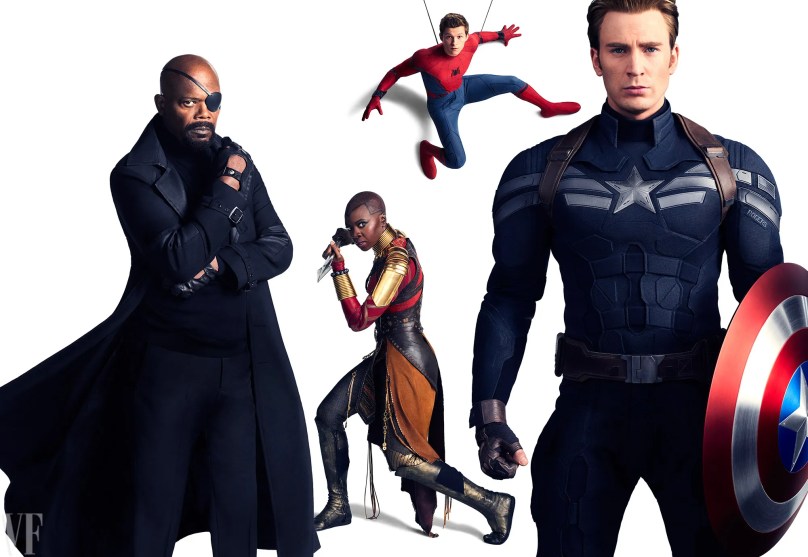
The Unmarvelous Marvel Universe
When I first came to Los Angeles at the tail end of 1966, it was the beginning of a Golden Era for people like me who loved the cinema and saw it as an art form that would prevail well into the next century.
Only, it didn’t. The great Hollywood directors sputtered out with films that were pale copies of their best work. There was John Ford’s 7 Women (1966) and Howard Hawks’s Rio Lobo (1970). On the plus side, there were the French cinéastes of the Nouvelle Vague, including Jean-Luc Godard, François Truffaut, Jacques Rivette, Claude Chabrol, and Agnes Varda. And, across the Pacific, the Japanese were making great films which I have never tired of watching.
It was in 1968 that Andrew Sarris published The American Cinema:Directors and Directions, 1929-1968. It was a revision and expansion of an issue of Film Culture that came out several years earlier which I had photocopied while I was at Dartmouth College and which I always kept at my side.
But other things were happening. Hollywood was sputtering out like a volcano in its final throes. The film distribution companies were run by yahoos who insisted that people of my frame of mind were out-of-touch elitists and what the filmgoing public really wanted was Thoroughly Modern Millie and the Marvel Universe.
In the course of several decades, there was a dribble of good films from Hollywood and abroad, but mostly an avalanche of mediocrity. At the same time, it was getting harder to see the films I loved. I recorded hundreds of films on VHS videotape—but then videotape died. I switched to DVD, but now I am beginning to encounter “laser rot.”
I have in my library a number of volumes that are over a hundred years old. Unless they are destroyed, they will be readable for at least another hundred years. Such is not the case with films. The media on which they are stored has to be changed every few years because of the rate of change in the digital world.
So I have concluded that it will be difficult to be a film lover. Yet I almost never see current Hollywood film products in theaters. Sometimes on HBO or Showtime, but never at a cinema.
Fortunately, my books are still quite readable; and I am diving into them voraciously.
 Tarnmoor
You must be logged in to post a comment.