Hap

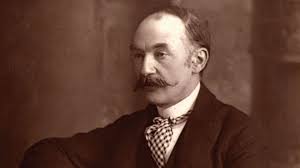
British Poet and Novelist Thomas Hardy (1840-1928)

Although most readers know Thomas Hardy as a novelist, do they know that in mid-career he gave up on the novel and concentrated on producing a body of verse that is as great as his prose, as the following poem demonstrates:

Hap

If but some vengeful god would call to me
From up the sky, and laugh: “Thou suffering thing,
Know that thy sorrow is my ecstasy,
That thy love’s loss is my hate’s profiting!”

Then would I bear it, clench myself, and die,
Steeled by the sense of ire unmerited;
Half-eased in that a Powerfuller than I
Had willed and meted me the tears I shed.

But not so. How arrives it joy lies slain,
And why unblooms the best hope ever sown?
—Crass Casualty obstructs the sun and rain,
And dicing Time for gladness casts a moan. . . .
These purblind Doomsters had as readily strown
Blisses about my pilgrimage as pain.

Hap

English Poet and Novelist Thomas Hardy (1840-1928)

He was a great novelist, but then gave it up and became a great poet. Alas, we do not recognize him as such, but I think in time people will realize his greatness.

Hap

If but some vengeful god would call to me
From up the sky, and laugh: “Thou suffering thing,
Know that thy sorrow is my ecstasy,
That thy love’s loss is my hate’s profiting!” 

Then would I bear it, clench myself, and die,
Steeled by the sense of ire unmerited;
Half-eased in that a Powerfuller than I
Had willed and meted me the tears I shed.

But not so.   How arrives it joy lies slain,
And why unblooms the best hope ever sown?
—Crass Casualty obstructs the sun and rain,
And dicing Time for gladness casts a moan. . . .
These purblind Doomsters had as readily strown
Blisses about my pilgrimage as pain.

Thoughts at Midnight

Thomas Hardy (1840-1928)

Even as I read one Dorsetshire author (John Cowper Powys), my mind goes to another who gave up writing novels and wrote nothing but poems for the rest of his life. I am thinking of Thomas Hardy. Here is a short poem by him:

Thoughts at Midnight

Mankind, you dismay me
When shadows waylay me! —
Not by your splendours
Do you affray me,
Not as pretenders
To demonic keenness,
Not by your meanness,
Nor your ill-teachings,
Nor your false preachings,
Nor your banalities
And immoralities,
Nor by your daring
Nor sinister bearing;
But by your madnesses
Capping cool badnesses,
Acting like puppets
Under Time’s buffets;
In superstitions
And ambitions
Moved by no wisdom,
Far-sight, or system,
Led by sheer senselessness
And presciencelessness
Into unreason
And hideous self-treason. . . .
God, look he on you,
Have mercy upon you!

“The Echo Elf Answers”

Thomas Hardy (1840-1928)

English poet Thomas Hardy uses an echo based on the last few words of a number of questions he puts regarding his future. It’s a somewhat dark poem, but a good one.

The Echo Elf Answers

How much shall I love her?
For life, or not long?
               “Not long.”
 
Alas! When forget her?
In years, or by June?
               “By June.”
 
And whom woo I after?
No one, or a throng?
               “A throng.”
 
Of these shall I wed one
Long hence, or quite soon?
               “Quite soon.”
 
And which will my bride be?
The right or the wrong?
               “The wrong.”
 
And my remedy– what kind?
Wealth-wove, or earth-hewn?
               “Earth-hewn.”

“The Echo Elf Answers”

Photo by Ed Weinman

Thomas Hardy (1840-1928) is best known for his novels. Although I admire them as much as anybody, I now like his poetry even more. His subjects seem to be on the somber side, but I love their simplicity and rugged construction, such as this one:

The Echo Elf Answers

How much shall I love her?
For life, or not long?
“Not long.”

Alas! When forget her?
In years, or by June?
“By June.”

And whom woo I after?
No one, or a throng?
“A throng.”

Of these shall I wed one
Long hence, or quite soon?
“Quite soon.”

And which will my bride be?
The right or the wrong?
“The wrong.”

And my remedy – what kind?
Wealth-wove, or earth-hewn?
“Earth-hewn.” 

Niflheim

Poet and Novelist Thomas Hardy (1840-1928)

I was looking for information on the Internet about Thomas Hardy when I came upon an interesting article on the Paris Review website. The opening paragraphs captured my attention:

Are you enjoying yourself at the moment? Please stop. It’s Thomas Hardy’s birthday, and he will wipe the smile right off your smug, contented, life-affirming face. You’re dealing with a man who knew how to deploy the word Niflheim, defined by the OED as “the region of eternal darkness, mist, and cold inhabited by those who died from old age or illness.” Hardy uses it to dispirited perfection in The Woodlanders, relating a kind of failure to connect: “But he continued motionless and silent in that gloomy Niflheim or fog-land which involved him, and she proceeded on her way.” Actually, The Woodlanders is full of an evocative, despondent murkiness. It extends even to the tiny twigs on the ground, which Hardy takes care to describe as they’re destroyed by a passing carriage: “they drove on out of the grove, their wheels silently crushing delicate-patterned mosses, hyacinths, primroses, lords-and-ladies, and other strange and common plants, and cracking up little sticks that lay across the track.”

Hardy wrote with a special zeal for death, and his sense of the morbid often lapsed into tone deafness. He witnessed two executions when he was a boy—maybe that had something to do with it. One of them was the hanging of Elizabeth Martha Brown, who was convicted of murdering her husband. By his own account, Hardy, then only sixteen, stood close enough to the gallows to hear her gown rustling; the hanging left an indelible mark on him such that seventy years later, in 1926, he could render it vividly in a letter to Lady Pinney, casting Brown’s final seconds in an unmistakably erotic light:

I am ashamed to say I saw her hanged, my only excuse being that I was but a youth and had to be in the town at that time for other reasons … I remember what a fine figure she showed against the sky as she hung in the misty rain, and how the tight black silk gown set off her shape as she wheeled half-round and back.

He added later:

The hanging itself did not move me at all. But I sat on after the others went away, not thinking, but looking at the figure … turning slowly round on the rope. And then it began to rain, and then I saw—they had put a cloth over the face—how as the cloth got wet, her features came through it. That was extraordinary. A boy had climbed up into a tree nearby, and when she dropped he came down in a faint like an apple dropping from a tree. It was curious the two dropping together.

“Wessex”

Here is one of my favorite dog poems. It is by Thomas Hardy, who is better known for his novels than his poetry. Wessex was the name of Hardy’s dog, and it is also the scene of his novels, such as Return of the Native and Tess of the Durbervilles.

A Popular Personage at Home

'I live here: "Wessex" is my name:
I am a dog known rather well:
I guard the house but how that came
To be my whim I cannot tell.

'With a leap and a heart elate I go
At the end of an hour's expectancy
To take a walk of a mile or so
With the folk I let live here with me.

'Along the path, amid the grass
I sniff, and find out rarest smells
For rolling over as I pass
The open fields toward the dells.

'No doubt I shall always cross this sill,
And turn the corner, and stand steady,
Gazing back for my Mistress till
She reaches where I have run already,

'And that this meadow with its brook,
And bulrush, even as it appears
As I plunge by with hasty look,
Will stay the same a thousand years.'

Thus 'Wessex.' But a dubious ray
At times informs his steadfast eye,
Just for a trice, as though to say,
'Yet, will this pass, and pass shall I?' 

A Winter Poem

Wood Thrush

I have always thought that Thomas Hardy was vastly underrated as a poet. Try this poem on for size and imagine that the time is the end of the day at the end of the year and (even) the end of the century:

The Darkling Thrush
I leant upon a coppice gate
      When Frost was spectre-grey,
And Winter’s dregs made desolate
      The weakening eye of day.
The tangled bine-stems scored the sky
      Like strings of broken lyres,
And all mankind that haunted nigh
      Had sought their household fires.
The land’s sharp features seemed to be
      The Century’s corpse outleant,
His crypt the cloudy canopy,
      The wind his death-lament.
The ancient pulse of germ and birth
      Was shrunken hard and dry,
And every spirit upon earth
      Seemed fervourless as I.
At once a voice arose among
      The bleak twigs overhead
In a full-hearted evensong
      Of joy illimited;
An aged thrush, frail, gaunt, and small,
      In blast-beruffled plume,
Had chosen thus to fling his soul
      Upon the growing gloom.
So little cause for carolings
      Of such ecstatic sound
Was written on terrestrial things
      Afar or nigh around,
That I could think there trembled through
      His happy good-night air
Some blessed Hope, whereof he knew
      And I was unaware.


“This Hint of an Unhappy Ending”

Serbian-American Poet Charles Simic

Serbian-American Poet Charles Simic

Born in Belgrade, Serbia, Душан “Чарлс” Симић (better known today as Charles Simic) is probably one of our best poets. There is a simplicity and strength in his lines, which are usually blank verse. He received the Pulitzer Prize for poetry in 1990 for his collection The World Doesn’t End, and was a finalist in both 1983 and 1986. In 2007, he was appointed Poet Laureate.

Below is his poem entitled “Clouds Gathering,” which takes a romantic setting and sees beyond it the threats to happiness that all men face:

It seemed the kind of life we wanted.
Wild strawberries and cream in the morning.
Sunlight in every room.
The two of us walking by the sea naked.

Some evenings, however, we found ourselves
Unsure of what comes next.
Like tragic actors in a theater on fire,
With birds circling over our heads,
The dark pines strangely still,
Each rock we stepped on bloodied by the sunset.

We were back on our terrace sipping wine.
Why always this hint of an unhappy ending?
Clouds of almost human appearance
Gathering on the horizon, but the rest lovely
With the air so mild and the sea untroubled.

The night suddenly upon us, a starless night.
You lighting a candle, carrying it naked
Into our bedroom and blowing it out quickly.
The dark pines and grasses strangely still.

I love the last line, which reminds me of Thomas Hardy’s poem “The Subalterns,” in which nature apologetically admits to its unfortunate role as contributing to man’s suffering.

A Neglected Poet

Rain as a Subaltern

Rain as a Subaltern

Thomas Hardy is not one of our most widely-read poets. If anything, people are far more familiar with his novels, such as Jude the Obscure, Tess of the D’Urbervilles, and Far from the Madding Crowd. Fortunately, after years of neglect, his poems are coming into their own. The other night, I was reading an essay on the 20th century Russian poet Joseph Brodsky in J. M. Coetzee’s Stranger Shores: Literary Essays 1986-1999, and I came across the following:

[Joseph] Brodsky’s system can best be illustrated from the essay on Thomas Hardy. Brodsky regards Hardy as a neglected major poet, “seldom taught, less read,” particularly in America, cast out by fashion-minded critics into the limbo of “premodernism” (On Grief, pp. 373, 315, 313)

It is certainly true that modern criticism has had little of interest to say about Hardy. Nevertheless, despite what Brodsky says, ordinary readers and (particularly) poets have never deserted him. John Crowe Ransom edited a selection of Hardy’s verse in 1960 [I have a copy]. Hardy dominates Philip Larkin’s widely read Oxford Book of Twentieth-Century English Verse (1973), with 27 pages as opposed to 19 for Yeats, 16 for Auden, a mere 9 for [T. S.] Eliot. Nor did the Modernist avant-garde dismiss Hardy en bloc. Ezra Pound, for instance, tirelessly recommended him to younger poets. “Nobody has taught me anything about writing since Thomas Hardy died,” he remarked in 1934.

Here is my favorite of Hardy’s poems. Picture a man struggling to walk through a rainstorm:

The Subalterns

I

“Poor wanderer,” said the leaden sky,
“I fain would lighten thee,
But there are laws in force on high
Which say it must not be.”

II

–“I would not freeze thee, shorn one,” cried
The North, “knew I but how
To warm my breath, to slack my stride;
But I am ruled as thou.”

III

—“To-morrow I attack thee, wight,”
Said Sickness. “Yet I swear
I bear thy little ark no spite,
But am bid enter there.”

IV

—“Come hither, Son,” I heard Death say;
“I did not will a grave
Should end thy pilgrimage to-day,
But I, too, am a slave!”

V

We smiled upon each other then,
And life to me had less
Of that fell look it wore ere when
They owned their passiveness.

Hardy can be at one and the same time incredibly simple and incredibly deep. At the same time, we have sickness and death acting with compassion against the poor traveler. Who can write such a poem today?