
Hap

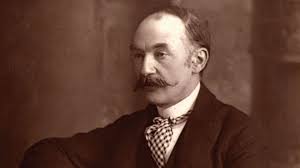
British Poet and Novelist Thomas Hardy (1840-1928)

Although most readers know Thomas Hardy as a novelist, do they know that in mid-career he gave up on the novel and concentrated on producing a body of verse that is as great as his prose, as the following poem demonstrates:

Hap

If but some vengeful god would call to me
From up the sky, and laugh: “Thou suffering thing,
Know that thy sorrow is my ecstasy,
That thy love’s loss is my hate’s profiting!”

Then would I bear it, clench myself, and die,
Steeled by the sense of ire unmerited;
Half-eased in that a Powerfuller than I
Had willed and meted me the tears I shed.

But not so. How arrives it joy lies slain,
And why unblooms the best hope ever sown?
—Crass Casualty obstructs the sun and rain,
And dicing Time for gladness casts a moan. . . .
These purblind Doomsters had as readily strown
Blisses about my pilgrimage as pain.
Sorrow and the Writer

Sorrow

Sorrow

Sometimes, when a painful section is still in rough draft, a new attachment, and new suffering, come along which enable us to finish it, to give it substance. One cannot really complain too much about these great but useful sorrows, because there is no shortage of them and they do not make us wait long for them. None the less, we have to hurry if we are to profit from them, for they do not last very long: one finds consolation, or else, if they are too overwhelming, and if one’s heart is no longer very sound, one dies. Because happiness alone is good for the body; whereas sorrow develops the strength of the mind. Moreover, even if it did not reveal a law to us each time this happened, it would be no less indispensable for returning us each time to the truth, forcing us to take things seriously, and uprooting each time the weeds of habit, scepticism, levity and indifference. Admittedly this truth, which is not compatible with happiness, or with health, is not always compatible with life either. Sorrow kills in the end. At each new, unbearable affliction, we feel yet another vein stand out, extending its deadly sinuosity across our temples, or under our eyes. And it is in this way that are gradually formed those terrible, ravaged faces of the old Rembrandt, and the old Beethoven, whom everybody used to laugh at.—Marcel Proust, Finding Time Again (Trans. Ian Patterson)