It was another warm day, so I decided to drive to Chace Park in the Marina . stopping at Trader Joe on the way to pick up a salad and beverage for a picnic on the way. I had only a few pages more to read of Virgil’s Georgics and hoped to finish the book while enjoying the sea breezes.
It was not to be. A crow was flopping around on the ground, unable to fly. Several passersby had stopped and were loudly discussing what to do about the poor crow. There were as many opinions as there were people. Eventually, a homeless person picked up the bird and placed it a few feet away in the shade.
What did I do? Nothing. Crows are wild creatures. Any intervention on my part would have terrified the bird at a point when it was dealing with its own problems. I was not about to make a pet of it so that I could brag to my friends that I had “rescued” it.
I was outraged that the people in the park had in some way profaned the final moments of one of God’s creatures.
Perhaps many people would feel that I was being hard hearted because I chose not to interfere. Perhaps I was being kinder to that bird by leaving it alone. After all, I actually like crows.
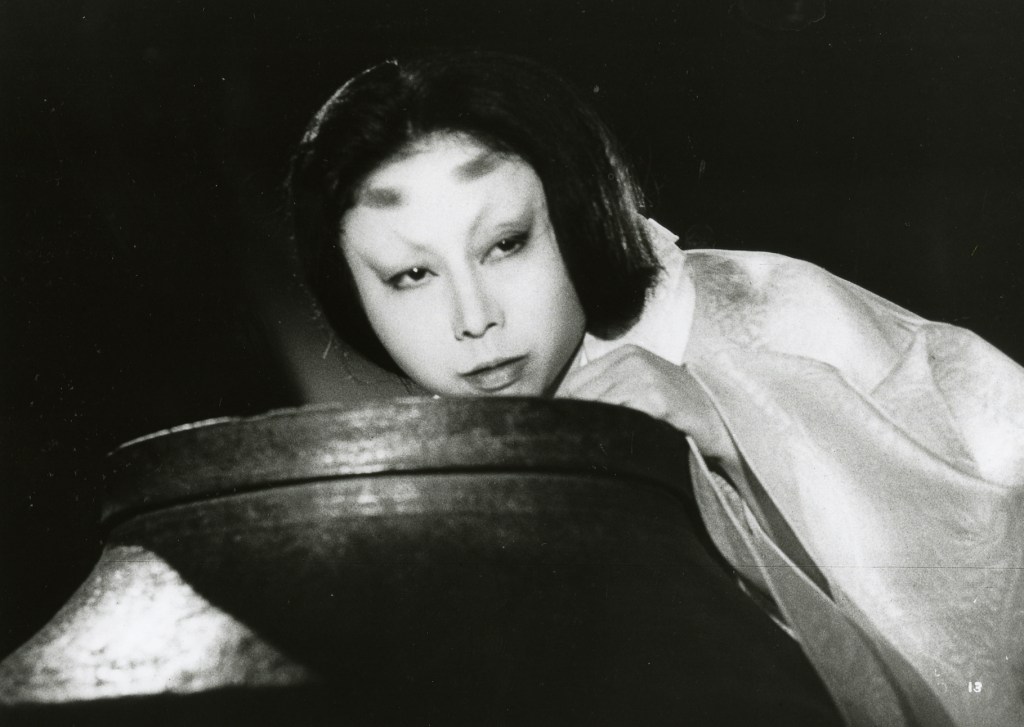
Both films begin with the same situation. In Medieval Japan, there is civil war. Men are pressed into one of the competing armies, leaving behind a mother and wife in a hut. The situation is dangerous, what with deserters and roving bands of masterless samurai. And the same actress appears in both films, Nobuku Otawa, who also happened to be the director’s wife.
The two films are Onibaba (1964) and Kuroneko (1968), both by the same director—Kaneto Shindo— and both produced by the Toho Studio. In the former film, the hut is located in a sea of tall reeds; in Kuroneko, in a bamboo forest.
In the 1960s, I believe that the best films produced anywhere in the world were made by a handful of Japanese film studios: Toho, Daiei, Schochiku, Nikkatsu, and Tohei. Although Hollywood pioneered wide-screen films, it was the Japanese who mastered the medium, whether in black and white or in color.
Nobuku Otawa in Shindo’s Kuroneko
Last night I stayed up late watching Onibaba and Kuroneko on the Turner Classic Movies (TCM) channel.
Onibaba is the better of the two films. The tall grass becomes a character in the film, much like the sand dunes in Hiroshi Teshigahara’s Woman in the Dunes (1964). When the daughter runs through the tall grass to tryst with her lover, the viewer feels that anything can happen. And it does: A demon appears in her path blocking the way.
It’s not quite here yet, but it’s coming. Lhude sing cuccu … or whatever. Summer has its moments in Southern California. Mostly, it’s just hot.
This time of year, I like to read works by William Faulkner (this summer, I’ll tackle his Collected Short Stories) and travel books about Arabia and India (I’ve already begun Charles M. Daughty’s Travels in Arabia Deserta, Volume I). Then, too, I will read the Travis McGee novels of John D. MacDonald and some Icelandic detective stories.
I will drink ungodly amounts of iced tea. I know it’s a powerful diuretic, but it does moisten the palate. This summer, it will mostly be the Ceylon loose tea from Ahmad of London. After the autumn equinox, I’ll switch to Darjeeling (when I need a lift) or Baruti or Ghalami Assam.
When it gets too hot, we’ll have a picnic lunch at Chace Park in the Marina and revel in the cool sea breezes, which typically die within a few hundred feet of the shore.
I will sleep without covers at night, usually with the window open. I will have to listen to all the dysfunctional car alarms, the patron’s of the bar across the street, and the cursing and moaning of all the street people.
In the end, it’s doable. One thing I will not do is travel—unless I could afford a flight to Alaska or Patagonia. The desert will be blisteringly hot, and we are surrounded by hundreds of miles of desert.
My most memorable vacations were to Yucatán, Peru, Patagonia, and Iceland. My least memorable vacations were going back to Cleveland to visit my parents and be treated like a 4-year-old.
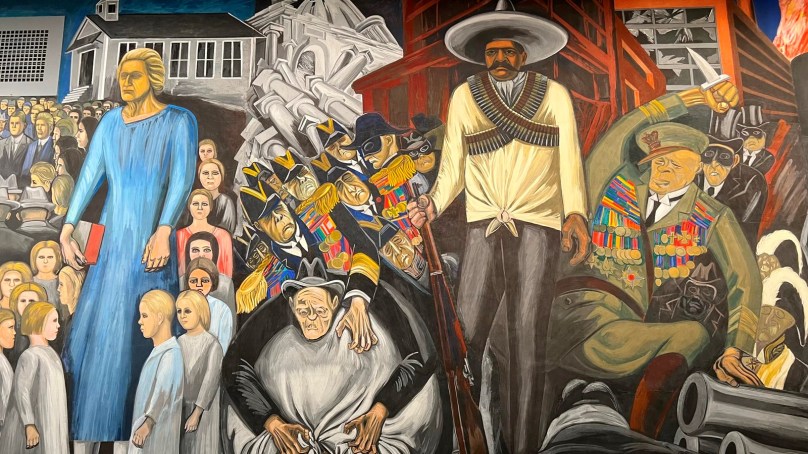
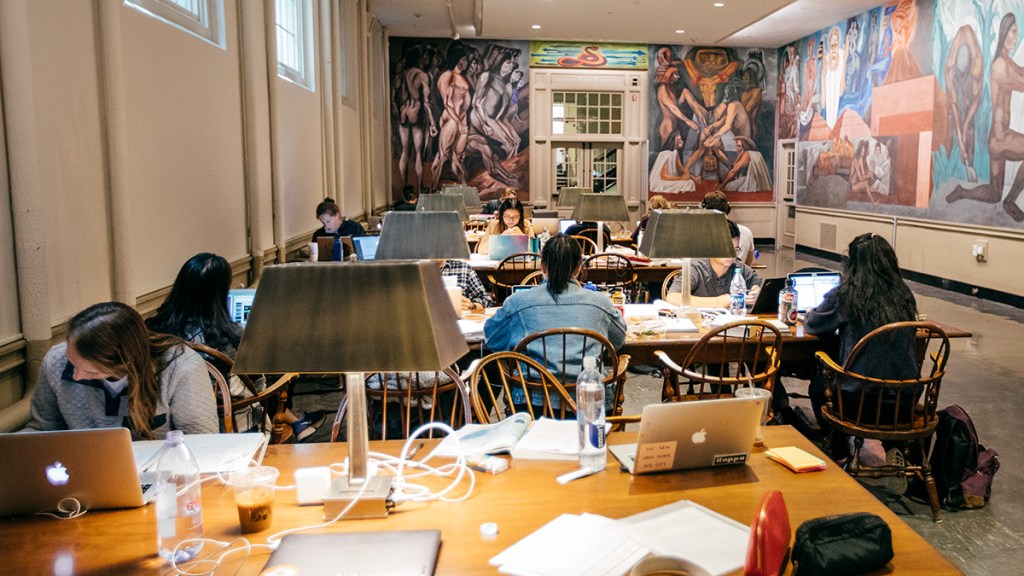
One of the things I most loved about my years at Dartmouth College was studying in the Baker Library’s Reserve Room, as it was then called. The Mexican artist José Clemente Orozco (1883-1949). Between 1932 and 1934, he painted a series of murals entitled “The Epic of American Civilization” in the college’s Baker Library.
There is a detailed discussion of Orozco’s mural put out by Dartmouth’s Hood Museum describing all the panels.
The Reserve Room
Sometimes I think it is those murals which first got me interested in going to Mexico. Nine years after I graduated, I finally made it to Yucatán and visited the ruins at Uxmal, Chichén Itzá, Mayapan, and Kabah during a two-week trip in November 1975.
Until I saw Orozco’s work, Mexico and the Pre-Columbian civilizations of the Americas just weren’t on my radar. Afterwards, they became a major preoccupation.
Quetzalcoatl in a Panel of the Orozco Murals
Little did I know in my college years that my interest in the murals would eventually lead me not only to Mexico, but also Argentina, Guatemala, Honduras, Uruguay, Chile, Peru, and Ecuador.
It was November 2015. I had just returned by train from Tigre where I had explored the delta of the Rio Paraná on a boat. That evening, I wanted to take a night bus to Puerto Iguazú to see the famous waterfalls. First I had to get a bus ticket, then take a cab back to my hotel in Recoleta and pick up my luggage, which was being held for me at the desk.
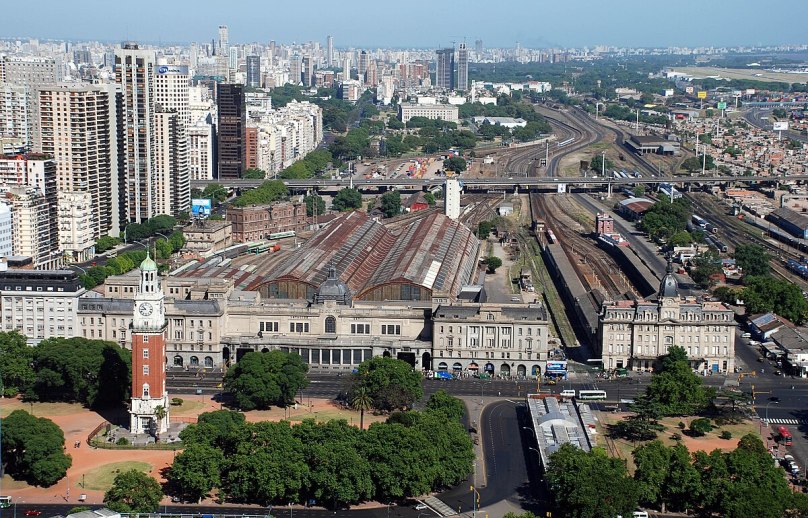
The main Buenos Aires bus station is a couple hundred yards’ walk to the north of the train station, just to the right (not shown) of the train station shown above.
As I walked along the crowded walkway to the bus station, I smelled an odorous mix of steak sauce and mustard that was squirted onto my back by a young couple that was following me. They were exceedingly polite as they applied paper towels to the mess and offered to accompany me to a location on the left where I would be cleaned up.
Cleaned out was more like it. I was familiar with this pickpocket trick. As I was carrying several thousand Argentinean pesos on my person, as well as several hundred dollars cash, I immediately went to my right and hailed one of the numerous cabs that had just dropped someone off at the bus and train stations. I jumped into the cab and asked them to drive me to my hotel in Recoleta.
The cab driver was not happy to be dealing with a rider who made his cab smell weird. Still, he drove me and I gave him a generous tip to clean the steak sauce/mustard smell from the back seat.
I picked up my bags and took another cab—this time directly to Retiro Bus Station, avoiding the walkway between it and the train station. I bought my ticket to Iguazú and got on the bus, still reeking. When, after a good night sleep, I got to my destination, I talked my hotel into laundering my still-smelly clothes.
Shortly after we survived the Covid-19 onslaught, I noticed that many of my favorite restaurants were shutting their doors. There was Papa Cristo’s Greek restaurant at Pico and Normandie near downtown L.A.; the Original Pantry at 9th and Figueroa, which was closed only a single day over the last century but is no more; and Jerry’s Deli, once a thriving chain.
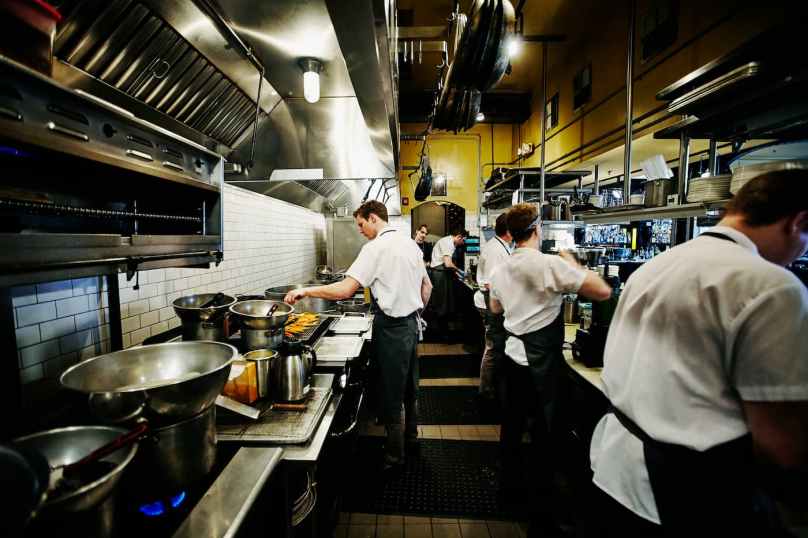
Come to think of it, I am always surprised that restaurant stay open. I cannot imagine a less rewarding job than being the owner, manager, or supervising chef at a restaurant. The hours are long, your hands get scarred and burnt; you don’t make much money; and there are stringent health and sanitation requirements.
I have been reading Anthony Bourdain’s book Kitchen Confidential, which tells of one chef’s experiences in the New York and Provincetown, MA restaurant scenes. At one point, he writes:
To want to own a restaurant can be a strange and terrible affliction. What causes such a destructive urge in so many otherwise sensible people? Why would anyone who has worked hard, saved money, often been successful in other fields, want to pump their hard-earned cah down a hole that statistically at least will almost surely prove dry? Why venture into an industry with enormous fixed expenses (rent, electricity, gas, water, linen, maintenance, insurance, license fees, trash removal, etc.), with a notoriously transient and unstable workforce, and highly perishable inventory of assets?
Especially with the current occupant of the White House, who has it in for kitchen and agricultural workers, who traditionally tend to be illegal immigrants. As the owner of hotel restaurants at his glitzy Trump properties, who is going to work in his restaurant kitchens? Then, too, all this uncertainty over tariffs is going to hit hard at food items that are typically imported, such as winter fruits, avocados, and seafood. But then, we are entering a period of seat-of-the-pants decisions made without weighing the consequences.
Perhaps all that will be left are the “factory” restaurants like McDonalds and Burger King. That would certainly slash my restaurant expenses.







 Tarnmoor
You must be logged in to post a comment.