Usually, I spend much of the month of October each year reading gothic or horror fiction. I have already started reading Ann Radcliffe’s The Italian, or the Confessional of the Black Penitents (1797), after which she quietly stopped writing and spent the last twenty-six years of her life as a private person. I have fond memories of reading her novels The Romance of the Forest (1791) and The Mysteries of Udolpho (1794).
Also, I will inevitably read one of Joyce Carol Oates’s underrated gothic novels or collections of short fiction. Other possibles are Thomas Ligotti and Robert Aickman. And I will certainly re-read some of Edgar Allan Poe’s stories.
In November, I will write a post detailing with gothic/supernatural/horror titles I have read.
We hadn’t been to a car show for several months, so when Martine handed me a flier for the Klassics for Kids Benefit Car Show sponsored by the Calas Park Volunteer Association in Carson, I jumped at the chance. It was a cloudy and muggy day (another of those Mexican monsoons), but it was an interesting event.
For one thing, Martine and I were probably the only gringos in attendance. No matter: It was a neighborhood event, and the people in attendance were super friendly.
Neighborhood Girls at the Klassics for Kids Car Show
Most of the cars being exhibited were souped-up classic Chevrolets, many of which were purchased from Giant Felix Chevrolet on Figueroa in Downtown Los Angeles. There were the usual hot rod modifications, including hydraulics, chain link steering wheels, and numerous artistic modifications. This is only the second show we have attended that concentrated on Hispanic car culture. It was an interesting experience.
Side View Mirror Art (with Martine’s Straw Hat)
Afterwords, Martine and I stopped at a Jollibee Foods Restaurant on Carson Boulevard. It was another cultural experience, this time of a culinary nature. Jollibee’s is a Filipino chain which is expanding rapidly in the United States. Based on the quality of their burgers and their chicken, I think they will succeed beyond their wildest dreams. I first encountered them at the food court of the Ala Moana Shopping Center in Honolulu. I didn’t sample their food then, but was curious at the loyalty of their customer base and the long lines at their restaurant.
This recipe came to me through the “How to Cook Great” site on YouTube. Click here for an instructive video that produces almost exactly what I will describe in this post. The following recipe will make 4-5 servings of a delicious vegan curry.
For some of the ingredients, you will need to shop at an Indian grocery—especially if you want the dish to taste authentic. These ingredients are marked in the text by IND in square brackets: [IND].
I typically use a largish nonstick pot that has a cover for the final stage of cooking.
On to the recipe:
Put several tablespoons of sunflower seed oil in the pot and turn to heat to moderate high.
When the oil is hot, add a several tablespoons of black mustard seeds [IND] and cumin seed (also known as jeera) [IND] and watch the seeds pop. Stir for up to a minute.
Take two largish russet potatoes, peel them, and cut into pieces slightly smaller than 1 cubic inch. Stir for several minutes.
Add a large dollop of garlic ginger paste [IND] and stir in.
Add salt to taste,
Slice one medium size red onion and stir into the mix. Stir for a couple of minutes.
Add the following three spices, approximately one heaping tablespoon of each: (a) haldi turmeric [IND], (b) cumin, and (c) (if desired) a hot chile powder. For the chile powder, you can substitute Hungarian paprika if you can’t handle the heat. Stir.
Dice into pieces a medium to large eggplant and add to the mix. Continue stirring.
If you like spicy food, mice one jalapeño or two serrano chile peppers.
Cut up four or five small tomatoes and add to the pot. Stir.
Turn down the heat to medium low, cover the pot, and cook for ten to twenty minutes.
Chop a handful of cilantro and add before serving.
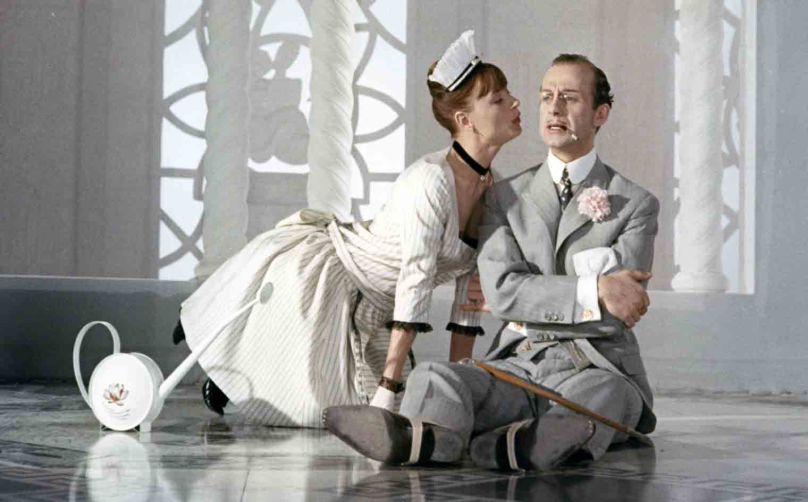
Harriet Andersson and Jarl Kulle in Bergman’s All These Women (1964)
Yesterday I posted about my love for black & white films. Today, I would like to redress the balance by talking about the pros and cons of color film. With the new motion picture and video cameras, color is, for the most part, what the camera is programmed to shoot, especially when the camera is digital.
There was a brief time in the 1960s when film directors made some exciting use of color film stock. I am thinking of such films as Michelangelo Antonioni’s The Red Desert (1964), Ingmar Bergman’s All These Women (1964), and—going back a couple of decades—Michael Powell and Emeric Pressburger’s Black Narcissus (1947).
In fact, the Internet Movie Database (IMDb) has released a list of 275 films “with Amazing Use of Colours.” The list includes some well-known titles as Alfred Hitchcock’s Vertigo (1958), Robert Zemeckis’s Forrest Gump (1994), Jacques Demy’s The Umbrellas of Cherbourg (1964), and Steven Spielberg’s E.T. (1982). Interestingly, there are scores of titles of films of which I have never heard: In each case, some film-maker wanted to make something different and succeeded.
As digital film becomes more prevalent, the temptation is for producers and directors to not attempt anything special. This is particularly true of films released by HBO, Netflix, Hulu, and others in multiple parts. Most of these productions I frankly ignore. Graphically speaking, most are failures.
Even films released as features for the theaters are not necessarily any better. In the old days of the Hollywood Studios, interesting cinematography was a matter of institutional pride. But that was then….
Yesterday as I was watching John Ford’s The Fugitive on Turner Classic Movies (TCM), I was reminded of what Peter Bogdanovich said about black & white vs. color: “Orson Welles says every performance looks better in black and white. It’s the fact that you don’t see blue eyes and blond hair. You focus on the performance, not the look of the people. And it enables you to capture the period better.” And that is why he shot The Last Picture Show (1971) in black and white.
When I was growing up, I preferred color, even though the color at that time was mostly three-strip Technicolor, which, though beautiful in its own right, is not particularly realistic. Then, in 1962, I saw a black & white film that changed me: Carl Dreyer’s powerful study of witchcraft in Denmark, Day of Wrath (1943). I started attending the Dartmouth Film Society’s screenings, and I saw numerous motion pictures that made me appreciate both color and black & white.
In the world of black & white, there are some great cinematographers. They include Gabriel Figueroa (he shot The Fugitive); John Alton, the great noir master; Joseph Von Sternberg and his regulars Lee Garmes and Bert Glennon; Sidney Hickox (the 1946 The Big Sleep); and Gregg Toland. Interestingly, the great B/W photographers could also make great color films—but not always vice versa.
Today, I have no preference between B/W and color. Most of the films I watch on TCM are in black and white, probably because I do not retain my childhood preference for color. Also, I will willingly watch silent films of the 1920s and films of the 1930s, 1940s, and up to the present day. Curiously, if I am prejudiced, it is mostly against recent films, which are overwhelmingly in color.
For balance, I will also write a blog about my favorite color films within the next few days.
I don’t associate with brands as such. Today, brands are no longer consistent in their quality. That is because corporations are about money, not customer satisfaction.
Since I am planning for a possible trip to Isla Mujeres in Mexico, I have been watching dozens of videos posted on YouTube by mostly young influencers. They have proven to be helpful in one way: I have a pretty good idea what Isla Mujeres looks like.
On the other hand, I have never seen so many mispronunciations and errors of fact. I don’t get the feeling that many of these influencers ever did their research before picking up their camera and buying a plane ticket. Fortunately, there are exceptions, such as this eminently useful post on how to avoid the “shark tank” at the Cancun International Airport, with its ravenous timeshare condo salespersons.
One unfortunate tendency is for most of these influencers to get sloshed on cocktails with every meal and between meals. Many of the travel videos for Isla Mujeres are 50% taken up with drinking sessions. Talk about Ugly Americans!
Also, it becomes very evident that these influencers are selling their recommendations of hotels, destinations, restaurants, and bars—presumably for free or heavily discounted products or services.
I will still consult many of these videos because they do give me some ideas. One simply has to learn to separate the wheat from the chaff.
Octavio Paz is Mexico’s lone winner of the Nobel Prize in Literature. He is best known for his poetry, but he also wrote a great long essay about Mexico entitled The Labyrinth of Solitude (1950). Below is a haunting poem by him about human isolation:
The Street
Here is a long and silent street. I walk in blackness and I stumble and fall and rise, and I walk blind, my feet trampling the silent stones and the dry leaves. Someone behind me also tramples, stones, leaves: if I slow down, he slows; if I run, he runs I turn: nobody.
Everything dark and doorless, only my steps aware of me, I turning and turning among these corners which lead forever to the street where nobody waits for, nobody follows me, where I pursue a man who stumbles and rises and says when he sees me: nobody.
That’s a typical young person’s question. Despite my advanced age (LXXX), I am energetic at all times except the late afternoon, when I tend to nap with an open book in my lap. With dinner, my energy level rebounds.
Don’t be misled by the above film poster: The “Cert X” refers to the British rating at the time as unsuitable for children. When I saw Rodan in 1957, I was scared out of my pants, particularly by all the claustrophobic monster scenes in the coal mine. And now, sixty-eight years later, I saw it again the other night. Both as a twelve-year-old child and as an old codger, I enjoyed the film immensely. It really did have a cast of thousands, and it showed models of several Japanese cities being demolished by the two Rodan monsters.
Mount Aso on the island of Kyushu—the birthplace of Rodan—is Japan’s most active volcano, and among the largest in the world. It has erupted as recently as 2021.
The Crater of Mount Aso, Where Rodan Was Born
Unlike Godzilla, Rodan did not use many of the big Toho Film Studio stars, and certainly none that I recognized. And it did not feature any annoying child stars who made goo-goo eyes at the monsters.
It is always interesting to re-see movies that impressed one as a child. It’s a way of taking a measure of oneself after decades of growth. I do the same thing with books. Sometimes, as a child, I am impressed for all the wrong reasons. For instance, as a college student, my favorite book was Gilbert Highet’s The Art of Teaching. I desperately wanted to become a college professor. Now, after Gen X, Gen Z, and Gen Whatever, I have no desire to light a fire under kids whose sacred scripture is Tik Tok.










 Tarnmoor
You must be logged in to post a comment.