
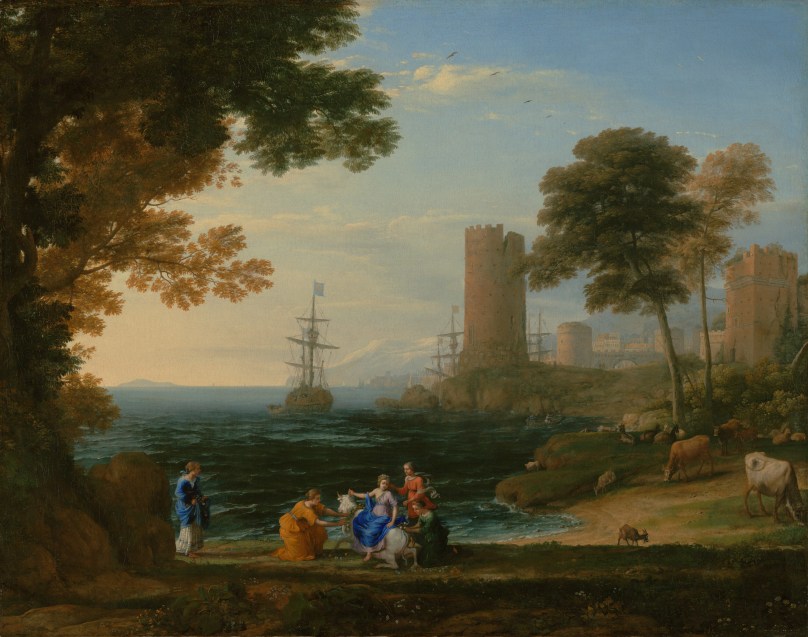
Claude Lorrain’s “Coast View with the Abduction of Europa”
Goethe perhaps said it best: “Claude Lorrain knew the real world by heart, down to the minute details. He used it as a means of expressing the harmonious universe of his soul.”
Both Lorrain (1604-1682) and Nicolas Poussin (1594-1665) made a career of creating peaceful canvases that draw the viewer’s eye in and leave him or her in a meditative state. That is the case even though the subject matter of the above painting is of a violent rape:
The Abduction of Europa is a classical myth from Ovid’s Metamorphoses, in which Zeus transforms himself into a white bull to abduct the Phoenician princess Europa. He lures her onto his back and carries her across the sea to the island of Crete, where they have children, including Minos, who become the first king of Crete and one of the divine judges of the underworld.
Rembrandt also painted the scene in a much more dramatic fashion, but in Lorrain’s painting, it is almost an afterthought—as if it could have been replaced by dancing Naiads or a shepherd with his flock with no loss in overall effect.
Every time I visit the Getty Center in the Santa Monica Mountains, I feel a frisson of excitement as I take a fresh look at the museum’s incredible collection.


 Tarnmoor
You must be logged in to post a comment.