Miami on the Pacific

If It Gets Any More Humid …

Thanks, Mario! The Mexican storm of this name has, upon dissipating flooded California with moist, tropical air and the threat of thunderstorms. As I went downtown today for my weekly Mindful Meditation session at the L.A. Central Library, I suddenly felt many of my joints protesting—from my formerly broken shoulders (both of them) to my left hip (replaced a quarter of a century ago).

Somehow, I made it, even though the elevator down to the Metro Rail station at Seventh Street was closed for repairs. Back when it was built, the architects decided they didn’t need a down escalator: Stairs should do nicely. Hah!

The humidity will probably last through the weekend, regardless what the weather forecaster say. What do they know?


Plotting a Getaway

Isla Mujeres Seen from the Air

The island is a half hour boat ride from Cancun’s Puerto Juarez. It is approximately 4.3 miles (7 km) long and on an average of 0.4 miles (650 meters) wide. In the above photo, you are viewing the eastern tip of the island, known as Punta Sur. The main town and the best swimming beaches are at the far end.

I am in the process of trying to convince Martine to come with me for a week in Isla Mujeres. It would be a low stress visit with lots of great seafood and, at Playa Norte, a beach that has a sand bottom, no waves, no rip tides, no rocks, no seaweed, and plenty of clear, utterly transparent water of the right temperature.

Martine does not like traveling to Mexico (she’s been to Yucatán once and Cabo San Lucas once). I am hoping I can lure her with pictures of a no-fuss, no-muss destination with great seafood, swimming, and shopping. And virtually no automobiles, except for taxis.

Shopping on Isla Mujeres

Although Isla Mujeres is famous for diving and snorkeling, I have no intention to do either. I have never dived or snorkeled before, and I don’t intend to start at age 80.

I have been watching YouTube videos submitted by Internet Influencers. They have been useful for showing what the place looks like, and how young influencers like to get sloshed when they’re away from home.

Wish me luck with Martine.

Cooking Flop

Daily writing prompt
Write about your most epic baking or cooking fail.

My biggest cooking failures are in not properly judging my sweetheart’s taste. Basically, she can’t eat anything that has a vowel in its name (or so it seems). Once I find something she’ll eat, I keep using the same recipe … without any changes whatsoever.

I also have cooking failures when I cook for myself, but they are no big deal.

Gyökér

Stamp Honoring Hungarian Poet Radnóti Miklós (1909-1944)

The title of this post is the Magyar (Hungarian) word for “Roots.” Radnóti was a Jewish-Hungarian poet who was conscripted into forced labor by the Nazis and marched to the point of exhaustion. The poem below was found in his pocket when his body was exhumed from a mass grave.

Roots

Strength courses in the root;
It drinks the rain, it lives together with the soil,
And its dream is white as snow.

From beneath the soil to above the soil it bursts;
The root crawls, cunning,
Its arms like ropes.

On the root’s arms, worms sleep;
On the root’s legs, worms sit;
The world grows worm-ridden.

Yet the root lives on below;
The world does not concern it —
Only the branch does, full of leaves.

Marveling at the branch, it feeds it constantly;
To it it sends its savors,
Its sweet, celestial savors.

Now I too am a root;
I too now live among worms;
It is there that poetry is made.

I was once a flower; now I have become a root,
With the heavy dark soil above me;
My fate now ended,
A saw wails above my head.

Below is the first stanza of the poem in Hungarian, just to give you an idea of the severe compression possible in the Magyar language:

Gyökér

A gyökérben erő surran,
esőt iszik, földdel él
és az álma hófehér.

“The Harmonious Universe of His Soul”

Claude Lorrain’s “Coast View with the Abduction of Europa”

Goethe perhaps said it best: “Claude Lorrain knew the real world by heart, down to the minute details. He used it as a means of expressing the harmonious universe of his soul.”

Both Lorrain (1604-1682) and Nicolas Poussin (1594-1665) made a career of creating peaceful canvases that draw the viewer’s eye in and leave him or her in a meditative state. That is the case even though the subject matter of the above painting is of a violent rape:

The Abduction of Europa is a classical myth from Ovid’s Metamorphoses, in which Zeus transforms himself into a white bull to abduct the Phoenician princess Europa. He lures her onto his back and carries her across the sea to the island of Crete, where they have children, including Minos, who become the first king of Crete and one of the divine judges of the underworld.

Rembrandt also painted the scene in a much more dramatic fashion, but in Lorrain’s painting, it is almost an afterthought—as if it could have been replaced by dancing Naiads or a shepherd with his flock with no loss in overall effect.

Every time I visit the Getty Center in the Santa Monica Mountains, I feel a frisson of excitement as I take a fresh look at the museum’s incredible collection.

The La Brea Tar Pits

The Lake Pit, Largest of the La Brea Tar Pits

It’s one of those redundant names: brea in Spanish means tar, so the La Brea Tar Pits are literally the Tar Tar pits. (Similarly, Torpenhow Hill in Britain means Hillhillhill Hill.)

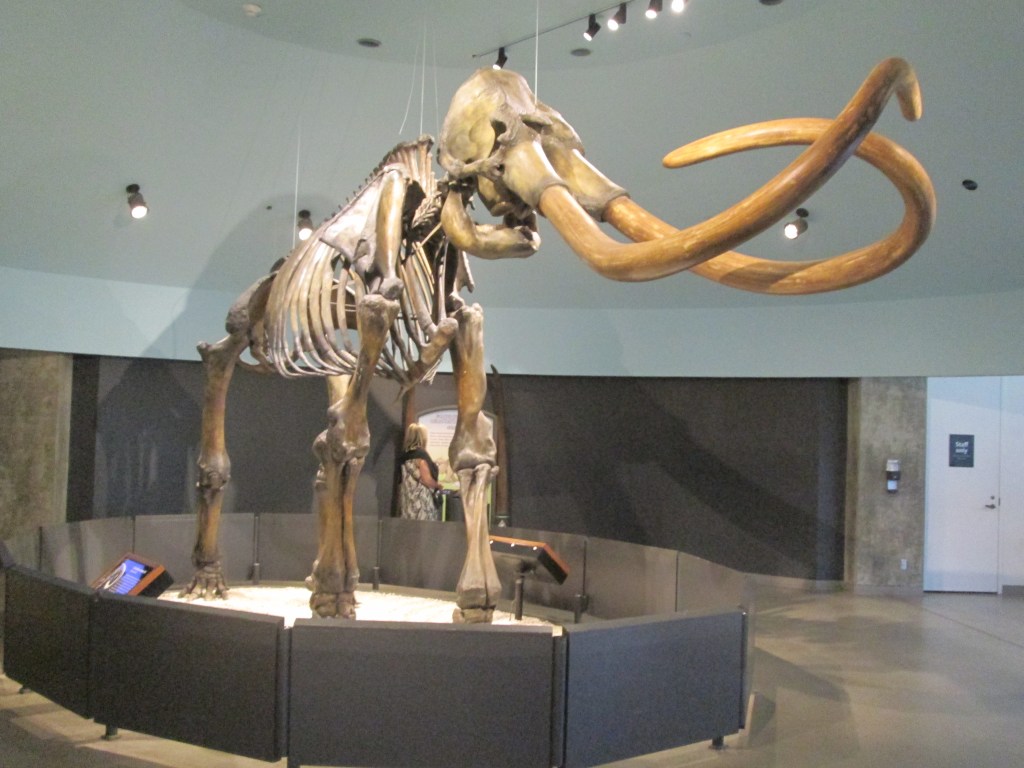
Martine and I haven’t visited the tar pits for almost a decade, so we drove down to Hancock Park and took a good look at what the area looked like ten thousand plus years ago. Based on the skeletons that have been fished out of the pits, there were giant sloths, mammoths, lions, camels, sabertooth tigers, and many, many dire wolves.

Skeleton of Columbian Mammoth

The archeological record shows that there were humans living in the area during the Ice Age. It couldn’t have been much fun for them to contend with their primitive weapons against so many gigantic mammals.

Visiting the pits, I am reminded of a famous line in Joseph Conrad’s The Heart of Darkness, when Marlowe points to the shore of the Thames and says: “And this also,” said Marlow suddenly, “has been one of the dark places of the earth.”

The La Brea Tar Pits Museum is a fascinating place to visit. In addition to all the skeletons of giant mammals who perished by drowning in the pits, there is a lab which allows you to watch volunteers cleaning bones recently pulled from the pits. (There are a number of them on the grounds.)

Martine got into the spirit of the occasion by donning a dire wolf headdress:

Martine with Wolfish Smile

My Word!

Daily writing prompt
What’s your favorite word?

Since I am multi-lingual, here are my favorite words in my four languages:

  • Spanish: pendejo, literally “pubic hair,” describing someone you really don’t like.
  • French: débrouillir, literally “de-fog” or “unravel,” how Inspector Maigret solves crimes.
  • Hungarian: lófasz, literally “horse’s dick,” used regularly to describe something insignificant or non-existent.
  • English: septemfluous, literally “flowing in seven streams,” a word with very limited applicability, like medioxumous, rotl, or crwth.