I think that “Having It All” is a recipe for unhappiness. In most cases it can’t be done. And if it is done, it is not sustainable. In the words of the Dhammapada:
If you are filled with desire Your sorrows swell Like the grass after the rain.
But if you subdue desire Your sorrows fall from you Like drops of water from a lotus flower.
In Culver City there is an interesting museum dedicated to the period of the Cold War. It’s called the Wende Museum after the German term for “turning point” or “change.” Today Martine and I paid it a visit. We were most interested in seeing the current exhibition entitled “Counter/Surveillance: Control, Privacy, Agency,” which featured equipment and techniques for surveillance of the population of Soviet Russia and its satellites.
More than half my life was passed in fear of nuclear annihilation. We had relatives in the Budapest area and frequently sent them large clothbound bundles of clothing and other necessities addressed in indelible ink. Sometimes, our relatives actually received those packages.
I vividly remember the drills in grade school where we would protect ourselves from the A-Bomb by cowering under our desks in a “duck and cover” drill.
The Surveillance Exhibit at the Wende Museum
It is odd that we almost feel nostalgia for our old enemies. Now we are in the process of becoming everyone’s enemy, and a diverse mix of countries and terror groups are taking aim at us for our misdeeds. Americans are rethinking their foreign vacations to avoid facing an uncertain reception abroad.
When the Soviet Union collapsed around 1990, there was so much jubilation. We had won! Or had we? Now we are in the process of becoming the enemy. Not a pleasant prospect!
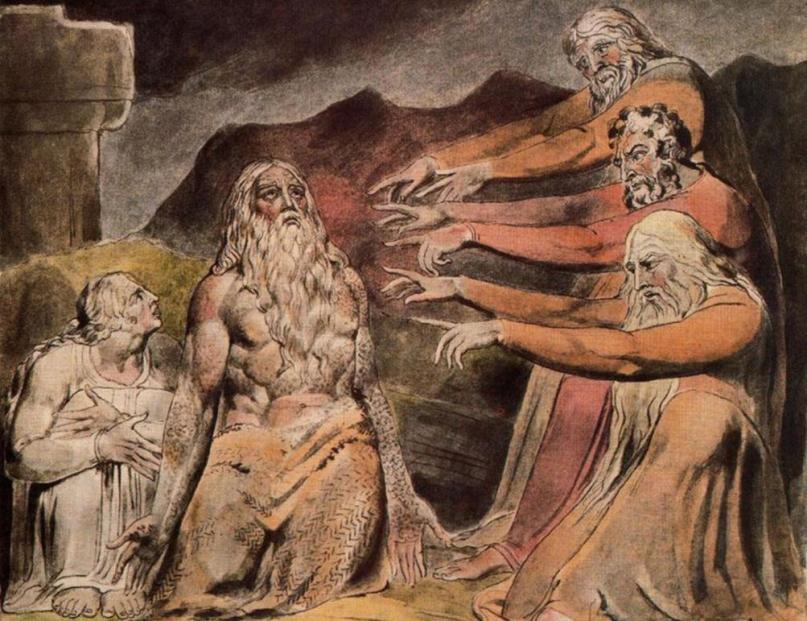
The following prose poem by Wisława Szymborska is the best treatment I have ever read of the Old Testament Book of Job.
SYNOPSIS
Job, sorely tried in both flesh and possessions, curses man’s fate. It is great poetry. His friends arrive and, rending their garments, dissect Job’s guilt before the Lord. Job cries out that he was righteous. Job does not know why the Lord smote him. Job does not want to talk to them. Job wants to talk to the Lord. The Lord God appears in a chariot of whirlwinds. Before him who had been cloven to the bone, He praises the work of his hands: the heavens, the seas, the earth and the beasts thereon. Especially Behemoth, and Leviathan in particular, creatures of which the Deity is justly proud. It is great poetry. Job listens: the Lord God beats around the bush, for the Lord God wishes to beat around the bush. Job therefore hastily prostrates himself before the Lord. Events now transpire in rapid succession. Job regains his donkeys and camels, his oxen and sheep twofold. Skin grows over his grinning skull. And Job goes along with it. Job agrees. Job does not want to ruin a masterpiece.
—Wisława Szymborska. Poems New and Collected 1957-1997
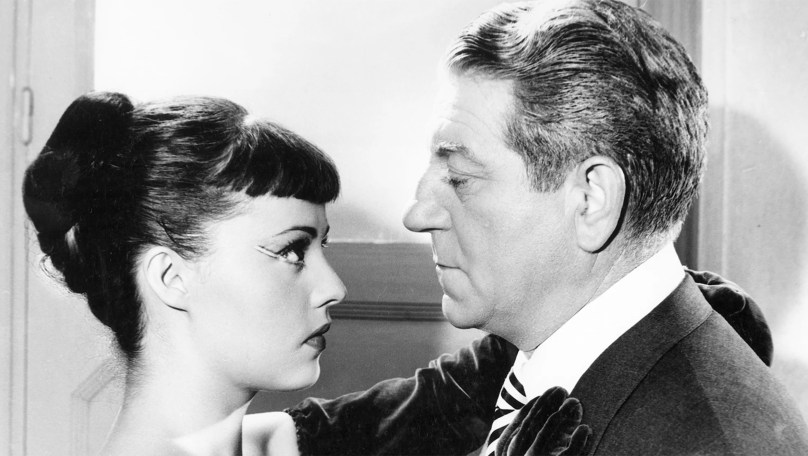
Jeanne Moreau and Jean Gabin in Touchez pas au grisbi
Last week I saw a great film on Turner Classic Movies’ “Noir Alley.” It was Jacques Becker’s 1954 film Touchez pas au grisbi starring Jean Gabin, one of the all-time great actors of the French Cinema. What made him great was the opposite of what makes most American film actors today look cheesy and fake.
It all relates to what is known in cinema as the Kuleshov Effect, an experiment made by Lev Kuleshov and other Soviet filmmakers. Here is how Wikipedia describes it:
Kuleshov edited a short film in which a shot of the expressionless face of Tsarist matinee idol Ivan Mosjoukine was alternated with various other shots (a bowl of soup, a girl in a coffin, a woman on a divan). The film was shown to an audience who believed that the expression on Mosjoukine’s face was different each time he appeared, depending on whether he was “looking at” the bowl of soup, the girl in the coffin, or the woman on the divan, showing an expression of hunger, grief, or desire, respectively. The footage of Mosjoukine was actually the same shot each time. Vsevolod Pudovkin (who later claimed to have been the co-creator of the experiment) described in 1929 how the audience “raved about the acting … the heavy pensiveness of his mood over the forgotten soup, were touched and moved by the deep sorrow with which he looked on the dead child, and noted the lust with which he observed the woman. But we knew that in all three cases the face was exactly the same.”
Kuleshov’s Experiment
In today’s Hollywood, on the other hand, actors tend to overdo the mobility of their facial expressions. Add to that the fact that, when they act the part of a tough guy, they are bearded, scraggly, and tattooed.
Compare that to the acting of Jean Gabin in Touchez pas au grisbi. He always looks the same, dapper and somewhat atone-faced. This is equally true when he is romancing dance hall girls or pumping lead into a rival gangster who wants the gold bars (the grisbi, or loot) he stole in an earlier robbery. One of the reasons, I think, for the popularity of Clint Eastwood is that he acts tough without hamming it up.
Yesterday, I drove 100 miles to the city of Temecula, midway between Riverside and San Diego on Interstate 15. My niece Jennifer Duche was being married to her boyfriend John Margolis at the Falkner Winery east of the city.
The wedding ceremony itself was short and sweet; but as we waited for the outdoor reception to begin, a cold wind from the west set us all to shivering. I was just recovering from a cold from the week before, so I decided to leave before dinner was served.
So instead of tri-tips with chimichurri, I stopped at an In-N-Out Burger in town on my way back to the motel. At least I think I was spared from a relapse.
Temecula is a weird town surrounded by picturesque wineries and neo-Spanish architecture. Most of the restaurants were from regional or national chains. My hotel was brand new, full of elegant suites; and I think I was the only tenant.
The important thing was that I was there to wish Jen and John a good start to their married life together.
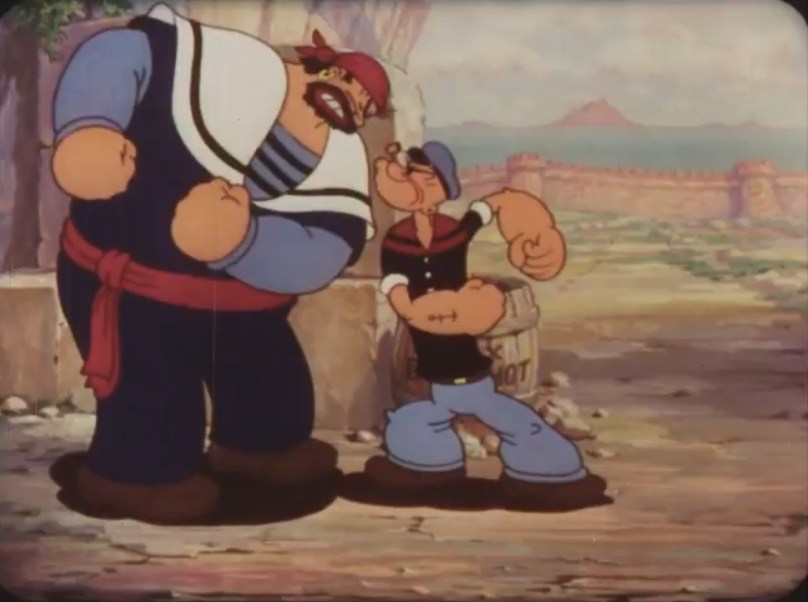
Bluto and Popeye in Popeye the Sailor Meets Sinbad the Sailor
Okay, I know it doesn’t make any sense, but I love it. There’s a sixty-ish grizzled sailor, his beanpole girlfriend, a dark muscle-bound bear of a human, and occasionally this guy who has a voracious hunger for hamburgers (but no cash). The run of the Max and Dave Fleischer Popeye cartoons includes some 108 films from 1933 to 1942.
My favorites are the following three color two-reelers, which have classical Arabian Nights settings:
Of course, I also love all the black and white one-reelers. The usual plot comes down to a fight between Popeye and Bluto, usually over the hand of Olive Oyl, which Popeye wins after he opens a can of spinach and thrusts the contents down his throat. As for Olive, she is typically torn over Popeye and Bluto; but she has no trouble accepting the winner of the fight.
Here is one of my favorite black-and-white cartoons, “The Paneless Window Washer” (1937), which features Popeye and Bluto as duelling window-washers, with Olive the usual prize to the winner:
It’s all pretty old, probably the oldest being the socks, which I bought half a century ago and are still going strong. (As you may have guessed, I am no fashion plate.)
The Archbishop’s Enclosed Garden in Mérida, Yucatán
Do you ever really use your front lawn? There you are, in full view of wandering passersby and the occasional hobo. You feel self-conscious and even slightly stupid—unless you are doing yard work.
Take a look at the above courtyard, which is surrounded on all sides by the Mérida, Yucatán archbishop’s palace. It was a hot, humid day; yet the garden was cool with comfortable benches in the shade. I took advantage of the benches before seeing the rest of the art museum that the archbishop’s palace has been turned into.
I love the Mexican houses that have no setback from the street, instead enclosing a private courtyard that is in actuality the heart of the house. Of course, there are laws that prevent such a thing in the United States. Hence all those front lawns that are thirsty for water and fertilizer and are never used for the pleasure of the family within.
Granted, the archbishop had the means to have something special built for him; but I have seen scores of small gardens in more modest Mexican houses, including many of the small hotels at which I have stayed. In many cases, they are used as bars or simple restaurants.
Sometimes I think that the water shortages in California and other desert states could be alleviated simply by getting rid of those front lawns that attempt to imitate an English country house. California is not England, nor is it the Eastern U.S.








 Tarnmoor
You must be logged in to post a comment.