Philosophy for Whom?

The Emperor Marcus Aurelius (121-180 AD)

Ever since I was a high school student, I pictured myself as studying philosophy and thereby improving my life. Very early on, I learned that most philosophers were too abstruse for the likes of me. I ran up against the likes of Kant, Heidegger, Sartre, Wittgenstein, and Hegel—and found myself considerably less smart than I thought. (However, I liked Sartre’s fiction and plays).

Recently I found myself drawn to the philosophers of ancient Greece and Rome. Now it seems that philosophy is several removes from everyday life. Read A. J. Ayer and Wittgenstein, and you’ll have no idea how to live your life. But read the ancient Stoics, and you can indeed feel better about your life.

Particularly interesting are the following Roman philosophers:

  • Lucius Annaeus Seneca (4 BC to 65 AD) practically ran the Roman Empire while he helped to educate the young Nero. Unfortunately, his pupil did not turn out well; and Nero ordered his tutor to commit suicide. Read in particular his Letters of a Stoic.
  • Epictetus (50-135 AD) was a former slave who wrote a very readable treatise entitled The Enchiridion.
  • Marcus Aurelius (121-180 AD) was the last of the benevolent Antonine emperors. (As great a philosopher as the father was, his son Commodus was one of the worst emperors.) The Meditations are a highly readable journal of Marcus Aurelius’s thoughts while ruling a large part of the known world.

The amazing thing about the works of these Stoic philosophers is that they are relevant and highly readable today. Much more so than most of the present day philosophers.
The Pill of Murti-Bing

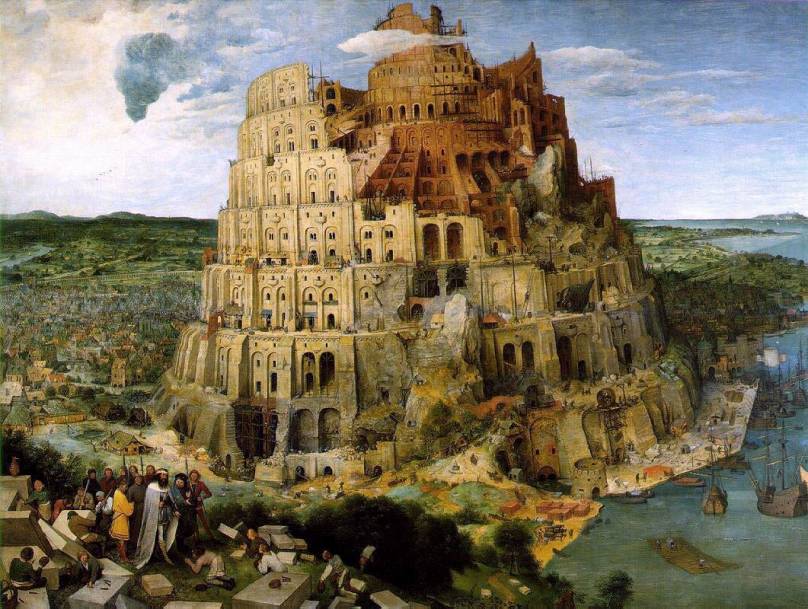
“The Tower of Babel” by Peter Bruegel the Elder

When I used to write ads for the software company whose director of corporate communications I was, I was always running afoul of management, who always insisted that I put a positive spin on every point I made. Anything that could possibly be seen to be negative was to be avoided at all costs.

Being a bit negative is a part of my Hungarian heritage. When your country is on one of the two main invasion paths into Europe (the other being Poland), you can’t help a certain amount of negativity. It’s part of our nature.

I feel there is something wrong about always being positive. It tends to encourage the persons on the other end to be passive and accepting. Polish poet Czeslaw Milosz, writing in The Captive Mind, a book about why people accepted the promises and lies about Communism, quotes an earlier Polish novel from the 1920s:

In this story, Central Europeans facing the prospect of being overrun by unidentified Asiatic hordes pop a little pill [the pill of Murti-Bing] which relieves them of fear and anxiety; buoyed by its effects, they not only accept their new rulers but are positively happy to receive them.

In an article entitled “Murti-Bing Conservatism” written for The American Conservative, Rod Dreher develops this idea:

For Miłosz, Polish intellectuals who capitulated to communism and Soviet rule had taken the pill of Murti-Bing. It was what made their condition bearable. They could not stand to see reality, for if they recognized what was really happening in their country, the pain and shock would make life too much to take.

This is why people who have no financial or status tied up in protecting abuse of corruption within an institution can nevertheless be expected to rally around that institution and its leaders. Those who tell the truth threaten their Murti-Bing pill supply, and therefore their sense of order and well-being. To them, better that a few victims must be made to suffer rather than the entire community be forced to wean itself from Murti-Bing.

In the United States, we are facing a similar situation today—all the way from the opposite end of the political spectrum. It is not Communism that is the cause, but Trumpism. Millions of voters who are either ignorant or disingenuous choose to believe that water runs uphill and that the current President is spouting truth when in actuality he is lying like a rug.

I recommend that anyone interested in what happens to this country read Milosz’s The Captive Mind. It is by far the best book about Communism I have ever read.

Oh, and the Tower of Babel? That’s what happens when our sense of reality has become so fragmented that our society begins to fracture.

Picturesque

Porcelain Tiles Decorate the Outer Wall of a Hungarian Building

In 1853, a Hungarian businessman named Miklós Zsolnay founded the Zsolnay (ZHOAL-nah-ee) Porcelánmanufaktúra Zrt (Zsolnay Porcelain Manufactory Private Limited) in the town of Pécs near the border with what is now Croatia.

Before long, the products of his factory started turning up in the most interesting places, such as the roof of the Matthias Church in Budapest’s Castle District:

Not to mention interestingly designed and wildly colored porcelain vases and figurines:

In a way, one can’t go to Hungary without encountering the works of the Zsolnay Manufactory. Their work has become one of the most characteristic looks in Hungarian architecture, furnishings, and knickknacks.

“God and the Devil Are Blood Brothers”

“Satan Before the Lord” by Corrado Giaquinto (1703-1768)

The following is from Mircea Eliade’s “Mephistopheles and the Androgyne or the Mystery of the Whole” in his The Two and the One.

The motif of the association, indeed the friendship, between God and the Devil is particularly noticeable in a type of cosmogenic myth that is extremely widespread and can be summed up as follows: In the beginning there were only the Waters, and on those Waters walked God and the Devil. God sent the Devil to the bottom of the ocean with orders to bring him a little clay with which to make the World. I omit the details of this cosmic dive and the results of this collaboration by the Devil in the work of Creation. All that concerns our purpose are the Central Asian and South-Eastern European variants which stress the fact that God and the Devil are blood-brothers, or that they are co-eternal or, indeed, God’s inability to complete the World without the Devil’s help.

Classics of Travel Literature

I have always loved reading classical travel books—even if they were written long ago. Here is a list of some of my favorites, listed below in no particular order:

  • Matsuo Basho, The Narrow Road to the Deep North (1694). This is the earliest book on the list including a poetic rendering of the author’stravels to shrines in Japan, written in haiku.
  • Bruce Chatwin, In Patagonia (1977). A not entirely reliable account of the author’s journeys through Patagonia.
  • John Lloyd Stephens, Incidents of Travel in Central America, Chiapas, and Yucatan (1841). The book that made we want to go to Mexico. Great illustrations by Frederick Catherwood.
  • Paul Theroux, The Old Patagonian Express (1979). Still my favorite of his works, made me want to visit South America.
  • Freya Stark, The Valleys of the Assassins and Other Persian Travels (1934). She traveled alone throughout the Middle East and lived to be 100 years old.
  • Robnert Byron, The Road to Oxiana (1937). A travel book in which the author fails to reach his destination, but what he does see his so interesting that it doesn’t matter.
  • Sir Richard Francis Burton, Personal Narrative of a Pilgrimage to Al Medinah and Meccah (1855-1856). It took incredible gall for an Englishman to pass himself off as an Afghan physician and visit the holiest sites of Islam.
  • Jonathan Raban, Passage to Juneau: A Sea and Its Meanings (1999). Life doesn’t stop just because you want to pilot a yacht to Juneau, Alaska.
  • Ryszard Kapuściński, Travels with Herodotus (2007). A brilliant Polish travel writer tells how the ancient Grfeek historian informed him on his travels.
  • D. H. Lawrence, Sea and Sardinia (1921). It was written in just a few days, but it’s great anyhow.
  • Lawrence Durrell, Bitter Lemons (1957). The author of The Alexandria Quartet describes his years spent on the island of Cyprus in the Mediterranean.
  • Patrick Leigh Fermor, A Time of Gifts (1977). Travels through Central Europe just before the Second World War.

I cannot help but think some of my other favorites are missing. What you won’t find on this list are books like Eat, Pray, Love and such bourgeois fantasies as A Year in Provence. If that’s what you prefer in travel literature, I would prefer that you don’t undertake to read any of my recommendations. Ever.

The Art of Mihaly Munkácsy

Mihály Munkácsy’s “The Cell of the Condemned”

This is the first of several posts I will write about famous Hungarian painters. IO begin with Mihály Munkácsy (1844-1900), known primarily for his genre paintings and Biblical scenes. Although of Bavarian origin, he changed his name to reflect the town of his birth: Munkács. He traveled extensively in Europe and worked with a number of well-known artists of the time.

According to Andrienn Szentesi, writing in The Essential Guide to Being Hungarian, edited by István Bori:

Mihály Munkácsy’s first masterpiece was Siralomház (Cell of the Condemned). Fifteen human figures can be seen in this painting, people to whom, it is safe to presume, something terrible has just happened. Dark hues, not least various shades of brown and black, have the run of this painting, too; and of course this serves to reinforce the work’s depressing theme. Also discernible, however, is just ba bit of white and red; for example, a little girl calls attention to herself as she stands in a corner in a red skirt. What has she just been through? What fate awaits her?

Mihály Munkácsy’s “Paris Interior”

Somewhat lighter is Munkácsy’s Paris Interior (above). A young woman sits reading while a small child plays on the floor behind her.

Mihály Munkácsy’s “Christ Before Pilate” (1882)

Above is one of three Biblical subjects painted in a series that also included Golgotha and Ecce Homo.

Munkácsy dies in a Bonn mental hospital in 1900. As the Wikipedia article on him says, “Neither 19th century visual art nor the historical developments of Hungarian art can be discussed without considering Munkácsy’s contributions. His works are considered the apogee of national painting. He was a standard-setter, an oeuvre of reference value.”

In Search of Okayness

The Archetypal Image of Wellness

In America, the cult of Wellness promises endlessly but doesn’t deliver. The image of a twenty-something blonde doing yoga in a beautiful landscape is all well and good, but not exactly the best guide for someone who has been knocked around by life.

It has also become associated with unhelpful practices such as opposition to vaccines, strange dietary practices and weird nutritional supplements.

What I propose to replace the notion of wellness is a concept I have invented called okayness. Let’s face it: You’re not going to live a perfect life. You will have strange illnesses, your teeth will be less than perfect, your family life will be somewhere south of the rom com ideal. What you need is a philosophy of living an acceptable, or okay, life.

Start by disavowing perfection. Start feeling some compassion for yourself. You’re not going to eat seven pounds of kale each day or buy $500 worth of nostrums advertised or recommended by TikTok influencers.

Go for variety in your life. That includes food, activities, and travel. Don’t waste time arguing about religion, politics, or money. Get by. Be okay!

Enter the Crane

From Ancient Greece Comes the Story About Who We Are

This is a reprint from a blog that I posted eight years ago. I would not change a word. Except: Note that I was not at the Santa Monica Library today.

In case you are not familiar with this ancient tale by Aesop, here is a retelling from a website called Fables of Aesop:

The Frogs were tired of governing themselves. They had so much freedom that it had spoiled them, and they did nothing but sit around croaking in a bored manner and wishing for a government that could entertain them with the pomp and display of royalty, and rule them in a way to make them know they were being ruled. No milk and water government for them, they declared. So they sent a petition to Jupiter asking for a king.

Jupiter saw what simple and foolish creatures they were, but to keep them quiet and make them think they had a king he threw down a huge log, which fell into the water with a great splash. The Frogs hid themselves among the reeds and grasses, thinking the new king to be some fearful giant. But they soon discovered how tame and peaceable King Log was. In a short time the younger Frogs were using him for a diving platform, while the older Frogs made him a meeting place, where they complained loudly to Jupiter about the government.

To teach the Frogs a lesson the ruler of the gods now sent a Crane to be king of Frogland. The Crane proved to be a very different sort of king from old King Log. He gobbled up the poor Frogs right and left and they soon saw what fools they had been. In mournful croaks they begged Jupiter to take away the cruel tyrant before they should all be destroyed.

“How now!” cried Jupiter “Are you not yet content? You have what you asked for and so you have only yourselves to blame for your misfortunes.”

In the archaic L’Estrange version, the moral is: “The mobile are uneasie without a ruler: they are as restless with one; and the oft’ner they shift, the worse they are; so that government or no government; a king of God’s making, or of the peoples, or none at all; the multitude are never to be satisfied.”

As I sat down reading in the Santa Monica Main Library this morning, I noticed that the people seated around me look as if they had lost their battle with life. One black man alternately wept and swore; and a bearded youth in a hoodie kept calling his family to beg money for his anxiety medications. The coffee shops are full of people with notebook computers, undoubtedly using social media to communicate with people they don’t know or really care about. The natives appear to be restless.

This restlessness is probably what elected our current President, who is very much like Aesop’s King Stork. He seems to be comfortable only with billionaires and despots. And what can we expect from him? The answer, in one word is covfefe, and lots of it—brown, gooey, and pungent.

Entering the Era of Crummy Technology

(Not So) Smart Phones

Little did I think way back around 1964 when I was fooling around with a General Electric 265 computer at Dartmouth College that computer technology would become so prevalent sixty years later. I moved from being an English Major in 1966 to seeking a Master of Arts in film history and criticism at UCLA in Los Angeles to becoming a self trained computer programmer in 1968 at System Development Corporation (SDC) in Santa Monica, California.

From there I moved on being a computer programmer for Urban Decision Systems in 1971, morphing into a Director of Corporate Communications to avoid working directly under the president’s thumb. When that went bust in 1991, I became an Network Administrator and Office Manager for a Westwood accounting firm, which lasted until the end of 2017.

I am now retired after a lifetime with computers. As I look around me today, I find technology everywhere—from automated attendant services that make it a 45-minute ordeal to telephone a corporation to expensive smart phones that are inferior in quality to the old Bell land lines to error-prone GPS systems to touch-screen interfaces that force you to repeat your keystrokes endlessly.

Tomorrow, I will have to pay a Blue Cross bill over the phone—and I dread the interaction with their automated attendant. They refuse to make it easy to pay them unless I let them auto-fill all my prescriptions. Even when my doctor changes medications or dosages.

I own a flip phone, but not a smart phone. Being a senior, I cannot read the tiny screens without changing to my reading glasses. If I were an eight-armed Hindu deity, it would be no trouble at all. But, alas, I am a mere human.

At SDC, I wrote three hefty user manuals. Now I find that user manuals are hard to come by. If you can’t find a portable data file (pdf) version on the Internet, you have to just fly by the seat of your pants. I guess people just don’t like to read any more.

What frightens me is not that we advance three steps forward and two steps back, but two steps forward and three steps back.