


In a heat wave such as the one we are now experiencing, I would have to say from the time the sun goes down in the evening to the time the sun comes up in the morning.
Home » Articles posted by Tarnmoor (Page 20)
Author Archives: Tarnmoor
August Is for Lizards
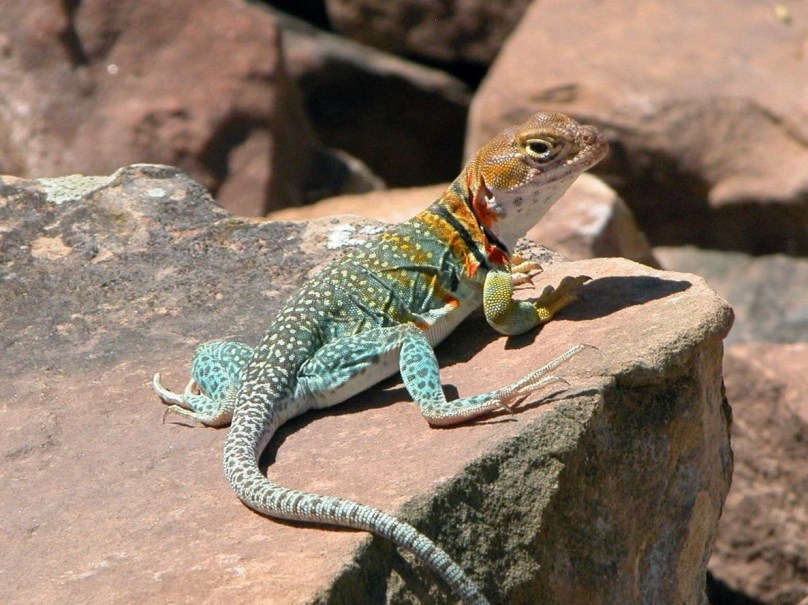
We’ve had it pretty easy up until now. We all knew that the heat would suddenly descend on us along the Southern California coast, just as it has for weeks in the East, South, and Midwest.
Even now, it is nowhere near as hot and sticky here as it is inland or in the San Fernando and San Gabriel Valleys. (And we won’t even mention the Coachella Valley.)
Living as we do in an apartment building without any insulation, let alone air conditioning, it can get hot after a few days of heat radiating toward our walls and roof—and it can stay hot. Martine and I have fans going all over the place. It helps, particularly after the sun goes down; but dropping off to sleep is not easy.
I was going to cook a minted rice casserole for supper. As dinner time approached, however, I gave up on the idea. What? Turn on the oven on a day like this? No way José!
Instead I had some blue cheese with Ritz crackers, a glass of unsweetened ice tea, and a white peach.
Based on past experience, I knew the heat wave would last for days, perhaps even weeks, longer than the weather forecasters said it would. Time to live like a lizard!
Giving Life to a Period in History
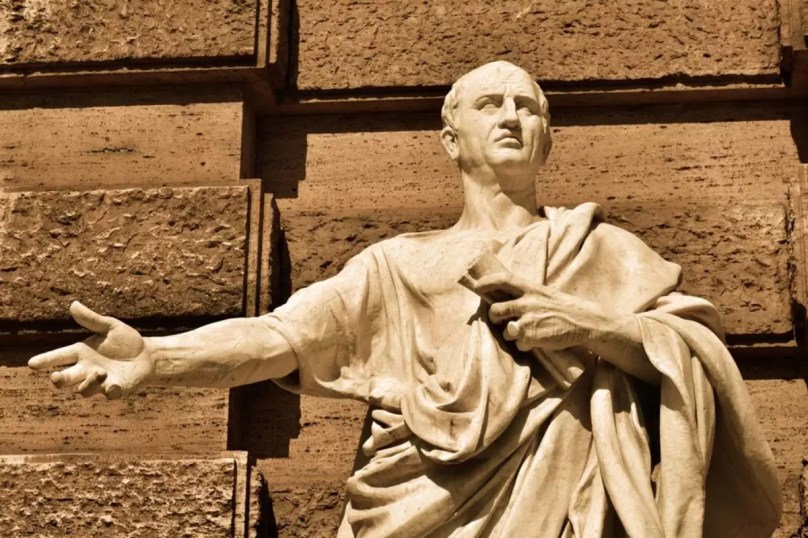
Roman Senator Marcus Tullius Cicero (100-43 BCE)
How many letters and journals have come down to us from Ancient Egypt or Classical Greece or Biblical Palestine? None. Consequently, our view of their respective civilizations is an incomplete one. For the last years of the Roman Republic, however, we have a voluminous orator, letter writer, and philosopher who was very much at the center of the action.
Marcus Tullius Cicero was one of the most powerful members of the Roman Senate. From him, we have political orations, speeches for the prosecution or defense of murder trials, essays on the gods and growing old (among other subjects), and letters to friends and political associates. In particular, his letters to his friend Atticus give us a picture of his times such as we do not have from any other ancient civilization.
What is more, his works are eminently readable today. In fact, his oration attacking Mark Antony was so effective that the Roman general promptly sent out an assassin to shut him up permanently.
I have just finished viewing the HBO/BBC co-produced mini-series called Rome (2005-2007) which covered the last days of the Roman Republic. The twenty-two episodes include incidents in the life of Julius Caesar, Augustus Caesar, Mark Antony, Pompey the Great, Brutus, Cassius, Cleopatra, and Cicero.
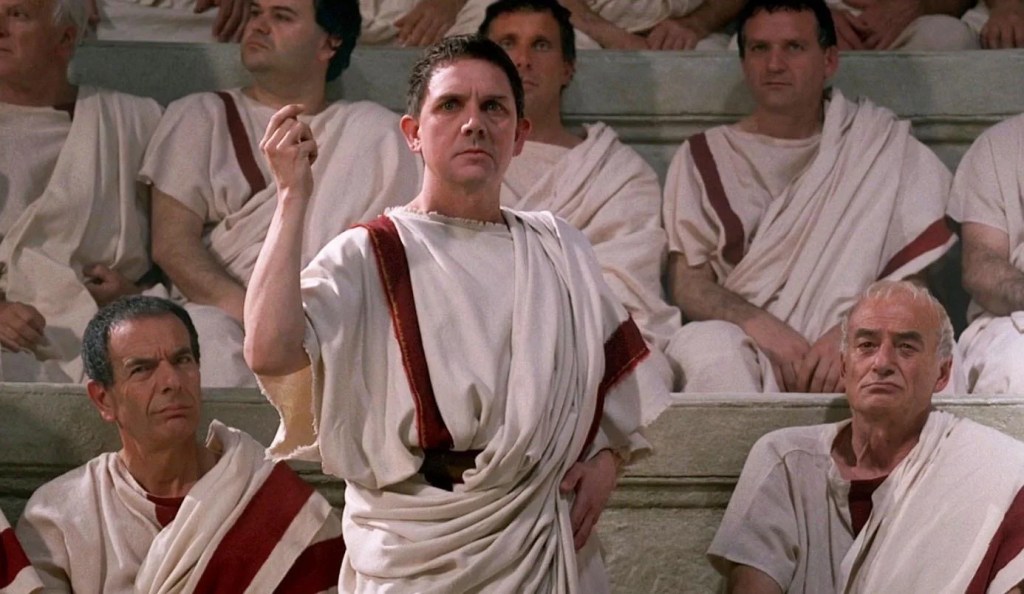
David Bamber as Cicero in the HBO/BBC Mini-Series Rome
Both the mini-series and Cicero’s own writings portray the senator as a deeply divided individual. He was a follower of Gnaeus Pompey and was with him when he lost to Julius Caesar at Pharsalus. Then he sided with Brutus, Cassius, and the other slayers of Julius Caesar and was with them at the Battle of Philippi. That did not sit well with Antony and Octavian (later renamed Augustus), who agreed to his demise.
Even more than two thousand years later, we can see clearly that Cicero was a follower of the old, traditional senate and of Cato the Younger, who committed suicide after Philippi. In 63 BCE, he led the overthrow of the conspiracy of Lucius Sergius Catiline, having several of the participants executed without trial. Ever after, he was disappointed that the people did not express sufficient gratitude. It was clearly a case of, “Yes, but what have you done for us lately?”
I strongly urge you to read some of the excellent Penguin translations of Cicero’s work and, if you have time, view the Rome mini-series, which is still available on HBO.
Recipe


At present, my favorite recipe is for Spanish Rice. You can read about it in this blog post from last year..
Excitement?


It’s been a long time since I’ve been excited about anything. Probably because I don’t have the money to travel to the places I want to visit. Oh, well, it’s not bad to be on an even keel either.
Mexican Rules

I was reading Oliver Sacks’s Oaxaca Journal—a book I do not recommend you read unless you are a botanist—when I came across this passage which reminded me of past trips to Mexico:
“What gate do we go from?” everyone is asking. “It’s Gate 10,” someone says. “They told me it was Gate 10.”
“It’s Gate 3,” someone else says, “It’s up there on the board, Gate 3.” Yet another person has been told we are leaving from Gate 5. I have an odd feeling that the gate number is still, at this point, indeterminate. One thought is that there are only rumors of gate numbers until, at a critical point, one number wins. Or that the gate is indeterminable in a Heisenbergian sense, only becoming determinate at the final moment (which, if I have the right phrase, “collapses the wave function”). Or that the plane, or its probability, leaves from several gates simultaneously, pursuing all possible paths to Oaxaca..
. . . . . . . . . . . . . . . . . . . . . . . . . . . . . . . . . .
This reminds me of a trip my brother and I took to Mexico in 1979. We flew into Mexico’s Benito Juarez Airport and were to take a connecting flight to the misnamed city of Villahermosa. Not only was the gate uncertain, not only was the time uncertain, but whether the flight would take place at all was uncertain. (You can read more about it here.) This was a interesting lesson in traveling under Mexican rules.
This was no longer the precise Anglo-Saxon world we had just left behind. There was uncertainty everywhere. If you let it bother you, you will mot enjoy your vacation. If, on the other hand, you take it as a “Heisenbergian” event and hang in there to see how it all sorts out, you not only win but you learn an interesting lesson that, in the end, you can take back home with you.
A Brief Tenure

Statue of Julius Caesar as a God
I have just finished reading Adrian Keith Goldsworthy’s biography, Caesar: Life of a Colossus. While not pertaining directly to the subject of his biography, Goldsworthy includes an amusing anecdote about a consul who dies on his last day in office and the consul-for-a-day who succeeds him:
When Fabius Maximus went to watch a play and was announced as consul, the audience is said to have yelled out, “He is no consul!” He died on the morning of his last day in office. Caesar received the news while presiding over a meeting of the Tribal Assembly, which was going to elect quaestors for the next year. Instead, he had the people reconvene as the Comitia Centuriata and vote for a new consul. Just after midday another of his legates from Gaul was chosen, Caius Caninius Rebilus, whose spell as consul therefore lasted no more than a few hours. A few days later Cicero joked that ‘in the consulship of Caninius nobody ate lunch. However, nothing bad occurred while he was consul—for his vigilance was so incredible that throughout his entire consulship he never went to sleep.’ At the time he is supposed to have urged everyone to rush and congratulate Caninius before his office expired.
Tojásleves

The Plaza Mayor in Cuenca, Ecuador
My brother and I were in Cuenca, Ecuador. In a few days, he had to leave to honor a work commitment, while I was to stay behind for another week. On the Plaza Mayor in Cuenca, Dan and I made an interesting discovery. There was a café that served a perfectly authentic Hungarian tojásleves, or egg soup.
When we checked for any Magyar influence in the kitchen, we were met with looks of confusion and consternation. What reminded us so much of our mother’s beloved egg soup was actually a local dish.
Sometimes, one can travel halfway across the world only to find something that reminds one of home. Not always. More often than not, one makes strange new discoveries.
This time, after a couple weeks in Ecuador, Dan and I had a taste that sent us back to our childhood in Cleveland. Here is a copy of the original Hungarian recipe. Only, Mom would add some sour cream in ours.
Top 10


In no particular order:
- John Ford: The Searchers
- Buster Keaton: The General
- Howard Hawks: The Big Sleep
- Alfred Hitchcock: Vertigo
- Carl Theodor Dreyer: Day of Wrath
- Jean-Luc Godard: Alphaville
- Jean-Pierre Melville: Touchez Pas au Grisbi
- Yasujiro Ozu: Late Spring
- Kenji Mizoguchi: Sansho the Bailiff
- Federico Fellini: La Strada
It’s a Dog’s Life
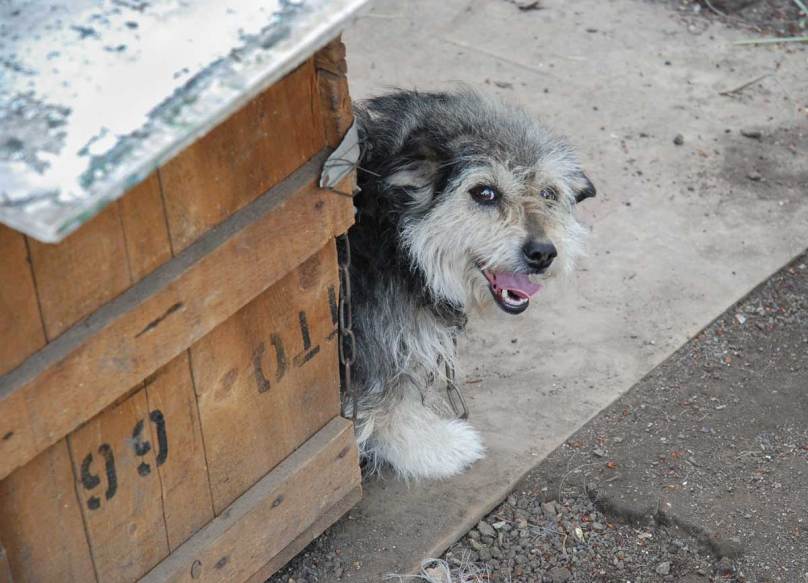
I could not believe my eyes. When I woke up this morning, I joined Martine on the living room couch while she was watching the news. Fox news, as it turned out. Somewhere in South Los Angeles, a pedestrian was killed by a hit-and-run driver. The newscasters practically ignored the dead human, spending all their sympathy on the victim’s dog. Much was made of the fact that a good Samaritan had volunteered to take the dog.
In some future newscast, I fully expect to see the dead pedestrian ignored entirely while an ambulance and psychiatrist are called in for the victim’s pet.
Only in America …
 Tarnmoor
You must be logged in to post a comment.