


There’s little or no enjoyment in writing. If you want to write, you have to write—frequently. It’s a compulsion. On the plus side, being a writer makes me a better reader.
Home » Articles posted by Tarnmoor (Page 21)
Author Archives: Tarnmoor
Peele Castle in a Storm
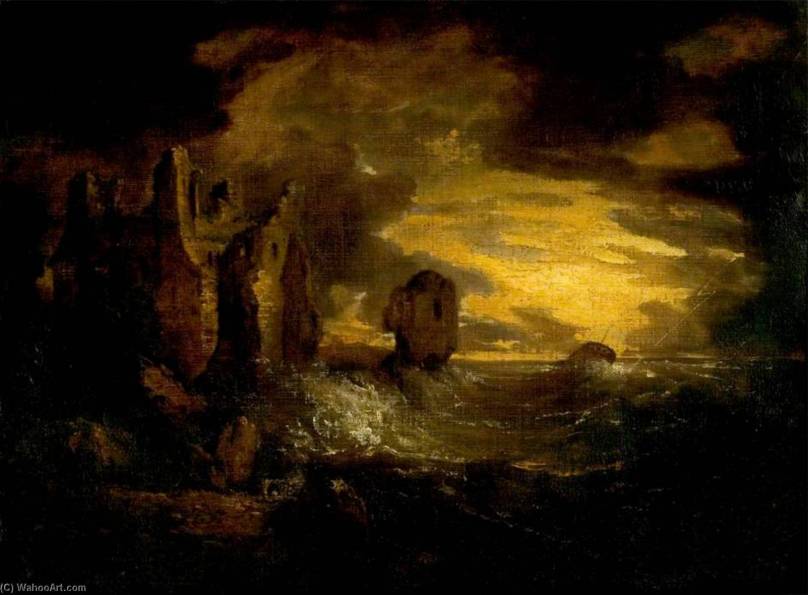
George Howland Beaumont: “Peele Castle in a Storm, Cumbria, 1800”
William Wordsworth is and always has been one of my favorite poets. The Beaumont named in the poem is the painter George Howland Beaumont (1753-1827), creator of the above painting.
Elegiac Stanzas Suggested by a Picture of Peele Castle in a Storm, Painted by Sir George Beaumont
I was thy neighbour once, thou rugged Pile!
Four summer weeks I dwelt in sight of thee:
I saw thee every day; and all the while
Thy Form was sleeping on a glassy sea.
So pure the sky, so quiet was the air!
So like, so very like, was day to day!
Whene’er I looked, thy Image still was there;
It trembled, but it never passed away.
How perfect was the calm! it seemed no sleep;
No mood, which season takes away, or brings:
I could have fancied that the mighty Deep
Was even the gentlest of all gentle things.
Ah! then, if mine had been the Painter’s hand,
To express what then I saw; and add the gleam,
The light that never was, on sea or land,
The consecration, and the Poet’s dream;
I would have planted thee, thou hoary Pile
mid a world how different from this!
Beside a sea that could not cease to smile;
On tranquil land, beneath a sky of bliss.
Thou shouldst have seemed a treasure-house divine
Of peaceful years; a chronicle of heaven;—
Of all the sunbeams that did ever shine
The very sweetest had to thee been given.
A Picture had it been of lasting ease,
Elysian quiet, without toil or strife;
No motion but the moving tide, a breeze,
Or merely silent Nature’s breathing life.
Such, in the fond illusion of my heart,
Such Picture would I at that time have made:
And seen the soul of truth in every part,
A steadfast peace that might not be betrayed.
So once it would have been,—’tis so no more;
I have submitted to a new control:
A power is gone, which nothing can restore;
A deep distress hath humanised my Soul.
Not for a moment could I now behold
A smiling sea, and be what I have been:
The feeling of my loss will ne’er be old;
This, which I know, I speak with mind serene.
Then, Beaumont, Friend! who would have been the Friend,
If he had lived, of Him whom I deplore,
This work of thine I blame not, but commend;
This sea in anger, and that dismal shore.
O ’tis a passionate Work!—yet wise and well,
Well chosen is the spirit that is here;
That Hulk which labours in the deadly swell,
This rueful sky, this pageantry of fear!
And this huge Castle, standing here sublime,
I love to see the look with which it braves,
Cased in the unfeeling armour of old time,
The lightning, the fierce wind, the trampling waves.
Farewell, farewell the heart that lives alone,
Housed in a dream, at distance from the Kind!
Such happiness, wherever it be known,
Is to be pitied; for ’tis surely blind.
But welcome fortitude, and patient cheer,
And frequent sights of what is to be borne!
Such sights, or worse, as are before me here.—
Not without hope we suffer and we mourn.
El Segundo Car Show

Purple 1950 Mercury
Martine and I used to frequent the Automobile Driving Museum in El Segundo, but were dismayed to find that it had closed its doors earlier this year. Luckily, the City of El Segundo puts on its own car show once a year and closes down its main commercial streets to make room.

Flyer for El Segundo Car Show
Unlike me, Martine is an aficionado of classical American cars, particularly of the 1950s, 1960s, and 1970s. She had a number of conversations with the car owners, two of whom came up to me afterwards and spoke highly of her grasp of the subject. In all, we spent three and a half hours looking at hundreds of cars, most of which were models about which my little girl knew her stuff.

Martine Admiring Soapbox Derby Racer
At the show, we learned of several other upcoming car shows, including one at the Police Academy in Elysian Park sponsored by the LAPD. It looks like we’ll be going to that one, too.
Our Nero
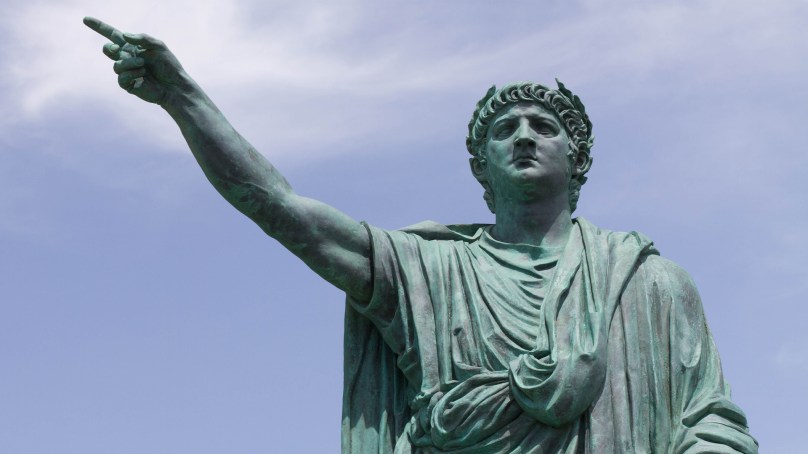
Roman Emperor Nero (AD 37-68)
Much as I dislike writing about politics, I have recently noticed some strange resemblances between the current occupant of the White House and the Roman Emperor Nero:
Actors. Nero appeared before the Roman public as a poet, musician, and charioteer; while our president was famed as the actor in a reality TV show called “The Apprentice.”
Wrecking. Nero purportedly burned down a large part of Rome so he could build a gigantic palace for himself called the domus aureus, “The Golden House.” Our president is destroying the institutions of government that he feels do not benefit billionaires like himself.
Praetorian Guard. Nero was murdered by his own Praetorian Guard. Our president, on the other hand, is developing his own Praetorian Guard called ICE. To date, they have not murdered him.
Low-Class Supporters. The provision of “bread and circuses” to the Roman masses made Nero popular among lower class denizens of Rome. Whereas the persecution of various minorities is popular among the red-hatted MAGA supporters of our president.
So far, our current president has not directly ordered any of his family murdered, but if I were Melania, Donald Junior, or Eric, I would not sleep well of nights.
Future


At my age (eighty), it is tempting the fates to have clearly defined goals, other than to live out the remainder of my days with peace and growing understanding.
Emergency


For what? An earthquake? A tidal wave? A volcanic eruption? An alien invasion? Hangnail?
Eiseley on Spiders

Yesterday, I posted a quote from Loren Eiseley’s The Unexpected Universe about spiders. He frequently thought about and wrote about seemingly small and insignificant creatures. Here is a poem he wrote about spiders in 1928 that was published in Prairie Schooner:
Spiders
Spiders
are poisonous, hairy, secretive.
Spiders are old—
they watch from dark corners while wills are made.
They weave grey webs for flies, and wait…
tiles drop from the roof,
leaves turn moldy under the black, slanting rain,
people die…
and the spiders inherit everything.
Spiders are antiquarians—
fond of living among ghosts and haunted ruins,
The black jade pillars totter in the halls of Marduk;
stones fall from the archways,
at night grey sand
whines by the lampless windows.
The god lies shattered,
his green-jeweled eyes are gone;
the sockets are hacked and empty as a skull.
Upon his face a squat tarantula is creeping…
a bland yellow noon
smiles at a black tarantula
creeping on the skull of a god!
Spiders are ghouls—
they live secret lives in graveyards,
A red spear of light
pierces the stained vault-window
and makes a warm pool on a black coffin in a niche.
A lean spider droops on a thread from above,
falls into the light, and changes color…
a crimson spider
sprawling on an ebony coffin
mumbles a fly in his toothless mouth.
Spiders…
time is a spider,
the world is a fly
caught in the invisible, stranded web of space.
It sways and turns aimlessly
in the winds blowing up from the void.
Slowly it desiccates… crumbles…
the stars weave over it.
It hangs…
forgotten.
Word


Irregardless
Peace


Above all, stay away from politics and avoid the news like the plague. It’s the arena where the worst shit happens.
Lessons from a Spider

Orb Weaver Spider in Its Web
Probably the most famous lesson learned from a spider weaving its web is of Robert the Bruce, King of Scotland, who, hidden in a cave, marveled at a spider’s persistence in completing its web. Supposedly, it inspired him to attack the English at Bannockburn in 1314 and win a decisive victory. American naturalist Loren Eiseley learned a very different lesson watching an orb spider weaving its web. The following quote comes from his collection of essays entitled The Unexpected Universe.
For example, I once received an unexpected lesson from a spider.
It happened far away on a rainy morning in the West. I had come up a long gulch looking for fossils, and there, just at eye level, lurked a huge yellow-and-black orb spider, whose web was moored to the tall spears of buffalo grass at the edge of the arroyo. It was her universe, and her senses did not extend beyond the lines and spokes of the great wheel she inhabited. Her extended claws could feel every vibration throughout that delicate structure. She knew the tug of wind, the fall of a raindrop, the flutter of a trapped moth’s wing. Down one spoke of the web ran a stout ribbon of gossamer on which she could hurry out to investigate her prey.
Curious, I took a pencil from my pocket and touched a strand of the web. Immediately there was a response. The web, plucked by its menacing occupant, began to vibrate until it was a blur. Anything that had brushed claw or wing against that amazing snare would be thoroughly entrapped. As the vibrations slowed, I could see the owner fingering her guidelines for signs of struggle. A pencil point was an intrusion into this universe for which no precedent existed. Spider was circumscribed by spider ideas; its universe was spider universe. All outside was irrational, extraneous, at best, raw material for spider. As I proceeded on my way along the gully, like a vast impossible shadow, I realized that in the world of spider I did not exist…..
I began to see that among the many universes in which the world of living creatures existed, some were large, some small, but that all, including man’s, were in some way limited or finite. We were creatures of many different dimensions passing through each other’s lives like ghosts through doors.
 Tarnmoor
You must be logged in to post a comment.