Tsutomo Yamazaki (Left) in Kurosawa’s High and Low (1963)
This is an unusual thing to say, but if I were to look at all the great film directors with a point of view of selecting the one that would make the best general on the battlefield, my choice would be Japan’s Akira Kurosawa (1910-1998).
Yesterday evening I did not post here because I was watching Kurosawa’s great noir film High and Low for the third time. The tale follows Toshiro Mifune as a shoe manufacturer whose son is kidnapped and held for ransom. Except it turns out that it is actually his live-in chauffeur’s son who is taken. In paying the ransom anyhow, Mifune impoverishes himself, losing his business, his house, and even his furniture.
Why do I feel that Kurosawa would make an able general? In no other film (except one, that I shall mention later) is there so much intelligently conveyed detail that enables a viewer to follow the police investigation in all its aspects during its 143 minute length without feeling lost. And the film gallops along like a 73 minuter Poverty Row quickie.
During its course, Kurosawa takes us into such a realistic picture of heroine addiction that, even today, would be too much for Hollywood to handle.
The only other film that so capably marshals s vast amount of detail is the same director’s Seven Samurai (1954). This is actually a film about a 16th century military campaign in which seven masterless samurai help farmers fight back an invasion of forty mounted bandits who are after their crops. Throughout the film’s 207 minute length, we are aware of what is happening in every part of the battlefield as the samurai and farmers battle the bandits. As with High and Low, the film zips along at a fast pace despite a vast amount of detail without losing its audience.
Compare these with the average current Hollywood production in which 120 minutes seems like a lifetime and the audience is slogging through a swamp shortly after the opening credits.
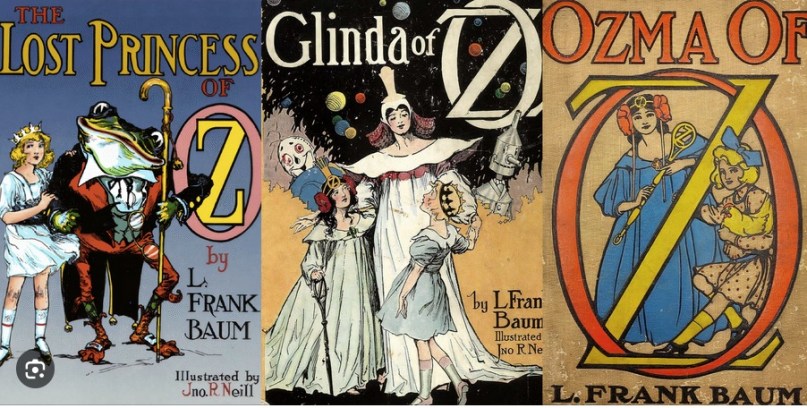
Original Covers of Three of L. Frank Baum’s Oz Books
It’s all well and good to read serious literature, but every once in a while it is good to return to the land of childhood. Why? It is a place where imagination rules, and we can all use a little childlike imagination to see us through the consequences of our bad decisions.
After reading a serious Russian novel (Eugene Vodolazkin’s The Aviator), I decided to read the sequel to L. Frank Baum’s The Wonderful Wizard of Oz, namely: The Marvelous Land of Oz. In all, Baum wrote some fourteen books set in the Land of Oz, and I intend to read all of them—even the ones I have read some decades ago.
In this second book of the series, there is no Wizard, no Dorothy, no Toto, and no Kansas. We do, however, encounter the Scarecrow and the Tin Woodsman and even the Good Witch Glinda. As Baum was no slave to precedent, he introduces several new characters: the boy Tip, Jack Pumpkinhead, an animated sawhorse, and others. There are in addition the moderately bad witch Mombi, the feminist General Jinjur, the Gump (an animated flying machine made of inanimate spare parts), and H. M. Woggle-Bug, T. E. (The H. M. is short for Highly Magnified, and T. E. refers to his being Thoroughly Educated.)
The closest thing to a villain is Mombi, who is allied with General Jinjur and his all-girl army to rule Oz after the Scarecrow and his friends are driven out. Jinjur’s army does not come across as much of a threat, as they are armed only with knitting needles.
I plan to read one Oz book per month until I have finished the series, which I have complete on my Kindle.
One of my favorite American poets is a member of the Muscogee (Creek) Native American Nation, who has served three terms as poet laureate of the United States. Her poetry is simply magical, as the following sample shows:
Don’t Bother the Earth Spirit
Don’t bother the earth spirit who lives here. She is working on a story. It is the oldest story in the world and it is delicate, changing. If she sees you watching she will invite you in for coffee, give you warm bread, and you will be obligated to stay and listen. But this is no ordinary story. You will have to endure earthquakes, lightning, the deaths of all those you love, the most blinding beauty. It’s a story so compelling you may never want to leave; this is how she traps you. See that stone finger over there? That is the only one who ever escaped.
Several days ago, Martine expressed some interest in going to a Walmart … because, well, she hadn’t seen the inside of a megastore for several years. With some reluctance, I drove her to the giant Walmart in Panorama City, at the corner of Roscoe and Van Nuys. Originally, I intended to drop her off and go to a huge bookstore nearby. But then I asked myself, “Do I really need to buy more books?”
That was my mistake. For almost two hours I wandered around the store looking at all the merchandise. In the menswear department, I didn’t see any pants under 30 inches in the inseam. I looked at the shirts: They had flimsy pockets that would dump my reading glasses on the ground every time I bent over.
I guess that for some people seeing so much merchandise and so many services in one place was exhilarating. For me, it was profoundly depressing.
It brought to mind the Atlantic Mills megastore in Bedford, Ohio to which my parents took me. I remember we bought a clunky Recordak tape recorder there. Then there was the huge Fedco Store on La Cienega whose late night pharmacy I had to visit after a visit to the emergency ward for urethral strictures.
I was delighted when I got Martine to agree to leave after purchasing a box of cheap light bulbs. From there, we drove to Otto’s Hungarian Import Store and Deli in Burbank to buy some gyulai kolbasz sausage. We ate lunch nearby at Lancer’s on Victory near Magnolia. It’s one of those 1950s style coffee shops that managed to make it to the 21st century.
I used to subscribe to the New York Review of Books in print form, but I got lazy about reading the issues. Yet I saved all of them and am now reading them, mostly when I go out by myself to lunch. Today, at a local Egyptian Restaurant in Culver City, I read this poem by Diane Seuss in an issue dated June 23, 2022. It’s called “Weeds.”
Weeds
The danger of memory is going to it for respite. Respite risks entrapment. Don’t debauch yourself by living in some former version of yourself that was more or less naked. Maybe it felt better then, but you were not better. You were smaller, as the rain gauge must fill to the brim with its full portion of suffering.
What can memory be in these terrible times? Only instruction. Not a dwelling.
Or if you must dwell: The sweet smell of weeds then. The sweet smell of weeds now. An endurance. A standoff. A rest.
Whenever things go blooey here in Sunny California, as they are wont to do from time to time, I remind myself that I am at the center of my being an Eastern European. I may have been born in Cleveland, Ohio, but the language that spoke most intimately to my emotions was Magyar (Hungarian).
My life has been a series of shifts from east to west and back again. That has prevented me from being depressed at setbacks that have occurred. We Eastern Europeans are used to suffering. But we have our own insane pride that prevents us from falling apart.
Consequently, I love reading literature that has been translated from Hungarian, Czech, Polish, Serbian, Romanian, Ukrainian, and Russian. And whatever my politics are—and they are certainly not on the side of Vladimir Putin—I see the stories, novels, dramas, and poems the product of a people, not a political system. The people are all right, however the politics might suck.
I have always dreamed of riding from Moscow to Vladivostok on the Trans-Siberian Railroad. To see a vast country unrolling before my eyes on the long trip to the Sea of Japan. I also see myself as reading long Russian novels during that trip. Alas, I think I am now too old for such an adventurous journey.
Currently, I am reading Eugene Vodolazkin’s The Aviator, which makes me feel these things more intensely.
Although I learned to play chess at the age of nine, I am no wizard at the game. In fact, my game is pretty mediocre. I leave pieces en prise (open to capture). I miss mates in two. I fall into opening traps. But I love the game and spend an average of an hour a day on Chess.Com solving problems, playing chess bots, and following the latest chess news.
When the conversation turns to the latest computer game, I just smirk. Chess is a game that will occupy my mind for a lifetime, not merely an intermission on TV.
If you look at all the possible combinations for white and black for just the first ten moves, the number is larger than the number of atoms in the universe. The game is over a thousand years old: It first emerged in India as the game called Chaturanga. It came to the West through Persia, where it was called Shah Mat (“The King Is Helpless”). That is where the term Checkmate arose.
I regularly play chess openings that date from the Sixteenth Century (the Ruy Lopez). There are mating patterns from the Eighteenth Century (Legal’s Mate).
I still have several shelves of classical chess books that I have pipe dreams of studying at some point. These include game collections from the likes of Bobby Fischer, Alexander Alekhine, Paul Morphy, José Raul Capablanca, and my hero, the Estonian Paul Keres.
Whatever happens, chess will have enriched my life immeasurably.
As I read today for the first time a play by French Writer Honoré de Balzac, I was reminded of the last scene in his great novel Père Goriot as Eugène de Rastignac attended the poor funeral of his old neighbor Goriot..
But just as the coffin was put in the hearse, two empty carriages, with the armorial bearings of the Comte de Restaud and the Baron de Nucingen, arrived and followed in the procession to Pere-Lachaise. At six o’clock Goriot’s coffin was lowered into the grave, his daughters’ servants standing round the while. The ecclesiastic recited the short prayer that the students could afford to pay for, and then both priest and lackeys disappeared at once. The two grave diggers flung in several spadefuls of earth, and then stopped and asked Rastignac for their fee. Eugene felt in vain in his pocket, and was obliged to borrow five francs of Christophe. This thing, so trifling in itself, gave Rastignac a terrible pang of distress. It was growing dusk, the damp twilight fretted his nerves; he gazed down into the grave and the tears he shed were drawn from him by the sacred emotion, a single-hearted sorrow. When such tears fall on earth, their radiance reaches heaven. And with that tear that fell on Father Goriot’s grave, Eugene Rastignac’s youth ended. He folded his arms and gazed at the clouded sky; and Christophe, after a glance at him, turned and went—Rastignac was left alone.
He went a few paces further, to the highest point of the cemetery, and looked out over Paris and the windings of the Seine; the lamps were beginning to shine on either side of the river. His eyes turned almost eagerly to the space between the column of the Place Vendome and the cupola of the Invalides; there lay the shining world that he had wished to reach. He glanced over that humming hive, seeming to draw a foretaste of its honey, and said magniloquently:
“Henceforth there is war between us.”
And by way of throwing down the glove to Society, Rastignac went to dine with Mme. de Nucingen.
I don’t like writing about politics, but not to react at all to what is happening to my country would be to suppress my fears and my rage at the second presidential term of Donald Trump, or, as I call it, the Revenge Tour.
With the shutdown of all government functions that our president doesn’t like—in effect, most of them—our nation is being diminished day by day. Here is what I see happening until the Devil takes the man:
THE UNITED STATES OF AMERICA HE UNITE STATE F AMERIC E UNIT STAT AMERI UNI STA AMER UN ST AME N S AM A [NOTHING]
At present, flights are being delayed or canceled by 10%. Perhaps in a few days, it will be 20% How long before it becomes 100%
I am angry that ignorant voters could become a majority and unravel everything that made this country great. I can see it all now: Venezuela, Somalia, Myanmar, Haiti, and us. Ugh!
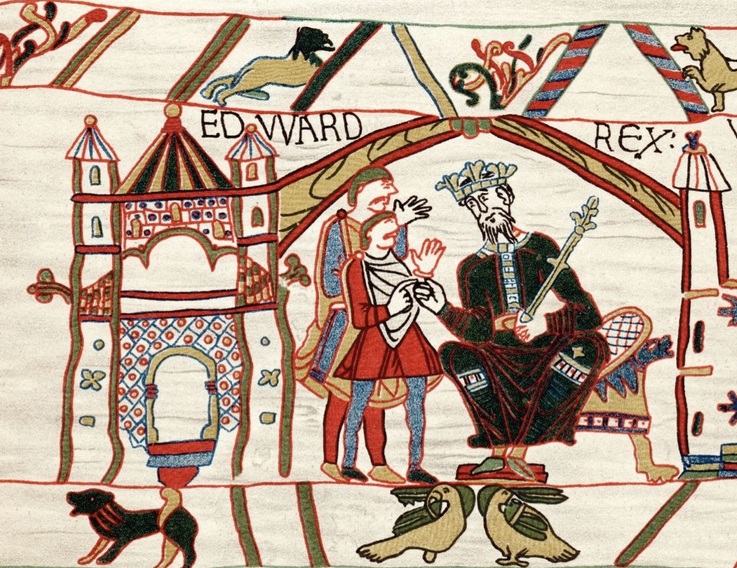
One of Many Anglo-Saxon Edwards Who Preceded the Conquest
The English language has a long history. We don’t have any samples of what the English spoke during the Roman occupation. In fact, it was not until the Angles, Saxons, and Jutes crossed the Channel into Britain that we have the bare bones of a literature. Today, I present one of the great Anglo-Saxon poems.
If you want to hear the poem in the original Anglo-Saxon of the Dark Ages, you can do so by checking out this YouTube site. It is a far, far cry from the language we speak today.
Here is “The Wanderer” in a modern translation from the Poetry Foundation:
The Wanderer
Always the one alone longs for mercy, the Maker’s mildness, though, troubled in mind, across the ocean-ways he has long been forced co stir with his hands the frost-cold sea, and walk in exile’s paths. Wyrd is fully fixed.
Thus spoke the Wanderer, mindful of troubles,
of cruel slaughters and dear kinsmen’s downfall: “Often alone, in the first light of dawn, I have sung my lament. There is none living to whom I would dare to reveal clearly my heart’s thoughts. I know it is true that it is a nobleman’s lordly nature to closely bind his spirit’s coffer, hold fast his treasure-hoard, whatever he may think. The weary mind cannot withstand wyrd, the troubled heart can offer no help, and so those eager for fame often bind fast in their breast-coffers a sorrowing soul, just as I have had to take my own heart— Often wretched, cut off from my own homeland, far from dear kinsmen—and bind it in fetters, ever since long ago I hid my gold-giving friend in the darkness of earth, and went wretched, winter-sad, over the ice-locked waves, sought, hall-sick, a treasure-giver, wherever I might find, far or near, someone in a meadhall who might know my people, or who would want to comfort me, friendless, accustom me to joy. He who has come to know how cruel a companion is sorrow for one with few dear friends, will understand: the path of exile claims him, not patterned gold, a winter-bound spirit, not the wealth of earth. He remembers hall-holders and treasure-taking, how in his youth his gold-giving lord accustomed him to the feast—that joy has all faded.
And so he who has long been forced to forego
his lord’s beloved words of counsel will understand: when sorrow and sleep both together often bind up the wretched exile, it seems in his mind that he clasps and kisses his lord of men, and on his knee lays hands and head, as he sometimes long ago in earlier days enjoyed the gift-throne. But when the friendless man awakens again and sees before him the fallow waves, seabirds bathing, spreading their feathers, frost falling and snow, mingled with hail, then the heart’s wounds are that much heavier, longing for his loved one. Sorrow is renewed when the memory of kinsmen flies through the mind; he greets them with great joy, greedily surveys hall-companions—they always swim away; the floating spirits bring too few familiar voices. Cares are renewed for one who must send, over and over, a weary heart across the binding waves.
And so I cannot imagine for all this world
why my spirit should not grow dark when I think through all this life of men, how suddenly they gave up the hall-floor, mighty young retainers. Thus this middle-earth droops and decays every single day; and so a man cannot become wise, before he has weathered his share of winters in this world. A wise man must be patient, neither too hot-hearted nor too hasty with words, nor too weak in war nor too unwise in thoughts, neither fretting nor fawning nor greedy for wealth, never eager for boasting before he truly understands; a man must wait, when he makes a boast, until the brave spirit understands truly where the thoughts of his heart will turn.
The wise man must realize how ghastly it will be
when all the wealth of this world stands waste, as now here and there throughout this middle-earth walls stand blasted by wind, beaten by frost, the buildings crumbling. The wine halls topple, their rulers lie deprived of all joys; the proud old troops all fell by the wall. War carried off some, sent them on the way, one a bird carried off over the high seas, one the gray wolf shared with death—and one a sad-faced man covered in an earthen grave. The Creator of men thus destroyed this walled city, until the old works of giants stood empty, without the sounds of their former citizens.
He who deeply considers, with wise thoughts,
this foundation and this dark life, old in spirit, often remembers so many ancient slaughters, and says these words: ‘Where has the horse gone? where is the rider? where is the giver of gold? Where are the seats of the feast? where are the joys of the hall? O the bright cup! O the brave warrior! O the glory of princes! How the time passed away, slipped into nightfall as if it had never been! There still stands in the path of the dear warriors a wall wondrously high, with serpentine stains. A storm of spears took away the warriors, bloodthirsty weapons, wyrd the mighty, and storms batter these stone walls, frost falling binds up the earth, the howl of winter, when blackness comes, night’s shadow looms, sends down from the north harsh hailstones in hatred of men. All is toilsome in the earthly kingdom, the working of wyrd changes the world under heaven. Here wealth is fleeting, here friends are fleeting, here man is fleeting, here woman is fleeting, all the framework of this earth will stand empty.’
So said the wise one in his mind, sitting apart in meditation.
He is good who keeps his word, and the man who never too quickly shows the anger in his breast, unless he already knows the remedy a noble man can bravely bring about. It will be well for one who seeks mercy, consolation from the Father in heaven, where for us all stability stands.
A Word of Explanation
The following discussion is taken from the Octavia Randolph website:
Wyrd is an Old English noun, a feminine one, from the verb weorthan “to become”. It is related to the Old Saxon wurd, Old High German wurt, Old Norse urür. Wyrd is the ancestor of the more modern weird, which before it meant odd or unusual in the pejorative sense carried connotations of the supernatural, as in Shakespeare’s weird sisters, the trio of witches in MacBeth. The original Wyrd Sisters were of course, the three Norns, the Norse Goddesses of destiny.
Wyrd is Fate or Destiny, but not the “inexorable fate” of the ancient Greeks. “A happening, event, or occurrence”, found deeper in the Oxford English Dictionary listing is closer to the way our Anglo-Saxon and Norse forbears considered this term. In other words, Wyrd is not an end-point, but something continually happening around us at all times. One of the phrases used to describe this difficult term is “that which happens”.










You must be logged in to post a comment.