Daily writing prompt
Are there things you try to practice daily to live a more sustainable lifestyle?


Yes: Mindful Meditation. Learning to place oneself in what is, not what you want it to be.

Home » Articles posted by Tarnmoor (Page 28)
Yes: Mindful Meditation. Learning to place oneself in what is, not what you want it to be.

It was not until I retired at the end of 2017 that I had any control over my life. First it was my parents, who exercised a mostly benign control over my life. That then shaded into my work life, where for over forty years I felt stressed working for a couple of egomaniacal bosses.
Suddenly, at the beginning of 2018 I was finally able to do what I wanted. Mostly, that entailed extra time for reading and catching up on hundreds of classic movies I had always wanted to see. It would have been perfect if I were able to travel more, but that requires money; and money is always in short supply when one is on a fixed income.
Just before retirement, I started going to the mindful meditation sessions at the L.A. Central Library. Every Thursday—except during the Covid epidemic—there was a free 30-minute mindful meditation session guided by a trained member of UCLA’s mindfulness education center.
I suddenly felt space opening up in my life. Even when I was waiting in the doctor’s office or stuck at a long traffic light, I no longer felt stressed. During these interstices in my life, I would use the time to relax totally while still being attentive to my surroundings. (Compare this to those poor souls who try to relax with a smart phone in their hands.) And I didn’t even hat to sit in some uncomfortable lotus posture.
Previously, I had been prey to insomnia. Now as soon as I slip under the covers, I take three deep breaths, inventory how relaxed I feel from the top of my head down to my toes, and slowly think about my breathing as I drop off to sleep.
At the age of eighty, I’ve never felt happier. I know very well that I am in the endgame of my life. Hard times lie ahead, but I feel stronger and more able to weather them.
Its a five-way tie: Icelandic plokkfiskur (potato and cod stew); Southern Thai jungle curry with fish; Cantonese Chinese pumpkin stir-fry; Japanese salmon skin sushi; and Italian bucatini carbonara.

I find myself rereading books more often, sometimes by design, but more often by accident. For instance, I am reading the L.A. Central Library’s copy of Lawrence Ferlinghetti’s Writing Across the Landscape: Travel Journals 1960-2010. As I started reading it yesterday, I noticed the same light pencil marks I used to mark passages. “A kindred spirit,” was the first thought that crossed my mind. Then, when I loaded Goodreads.Com, I noticed that I wrote a review of the book in 2023. The stray marks were, in fact, mine. A kindred spirit, indeed!
Here are the books that I have reread so far this year, with the ones I have accidentally reread marked with an asterisk:
The funny thing is that I have enjoyed the rereads as much as the first-time reads, even when they were accidental.
I keep a log of 99+% of the books I have read since 1972. When I choose a book to read, I don’t always check the three data files—one a PDF and the other two Excel spreadsheets—which log all several thousand books I have read in the interval. Sometimes, I notice when rereading a book that I have somehow changed in some small or large particular.
For instance, I used to be a big fan of Jules Verne, even some of his lesser-known works. But when I reread From Earth to the Moon and Round the Moon a few years ago, I was disappointed. Perhaps I’ll reread 20,000 Leagues Under the Sea—my favorite among his works—to see how it plays now.
Work shirts and pants. They last longer.

Chinese Poet Du Fu (712-770)
Although the Chinese language is a formidable obstacle to understanding the poetry written in it, there are some Chinese poets whose thoughts nonetheless ring clear. Such is Du Fu (aka Tu Fu), who wrote some thirteen hundred years ago. The name of the poem in today’s blog is:
Restless Night
As bamboo chill drifts into the bedroom,
Moonlight fills every corner of our
Garden. Heavy dew beads and trickles.
Stars suddenly there, sparse, next aren’t.
Fireflies in dark flight flash. Waking
Waterbirds begin calling, one to another.
All things caught between shield and sword,
All grief empty, the clear night passes.
The question makes it seem as if spirituality were something apart from my life. If spirituality is a stranger to you, your life is impoverished to say the least.

The Main Square of Acanceh, Yucatán … With Pyramid
During my magical first trip to Yucatán in November 1975, I decided to hire a guide. I could have gone to a fancier tour office, but I settled on Turistica Yucateca on a Mérida side street. I wish I could remember the name of the owner who didn’t speak a word of English, just as I didn’t speak a word of Spanish. No matter, if you want to communicate, you will; and you will be understood, more or less.
The señora at Turistics Yucateca set me up with an English-speaking guide named Manuel Quiñones Moreno who had access to a car for two days of travel. Instead of going at first to the big Maya sites such as Uxmal or Chichén Itzá, I decided to “start small” by spending some time at Dzibilchaltún on the first day and then going to Mayapan the next day.
After touring Dzibilchaltún, Manuel and I sat down at the entrance to the ruins and played chess. I lost two games in quick succession to Manuel and decided he was several levels better than me.
The next day we drove to Acanceh, where we ate lunch on the zócalo in view of the pretty church and a Mayan pyramid. Then we drove to the late Maya ruins at Mayapan, when much of the peninsula was under the control of a militaristic government which was still in existence when the Spanish arrived.
When I was last in Mérida, I inquired if Manuel Quiñones Moreno was still around. Apparently, he was; and he was still a tour guide a quarter of a century later, though now based in Uxmal. I tried to contact him there, but he was not available when I called.
To begin with, I am deeply skeptical of most self-care claims. In the end, I tend not to stray too far from the middle path, going for variety more than super-foods and trendy exercise regimens.

The Jitlada Restaurant in L.A.’s Thai Town
One of the things I love most about Los Angeles are all the nationalities with their delicious cuisine. Today, Martine, my brother Dan, and I drove to the Jitlada Restaurant in East Hollywood’s Thai Town. It’s located in a downmarket L-shaped streetcorner mall with obvious parking problems. I’d been to the restaurant twice before—each time having a memorable meal.
Third time’s a charm. My spicy jungle curry with catfish and eggplant was spicy enough to burn a hole in concrete, and my brother’s scallops with eggplant was superb. Because she can’t handle spicy, Martine had chicken satay and a mango smoothie. For desert we all had different coconut ice cream preparations.
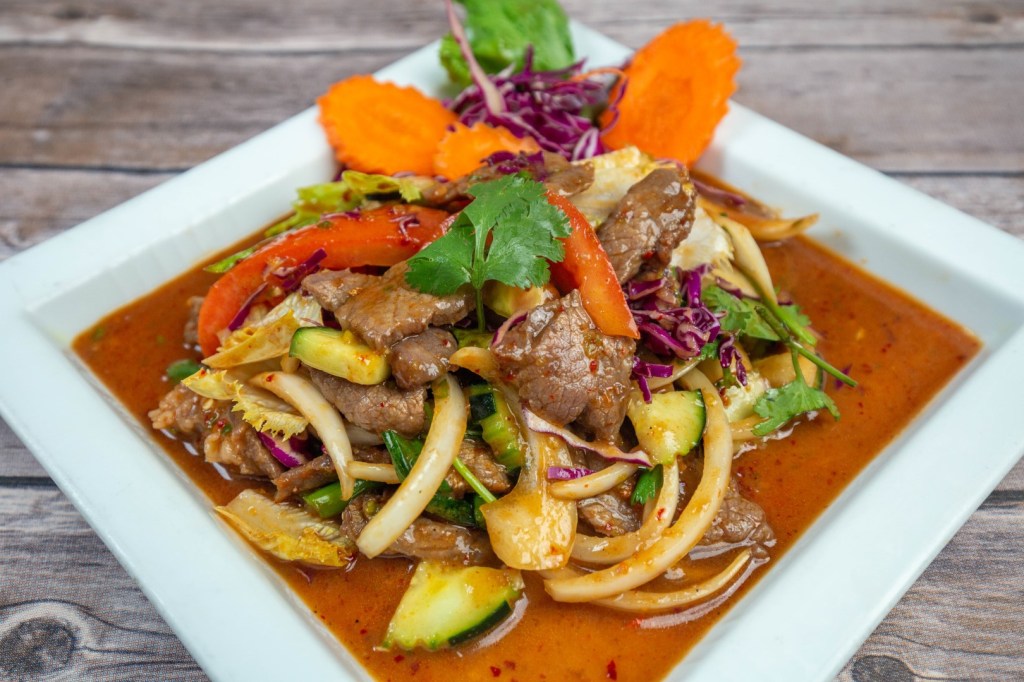
A typical Jitlada Curry
You may think you’ve had Thai food before, but owner Jazz Singsanong’s Southern Thai cuisine is the real thing. Not for nothing does the Jitlada appear year after year in all the lists of the best restaurants in Los Angeles. It now even sports a mention from the Michelin Guide. It easily deserves sit and more.
There are two menus, a green one where you can specify how spicy you want your dish, and a white menu which is spicy whether you will or not. Irrespective of your food tolerances, you can have a supremely satisfying meal at Jitlada.
If you’re interested you should take a look at the menu.


 Tarnmoor
You must be logged in to post a comment.