Disney and the Gipper

Mock-Up Costume Upon Which the Dress of Snow White Was Modeled

Mock-Up Costume Upon Which the Dress of Snow White Was Modeled

When we were at the Grier Musser Museum yesterday, its curator, Susan Tejada, told us about a large Walt Disney exhibit at the Ronald Reagan Presidential Library in the Simi Valley. It didn’t take much convincing for Martine, who likes the library at Christmastime because of their Christmas Trees of Other Nations exhibit.

Well, things didn’t turn out as we expected. To begin with, the parking lot was filled to overflowing, so we had to park a mile down the hill. Fortunately, the crowds had been anticipated; and there was a shuttle bus service that plied up and down the hill all day. Even then, we had to wait in a line for almost half an hour just to get inside. And when we did, the exhibits were a mob scene.

You see, Southern California is full of tourists who have come to see the Rose Bowl and its Tournament of Roses Parade. While they are here, they take bus tours to such locales as Hollywood (why?), the Reagan Library, and the Santa Monica Pier. We ran into several hundred Wisconsin Badgers fans sporting name tags hung around their necks.

What Martine and I did was to force our way through the crowds to the Disney exhibit, which was put on by D23, the Official Disney Fan Club, and then we split up. Martine went to see as much of the standard exhibits as she could, while I repaired to the Ronald Reagan Country Café and read W. Baring Pendleton’s excellent biography of English journalist and reformer, William Cobbett.

It was worth seeing the Disney exhibit—despite the crowds—but I think I had the better idea of sitting in the café with some green tea and reading a good book. I was already familiar with most of the regular exhibits. Oh, and the Christmas Trees of Other Nations? The Reagan Library stopped doing that three years ago. Tant pis!


A Glance Back at Christmas

Christmas at the Grier Musser Museum

Christmas at the Grier Musser Museum

Today, Martine and I finished up our Christmas by seeing the holiday-oriented antiques and special collections on view at the Grier Musser Museum near downtown Los Angeles. Susan and Ray Tejada have the most incredible collection of memorabilia related to the different holiday seasons. We have seen their displays for Halloween, Christmas, and Valentine’s Day—and I understand they have other displays for Chinese New Year, Presidents Day, St. Patrick’s Day, and Independence Day—to name just a few. Below, for instance, is Susan Tejada holding a recently purchased George Washington commemorative plate:

Susan Tejada of the Gier Musser Museum

Susan Tejada of the Gier Musser Museum

At a time when so many of our Christmas observances have been nipped in the bud by recession-related budget cuts, it’s nice to know that one can get a real feeling for the Yuletide season by seeing a collection of music boxes, dolls and statues, old Christmas cards and wrapping paper—all relating to the season.

Although Huell Howser has done two shows that I know of featuring the museum, I feel that more people should know about it. Most spectacular are the occasional Sunday openings preceding the major holidays, with such extras as punch and cookies and an occasional film or slide show in the basement theater. If you are interested in visiting, you have to make a reservation by calling toward the end of the week at (213) 413-1814. The museum is open on Saturday afternoons, by appointment, and on selected Sundays.

The building in which the museum is located used to be a maternity hospital connected with Susan’s family. Her father, Martin L. Krieger, was not only a physician, but the author of several stories about the sea which he co-authored with Fleming MacLeish.


Phoenix dactylifera

Deglet Noor Dates

Deglet Noor Dates

During the relatively fruitless months that stretch between October and February (when the first fresh strawberries become available) is a good time to appreciate the fruit of the date palm, or Phoenix dactylifera.

Approximately 95% of the dates sold in the United States are grown in California’s Coachella Valley near Indio. While we were in the Palm Springs area, Martine and I spent the afternoon preceding Christmas Eve visiting two date gardens, the Oasis Date Gardens in Thermal and the Shields Date Gardens in Indio.

There are a number of different varieties of dates, ranging from the large and hypersweet Medjools to the Deglet Noors (my favorites), Zahidis, Barhis, and Khadrawies, to name just a few. When one buys relatively recently harvested dates in the Coachella Valley, they tend to be more moist. Supermarket dates just don’t cut it. Sometimes I will buy dates from our local farmer’s market in Santa Monica, because the dealer there drives in all the way from Mecca near the Salton Sea.

Below is a photo I took at the Shields Date Gardens:

Date Palms at Indio’s Shields Date Gardens

Date Palms at Indio’s Shields Date Gardens

Note the ladders dangling from the top of some of the trees. During the harvest, they are joined to other ladders so that the dates could be hand-picked. There is, insofar as I know, no mechanization possible that would maintain the quality of the crop. The trees are relatively bare now: As October approaches, the bunches of dates are covered with a cone-shaped paper wrap to prevent rain and predators from damaging the crop.

Most Americans tend to be relatively unfamiliar with dates, which comes as something of a surprise to me because they are sweet, loaded with vitamins and minerals, and relatively inexpensive. But then, I have been buying them from the Coachella Valley for over forty years.


A B-17 Collision

B-17 in the Air

B-17 in the Air

This B-17 met a head-on attack by three Focke Wulf Fw 190 fighters. The gunners exploded two of them, and the top turret poured a stream of shells into the cockpit of the third. With a dead man at the controls, the fighter screamed in, and at a closing speed of 550 miles per hour smashed head-on into the number-three engine.

The tremendous impact of the crash tore off the propeller. It knocked the heavy bomber completely out of formation as though a giant hand has swatted a fly. The fighter cartwheeled crazily over the B-17.

It cut halfway through the wing, and then sliced a third of the way through the horizontal stabilizer. The top and ball turrets immediately jammed, the radio equipment was smashed to wreckage, and all the instruments “went crazy.” Pieces of metal from the exploding, disintegrating Focke Wulf tore through the fuselage, and a German gun barrel buried itself in the wall between the radio room and the bomb bay.

Crews of nearby bombers watched the collision. They saw a tremendous explosion, and the bomber hurtling helplessly out of control, tumbling as she fell. They reported when they returned to base that the Flying Fortress had blown up, and that the crew must be considered dead.

The old Queen hadn’t blown up, and the crew was far from dead. The pilots struggled wildly in the cockpit, and somehow between them, managed to bring their careening bomber back under control. The gunners shot down a fourth fighter that had closed in to watch the proceedings.

And then they brought her all the way back to England, and scraped her down for a belly landing on the runway.

Postscript: not a man was injured.—Martin Caidin, Black Thursday

B-17 Walkthrough

Martine with Boeing B-17 in Background

Martine with Boeing B-17 Flying Fortress in Background

Aviation museums run the gamut from “gearhead” airplane body shops to extensive collections of aircraft and exhibits. In this latter category is the Palm Springs Air Museum, adjacent to the Palm Springs Airport on Gene Autry Trail. We allotted four hours to seeing this museum, and—to Martine’s point of view anyway—it was about four hours too short.

Apparently, the Coachella Valley is home to many aviation veterans of the Second World War. The museum was crowded with volunteers who knew the planes intimately and were willing to answer questions.

Near the little café in one of the hangars was a huge Boeing B-17 Flying Fortress that was being restored by aficionados. For a five dollar donation, we could walk through the plane from the cockpit to the rear door. It was a tempting challenge, though I knew it would be a tight squeeze for my portly frame. So we ponied up the ten bucks and did it.

B-17 Cockpit

B-17 Cockpit

For starters, the highly analog cockpit controls (see above) were a revelation to a digital denizen such as myself. We barely managed to make it up the ladder to squeeze in the space behind the cockpit. The B-17’s crew of ten must have been immune to claustrophobia, especially the tail gunner and the gunner in the 360-degree rotating gun position under the aircraft. The former was totally cut off from the rest of the aircraft by the rear bomb bay.

The B-17 was featured in a number of war films including Memphis Belle (both versions: 1944 and 1990), Flying Fortress (1942), Air Force (1943), 12 O’Clock High (1949), and Tora! Tora! Tora! (1970).

If you ever find yourself in Palm Springs, and if you are as much of a history nut as I am, you could do worse than spend a whole day at the Palm Springs Air Museum. (I had to promise Martine that we would return so that she could finish viewing all the exhibits.)


Hugging the Enemy

General Vasily Chuikov, Commander of the 62nd Army at Stalingrad

General Vasily Chuikov, Commander of the 62nd Army at Stalingrad

We know a whole lot more about Field Marshal Friedrich Wilhelm Ernst Paulus, who commanded the German 6th Army besieging Stalingrad, than we know about General Vasily Ivanovich Chuikov, who fought the German war machine to a draw by his creative leadership of the Soviet 62nd Army. Part of the reason is that we have letters from Paulus and his staff describing the horrors of the siege of Stalingrad, letters that were to give Hitler and Goebbels fits as they tried to devise their own myth as to what really happened on the banks of the Volga.

What really happened was one of Stalin’s generals, who lived in a society where candid comments in private letters were used by the NKVD (predecessor of the KGB) as evidence of disloyalty to Stalin. Whatever Chuikov may have thought, it was what he did that made him one of Stalin’s favorite generals.

Both Hitler and Stalin had issued contradictory clear-cut orders regarding Stalingrad. Hitler insisted that the Wehrmacht capture the city at all cost, and that surrender was not an option. Stalin, on the other hand, issued equally clear-cut orders that the city must be held at all costs, and that surrender was not an option.

For almost six months, Chuikov invented a new kind of urban warfare in which the idea was to “hug the enemy.” By staying close to the Germans, Chuikov prevented the aerial bombardment by the Luftwaffe in that it turned out to be as dangerous to the Nazis as to the Red Army. By this time, much of the city was rubble. Chuikov ingeniously hid artillery and tanks in the ruins, and used small squads of six to eight men, supplemented by sharpshooters, to attack pockets of Wehrmacht troops. Extensive use was made of hand grenades and Molotov Cocktails.

Frequently, burnt-out tanks became bases for these squads, as the men were protected by the wrecked tank above their heads. The following is a quote from Chuikov:

The Germans underestimated our artillery. And they underestimated the effectiveness of our infantry against their tanks. This battle showed that tanks forced to operate in narrow quarters are of limited value; they’re just guns without mobility. In such conditions nothing can take the place of small groups of infantry, properly armed, and fighting with utmost determination. I don’t mean barricade street fighting—there was little of that—but groups converting every building into a fortress and fighting for it floor by floor and even room by room. Such defenders cannot be driven out either by tanks or planes. The Germans dropped over a million bombs on us but they did not dislodge our infantry from its decisive positions. On the other hand, tanks can be destroyed from buildings used as fortresses.

For five months, Chuikov fought the Germans to a draw. During this time, Marshal Georgi Zhukov formulated his Operation Uranus, which led to the encirclement and surrender of Paulus’s 6th Army.

Even as his men were out of ammunition and close to starving to death and being eaten alive by lice and other vermin, Hitler prevented them from surrendering. As it became obvious to the Fuehrer that Stalingrad was lost to him, he preferred the German people to think that the 6th Army committed mass suicide rather than surrender to the Russians. In the end, the 90,000 men who remained did surrender. Total German casualties were between 500,000 and 850,000 killed, wounded or captured.

Chuikov later led one of the armies converging on Berlin, where he accepted surrender of the city from General Helmuth Weidling. After the war, in 1955, he was made a Field Marshal by Khrushchev and eventually served as a member of the Central Committee of the Communist Party of the Soviet Union.

Even under a tyrant such as Stalin, it is possible to find heroism and innovation such as Chuikov’s. Because we tend to see World War Two as mostly a Anglo-American alliance, we have suppressed any knowledge of the awful 3,000-mile front that was the war in Russia, called by them the Great Patriotic War. They earned their victory … the hard way.

A Family Christmas

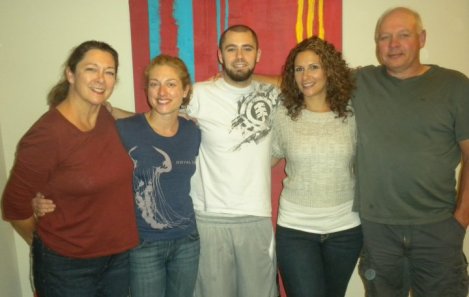
Lori, Hilary, Danny, Jennifer, and Dan

Lori, Hilary, Danny, Jennifer, and Dan

I just returned from Palm Springs about an hour or two ago after spending one of the best Christmases in my adult life. My brother and sister-in-law rented a house in PS’s “Movie Colony” neighborhood.

Present were Dan and Lori, my brother and sister-in-law; Hilary, just returned from Guatemala by way of her home in Seattle; Danny, from L.A.’s South Bay; Jennifer, from San Diego; and Martine and me from West Los Angeles.

As you know, I tend to be something of a Grinch; but the events of the last five days have melted the residual ice that encased my heart. It was great fun talking with my nephew and nieces, and spending the days touring the Coachella Valley with Martine while the kids were involved in hiking, swimming in hot pools, and such like.

Martine and I got to visit the Living Desert Zoo and Botanical Gardens in Palm Desert, which we’ve seen two or three times before; the Palm Springs Air Museum, a labor of love by WW2 veterans; the Oasis Date Gardens in Thermal, California; and the Shields Date Gardens in Indio, California. (Yes, I guess I really do enjoy eating dates.)

In the days to come, I will post blogs about the first two places above, which I think are world-class tourist destinations. And I will try to write something about the Coachella Valley’s date palms.

In the meantime, I hope all of you had a Merry Christmas!


Down Time

Palm Springs

Palm Springs

In a couple of hours, Martine and I will be heading to Palm Springs, where my brother and his family have rented a house for the holiday season. Because I do not happen to have a laptop computer. you will probably not hear from me until we return in a few days.

I plan to spend some quality time with my brother and his family, and to see some films and read some books. I will continue with my least likely Christmas book ever—Antony Beevor’s Stalingrad: The Fateful Siege 1942-1943, as well as some other reading interspersed.

We hope to visit one of our favorite zoos, The Living Desert in Palm Desert, which is also a botanical garden. (That, of course, depends on the weather, which is always dicey this time of year.)

So far the world has not ended yet, and it shows signs of persisting through the holidays. I’m sure a lot of people will end the day with egg on their faces, which is only right. As Monty Python warned us, “NOBODY expects the Spanish Inquisition!”

Dysfunctional Kids: Nature or Nurture?

How Do Spoiled Brats Come About?

How Do Spoiled Brats Come About?

We’ve all seen them. Today, at a CVS Pharmacy near work, I saw two of them. One little boy in his mother’s arms sobbing while complaining, “This is not very exciting.” The other, also a boy, was hanging on to his mother’s leg while she was desperately trying to run a credit card to pay for a prescription.

Because I have been sterile all my life, I have never had any children of my own. (And, no, I never did want to adopt anyone else’s children, either.) So I never was able to find out whether spoiled brats and other dysfunctional kids are born or just raised that way. Both my brother and I never fit into that category, if for no other reason than that my father ruled by terror, tempered with love.

Over my lifetime, I have seen both wonderful children and heinous brats come from the same families; and I knew the parents to be kind, loving people. Why does one child become a howling reincarnation of Satan, when all the others from the same brood are as gentle as can be? Did the parent spoil one of the children and clamp down on the others? I am truly perplexed by this phenomenon. I suspect that, if there is an answer, it may also provide an insight into troubled psychopaths such as Adam Lanza and other mass murderers.

We like to assign tags such as “mental health,” but we could just as easily use terms such as “evil” or “diabolically possessed.” If a child is so very troubled, it is sheer torture for the parents to continue raising that child. Do we punish them and society by insisting that it is all their fault and that they had better make the kid toe the line? Or do we take such children, give them a mallet and shovel, and have them clear mine fields, hoping that they set some of them off?

These are not trivial questions. Some of us think that anyone can be rehabilitated. Myself, I am not quite so confident that it is possible.