DMV

Time to Renew My Drivers License

As my drivers license expires in three weeks, I thought it would be a good idea to renew it before it was too late. I used to go to the Santa Monica DMV on Colorado Avenue. The last few times I went there, however, I felt as if I were in a Soviet bread line. Last time, I renewed my license in Torrance, which wasn’t bad. This time, I went to Culver City, which is much closer.

Everything went like clockwork. I was delighted that I no longer had to take the multiple choice “Knowledge Test” with its gotcha questions about blood alcohol, child seats, and obscure legal penalties—none of which is relevant to my driving experience. I was in and out in less than thirty minutes—a record for me. And I walked out with an Interim Driver License until the permanent one with my photo arrives after the holidays.

People tend to be very negative about the Department of Motor Vehicles. Probably, they all went to the Santa Monica branch.


Eluding the Trumpster Dumpster

Notes for Those Attempting to Flee the U.S. of A.

After the November 5th election, many voters are considering the possibilities of becoming an expatriate in a country where the next President (hopefully) could not touch them. After the recent threats to Mexico and Canada, this may not work.

There are two possibilities for a safe passage away from the Trumpster Dumpster. First, choose a country that the next President does not know exists. Here are a number of possibilities:

  1. Azerbaijan*
  2. Belize
  3. Benin
  4. Bosnia and Herzegovina*
  5. Burkina Faso*
  6. Burundi
  7. Cabo Verde
  8. Comoros
  9. Djibouti*
  10. Eritrea*
  11. Eswatini*
  12. Guinea-Bissau*
  13. Kiribati
  14. Kyrgyzstan*
  15. Lesotho*
  16. Liechtenstein*
  17. Malawi
  18. Nauru
  19. Niue*
  20. Sao Tome and Principe*
  21. Tajikistan*
  22. Timor-Leste
  23. Tuvalu
  24. Vanuatu*

To provide an extra level of safety from MAGA-hatted provocateurs, select one of the above countries marked with an asterisk (*). These are countries it is not likely the next President would be able to pronounce correctly enough to be understood.

Kigumi

The Art and Tradition of Japanese Carpentry

Today, I met my brother at the Japan House in Hollywood. He drove in from Palm Desert, where he is a builder whose specialty over the years has been working with wood. On display at the Japan House through January 22, 2025 is an exhibit entitled “Masters of Carpentry: Melding Forest, Skill and Spirit.” It was an awesome display of the beauty and intricate detail that is the art of Japanese carpentry.

According to the handout describing the exhibit:

The exhibit is structured around 5 pillars of daiku [Japanese woodworking masters] culture: a reverence for nature and the Japanese forest, the master carpenters’ refined tools, the practice of dōmiya daiku—the temple and shrine carpenters, kigumi— the strength and beauty of Japanese joinery, and the work of the sukiya daiku—the skillful carpenters employing natural materials to detail and finish teahouses.

What impressed me the most were the exhibits of the intricate joinery linking the boards, posts, and beams using careful measurement and relying as little as possible on nails and other iron and steel fasteners. The result is aesthetically pleasing and built to last. And because it is carefully selected from a large variety of native woods, it even smells beautiful.

According to the exhibit, the islands that constitute Japan are 67% forested. Even such exotic woods as persimmon fruit trees are used because of the striated grain of the wood.

Intricate and Ultimately Pleasing

Although, unlike my brother, I have no skill in woodworking, I quickly became aware that this was high art and a labor of love. This is an exhibit with broad appeal to anyone with an artistic frame of mind. The two hours we spent at the Japan House Masters of Carpentry Exhibit was well worth it.

Japan House Los Angeles
Gallery Level 2
6801 Hollywood Blvd
Los Angeles, CA 90028

https://www.japanhousela.com/

A Dream Within a Dream

Edgar Allan Poe (1809-1849)

I think we underestimate the poems of Edgar Allan Poe. Here’s one of his best, on the subject of life being but a dream. “Deceptively simple?” you might ask. Perhaps, but that is their strength.

A Dream Within a Dream

Take this kiss upon the brow!
And, in parting from you now,
Thus much let me avow —
You are not wrong, who deem
That my days have been a dream;
Yet if hope has flown away
In a night, or in a day,
In a vision, or in none,
Is it therefore the less gone
All that we see or seem
Is but a dream within a dream.

I stand amid the roar
Of a surf-tormented shore,
And I hold within my hand
Grains of the golden sand —
How few! yet how they creep
Through my fingers to the deep,
While I weep — while I weep!
O God! Can I not grasp
Them with a tighter clasp?
O God! can I not save
One from the pitiless wave?
Is all that we see or seem
But a dream within a dream?

Malibu in My Lungs

The Franklin Wildfire in Nearby Malibu

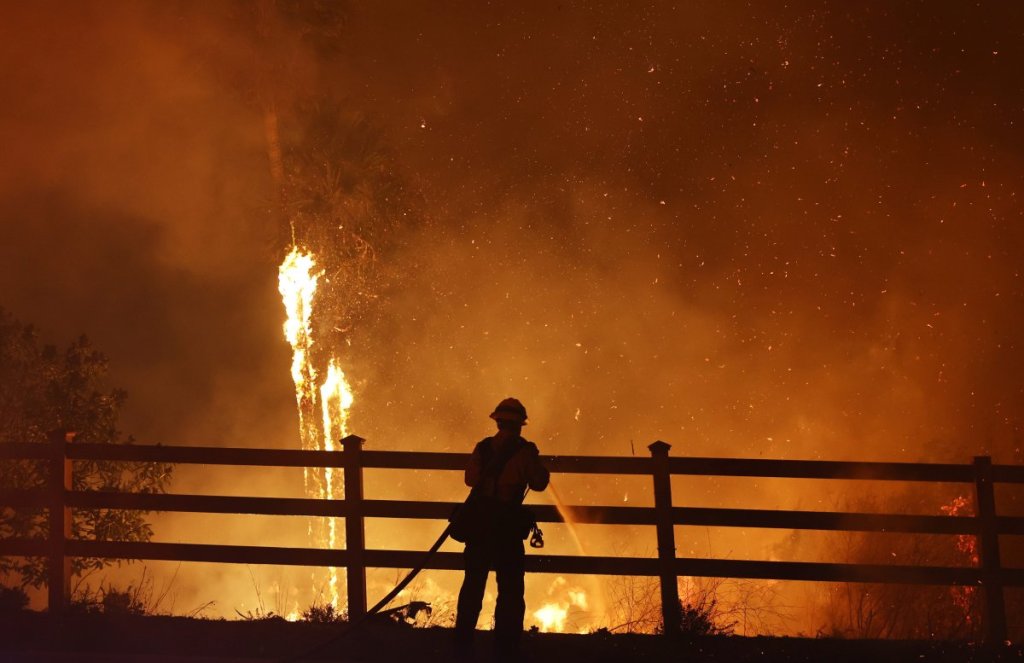
When the dry Santa Ana winds blow in from the desert, every tree, every cactus, every bush is at risk of being involved in a wild conflagration that eats up vast tracts of land. Such is the Franklin Fire in Malibu, which, after a week of rampant destruction, is only 54% contained.

Alas, a good part of the ash from that fire is contained in my lungs. It causes my nose to run, punctuated by mammoth sneezes that shake the walls of my abode. As the crow flies, I am only a few miles from Malibu Canyon, ground zero for the worst damage.

I have driven Malibu Canyon Road many times en route to Malibu Creek State Park, which is where the M*A*S*H television show was filmed.

After I was on crutches for two years, I had a crutch-burning party at Tapia Park around 1969. Unfortunately, the flames have destroyed Tapia Park where I celebrated being able to walk again without sticks.

If we get some rain soon, I will be able to go through the day without forcibly expelling ash from my lungs every few hours.

Psychological Experiments

John Cleese on Lawyers

I just finished reading John Cleese’s Professor at Large, which reprises a number of talks he gave at Cornell University while he was a visiting Professor-at-Large there over a period of some eighteen years. I broke out laughing when I read the following:

CLEESE: I had to switch to law [at Cambridge University] because there was almost nothing else I could switch to:

INTERVIEWER: So, you’re saying law is easier?

CLEESE: Well, law was kind of easier for me because I am fairly precise with my use of words and I can think in terms of categories, which is all law is—until you start practicing, and then it’s about villainy and low cunning.

I’ll tell you my favorite joke about lawyers because it actually involves universities. The psychological departments of universities are using lawyers now, instead of rats, in their experiments. There are three reasons for this. One is that there are more lawyers than rats. Second, there are some things that rats just won’t do. And thev third is is that there was a bit of a problem because sometimes the experimenters got fond of the rats. And I want you to know that joke has nothing to do with the fact that I am going through an expensive divorce at the moment.

A Bulletin from the Ministry of Silly Walks

John Cleese of Monty Python Shows You How

He’s not just one of the funniest men who have ever lived. He also has a brain, a very good one, in fact. For a number of years, he served as a Professor-at-Large at Cornell University in Ithaca, New York. During that time, he showed up occasionally and delivered some fascinating talks, which were collected and published in a book entitled Professor at Large: The Cornell Years.

His first talk was about his reactions to a book by Guy Claxton about creativity. It was called Hare Brain, Tortoise Mind:

It’s a book that addresses a danger that has been developing in our society for several years. This danger is based on three separate wrong beliefs. The first is the belief that being decisive means taking decisions quickly. The second is the belief that fast is always better. The third is the belief that we should think of our minds as computers.

Now, of course, there are situations where you have to think fast, like how to avoid a car driving on the wrong side of the freeway. It seems, however, that many American businessmen have made something of a fetish out being articulate and quick on the draw.

Creativity just cannot be made to order:

The point is, we just don’t know where we get our ideas from, but it certainly isn’t from our laptops. They just pop into our heads. The greatest poets and scientists freely admit that they have no control over the creative process. They all know that they cannot create to order. They can only put themselves in favorable—usually quiet—circumstances, bear the problem in mind, and … wait. Indeed, the whole creative process is so mysterious that academic psychologists who studied creativity in depth in the ’60s and ’70s eventually just gave up because they couldn’t get any further—they literally couldn’t explain it.

Seeing as how John Cleese and his five Monty Python associates are among the most creative comics of the last half century, I can only assume that the man knows what he is talking about. Even if he walks silly.

Don’t Toque to Me About Chefs!

Making a $45.00 Tower of Exotic Foodstuffs

The following is a repost from December 20, 2014.

The problem with American restaurants is that there are too many chefs and not enough cooks. Ever since the Food Network went on the air, people started paying too much attention to people with large white toques who like to mess around with food, forming little towers of quinoa with raspberry sauce and maybe a small amount of meat or fish. The less the foods appear to go together, the more renown the chef is likely to earn for his or her daring.

It’s become an epidemic. The tutsi-fruitsie is king. The ice tea is contaminated with passion fruit or other petrochemical waste. Side dishes avoid the usual rice or potatoes and provide instead broccolini with mashed yeast and ground Murano glass and Galena lead pellets.

Whenever I see some Culinary Institute of America (CIA) chef wearing a towering white toque, I know I’m in for a pretentious soaking. On the other hand, when I see what Hungarians call a szakács or szakácsnő (cook, masculine or feminine gender respectively), I know I am likely to have an excellent meal. There must be no toque or other sartorial trimmings. I want a good, honest cook who knows how to prepare food. And no little towers!

As for the Food Network, I hope they switch over to running “Antiques Roadshow” or “Pawn Stars.” Or maybe they can talk about Kim Kardashian or some other celebrity twinkie. They certainly have not done anything to improve the quality of food in this country.

Clarice Lispector in the U.S.

The Jewish-Ukrainian-Brazilian Clarice Lispector (1920-1977)

If Clarice Lispector were alive today, she would be celebrating her 104th birthday. The strikingly beautiful author with the high cheekbones and wild Scythian eyes was one of the greatest women writers of the 20th century, joining such titans as Virginia Woolf, Joan Didion, Ursula LeGuin, Patricia Highsmith, and Wislawa Szymborska.

In my e-mail today was a message from New Directions Publishing, which publishes some twenty titles by Lispector in English translation. It contained a link to a video entitled “Dias de Clarice em Washington.” It is 29 minutes long in Brazilian Portuguese with English subtitles.

During the 1950s, Clarice was married to a Brazilian diplomat named Maury Gurgel Valente who was posted to the embassy in Washington. From her house in Bethesda, Maryland, she took part in diplomatic social functions and raised a family, as well as writing a number of books and short stories … until it all became too much for her, and she filed for divorce, after which she returned to Brazil.

I urge you to see this video and see what a great writer must do when she is pulled between her marriage and her art:

Clarice Lispector (R) and Sons

The End of the Tether

This is a difficult subject to treat because I myself am reaching the age at which one can pay most grievously for mistakes made earlier in life. I have just finished re-reading Joseph Conrad’s The End of the Tether, about a British sea captain in Malayan waters who has passed up a peaceful retirement to help out his daughter, who had married unwisely.

Although Captain Whalley in his youth was one of the most brilliant sea captains in the South Seas, he has grown old and forced himself to take on a rickety steamship in need of repair. The owner is a nervous former lottery winner who serves as the ship’s engineer. While he spends every spare hour evaluating possible winning lottery numbers, Captain Whalley, with the help of a native serang, handles the sailing of the vessel.

Unknown at the outset is that Captain Whalley is going blind, and it is primarily the Malay serang who is responsible for captaining the ship. As one can guess, things do not end well.

As I approach eighty years of life on earth, I see many of my friends in their retirement years similarly afflicted as a result of difficult situations that over time have gone critical. I earnestly hope that I will not be one of them.

For one thing, I did not save up enough money for retirement, having spent obscene amounts of money on books. Today I have a fantastic library of five or six thousand volumes. But what happens if I should suddenly die? That would leave Martine in the position of trying to find out how to turn my library into cash, if possible. This at a time when there are precious few bookstores around that could buy hundreds of books at a time.

At least I don’t buy books any more. The Los Angeles Library and my Amazon Kindle account for most of the books I read.

I owe it to the people I love to whittle away at my library, however it pains me. Alas, I am mortal. I have made mistakes. I will pay for those mistakes.