One of my favorite poets at last weekend’s Los Angeles Times Festival of Books was Katie Farris, who read from her works on Saturday, April 20, at the Poetry Stage. Her recently published collection—Standing in the Forest of Being Alive—brought together her experiences with third-stage breast cancer, the global Covid pandemic, and an America at the point of heading for a messy divorce. Here is her explanation of how it all came together:
What drew me to her poems was her debt to Emily Dickinson and William Blake, two of my all-time favorite poets. In fact, there is definitely something of Emily in her work—without the sometimes obscure wording that sends the reader back to the beginning to make sense of the poet “telling it slant.” Below is the first poem from her collection:
Why Write Love Poetry in a Burning World
To train myself to find in the midst of hell what isn’t hell.
The body bald cancerous but still beautiful enough to imagine living the body washing the body replacing a loose front porch step the body chewing what it takes to keep a body going—
This scene has a tune a language I can read a door I cannot close I stand within its wedge a shield.
Why write love poetry in a burning world? o train myself in the midst of a burning world to offer poems of love to a burning world.
Poet Dr. Hala Alyan at the Los Angeles Times Book Festival
She is not only a poet and novelist, but also a clinical psychologist. As she read selections from her most recent poetry collection, The Moon That Turns You Back, Dr. Hala Anyan’s dark eyes flashed; her shock of brown curly hair fluttered in the breeze; and her voice modulated from quiet to powerful. She is a Palestinian-American born in Carbondale, Illinois. But her poems are never far from her ancestral home in a conflicted land.
Even as she read her poems, we heard the loud sounds of a demonstration at the University of Southern California (USC) loudly protesting the horrors of the Israelis’ revenge on the Palestinians. And now we hear that graduation ceremonies at USC have been put on hold during the crisis.
Naturalized
Can I pull the land from me like a cork? I leak all over brunch. My father never learned to swim. I won’t say where he was born. I’ve already said too much. Look, the gardenias are coming in. Look, my love is watching Vice again. Gloss and soundbites. He likes to understand. He plays devil’s advocate. My father plays soccer. It’s so hot in Gaza. It’s so hot under that hospital elevator. There’s no room for a child’s braid. In the staff meeting, I stretch my teeth into a country When they congratulate me on the ceasefire. As though I don’t take Al Jazeera to the bath. As though I don’t pray in broken Arabic. It’s okay. They like me. They like me in a coffin. They like me when I spit my father from my mouth. There’s a whistle. There’s a missile fist-bumping the earth. I draw a Pantene map on the shower curtain. I break a Klonopin* with my teeth and swim. The newspaper says truce and C-Mart is selling peaches again. Woolly in my palms. I’ve marched on the street too few times. I’ve ruined the dinner party with my politics. Sundays are tarot days. Tuesdays are for tacos. There’s a leak in the bathroom and I get it fixed in thirty minutes flat. I stop jogging when I’m tired. Nothing can justify why I’m alive. Why there’s still a June. Why I wake and wake and the earth doesn’t shake.
” Klonopin – Clonazepam is a benzodiazepine. It is approved for the treatment of panic disorder (with or without agoraphobia), as well as certain types of seizure disorders.
It is no surprise that the three poets whose readings I most liked at the Los Angeles Times Book Festival Poetry Stage were all women. They represented three different life paths which, while typically feminine, were universal in their humanity.
The first is Maggie Millner, born in upstate New York, an instructor in writing at Yale University. The poem is from her poetry collection entitled Couplets.
1.12
There are many ways, of course, of telling it. But each account obscures
some other version equally true. One is that I lied to everyone I knew.
Another—this one I really do believe— is that for years I loved him more than me.
I can conjure even now our first apartment’s tile: white diamonds in their blue argyle
frieze around the sink, the dirty grout I’d scour with a toothbrush while he was out
at work. I can count four bathmats over eight years, hear the record player catch
every time we stood up from the table. And I can still feel the invisible
moat we both lived in, on the other side of which we knew lay torment, exile, wreckage,
the anarchy of singledom. Loss upon loss. I remember testing it, the moat: throwing across
a rope to check its breadth, twice to the waist wading in before retreating, shamefaced,
reining myself back. To him it was a sea I think entirely impassable. To me
it was a dizzying ravine that circled us for years, then cut between.
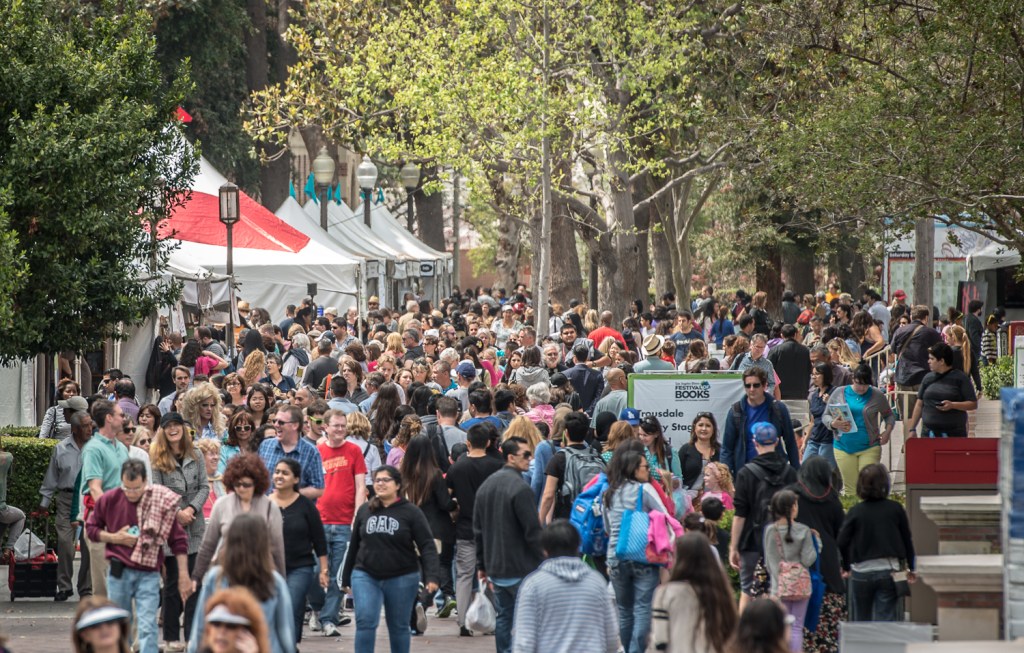
After several consecutive wet weekends, this last weekend was ideal for a big get-together. And that’s exactly what happened at the campus of the University of Southern California (USC) where the 2024 edition of the Los Angeles Times Book Festival took place. I do not recall being in such a crowd scene for decades. In fact, it was so crowded that I couldn’t buy more than three books because the booths that interested me the most were jammed with people.
The only reason I could tolerate the crowds is that they were there honoring books and reading, which are sacred to me. Never mind that most of them read nothing but crap. The important thing is that they were coming together to honor an activity that is disappearing from our anti-intellectual culture.
This time I noticed for the first time that so many of the booths related to self-publishing. And, since no one ever heard of these authors, their booths were, for the most part, unvisited. Well, they are part of the publishing world, too, and with luck a handful of them may make it to the big time.
As with last year, I spent most of my time at the Poetry Stage, where there was a different poetry reading every twenty minutes. There, I made the acquaintance of three women poets I will be discussing later this week.
The one that got away, however, was the Salvadorean poet Yesika Salgado, who spoke at the Latinidad Stage in Spanish, English, and Spanglish. She was magnificent. I couldn’t buy her book because the line to buy a copy and have the poet sign it was approximately a hundred persons long; and I was by that time exhausted and ready to return home.
I guess I should have spent more time at the Latinidad Stage. Even though my Spanish is pretty punk, the people in attendance were into their poets in a big way, and Yesika is a real force on the L.A. literary scene, as this YouTube video will show:
What with bookstores becoming rarer than hen’s teeth and the average American seemingly unable to read anything more daunting than the label of a beer can, I am becoming ever more determined to support books and reading. Therefore, I shall be spending the weekend looking at books, buying books, and attending talks by authors as well as poetry readings, My next post will be on Monday, April 22.
The Los Angeles TimesFestival of Books has become a huge event that brings together readers of all stripes. I even forego my usual sneering at readers of bodice-ripper romances: They, too, are readers—like me in one way, unlike in all others.
When I am not scanning book titles, I go for rest to the Poetry Pavilion, where there is a new poet every twenty minutes during the day. The pavilion never fills up like some of the other stages with big name celebrities, but it is (1) more comfortable and (2) more rewarding. Although I don’t read as much poetry as I should, it is always interesting to hear poets reading their own work.
Next week, I will write posts about those poets that interested me the most.
It was the summer of 2017 and the temperature soared above 100° Fahrenheit (38° Celsius) every day. It was Martine’s idea to visit the New Mexico desert during the summer, and we both paid a high price for it in terms of discomfort.
One of the high points of our trip was revisiting the UFO Museum in Roswell, New Mexico. I’m not entirely sure that I believe in UFOs; but, if they exist, the Roswell museum does the subject full justice. Plus they have t-shirts to die for in their store.
Fear Not! I Did Not Enter Through the Exit
I have always enjoyed visiting dinky museums in small towns. I will never forget the Eastern California Museum in Independence, California, where there is on view a full set of coyote dentures for a patient who had no patience with local dentists. Martine and I greatly enjoyed BOTH Loch Ness Museums in Scotland: the Loch Ness Center and Nessieland. And that despite the fact that I do not believe the monster exists!
One museum I did not visit was the Iceland Phallological Museum in Reykjavík. Anyone who has driven in Los Angeles traffic does not have to go out of his or her way to see multitudinous dicks of every variety. And you don’t have to pay admission for that!
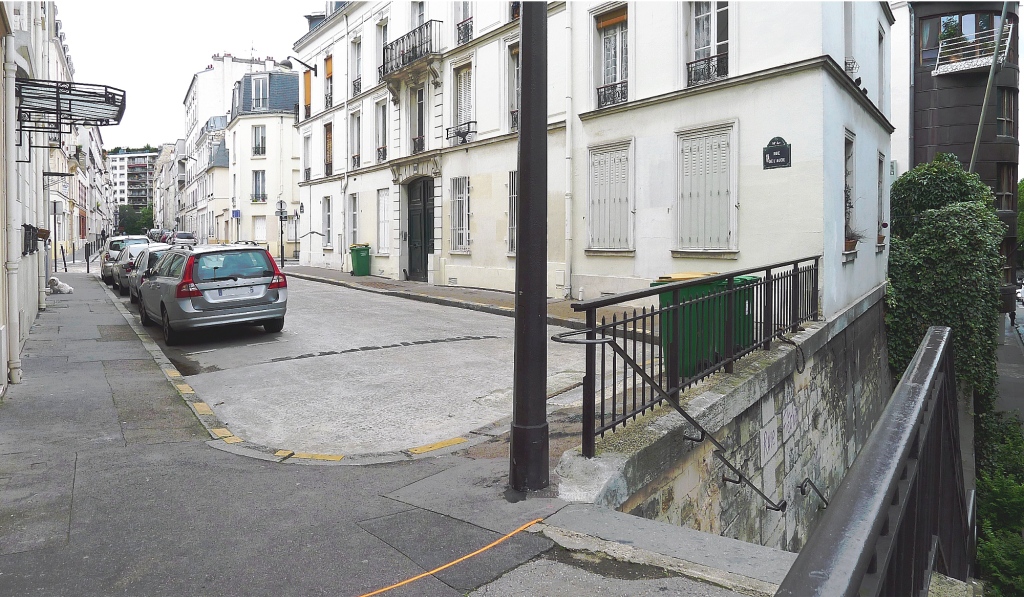
The Rue de l’Aude in the XV Arrondissement of Paris
I am fatally in love with the novels of Patrick Modiano. This evening, I re-read his The Black Notebook, published in France in 2012 as L’Herbe des nuits. His fatally lost characters end up wandering the streets of Paris, trying to recover lost memories. Meanwhile, I try following their path using an old copy of Paris Pratique par Arrondissement.
The following is from page 75 of my Houghton-Mifflin edition:
And I was afraid I would be waiting for her in vain that night. Then again, I often waited without knowing if she’d show. Or else she would come by when I wasn’t expecting her, at around four in the morning. I would have fallen into a light sleep, and the sound of the key turning in the lock would startle me awake. Evenings were long when I stayed in my neighborhood to wait for her, but it seemed only natural. I felt sorry for people who had to record appointments in their diary, sometimes months in advance. Everything was prearranged for them, and they would never wait for anyone. They would never know how time throbs, dilates, then falls slack again; how it gradually gives you that feeling of vacation and infinity that others seek in drugs, but that I found just in waiting. Deep down, I felt sure you would come sooner or later.
Today, as I was re-reading Patrick Modiano’s The Black Notebook (2012) with its labyrinthine reconstructions of an imperfectly remembered past, I thought of a poem by Charles Baudelaire that gave me the same feeling, It is called “The Swan”:
The Swan
I
Andromache, I think of you! The stream, The poor, sad mirror where in bygone days Shone all the majesty of your widowed grief, The lying Simoïs flooded by your tears, Made all my fertile memory blossom forth As I passed by the new-built Carrousel. Old Paris is no more (a town, alas, Changes more quickly than man’s heart may change); Yet in my mind I still can see the booths; The heaps of brick and rough-hewn capitals; The grass; the stones all over-green with moss; The _débris_, and the square-set heaps of tiles.
There a menagerie was once outspread; And there I saw, one morning at the hour When toil awakes beneath the cold, clear sky, And the road roars upon the silent air, A swan who had escaped his cage, and walked On the dry pavement with his webby feet, And trailed his spotless plumage on the ground. And near a waterless stream the piteous swan Opened his beak, and bathing in the dust His nervous wings, he cried (his heart the while Filled with a vision of his own fair lake): “O water, when then wilt thou come in rain? Lightning, when wilt thou glitter?” Sometimes yet I see the hapless bird — strange, fatal myth — Like him that Ovid writes of, lifting up Unto the cruelly blue, ironic heavens, With stretched, convulsive neck a thirsty face, As though he sent reproaches up to God!
II
Paris may change; my melancholy is fixed. New palaces, and scaffoldings, and blocks, And suburbs old, are symbols all to me Whose memories are as heavy as a stone. And so, before the Louvre, to vex my soul, The image came of my majestic swan With his mad gestures, foolish and sublime, As of an exile whom one great desire Gnaws with no truce. And then I thought of you, Andromache! torn from your hero’s arms; Beneath the hand of Pyrrhus in his pride; Bent o’er an empty tomb in ecstasy; Widow of Hector — wife of Helenus! And of the negress, wan and phthisical, Tramping the mud, and with her haggard eyes Seeking beyond the mighty walls of fog The absent palm-trees of proud Africa; Of all who lose that which they never find; Of all who drink of tears; all whom grey grief Gives suck to as the kindly wolf gave suck; Of meagre orphans who like blossoms fade. And one old Memory like a crying horn Sounds through the forest where my soul is lost…. I think of sailors on some isle forgotten; Of captives; vanquished … and of many more.
Sometimes I wonder why I am alive today. My father died at the age of 74 in 1985; and my mother, at the age of 79 in 1998. One reason I have survived is that between 1962 and 1966, I had to walk a mile to classes at Dartmouth College from one of the more distant dormitories, the infamous Middle Wigwam Hall, later renamed McLane Hall.
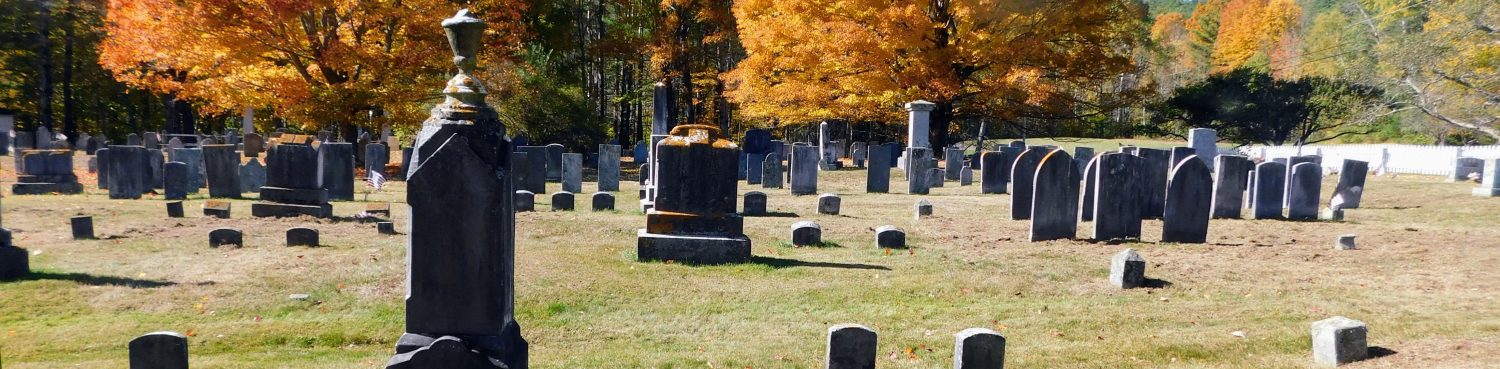
My journey led me past the Thayer School of Engineering, the Tuck School of Business, several dormitories, and the scary Hanover, New Hampshire cemetery. Burials in that graveyard went back to the 18th century. At the time I was in college, the walk past the cemetery was dark, lonely, and long. In the winter, it was also quite icy.
Then, after I graduated from college, I had brain surgery entailing the removal of my pituitary gland, after which I started growing again. My left hip did not like that, so the orthopedists at UCLA put me on crutches for two years. More exercise.
No sooner did I get off crutches than I did a lot of walking. It was 1.5 miles (2.4 km) from my apartment in Santa Monica to System Development Corporation, and 2.5 miles (4 km) from the same apartment to my next job at Urban Decision Systems. During that time, I also did a lot of hiking in the Santa Monica Mountains, sometimes on trails that were up to 10 miles (16.1 km) in length.
I don’t do so much walking any more, but over the years I had developed some good habits which, I think, are standing me in good stead today.
For their reading, Americans tend not to look beyond English-speaking North America and the countries of Western Europe. As a Hungarian, I have always delighted in the literature of Eastern Europe. In this post, I will give you a list of some of my favorite recent fiction from the former Soviet satellites, including one Ukrainian author, because Vladimir Putin is trying to turn his country into a Russian satellite.
I do not include any Russian authors—not because of any prejudice against—but because the field is so rich it deserves a separate post. Here’s the list in alphabetical order by author:
Ivo Andrić (Bosnian 1892-1975)
Won the Nobel Prize in 1961 for his novel The Bridge on the Drina about the Bosnian city of Viśegrad under the Ottomans and the Austro-Hungarians who succeeded them.
Ádám Bodor (Transylvanian Hungarian b. 1936)
His The Sinistra Zone (1992) is a delightfully funny story of one man’s quest to find his adopted son in a Romanian bear sanctuary and military zone near the Ukrainian border and spirit him return home with him.
Mircea Cărtărescu (Romanian b. 1956)
I am on the point of finishing his novel Solenoid (2015), which is a wonderful work strongly influenced by Kafka, Borges, and Boris and Arkady Strugatsky. He has been shortlisted for the Nobel Prize and is likely to win it soon.
Bohumil Hrabal (Czech 1914-1997)
I have read several great novels from this Czech writer, including Dancing Lessons for the Advanced in Age (1964), I Served the King of England (1973), and Too Loud a Solitude (1977). His gentle humor is catching.
Franz Kafka (Czech Jew 1883-1924)
Although he wrote in German and died a hundred years ago, his work is a major influence on many of the Eastern European authors. My favorites: The Trial (1925) and his short stories.
Gyula Krúdy (Hungarian 1878-1933)
I have read most of his work that has been translated into English, but my favorites were The Crimson Coach (1913) and his journalism collected in Krúdy’s Chronicles (published in 2000).
Andrey Kurkov (Ukrainian b. 1961)
He wrote most of his works in Russian (a larger audience and more $$$), but after Putin has vowed to switch to the Ukrainian dialect. My favorites: Death and the Penguin (1996) and Grey Bees (2018).
Stanislaw Lem (Polish 1921-2006)
Yes, I know he is a sci-fi writer, but his work, especially Solaris (1961) and The Futurological Congress (1971) are of high literary quality.
Olga Tokarczuk (Polish b. 1962)
Won the 2018 Nobel Prize. So far, I’ve read only one of her novels, namely, House of Day, House of Night (1998), which is one of the best books I’ve read so far this year.







You must be logged in to post a comment.