Archangels of the Andes

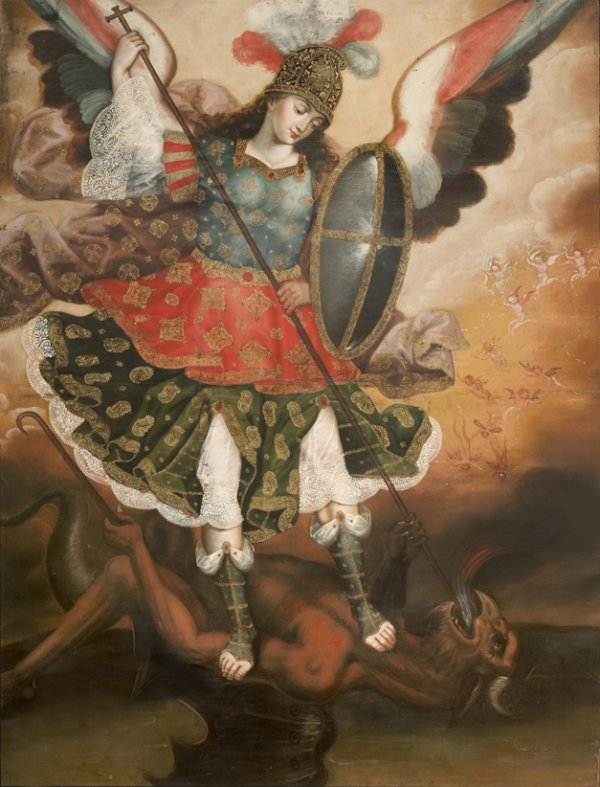
The Archangel Michael Vanquishing Satan

The Archangel Michael Vanquishing Satan

They are young, elegant, and handsome. Their wings are bi-colored, like the wings of mature condors. Yet they are all powerful and conquer their enemies with surpassing ease. They are the archangels depicted in paintings of the Cusco School of Art.

One has to imagine what it was like to be an Inca facing a compact phalanx of Spanish conquistadores mounted on horseback. At Cajamarca, many thousands were slaughtered by Pizarro and his hundred or so men. They barely even used their muskets, which were pretty useless in hand-to-hand combat in any case. No, it was Spanish steel and the strangeness of seeing warriors on horseback. Were they a single creature, man and horse? The Incas tried to kill the horses and display their corpses, thinking that now they would win with ease.

It was not to be so. The Incas were ultimately conquered, even though it took the better part of a century to complete the conquest. To the defeated, it didn’t look as if their gods were of much help to them. There must be something to this Christianity!

You can see it in the native painters’ depiction of angels, such as the one above. Michael defeats the demon without breaking a sweat or staining his doublet. He might just as easily be crocheting a doily or cleaning his nails. All throughout Peru, I saw hundreds of these archangels in the churches and archiepiscopal palaces, all with the same characteristics. The artists are usually indigenous Quechuans who painted multiple images of the same religious figures for distribution to churches all around the country.

When the Incans saw these angels, did they think of how easily they themselves were bested by the Spanish?


Two Christs for Modern Man

Bernard Verley as Christ and Edith Scob as Mary in Buñuel’s The Milky Way (1969)

Bernard Verley as Christ and Edith Scob as Mary in Luis Buñuel’s The Milky Way (1969)

After two centuries of Christian art,the West has produced thousands of images of Jesus Christ—almost none of which connects to people who are alive today. The Son of God is usually portrayed as a man who was born to be tortured to death on a cross, but not as a man who could gather around him twelve apostles and hundreds of followers.

One notable exception are the vignettes with Bernard Verley (above) as Christ in Luis Buñuel’s film The Milky Way (1969). The scene pictured above is at the marriage ceremony in Cana, when the Redeemer performed his first public miracle.

The other image is one I saw at the Getty Center today: It is the Italian painter Correggio’s “Head of Christ,” pictured below:

Correggio’s “The Head of Christ” (1530)

Correggio’s “The Head of Christ” (1530)

I like the look of consternation on Christ’s face as he contemplates what lies ahead while he is wearing the crown of thorns. This is the Christ who, the previous night at Gethsemani, had said: “My Father, if it be possible, let this cup pass from me; nevertheless, not as I will, but as you will.” He may be God, but the look on His face is 100% pure human.


Beyond the Master Forger’s Ability

Giovanni Bellini’s “The Transfiguration” (1480)

Giovanni Bellini’s “The Transfiguration” (1480)

Yesterday, I was drawn to the television by a segment on “Sixty Minutes” about the noted German art forger, Wolfgang Beltracchi. When Bob Simon of CBS asked him what painters he couldn’t forge, Beltracchi, without hesitation, answered Bellini. I took him to mean Giovanni Bellini (1430-1516) and not his brother Gentile (they were both brothers-in-law of the great Andrea Mantegna). The only time I remember ever seeing or original Giovanni Bellini was at the Frick Collection in New York City, which has a superb “St. Francis in Ecstasy” also painted in 1480. I have included an image below.

There is such an incredible sense of detail in a Bellini oil that I feel as if I could pick a background segment (say 1/64th of the total) and enlarge it to full size without losing anything. And the detail would be almost as fascinating as the foreground. Look at that fence following the upward path in “The Transfiguration” (above), and note the minor variations from post to post.Look at that dead tree at the lower left, or that couple meeting in the upper right near the tree.

I can almost imagine Bellini in an ecstasy such as St. Francis in the painting below.


St. Francis in Ecstasy (1480) at the Frick Collection

St. Francis in Ecstasy (1480) at the Frick Collection

Some people I know are put off by the Christian religious themes of Renaissance painting. The great ones would be great even if they were depicting a shoelace or a dirty dish. It’s almost as if the subject were irrelevant.


Art Without a Human Context

Not a Fan of Non-Representational Art

I’m Not a Fan of Non-Representational Art

There are people who like abstract art, and then there are people like me. I could go through a large museum of modern art in a quarter of an hour or less, stopping only for a handful of paintings that catch my eye. Admittedly, one finds masses of brilliant colors, bold designs, but nothing that relates to human experience. I have always been amazed that so many works of abstract art are so large, involving so many square feet of canvas and paint, yet  elicit so little response from me. How often does one find works of non-representational art that are small? Their very hugeness is part of their impact. I could spend half an hour looking at a small Renoir or Cézanne, yet pass by a room full of gigantic daubs with barely a shrug.

Some of my friends think there is something wrong with my taste in art. They urge me to visit Los Angeles’s Museum of Contemporary Art (MOCA), but I hesitate to devote my time and money to something that does not engage my intellect.

I have looked through some of my earlier posts about art, particularly those relating to Marcel Proust’s In Search of Lost Time. One is about Vermeer’s “A View of Delft”; another takes as its subject Pieter de Hooch’s “The Mother”; and yet another, Sandro Botticelli’s “The Trials of Moses.” Marcel Proust and I have this in common: paintings that send one on a tangent are infinitely preferred to those which only inspire a grunt accompanied by the exclamation “Meh!”

It is no surprise that banks and corporate headquarters tend to like large works of abstract art. They want people to think they are forward looking, at the leading edge. One looks at them as adjuncts of power rather than as works that can inspire even a modicum of thought. But, perhaps, power without thoughtfulness is what they are aiming at.


Boterismo

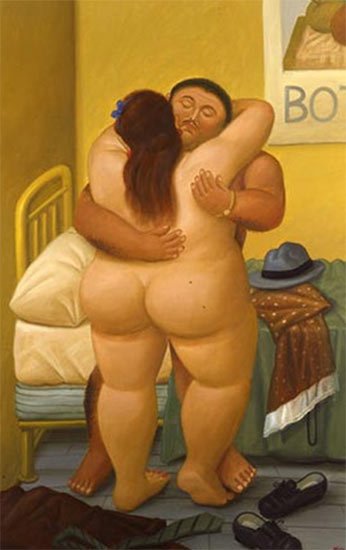
Yes, They Are a Little Thick

Yes, They Are a Little Thick

When Martine and I were in Calgary in 2010, Martine and I saw an exhibit entitled “The Baroque World of Fernando Botero” at the city’s Glenbow Museum. (Other than the fish and chips, it was the only thing I remember really liking about the city.) It was my first acquaintance with the Colombian artist other than an odd book cover or two, and I found myself liking his vertically challenged and horizontally enhanced vision. Born in Medellin, Colombia, in 1932, Fernando Botero has developed a unique style in both painting and sculpture. To see a gallery of his work, click here.

For your enjoyment, here is what Botero does to the art of ballet:

Botero Ballerina

Botero Ballerina

Is that an apple atop her head?


Ilya Repin, Painter

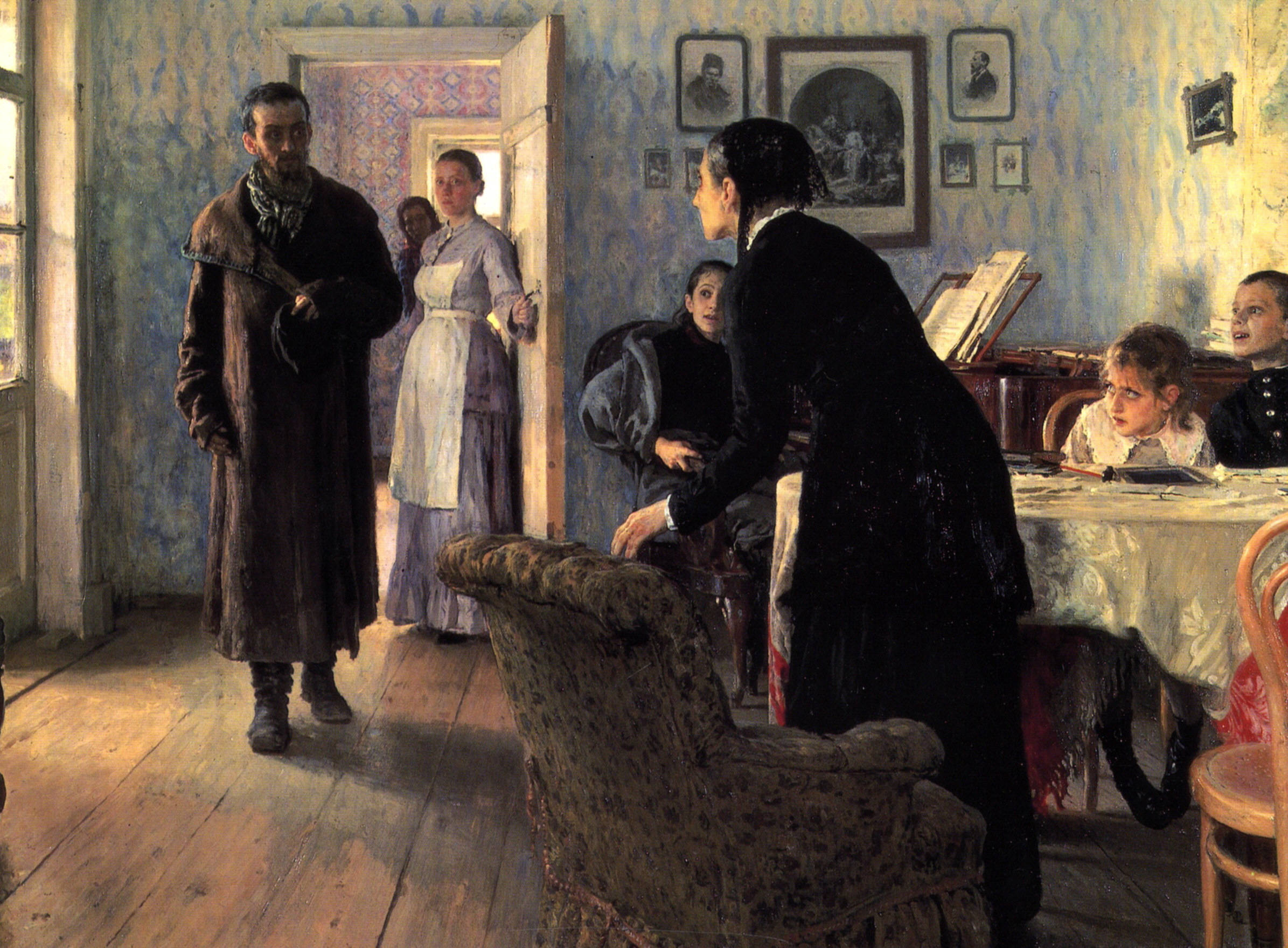
“Unexpected Visitors”—The Protypical View of 19th Century Russian Family Life

“Unexpected Visitors” (1883)—The Protypical View of 19th Century Russian Family Life

The only Russian painters that most of us in the Western World are able to name were likely expatriates, men such as Marc Chagall and Wassily Kandinsky. As for myself, I have a particular liking for the works of Ilya Yefimovich Repin (1844-1930), a Russian realist whose work was exhibited worldwide, but who lived and died in Russia. He was a supporter of the Russian Revolution of 1917 and was, in turn, honored by the Communist leadership.

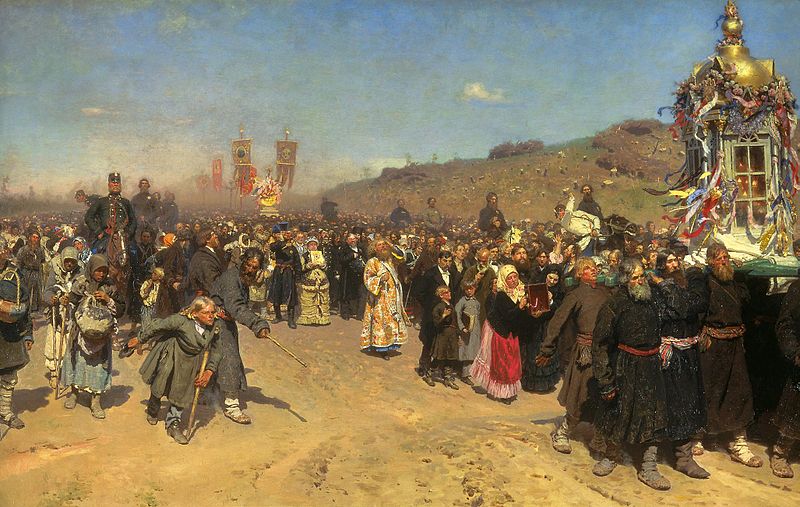
Among his most famous paintings are “Barge Haulers on the Volga” (1873);  “Unexpected Visitors,” shown above; “Religious Procession in Kursk Province” (1883), shown below; and “Reply of the Zaporozhian Cossacks” (1880-91).

“Religious Procession in Kursk Province”

“Religious Procession in Kursk Province”

The above painting strongly reminds me of the fiction of Nikolai Leskov, one of my favorite (and least well-known) Russian writers.

It’s Not Over Until the Bearded Lady Sings

In Eurovision, the Wurst Always Wins

In Eurovision, the Wurst Always Wins

I have always been amused by the annual Eurovision song contest, if only because it means so much to all the nations participating.This year, the winner was a bearded drag queen from Austria who goes by the name of Conchita Wurst (real name: Tom Neuwirth). I heard a bit of his/her number, “Rise Like a Phoenix,” on YouTube. I have to admit that Conchita was in good voice and deserved some credit for not turning the number into a freak show.

Every year, I root for Iceland to win. For a tiny little island nation (under 400,000 population), they have tons of raw musical talent. This year, the representative was a group called Pollapönk, which looks something like a cross between the Mighty Morphin Power Rangers and the Teletubbies. Their musical number was called “No Prejudice,” which you can see here at YouTube. This year Pollapönk placed a lowly fifteenth out of twenty-six. According to the Iceland Review website, their favorable votes came mostly from San Marino (8), France (7), and Italy (6).

I doubt anything lik Eurovision would ever make it big in the United States. Although Europe has the musical talent, Eurovision is far too political (big surprise!) and far too oriented toward a lumpenproletariat audience. It differs from such performers as Barry Manilow and Tom Jones mainly in the politically liberal orientation of the musical numbers presented.


Xul Solar

Jorge Luis Borges’s Favorite Painter Comments on Religion

Jorge Luis Borges’s Favorite Painter Comments on Religion

His real name was Oscar Agustín Alejandro Schulz Solari, but he was better known under the name Xul Solar. Born in Buenos Aires of a Latvian father, he spent his whole life in Argentina. When I was in Buenos Aires in 2006 and 2011, I desperately wanted to visit his museum; but I just wasn’t able to do so. Before he went completely blind in the 1950s, Jorge Luis Borges—whom you may know as one of my favorite writers—befriended him and wrote about his paintings. I have always been intrigued by what I have seen of his work.

If you are interested in seeing some of his work from the 1920s through the 1960s, take a look at the website of the Museo Xul Solar, which is in Spanish but easy to navigate.

In 1949, Borges made one of his cryptic pronouncements about the work of his friend:

Versed in all disciplines, curious of all mysteries, the father of writings, of languages, of mythologies, guest of hells and heavens, “panchess-player,” author and astrologer, perfect in indulgent irony and in the generous friendship, Xul Solar is one of the most important events of our age. There are minds who profess probity, others, discriminate abundance; Xul Solar’s plentiful invention does not exclude honest rigor. His paintings are documents of the unearthly world, of the metaphysical world in which the gods take the forms of imagination, dreams. Passionate architecture, happy colors, many circumstantial details, labyrinths, homunculi and angels unforgettably define this delicate and monumental art.

The taste of our time vacillates between mere linear pleasure, emotional transcription and realism painted by a dauber’s brush. Xul Solar renews, in his ambitious but modest way, the same painting of those who do not see with their physical eyes in the sacred field of Blake, of Swedenborg, of the yogis and of bards.


Odette

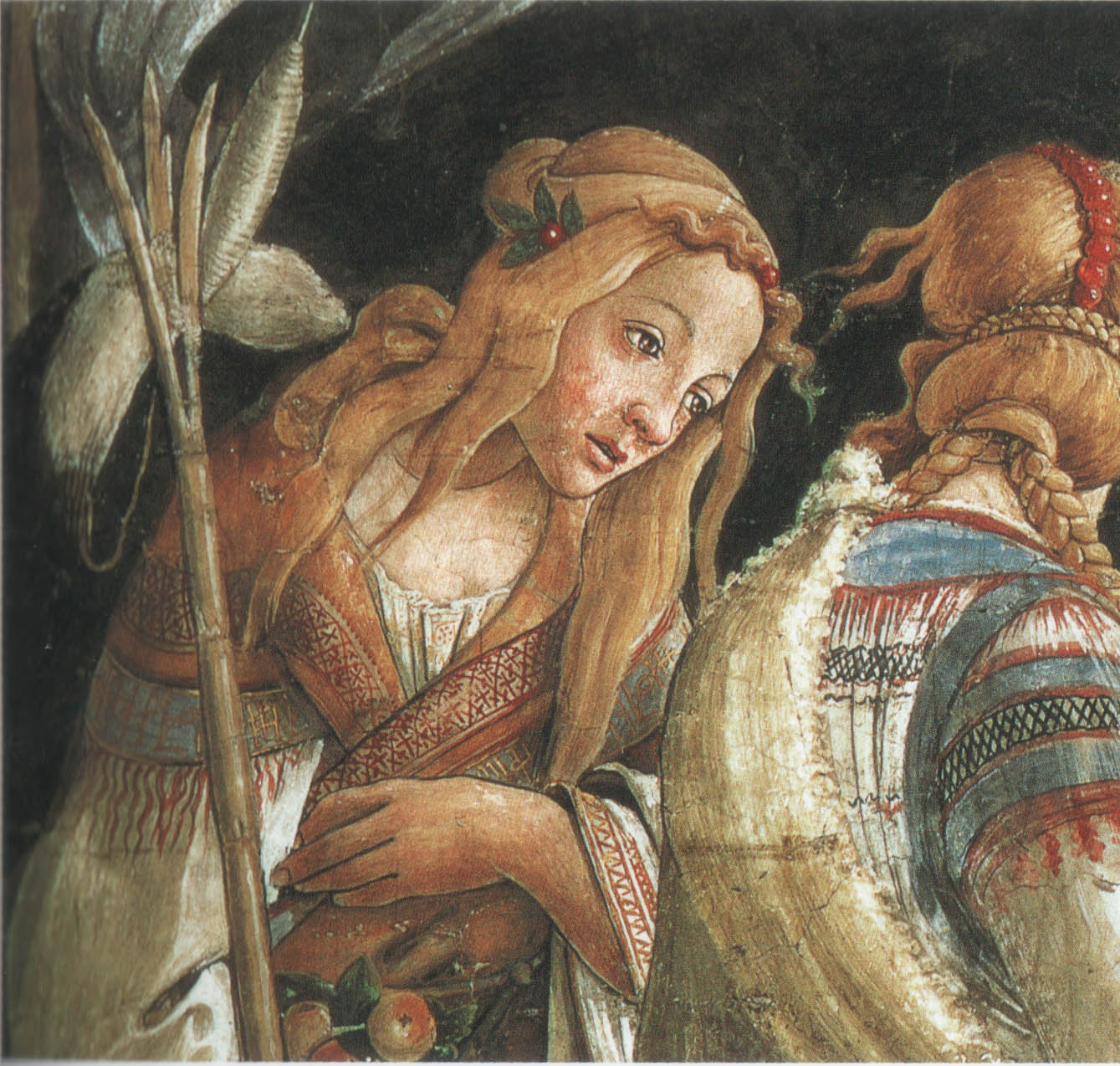
Detail of Zipporah from Botticelli’s The Trials of Moses

Detail of Zipporah from Botticelli’s The Trials of Moses

Shown above is a detail from Sandro Botticelli’s painting “The Trials of Moses” depicting Jethro’s daughter Zipporah. It is this image which Marcel Proust used to describe the love of Charles Swann’s life, Odette de Crécy. It was a mammoth undertaking, especially as Proust was gay: He constantly had to translate heterosexual behavior through a homosexual template, which was more familiar to him. (In later volumes, Marcel’s lover Albertine was thus “translated” from his Italian chauffeur, Alfred Agostinelli.) As difficult as it seems to do this, Proust succeeded so well that Swann’s Way is perhaps the greatest work in literature about disappointment in love.

Swann was not immediately taken with Odette:

[S]he had seemed to Swann not without beauty, certainly, but of a type of beauty that that left him indifferent, that aroused no desire in him, even caused him a sort of physical repulsion, one of those women such as everyone has his own, different for each, who are the opposite of the kind our senses crave. Her profile was too pronounced for his taste, her skin too delicate, her cheekbones too prominent, her figures too pinched. Her eyes were lovely, but so large they bent under their own mass, exhausted the rest of her face, and always gave her a look of being in ill health or ill humor.

A few pages later, we see what Swann (and by extension Proust) was doing in crystallizing his feelings toward this young woman::

He placed on his worktable, as if it were a photograph of Odette, a reproduction of Jethro’s daughter. He admired the large eyes, the delicate face, which allowed one to imagine the imperfect skin, the marvelous curls of the hair along the tired cheeks, and adapting what he had found aesthetically beautiful up to then to the idea of a living woman, he translated it into physical attractions which he rejoiced to find united in a creature whom he could possess. The vague feeling of sympathy that draws us toward a masterpiece as we look at it became, now that he knew the fleshly original of Jethro’s daughter, a desire that henceforth compensated for the desire that Odette’s body had not at first inspired in him. When he looked at that Botticelli for a long time, he would think of his own Botticelli, whom he found even more beautiful, and bringing the photograph of Zipporah close to him, he would believe he was clasping Odette against his heart.

Alas, Odette is openly unfaithful to Swann and drives him crazy with envy as the Comte de Forcheville moves in on his woman, while their friends at the Verdurins’ salon conspire against him. In the process, Swann’s life becomes bitter; and he no longer derives any joy from the things that hitherto had sustained him, his friends, his art, and high society. In the end, Swann admits to himself: “To think that I wasted years of my life, that I wanted to die, that I felt my deepest love, for a woman who did not appeal to me, who was not my type!”

Of course, that didn’t keep him from marrying her. But that is another story.

A Republican Designed by Cubists

Congressman Darrell Issa (R-CA)

Congressman Darrell Issa (R-CA)

Every time I look at a picture of Troglodyte Republican Congressman Darrell Issa, I think of the cubist paintings of a century or so ago. The lack of symmetry of his facial planes is rather marked; and I cannot help but wonder if it represents some seismic disaster in his brain. His right eyebrow seems to be an inch or more above his left eyebrow. Seems quite appropriate for a rightist, no?

Compare with the portrait by Juan Gris below and you’ll see what I mean:

Portrait by Juan Gris

Portrait by Juan Gris