Signor Piranesi’s Prisons

Why Do I Think of Prisons During Tax Season?

Why Do I Think of Prisons During Tax Season?

When I first came to Los Angeles, UCLA had a special program of renting prints and etchings to members of the university community at a low price. I fell in love with a print by Giambattista Piranesi (1720-1778), a Venetian artist known for his series of prints on prisons, or Carceri. I seem to remember having, for about six months, the above print, one of a series of sixteen he did that were to bridge the classical period with the romanticism and surrealism that were to follow.

In his Confessions of an English Opium Eater (1820), Thomas De Quincey wrote:

Many years ago, when I was looking over Piranesi’s Antiquities of Rome, Mr. Coleridge, who was standing by, described to me a set of plates by that artist … which record the scenery of his own visions during the delirium of a fever: some of them (I describe only from memory of Mr. Coleridge’s account) representing vast Gothic halls, on the floor of which stood all sorts of engines and machinery, wheels, cables, pulleys, levers, catapults, etc., etc., expressive of enormous power put forth, and resistance overcome. Creeping along the sides of the walls, you perceived a staircase; and upon it, groping his way upwards, was Piranesi himself: follow the stairs a little further, and you perceive it come to a sudden abrupt termination, without any balustrade, and allowing no step onwards to him.

I still love looking at Piranesi’s imaginative prisons, and I think of myself trapped in one of them—at least until April 15 or thereabouts. Tomorrow is the first of eight Saturdays I will have to work. Oh, well, here are only a little more than fifty days left of this dreadful time. I will probably survive, diminished only slightly.


“The Enigma of Arrival”

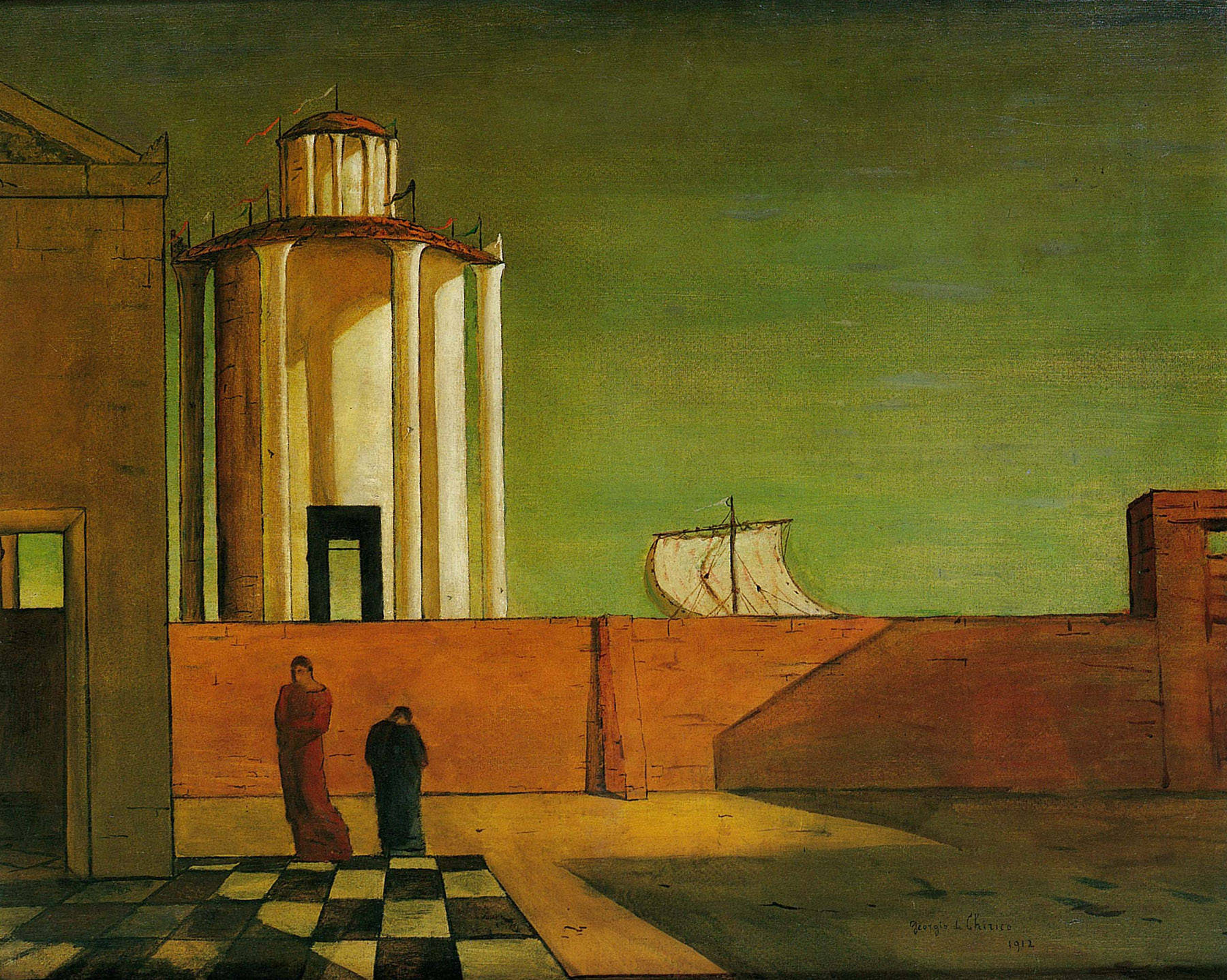
One of My Favorite Paintings by Giorgio de Chirico

One of My Favorite Paintings by Giorgio de Chirico

I remember the first time I landed at the Manuel Crescencio Rejón Aeropuerto in Mérida, Yucatán, in November 1975. It was my first real trip out of the country (I don’t include Niagara Falls and Tijuana as being quite outside the U.S.), and it was a real eye-opener. It was night, and the vibe was tropical. In the cab to the Hotel Mérida, I passed a huge Coca Cola bottling plant before we took the turn to the right toward Calle 60. So many businesses were open to the street, and families were seated at card tables with beers and sodas. The local men were all dressed in white; and the women wore colorfully embroidered huipiles.

What was different between this and all my previous travels was that I was alone in a strange land and feeling an unusual sense of the remoteness of all my previous experience to what I was experiencing in the moment. I felt like the two huddled figures in Giorgio de Chirico’s painting, “The Enigma of Arrival” (shown above)—except that the streets of Mérida were crowded. I didn’t get much sleep that night, much of which was spent leaning out of my sixth floor window onto Calle 60. All night long, figures walked up and down the street, occasionally stopping in mid-stride to stare right at me. (How did they do that?)

The next morning, I had breakfast at the Restaurant Express, which was right across the street from a 17th century Franciscan church and the old Gran Hotel, which used to be the only one in town around the turn of the century. Eventually, I grew used to the crowds, the food, the warm, humid, floral air. I loved Yucatán and went back there four or five times.

In 1987, V. S. Naipaul wrote a novel entitled The Enigma of Arrival, which discussed the strangeness of his life (he was born in Trinidad) in the English countryside.

I have grown to love the actual enigma of arrival in a different country. I am more alive to everything around me. It is a good feeling.


A 2,000 Year Old Painting

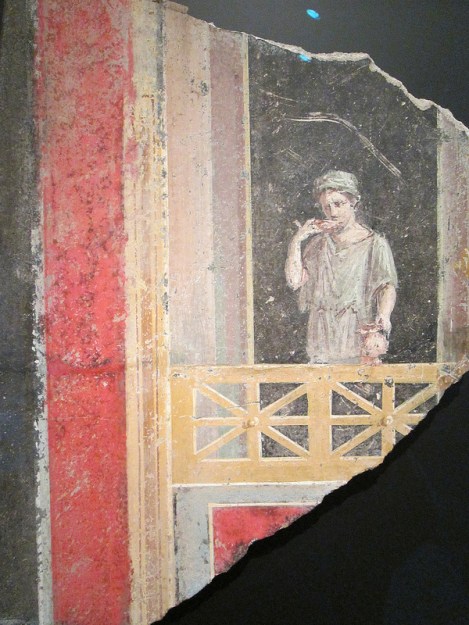
Fresco of a Young Woman on a Balcony

Fresco Fragment of a Young Woman on a Balcony

We don’t think of painting as having begun until the Middle Ages. There isn’t much that survives from Ancient Greece and Rome, but there are some, such as the above fresco fragment showing a young woman with a turban on a balcony. The original is to be found at Malibu’s Getty Villa. She appears to be drinking something from a shallow bowl and petting a dog or cat with her left hand. While there were no oil paintings as such—not as we think of them—there were frequent wall paintings in homes, temples, and other public buildings.

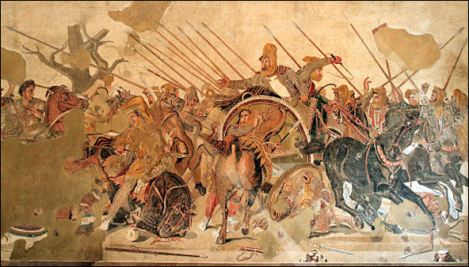
If we widen our definition of painting to include mosaics, then there are some even more spectacular works such as were found at the ruins of Pompeii and Herculaneum. I have seen mosaics that have solved problems of perspective that were not seen again for over a thousand years. Take, for example, the mosaic of one of the battles of Alexander the Great below:

Alexander the Great at the Battle of Issus Against the Persians

Alexander the Great at the Battle of Issus Against the Persians

It has always been my belief that most people feel that the Greeks and Romans were too ancient to be bothered with, and that art really sprang into existence during the Renaissance. Not so. A visit to Italy or such excellent museums as the Getty Villa in Malibu help redress the balance. For some background, see the excellent web page on Ancient Roman Art and Art Objects. Compare this with the Bayeux Tapestry and other Medieval battle scenes, which look relatively primitive in comparison.

The Art of Dust

Dust Magnified by an Electron Mkicroscope

Common Household Dust Magnified by an Electron Microscope

One would not think that regular household dust, when magnified by an electronic microscope, could look so artistic. In fact, if I saw a painting like this hanging in an art museum, I would think that here was a painter who had considerable promise.

But then I think of this stuff being sucked into my lungs and down my throat and wonder how I can survive. After all, things are being manufactured with ever more exotic materials; and the detritus from these materials is being sucked into our bodies. Maybe I should look for an electron microscope photograph of our lungs or our bloodstream.

This photo comes from The Guardian’s website, which directs you to other examples of microphotography. Happy hunting!


Henceforth Free

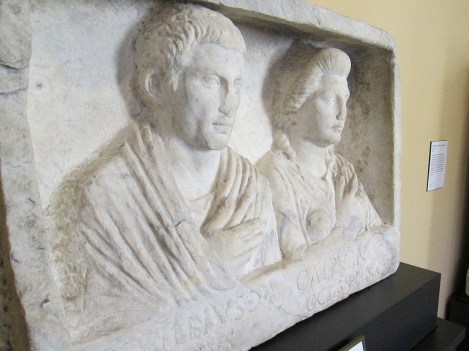
Tomb Monument for Popilius and Calpurnis

Roman Tomb Monument for Popilius and Calpurnia

One of the most touching grave monuments at the Getty Villa in Malibu is of a manumitted couple, Popilius and Calpurnia, who had been slaves before being freed by their master. The design is typical of monuments to freedman. Monuments such as this one lined the roads leading out of Rome. According to the descriptive panel accompanying the monument, “The panels announced the elevated social status of freedmen and their heirs, who were henceforth freeborn.” The monument dates from between A.D. 1 and A.D. 20—right around the time that Christ walked the earth.

I was greatly impressed by this panel, which I felt was made with some feeling for the ex-slaves, as if the artist knew them personally. There is a look of rectitude on their faces, above the hands folded on their breasts.

Works like this make me think that our ancient ancestors were more like us than we think. We would be just as impressed by Marcus Tullius Cicero as his fellow members of the Senate; and we would probably be even more appreciative of him than we are of our own Senators and Congressmen. We didn’t just come into being when personal computers, smart phones, and iPads came into existence. These are all accidentals.

Read yesterday’s post quoting one of Horace’s odes. I wouldn’t change a word of it for our own generation.

She Could Be Someone’s Mummy

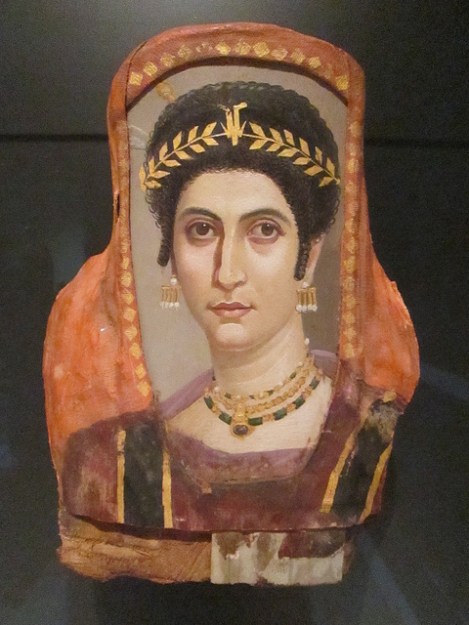
Hellenistic Mummy Burial Mask of a Young Woman

Hellenistic Mummy Burial Mask of a Woman

Rather than joining the throngs at the shopping centers for Black Friday, Martine and I visited the Getty Villa in Malibu. Not to be confused with the Getty Center off the San Diego Freeway, the Getty Villa is primarily a museum of the ancient world, concentrating on Greece and Rome.

The big draw today, however, was the Cyrus Cylinder, a cuneiform clay cylinder distributed by the Emperor Cyrus in 539 B.C. upon the occasion of the conquest of Babylon. The museum was crowded with Persian families visiting one of the most important historical milestones in their country’s history. The cylinder is shown below:

Cyrus Cylinder

Cyrus Cylinder

We tend to ignore ancient history because, well, it’s “ancient history.” What we don’t take into account is the often startling realism of portraiture, particularly by the Romans and Hellenistic Greeks. Shown at the top is a painted fabric mask applied to a mummy of a woman who died around the Fourth Century A.D. Several of the exhibit halls are filled with uncomplimentary busts of Roman emperors and commoners. One classic example is a somewhat sinister bust of Caligula, and another of a bearded old man. Roman coins, for example, make no attempt to “photoshop” their emperors with a more beautiful or imposing face. Being realists, the Romans wanted the plebs to know what their leaders really looked like.

Because we get four days off for Thanksgiving Weekend, I have usually made a reservation at the Villa for the day after Thanksgiving. Unfortunately, the idea seems to have caught on. Especially toward the end of the afternoon, the place was jammed. No matter, there is a serenity about art that has lasted for two thousand odd years. Will ours be venerated two thousand years from now? I think not.


No matter, we had a great time strolling through the

Looking Out for Number Two

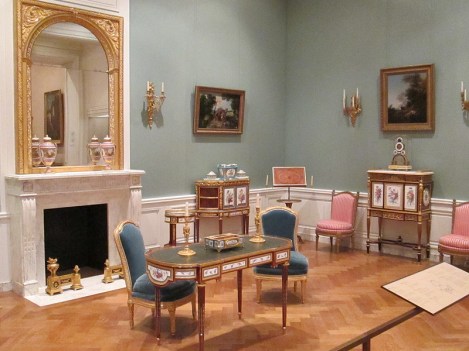
Elegance and—Yes!—Squalor

Elegance and—Yes!—Squalor

The galleries of 17th and 18th Century French furniture at the Getty Center are our favorite parts of their permanent collection. For one thing, they’re not as crowded as the galleries with paintings; for another, they let you take photographs. An elegant table or chair or cabinet can be just as much a work of art as a sculpture or an oil painting. It’s just that we are conditioned by our culture to regard fine art as something in oils on a canvas or wood backing. In fact, some of the furniture in the Getty incorporate small paintings on some of their panels.

Which brings me, by a commodius vicus of recirculation, to the Palace of Versailles in France. Imagine several miles of corridors with furniture such as pictured above, gorgeous drapes, halls with mirrors, paintings, gilded moldings, and in general the finest workmanship in all the fittings.

There was, however, one glaring exception: There were no bathrooms. Oh, the king, queen, and selected nobles had their own chaises percées which they could summon with a hand signal to one of their entourage. Anyone who was properly dressed (that meant a sword for you gentlemen, which could be rented from the palace concierge upon entry) would walk into the palace, wander into the King’s bedroom and watch him snuggle with his consort from behind a gold railing, and stroll through the grounds at his leisure.

But, being a mammal, there was always the chance that he or she would get “caught short.” When asking for the nearest restroom would get you nothing but disrespectful sniggers. According to one Internet source:

It’s difficult to believe today when gazing at the gleaming golden palace, but life at Versailles was actually quite dirty. There were no bathrooms as we would know them. Courtiers and royalty used decorative commodes in each room, while commoners simply relieved themselves in the hallways or stairwells. No one bothered to house-train the royal dogs, and servants did not consider cleaning up after them to be part of their job description. The constantly-altered chimneys did not draw well, so everything inside was covered with soot. The filth and disorder at Versailles during the ancient regime were noted in many records of the time.

So, imagine, if you will, what it was like to tour the palace being careful not to slip on another person’s bodily effluvia. Because it was considered beneath the monarch to concern himself with such trivial matters, it was not until 1715 that he ordered a weekly cleanup of the corridors by his servants. Imagine what it must have been like by then. Even today it’s a problem for tourists, according to one TripAdvisor report.

What a contrast between elegance and squalor!

Omigosh, What Have I Done?

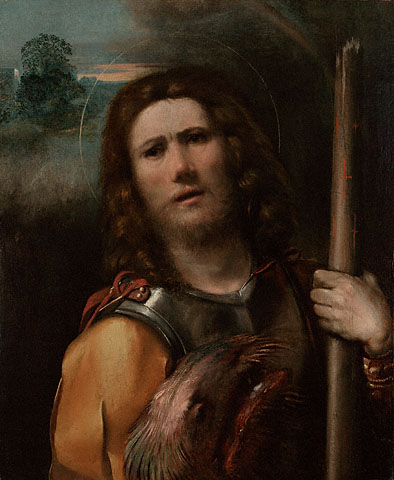
Saint George by Dosso Dossi (ca. 1515)

Saint George by Dosso Dossi (ca. 1515)

Today Martine and I drove to the Getty Center and looked at the paintings, special exhibitions, and decorative arts. What particularly interested me was a painting by the Italian Dosso Dossi (born Giovanni di Niccolò de Luteri) around 1515 of Saint George immediately after slaying the dragon. It’s not an expression of joy or celebration by any means. Almost, it seems as if the saint is asking himself, “Oh my God, what have I done?” Perhaps some ancient knowledge of the dragon’s has been conveyed to the Roman soldier, and he foresees that the world will never be the same again.

The painting is a small one, measuring 27½ x 24 inches, and by no means in a dominant location in the exhibition hall. Still, the facial expression drew my attention immediately and held it. I would have liked to photograph it (without flash, of course), but the guard in that particular hall forbade it; so I noted the name of the artist and luckily found it on the Getty Center website, which describes the oil as follows:

Dosso Dossi depicted the aftermath of Saint George’s battle with the dragon, in which he wields the creature’s bloodied head and the lance broken during the fight. Under an emerging rainbow, the victorious patron saint of Ferrara, Italy, emerges from the darkness of the battle. Dossi poignantly expressed his subject’s recent emotional turmoil in the saint’s penetrating expression. He appears weary yet resolute in his triumph.

The symbols of Saint George’s Christian faith—crosses rendered in vivid strokes of red paint as though the blood of his opponent drips down its shaft—mark the weapon. The color of the crosses echoes the blood ringing the beast’s mouth and also symbolizes the blood of Christ.

I don’t altogether agree with Saint George appearing “weary but resolute in his triumph.” I guess each work of art speaks to different people in different ways.

There is a poem by Jorge Luis Borges entitled “Limits” which, to me, conveys the spirit of this painting:

There is a line of Verlaine I shall not recall again,
There is a nearby street forbidden to my step,
There is a mirror that has seen me for the last time,
There is a door I have shut until the end of the world.
Among the books in my library (I have them before me)
There are some I shall never reopen.
This summer I complete my fiftieth year:
Death reduces me incessantly.

(Translated by Anthony Kerrigan)

Art and Courage

Opening Oneself Up to Create Art

Opening Oneself Up to Create Art

The reader walks away from real art heavier than she came to it. Fuller. All the attention and engagement and work you need to get from the reader can’t be for your benefit; it’s got to be for hers. What’s poisonous about the cultural environment today is that it makes this so scary to try to carry out. Really good work probably comes out of a willingness to disclose yourself, open yourself up in spiritual and emotional ways that risk making you look banal or melodramatic or naive or unhip or sappy, and to ask the reader really to feel something. To be willing to sort of die in order to move the reader, somehow. Even now I’m scared about how sappy this’ll look in print, saying this. And the effort actually to do it, not just talk about it, requires a kind of courage I don’t seem to have yet. … Maybe it’s as simple as trying to make the writing more generous and less ego-driven.—David Foster Wallace, Conversations with David Foster Wallace


Fragments of Eternity

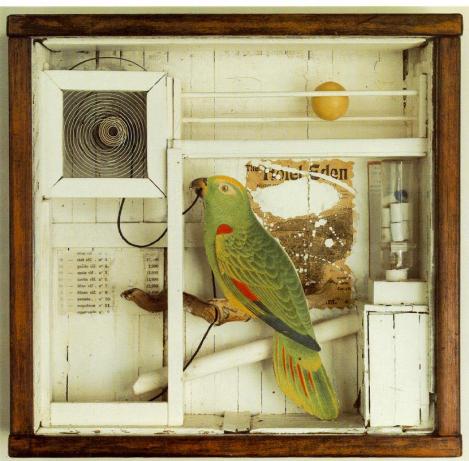
Joseph Cornell’s Hotel Eden

Joseph Cornell’s Hotel Eden

Sometimes even a fragment can set one’s mind a-roving. Today while eating lunch at the Attari Persian Sandwich Shop in Westwood, I started reading an article about the poetry of Charles Simic in the July 11, 2003 issue of The New York Review of Books. Because I was almost finished with my iced tea, I stopped reading the article and got up to make room for other diners. Before I folded up the issue, I saw an intriguing comparison between the poems of Emily Dickinson and the bricolage art of Joseph Cornell (1903-1972). Now who was this Joseph Cornell? I got back to the office and looked at several samples of his work, two of which I include here. I also read a poem by Emily Dickinson entitled “A Bird Came Down,” which I present below in its entirety:

A bird came down the walk:
He did not know I saw;
He bit an angle-worm in halves
And ate the fellow, raw.

And then he drank a dew
From a convenient grass,
And then hopped sidewise to the wall
To let a beetle pass.

He glanced with rapid eyes
That hurried all abroad,—
They looked like frightened beads, I thought;
He stirred his velvet head

Like one in danger; cautious,
I offered him a crumb,
And he unrolled his feathers
And rowed him softer home

Than oars divide the ocean,
Too silver for a seam,
Or butterflies, off banks of noon,
Leap, splashless, as they swim.

Everything is fairly clear until we come to the last two stanzas. At this point, Dickinson compares the bird’s wings to oars and butterflies, whose movement suggests to her a resemblance to swimming in the air. Now, let me ask you this: Did the bird accept the proffered crumb or not? Did the bird suddenly take to flight and suddenly remind the poet of butterflies diving, as it were, into the air?

You may notice: I do not present answers, merely questions. I am not such a tyrant as to wish to impose my interpretation (which, in any case, I have not yet arrived at and probably never will) on you. To me, poetry that is great suggests a multiplicity of questions, and no dogmatic answers. Poetry leads you to strange places and makes you see strange relationships. But, if it’s great poetry, it leaves the answers up to you. So, too, does the following box by Joseph Cornell:

Joseph Cornell’s Medici Boy

Joseph Cornell’s Medici Boy

What is it with that thing in the lower center that looks like a small fan? And what about those photos and drawings along the sides of the main image and the blocks at the bottom? Then there are those numbers that look like something taken off an oversized railroad schedule.

Eventually I’ll read the article about Charles Simic’s poetry. Perhaps tomorrow. In the meantime, certain fragments have made me see things that set my mind reeling. Even if my conclusions are different from those of the reviewer, I will have taken an interesting little journey.