Art and Courage

Opening Oneself Up to Create Art

Opening Oneself Up to Create Art

The reader walks away from real art heavier than she came to it. Fuller. All the attention and engagement and work you need to get from the reader can’t be for your benefit; it’s got to be for hers. What’s poisonous about the cultural environment today is that it makes this so scary to try to carry out. Really good work probably comes out of a willingness to disclose yourself, open yourself up in spiritual and emotional ways that risk making you look banal or melodramatic or naive or unhip or sappy, and to ask the reader really to feel something. To be willing to sort of die in order to move the reader, somehow. Even now I’m scared about how sappy this’ll look in print, saying this. And the effort actually to do it, not just talk about it, requires a kind of courage I don’t seem to have yet. … Maybe it’s as simple as trying to make the writing more generous and less ego-driven.—David Foster Wallace, Conversations with David Foster Wallace


Fragments of Eternity

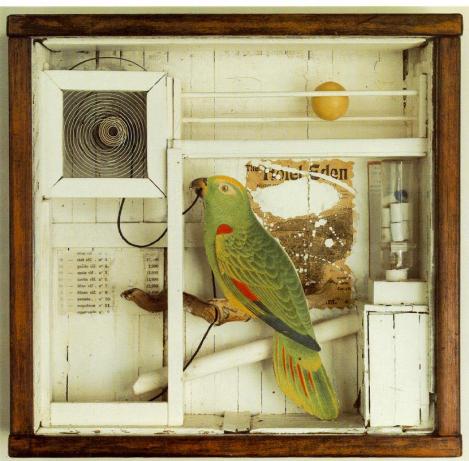
Joseph Cornell’s Hotel Eden

Joseph Cornell’s Hotel Eden

Sometimes even a fragment can set one’s mind a-roving. Today while eating lunch at the Attari Persian Sandwich Shop in Westwood, I started reading an article about the poetry of Charles Simic in the July 11, 2003 issue of The New York Review of Books. Because I was almost finished with my iced tea, I stopped reading the article and got up to make room for other diners. Before I folded up the issue, I saw an intriguing comparison between the poems of Emily Dickinson and the bricolage art of Joseph Cornell (1903-1972). Now who was this Joseph Cornell? I got back to the office and looked at several samples of his work, two of which I include here. I also read a poem by Emily Dickinson entitled “A Bird Came Down,” which I present below in its entirety:

A bird came down the walk:
He did not know I saw;
He bit an angle-worm in halves
And ate the fellow, raw.

And then he drank a dew
From a convenient grass,
And then hopped sidewise to the wall
To let a beetle pass.

He glanced with rapid eyes
That hurried all abroad,—
They looked like frightened beads, I thought;
He stirred his velvet head

Like one in danger; cautious,
I offered him a crumb,
And he unrolled his feathers
And rowed him softer home

Than oars divide the ocean,
Too silver for a seam,
Or butterflies, off banks of noon,
Leap, splashless, as they swim.

Everything is fairly clear until we come to the last two stanzas. At this point, Dickinson compares the bird’s wings to oars and butterflies, whose movement suggests to her a resemblance to swimming in the air. Now, let me ask you this: Did the bird accept the proffered crumb or not? Did the bird suddenly take to flight and suddenly remind the poet of butterflies diving, as it were, into the air?

You may notice: I do not present answers, merely questions. I am not such a tyrant as to wish to impose my interpretation (which, in any case, I have not yet arrived at and probably never will) on you. To me, poetry that is great suggests a multiplicity of questions, and no dogmatic answers. Poetry leads you to strange places and makes you see strange relationships. But, if it’s great poetry, it leaves the answers up to you. So, too, does the following box by Joseph Cornell:

Joseph Cornell’s Medici Boy

Joseph Cornell’s Medici Boy

What is it with that thing in the lower center that looks like a small fan? And what about those photos and drawings along the sides of the main image and the blocks at the bottom? Then there are those numbers that look like something taken off an oversized railroad schedule.

Eventually I’ll read the article about Charles Simic’s poetry. Perhaps tomorrow. In the meantime, certain fragments have made me see things that set my mind reeling. Even if my conclusions are different from those of the reviewer, I will have taken an interesting little journey.

Perfect Landscapes

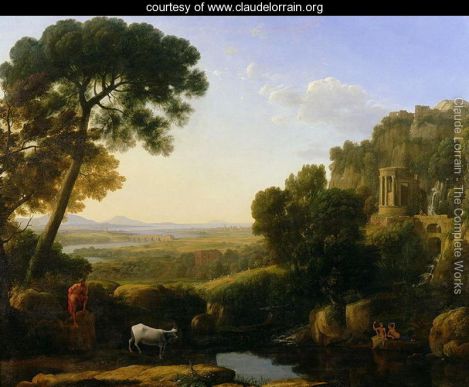
Claude Lorrain’s “A Landscape with Argus Guarding Io”

Claude Lorrain’s “A Landscape with Argus Guarding Io”

It doesn’t matter what the painting is called. It’s by Claude Lorrain (1600-1682), so it’s a landscape with classical overtones and various people picturesquely arranged across the foreground as if they were born to grace that landscape the moment they walked across it.

There is something so perfect about Lorrain’s landscapes that I was enthralled to discover a website called Claude Lorrain: The Complete Works. Granted that the pictures are all identified across the top and side, as in the example above, it is still wonderful to see so many of the master’s works all in one place. Take a look at the website and enlarge some of the landscapes: They are perhaps the best ever painted.

I don’t write about painting much, but that’s not because it isn’t important to me. It’s the same reason I don’t write much about music. Both art forms, especially music, tend to defy the world of words—and that’s where I tend to live.

This last weekend, I spent a whole day putting together an MP3 collection of some of my favorite music, including Brahms, Sibelius, Mahler, Tchaikovsky, Beethoven’s Symphonies and Late Quartets, Prokofiev, Elgar, Welsh choral music, and Argentinian tangos sung by Carlos Gardel. They will keep me company on my lonely travels across Iceland.

An Afternoon at LACMA

One of My Two Favorite Paintings at LACMA: Jan de Heem’s “Still Life with Oysters and Grapes”

One of My Two Favorite Paintings at LACMA: Jan de Heem’s “Still Life with Oysters and Grapes”

Today was the last day that I don’t have to show up for work until Friday, April 19: That’s thirty-nine consecutive days that I will have to work. (We have a three-day weekend after the April 15 tax deadline).

Martine and I took advantage of the last free day by visiting the Los Angeles County Museum of Art (LACMA) right near the famed La Brea Tar Pits by Wilshire & Fairfax. Over the years, LACMA has grown like Topsy: It now occupies a campus of some eight buildings, only three of which I visited. Scattered as the museum’s collections are, it is now much more difficult to find particular paintings or particular periods of art. There are two paintings I always look for. The first (shown above) is Jan Davidszoon de Heem’s “Still Life with Oysters and Grapes,” from the Dutch Golden Age of the 17th century.

The other, shown below, is a delightful Auguste Renoir painting of two girl’s reading from a book.

Pierre Auguste Renoir’s “Two Girls Reading”

Pierre Auguste Renoir’s “Two Girls Reading”

I am not always fond of the Impressionist painters, because I think some of them, such as Monet and Cézanne, can be too sterile in their search for effects (though not always). But in the above painting, the whole world revolves around the two girls. Displayed right next to it at the museum is a portrait of the artist’s son Jean portrayed as a huntsman. Because Jean grew up to be one of my favorite film directors, I have always been fond of that portrait as well.

Because Martine and I have different tastes in art, we split up and met later in the afternoon at the museum café, where I was drinking a cup of English Breakfast tea. In the meantime, on my own I visited the exhibits of Chinese and Korean art. Particularly interesting was a small traveling exhibit of Ming Dynasty Masterpieces from the Shanghai Museum. Many of them depicted members of the Taoist Immortals, often with a great sense of humor, such as the ink wash drawing showing one of them flying up to the heavens on the back of a giant carp.

There was also an excellent exhibit of ancient Meso-American art, showing the typical Mayan, Totonac, and other peoples’ sense of humor depicting gods, men, and animals—especially the latter.