Mexican Folk Art from the Casa de los Venados in Valladolid, Yucatán
Perhaps the largest collection of Mexican folk art in private hands is on display at the Casa de los Venados in Valladolid, Yucatán, about a block off the Zócalo. The collection contains 3,000+ pieces of high-quality folk art. If you should ever find yourself in Yucatán, you should consider paying a visit. Not only is the museum an eye-opener, but the city of Valladolid is worth spending several days touring.
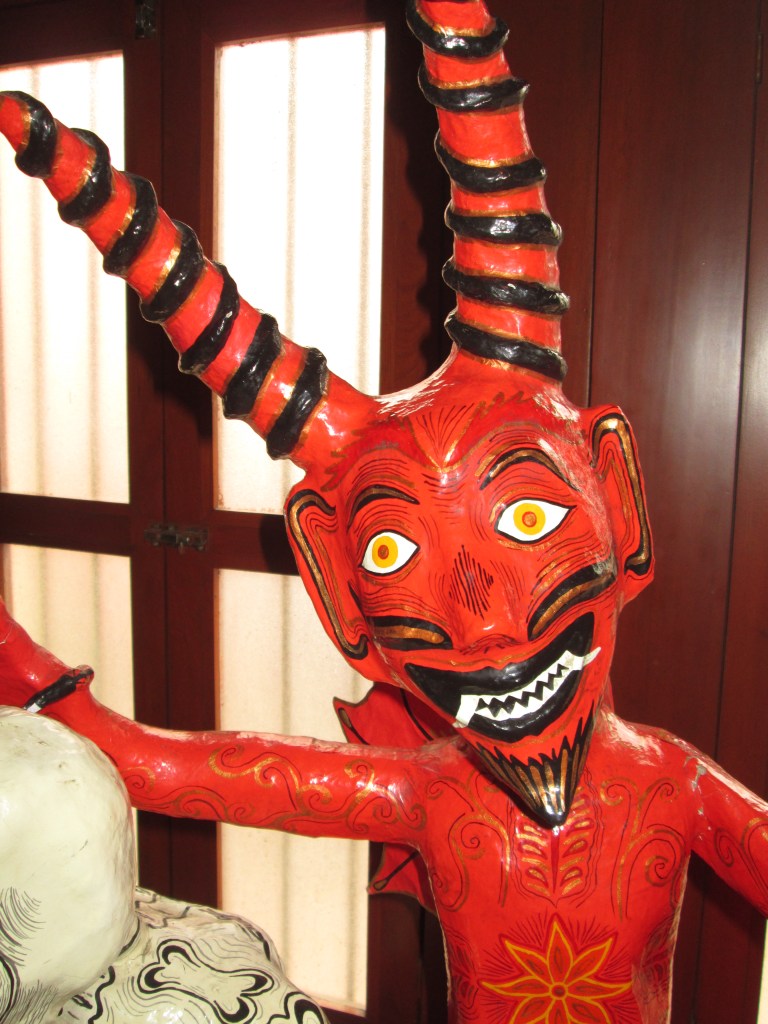
A Friendly Demon
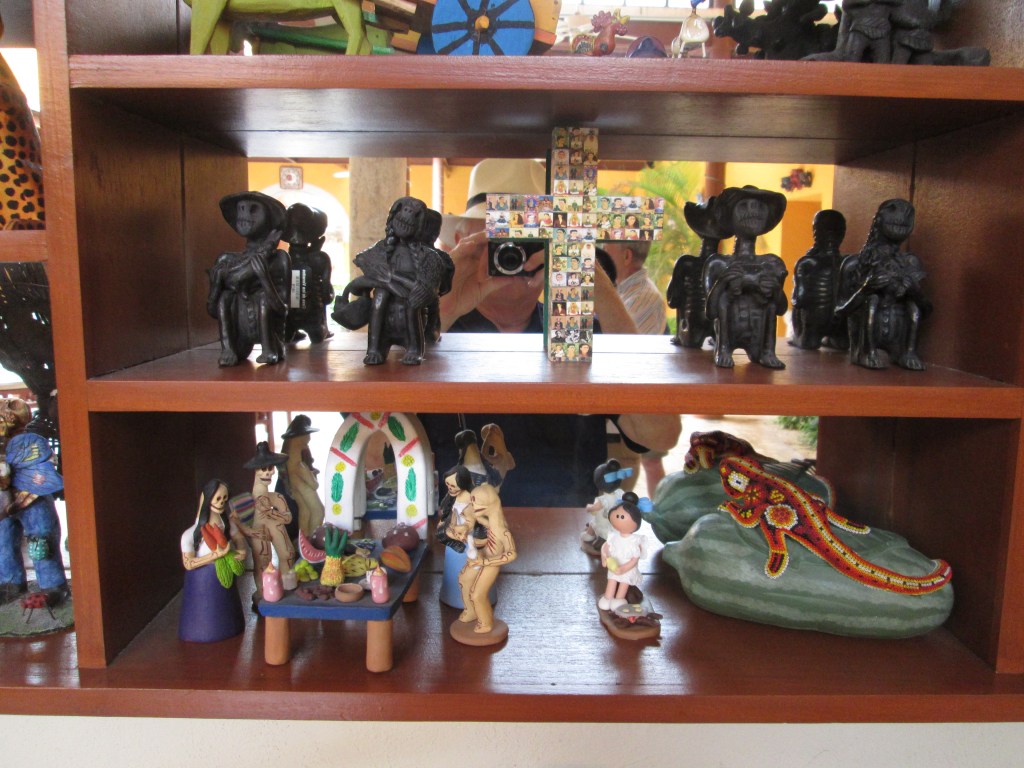
You Can See Me Taking the Picture to the Left of the Cross
The Casa de los Venados is probably the best museum of Mexican folk art I have ever seen.
Mexican Folk Art at the Museo de Casa Montejo in Mérida, Yucatán
Right on the Zócalo in Mérida is the Casa Montejo, which belonged to the family of conquistadores who conquered Yucatán for Spain. Today, the building is the main local branch of Banamex. Because the bank is a major supporter of traditional Mexican folk art, it maintains a free gallery on the premises. When I visited there in January 2020, there was an exhibit of folk art entitled “Detrás de una Máscara” (“Behind a Mask”) by the husband and wife team of Jacobo and María Ángeles.
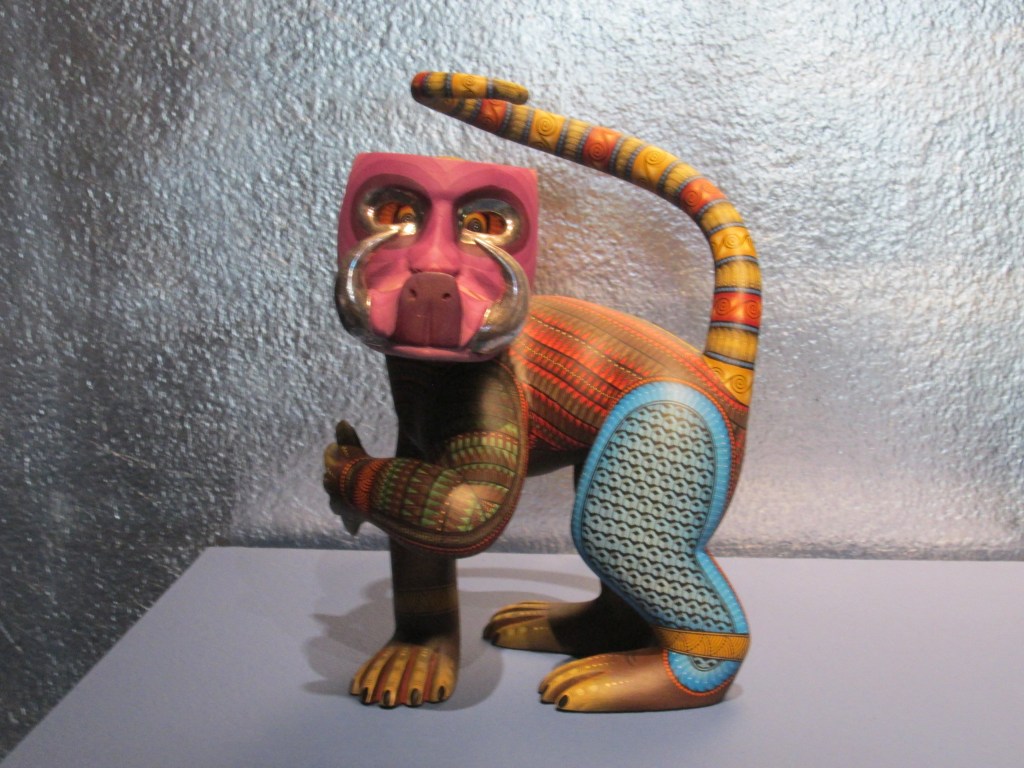
Below are some of the exhibits I saw at that show.
Above the main entrance to the gallery is an image of a conquistador crushing the bearded heads of Spain’s enemies. Since the Maya are not known for sporting beards, it does not literally refer to the conquest of the Maya except indirectly. Still, it’s a powerful image:
No, it’s not a garden of plants, but rather a sculpture garden, right near one of the turnoffs from U.S. 395 to Panamint Springs and Death Valley. It’s off the side of the road on the left as one heads north on the highway. I’ve noticed it several times on my trips to and through the Owens Valley as I passed through the town of Olancha, just south of Lone Pine.
As soon as Martine’s broken wrist heals, I hope to spend a little time studying the metal sculptures of Jael Hoffmann and photographing them. Unlike most modern sculptures, which leave me cold, I find that Jael’s work sets off little explosions in my head. Really great art does that: It makes you a different person than the what you were a few minutes earlier.
There is an excellent video on YouTube in which the artist is interviewed and discusses several of her sculptures—including most especially the one illustrated above. It is called “Internal Scapes,” which is an accurate description of how they affect me.
An Interview with Jael Hoffmann
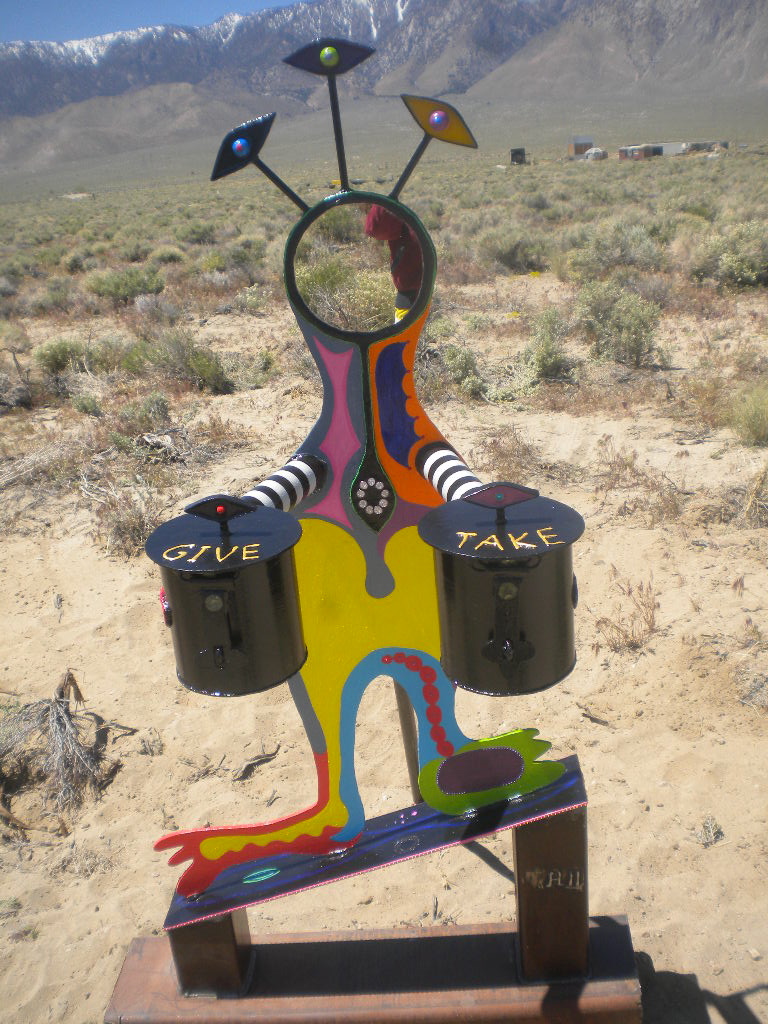
Below is one of her sculptures entitled “Give and Take”: It urges you to donate something in the can marked “Give” and take something from the can marked “Take.” As you examine both cans, your face is reflected in a mirror. Perhaps it will make you feel guilty if you take something without giving.
Jael Hoffmann’s “Give and Take”
Finally, there is another work I like which its creator calls “The Hitchhiker.” All three sculptures shown in this post are discussed in the YouTube video referred to earlier.
Jael Hoffmann’s “The Hitchhiker”
To see more of her work, I suggest you check out Jael’s website at www.jsculpt.com.
On Thursday of last week, I spent several hours at the Fowler Museum at UCLA viewing art that is outside the normal art marketplace. According to their website:
The Fowler Museum at UCLA explores global arts and cultures with an emphasis on Africa, Asia, the Pacific, and the Indigenous Americas—past and present. The Fowler enhances understanding and appreciation of the diverse peoples, cultures, and religions of the world through dynamic exhibitions, publications, and public programs, informed by interdisciplinary approaches and the perspectives of the cultures represented. Also featured is the work of international contemporary artists presented within the complex frameworks of politics, culture and social action. The Fowler provides exciting, informative and thought-provoking exhibitions and events for the UCLA community and the people of greater Los Angeles and beyond.
One gallery presented the work of Amir H. Fallah, a Persian-American, in an exhibit entitled “The Fallacy of Borders.” Then there were a number of Jain embroidered hangings from Indian shrines. There were a few Tanzanian paintings from the Tingatinga school left over from a larger exhibit that closed last month. Finally, there was the ongoing exhibit entitled “Intersections: World Arts, Local Lives” which included the following sculpture group from Mexico:
Calavera Sculpture from Mexico
Most of this art was not created for corporate conference rooms or major art museums. Much of it is folk art created to reflect a local culture. Some of it is commercial, but never for the art market of New York or London. All of it is outside European-American culture (except for some aboriginal American art).
When I visit the Fowler or other folk art museums, such as the Museo Mindalae in Quito, Ecuador, I see art that opens up other cultures to me. I am not just seeing another stale work of abstract expressionism created to make money in the New York market. I am seeing something that speaks for a people or for a religion. The result is utterly refreshing.
I hope in the weeks to come to reprise some of the folk art I have seen on my travels.
One of my favorite pieces of art is David Hockney’s “Pearblossom Highway, 11-18 April 1986, #2.” It is an almost perfect image of the Antelope Valley along the northern slope of the San Gabriel Mountains. I have driven that road a number of times on my way to Devil’s Punchbowl County Park, and even as far as Victorville—when I didn’t want to face traffic on the I-10 or the Pomona Freeway.
I am not always a fan of Hockney’s work, but this particular photo montage, in its own way, gives a better idea of the terrain than any single photograph would. It was originally created for Vanity Fair out of 800 photographs to support a story about the road trip that Vladimir Nabokov’s Lolita and Humbert Humbert took to Death Valley. For the story of the creation of this image, click on this website by the Los Angeles County Museum of Art.The actual site being depicted is the intersection of the Pearblossom Highway with 165th Street. The stop sign is no longer there, as a street light has replaced it. Also, the highway at this point has been widened to four lanes.
The Antelope Valley is still a desolate place, even though some half million people now live there, mostly along California Highway 14 as it wends north to join U.S. 395. The Pearblossom Highway (California 138) connects the Antelope Valley Freeway (California 14) with the I-15 at Victorville.
It’s a long and lonely haul, especially if one is behind a loaded big rig. But then, that is a good description of the L.A. experience.
Tsukioka Yoshitoshi’s “The Story of Otomi and Yosaburo” (1885)
His working life spanned a period of cataclysmic change in Japanese culture. Japanese print maker Tsukioka Yoshitoshi (1839-1892) started out in the Edo Period before Commodore Perry opened his island nation to the Western world, and died during the Meiji Restoration, which saw Japan being increasingly influenced by American and European ways. Yoshitoshi himself was a traditionalist in a rapidly changing world.
The woodblock art form in which he worked was referred to as ukiyo-e, commonly translated as “pictures of the floating world.” According to John Fiorillo:
Yoshitoshi was arguably the finest ukiyo-e print designer of the late nineteenth century. His figures were vividly realized and invested with a realism that relied, not insignificantly, on superb drawing ability. As he broke away from stagnating convention, Yoshitoshi’s seemingly unfettered imagination found expression in many subjects: history, folklore, legend, warrior tales, women, daily life, and old and new customs. He was uniquely gifted as a visual artist and a connoisseur of stories about Japanese and Chinese history and legend. By bridging the transition from the feudal society of the Edo period to the enlightenment restoration of the Meiji period, he succeeded in revitalizing ukiyo-e in unexpected ways.
“A Young Woman from the Kansei Period Playing with Her Cat” (1888)
This print is from a series entitled Thirty-two types of Beauty in Daily Life (Fūzoku sanjūnisō).
This composition presents a combination of stories and references. The tale originates from chapter 21 of the 14th-century historical epic Chronicle of Great Peace (Taiheiki). Lord Ko Moronao (d. 1351), a chief retainer of the Shogun Ashikaga Takauji (1305-1358), hears of a great beauty who happens to be the wife of another shogunal official, En’ya Takasada. Moronao arranges to see her after a bath and, even though she was without the feminine trappings of splendid robes and make-up, finds her irresistible. In an effort to take her for himself, he accuses En’ya of treason. But in a twist of fate, En’ya tries to flee and Moronao has the official and his family, including his wife, killed.
I decided to take a look at Yoshitoshi because he is not well known in the West, except to art specialists. His use of line and color in pursuit of traditional Japanese subjects during a period of transition makes him a great master in my book.
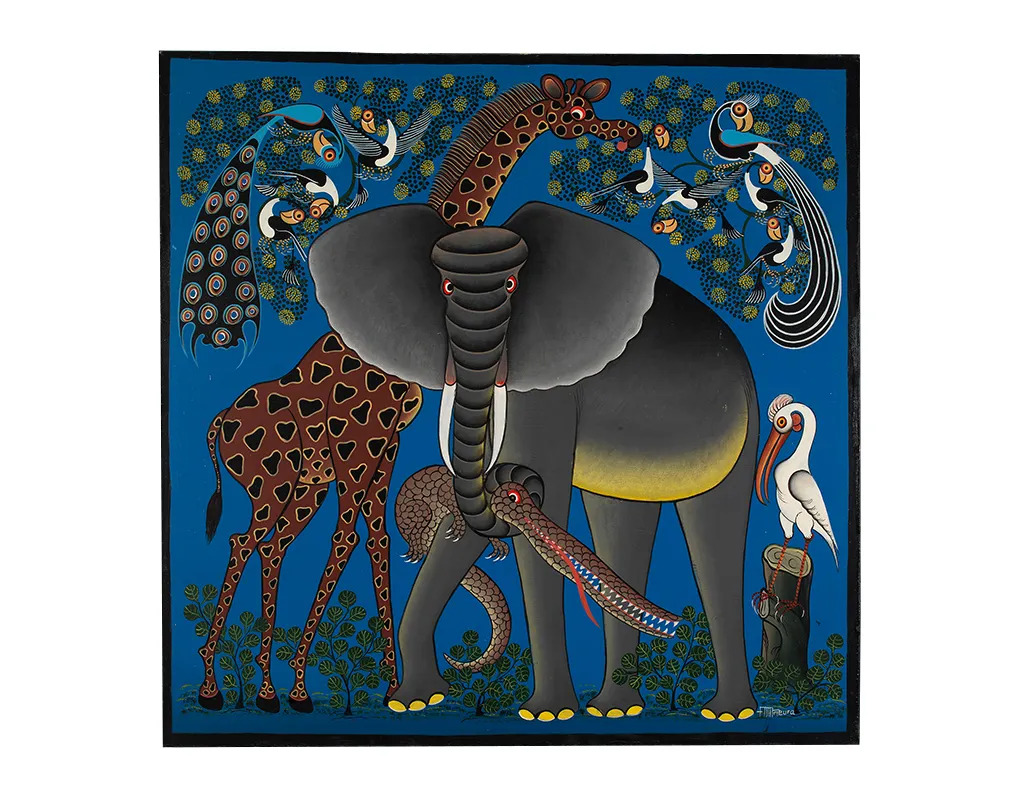
It all started with Edward Saidi (E.S.)Tingatinga of Dar-es-Salaam, Tanzania (1939-1972). He painted a series of animal paintings that became wildly popular. Then he started training a number of other fellow Tanzanians to paint in his style. For instance, the image above is by Abdul Amande Makura (b. 1954).
Below is an original by E.S. Tingatinga himself of a zebra with various African birds:
After E.S. Tingatinga died in 1972, six of his associates formed a group called the Tingatinga Partnership to perpetuate their founder’s style. It is thought that the style goes back much earlier than the 20th century, but it has become known as the Tingatinga painting style. According to the article on the style in Wikipedia:
Tingatinga is traditionally made on masonite, using several layers of bicycle paint, which makes for brilliant and highly saturated colours. Many elements of the style are related to the requirements of the tourist-oriented market; for example, the paintings are usually small so they can be easily transported, and subjects are intended to appeal to Europeans and Americans (e.g. the big five [African animals] and other wild fauna). In this sense, Tingatinga paintings can be considered a form of “airport painting.” The drawings themselves can be described as both naïve and caricatural; humour and sarcasm are often explicit.
This afternoon, I took the bus to UCLA and visited the Fowler Museum of global arts and cultures. What impressed me today were the African exhibitions, which included not only Tingatinga art but Fante Asato Flags from Southern Ghana and the work of Kwame Akoto of the Almighty God Art Works in Kumasi, Ghana.
The vigor and color of the African works moved me immeasurably more than anything I have seen by Jackson Pollock, Mark Rothko, or Piet Mondrian. I feel that we have arrived at an impasse with our art scene in the West.
When we were in Honolulu, Martine and I paid a visit to the Hawaii State Art Museum across the street from the Iolani Palace. I was amused by art created by two Hawaiian brothers of Japanese ancestry—Richard Hamasaki and Mark Hamasaki—going under the collective name ’Elepaio Press.
Here are several more of their works:
It’s Not Nice to Play “52 Pickup” with the Alphabet
There it was, occupying its own gallery and lying on its side. A giant inflated pink and white bunny. We were at the Hawaii State Art Museum, right across the street from the Iolani Palace. Actually, we had come to eat at the museum’s much heralded cafe, Artizen by MW. Unaccountably, it was closed that day.
The museum itself is interesting. The budget for the State of Hawaii sets aside a percentage to be used for promoting the arts. One result is the Hawaii State Art Museum, which doesn’t charge admission. Included in its galleries were works of art protesting state projects such as the construction of the H3 limited access highway from west Honolulu to the windward side of O’ahu. I can just imagine the stink that public sponsorship of protest art would cause in California.
In any case, the giant bunny was friendly, and Martine looked happy to have her picture taken with him.
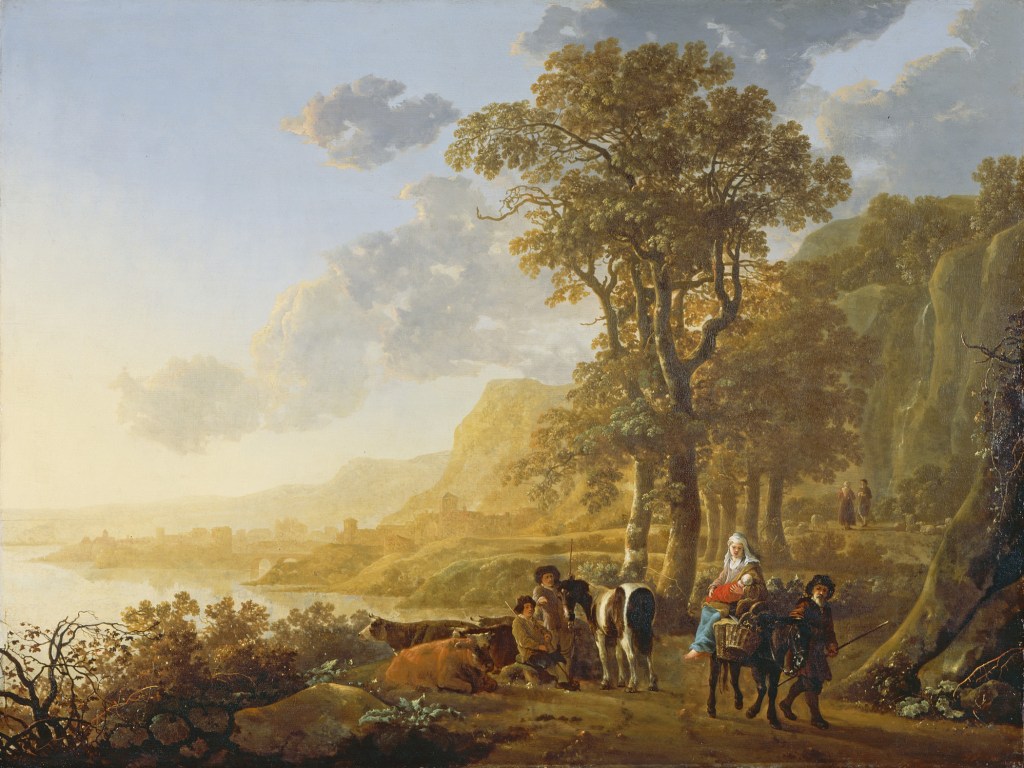
Although I saw this painting at the Getty Center in Los Angeles, it is actually on loan from the Los Angeles County Museum of Art. Apparently Aelbert Cuyp (1620-1691) painted several canvases of the Holy Family’s flight into Egypt to escape Herod’s massacre of the innocents born around Bethlehem. According to the Gospel of St. Matthew (2:16):
Then Herod, when he saw that he was mocked of the wise men, was exceeding wroth, and sent forth, and slew all the children that were in Bethlehem, and in all the coasts thereof, from two years old and under, according to the time which he had diligently inquired of the wise men.
This painting appealed to me because it moves its subject into an obviously European setting—certainly as far removed from the Sinai Peninsula as it is possible to be. At the same time, the scene is as peaceful as a bucolic Poussin or Lorrain painting of the same period.
Cuyp was noted for his landscapes. According to the Wikipedia entry on him, “he is especially known for his large views of Dutch riverside scenes in a golden early morning or late afternoon light.”







 Tarnmoor
You must be logged in to post a comment.