Why do Americans shower their billionaires with a level of adoration normally reserved for deities and saints? I think back to the Medicis and the Borgias during the Italian Renaissance. As J. H. Plumb wrote, “Commercial capitalism, struggling the the framework of feudalism, learned, through Italy, not only how to express itself in art and learning, but also how to make an art of life itself.”
Not so today, however! Donald Trump has given us golden toilet bowls, ornate golf courses, and tried to take away our democracy. Elon Musk managed to convince thousands of Americans that he was a genius—until he spent $44 billion buying Twitter and running it into the ground. After his latest anti-Semitic tirade, I think even most Tesla owners are rethinking their allegiances.
I cannot think of a billionaire today who has done anything but engage in self-aggrandizement. Instead of a Renaissance, we are now in a period that can only be described as Anti-Renaissance.
What ever happened to patronage of the arts? Oh, it still exists at the millionaire level; but not among the Trumps, Musks, and Bezoses of this world. The think the last billionaire to show any moves in this direction was Bill Gates of Microsoft fame.
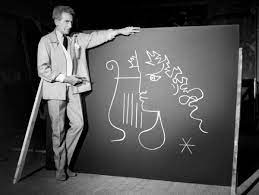
French poet, playwright, novelist, designer, filmmaker, visual artist and critic. He was one of the foremost artists of the surrealist, avant-garde, and Dadaist movements and an influential figure in early 20th century art.
He was, to quote one newspaper essay, a Renaissance man.
In the United States, he is probably best known for his films La Belle et la Bête (1946) and Orphée (1950). Although he created some paintings, he is probably better known for his line drawings, many referring to Greek myths such as the drawing of Orpheus illustrated above and used in the titles of his film on Orpheus.
“The Birth of Pegasus” (1953)
With his surrealist and Dada experience, Cocteau’s work is sometimes underestimated because the artist never took himself that seriously. I love the scene in Le Testament d’Orphée (1960) where the poet (played by Cocteau himself) is arrested by motorcycle cops who, when asked what the charge was, say, “Pedestrians are always suspect!”
There is no lack of artists who take themselves very seriously. Even his film masterpiece Orphée is not only profound, but profoundly funny in spots.
Yesterday, I decided to escape the summer heat by visiting the Getty Center and reveling in some great works of art. One of my favorite discoveries was a whole gallery full of paintings by the Italian Giacomo Ceruti (1698-1767). He was known as Pitocchetto, which means “The Little Beggar,” probably because so many of his paintings highlighted beggars, the poor, and people in humble occupations.
It’s a nice change from all the magnificent kings, princes, and nobles resplendent in gold and silk. One art critic, Mira Pajes Merriman, writes that Ceruti’s paintings confront us with
the detritus of the community; the displaced and homeless poor; the old and the young with their ubiquitous spindles, eloquent signs of their situationless poverty and unwanted labor; orphans in their orderly, joyless asylums plying their unpaid toil; urchins of the streets eking out small coins as porters, and sating them in gambling; the diseased, palsied, and deformed; lonely vagabonds; even a stranger from Africa—and all in tatters and filthy rags, almost all with eyes that address us directly…
And yet, confronted with one of his paintings, one is arrested by a different vision of the baroque era, not so different from our own tent encampments of the homeless.
“The Dwarf” by Giacomo Ceruti
One thing that sets Ceruti apart is that he allows his subjects their dignity, irrespective of the lowliness of their social status. He is above all a compassionate artist who is not above showing us an alternative picture of his times.
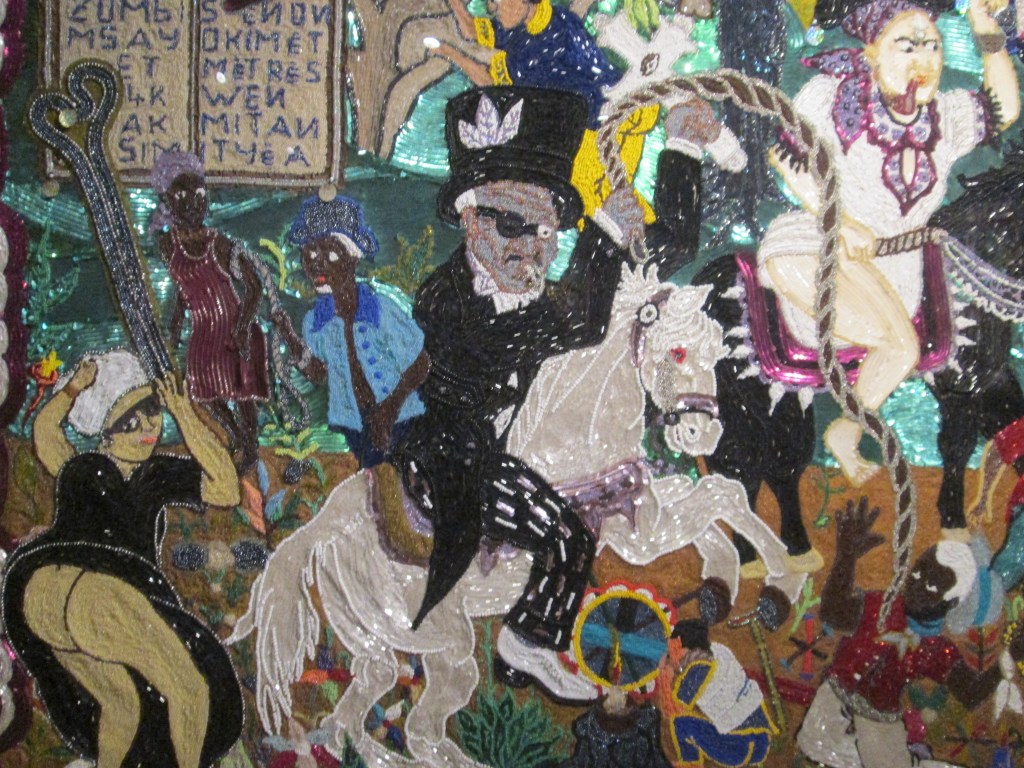
This afternoon, I once again took a walk on the UCLA campus and visited the Fowler Museum. There were two new exhibits that fascinated me, particularly the work of Myrlande Constant of Haiti. It was a strangely satisfying mix of Hieronymus Bosch and Haitian vodou (aka voodoo). On her website, the artist talks about the influence of vodou flags on her work:
Within the vodou community the flag is a sacred ritual object that identifies the hounfour and honors the spirits with whom it is associated. The sparkle of the sequin or mirror used to capture the attention of the iwa started in the temples. Drapo voudou (sequined sacred flags) are unfurled at the beginning of a ceremony. They are power points that are used for both identification and transformation. When the flag is unfurled it signals the congregants to come to order -the sacred is about to come home to roost. The spirits will soon walk next to (or in) the market woman.
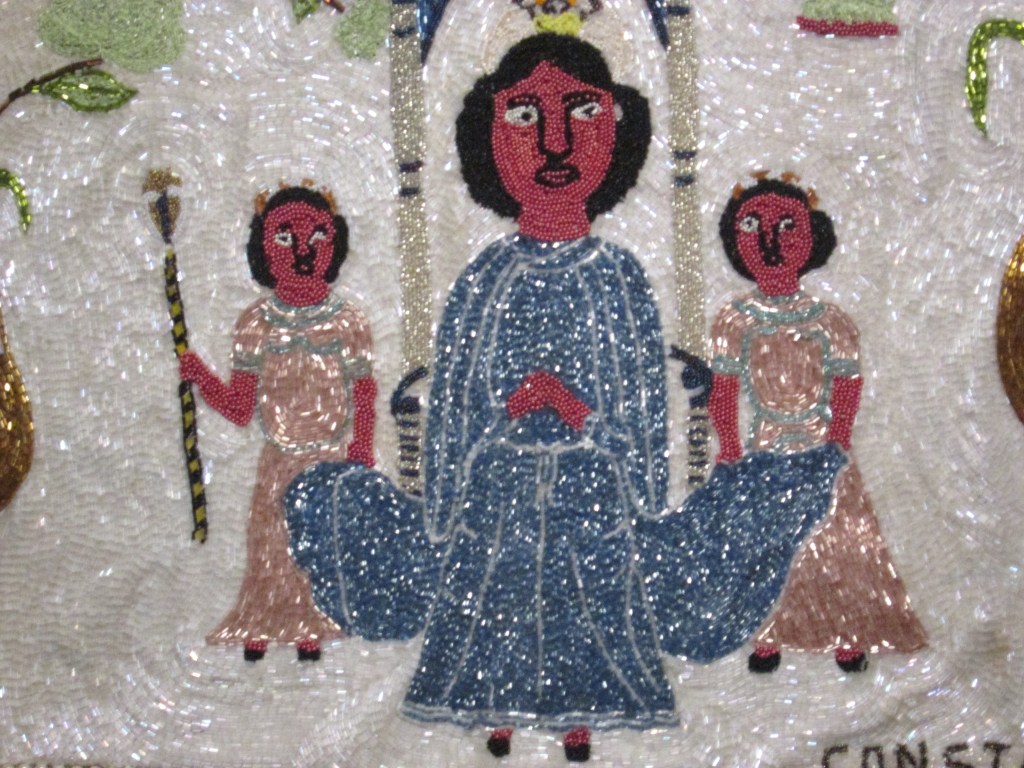
As I looked around the exhibit, I found myself drawn to details rather than to the overall design, which in any case I could ill understand as I am not a practitioner of vodou. Here are a couple of examples:
Like all the works on display, the art was covered with sequins, beads, and other shiny objects. The result was that I found myself immersed in detail. Is that Baron Samedi or Papa Legba on horseback? I don’t know, now why that woman at the lower left is exposing her buttocks.
Making frequent appearances were Catholic saints and angels, though in the world of vodou, everything has a different meaning.
Sometimes, it is useful to immerse oneself in a culture one doesn’t understand. The mysteries have a role to play in our lives—a role which, I believe, is ultimately benign.
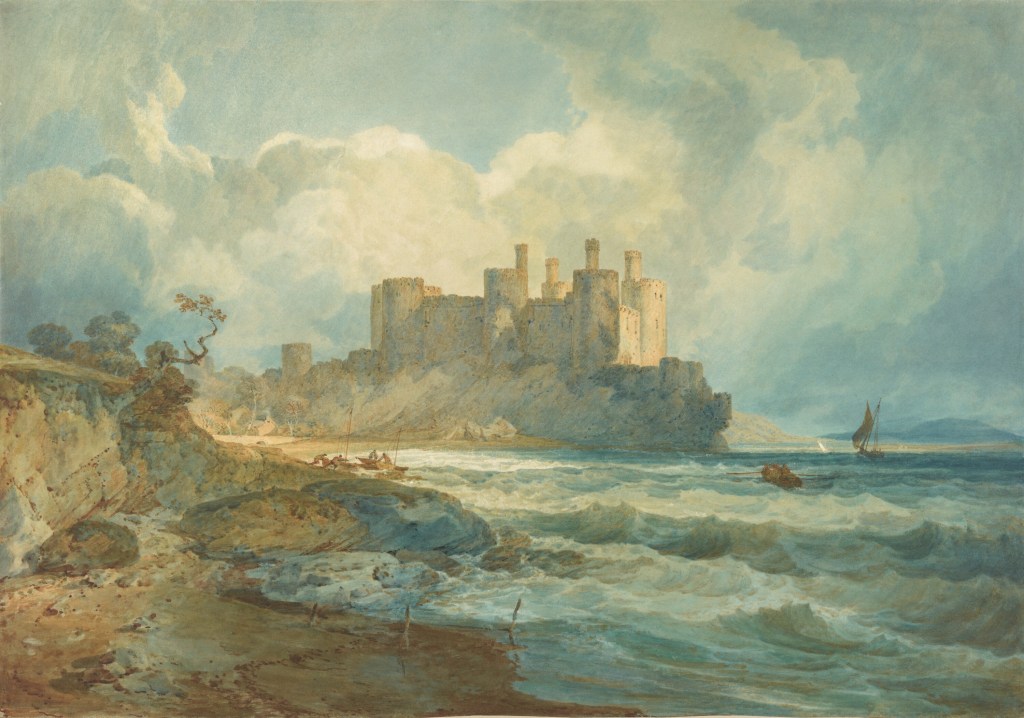
“Conway Castle, North Wales” as Painted by Joseph Mallord William Turner (1798)
Back in 1976, I visited Britain after making some money selling a script idea. One of the places I stayed was Betws-y-Coed, from which I could visit several beauty spots in North Wales. One of them was Conwy [sic] Castle. I was elated to see at the Getty Center J M W Turner’s rendition of Conway Castle, which is what the English called it.
The Getty website describes the painting:
On a dramatic, rocky area of the northern coast of Wales looms the late medieval Conway Castle. It towers over a stormy bay while fisherman struggle to pull their boats ashore. Caught in this uproaring of the sea, the tiny figures of fishermen in their boat convey a sense of humans’ barely significant place in the order of the universe.
The Welsh landscape exerted a strong hold on Joseph Mallord William Turner, and he made several sketching trips there in the 1790s. In this early Romantic painting, Turner represented the dramatic effects of natural light, allowing sunshine breaking through the clouds to illuminate the castle and the coast beyond.
The castle was built by Edward I—the evil king in Mel Gibson’s Braveheart played by Patrick McGoohan—between 1283 and 1287. It was one of a number of fortifications he built in his effort to subdue the Welsh. Here’s what it looks like today:
On Friday, I took a bus (to avoid the $20 parking fee) to the Getty Center to view the latest exhibitions and to reacquaint myself with the permanent collection. Unfortunately, the museum was mobbed. Time and time again, I was prevented from seeing a painting because some oversized bozo was stationed in front finger f—ing his smart phone, totally oblivious to the crowds and the magnificent artworks around him.
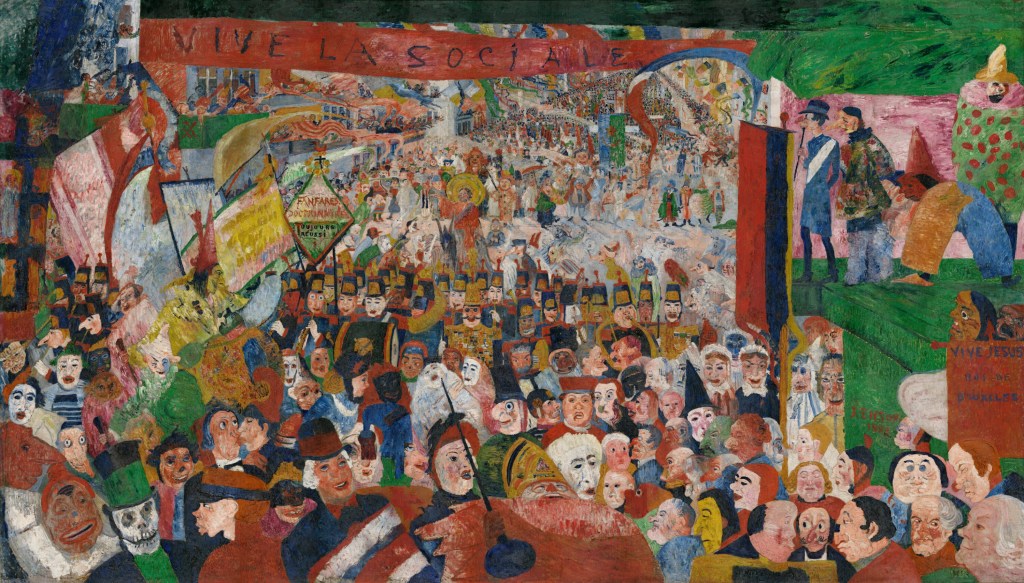
They reminded me of one of my favorite paintings in the Getty’s permanent collection, James Ensor’s Christ’s Entry into Brussels 1889. Look closely at the crowd entering with Christ who appears (with golden halo) in the center of the painting and slightly to the left. Now imagine each member of the crowd with a smart phone and not giving a tinker’s damn about anything but his or her Facebook or Instagram or whatever.
The Getty’s notes on the painting confirm my opinion:
James Ensor took on religion, politics, and art in this scene of Christ entering contemporary Brussels in a Mardi Gras parade. In response to the French pointillist style, Ensor used palette knives, spatulas, and both ends of his brush to put down patches of colors with expressive freedom. He made several preparatory drawings for the painting, including one in the J. Paul Getty Museum’s collection.
Ensor’s society is a mob, threatening to trample the viewer–a crude, ugly, chaotic, dehumanized sea of masks, frauds, clowns, and caricatures. Public, historical, and allegorical figures, along with the artist’s family and friends, make up the crowd. The haloed Christ at the center of the turbulence is in part a self-portrait: mostly ignored, a precarious, isolated visionary amidst the herdlike masses of modern society. Ensor’s Christ functions as a political spokesman for the poor and oppressed–a humble leader of the true religion, in opposition to the atheist social reformer Emile Littré, shown in bishop’s garb holding a drum major’s baton and leading on the eager, mindless crowd.
After rejection by Les XX, the artists’ association that Ensor had helped to found, the painting was not exhibited publicly until 1929. Ensor displayed Christ’s Entry prominently in his home and studio throughout his life. With its aggressive, painterly style and merging of the public with the deeply personal, Christ’s Entry was a forerunner of twentieth-century Expressionism.
I managed to enjoy my visit despite the crowds. I guess it was Spring Break for too many people, so I should have known better.
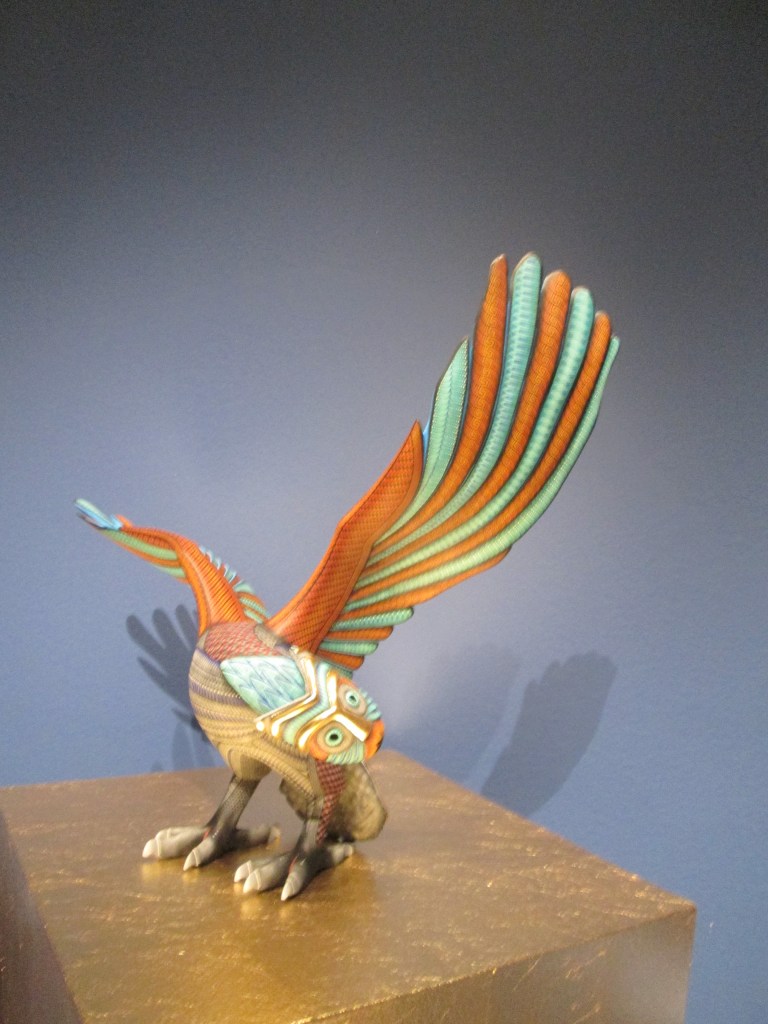
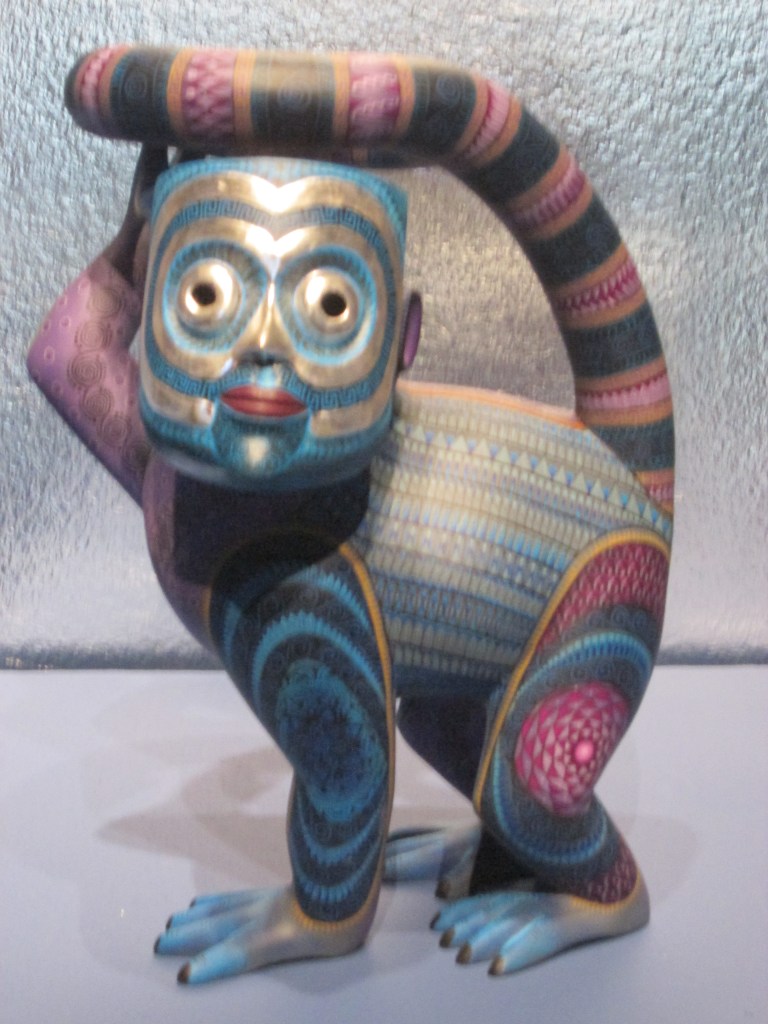
Mexican Folk Art from the Casa de los Venados in Valladolid, Yucatán
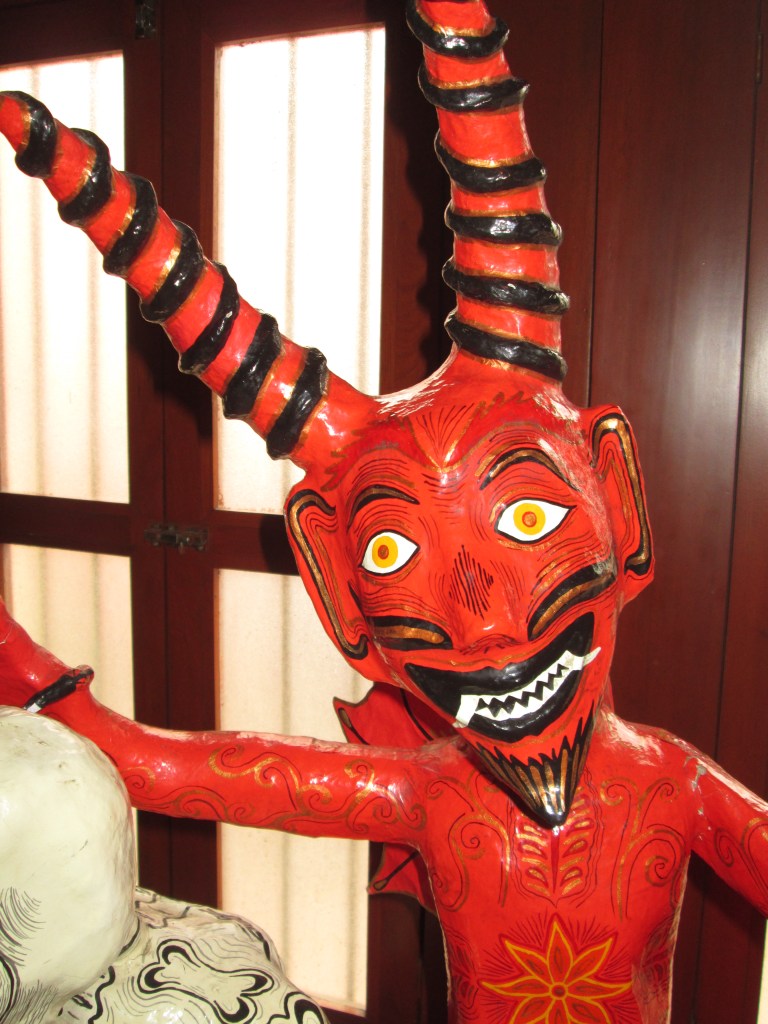
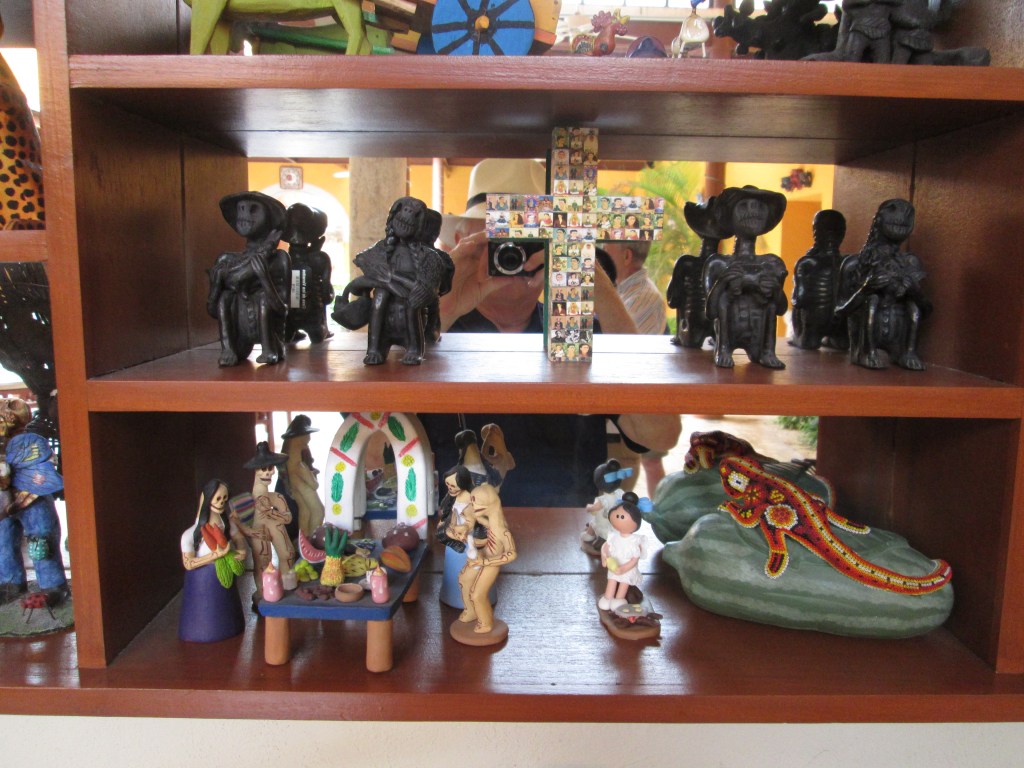
Perhaps the largest collection of Mexican folk art in private hands is on display at the Casa de los Venados in Valladolid, Yucatán, about a block off the Zócalo. The collection contains 3,000+ pieces of high-quality folk art. If you should ever find yourself in Yucatán, you should consider paying a visit. Not only is the museum an eye-opener, but the city of Valladolid is worth spending several days touring.
A Friendly Demon
You Can See Me Taking the Picture to the Left of the Cross
The Casa de los Venados is probably the best museum of Mexican folk art I have ever seen.
Mexican Folk Art at the Museo de Casa Montejo in Mérida, Yucatán
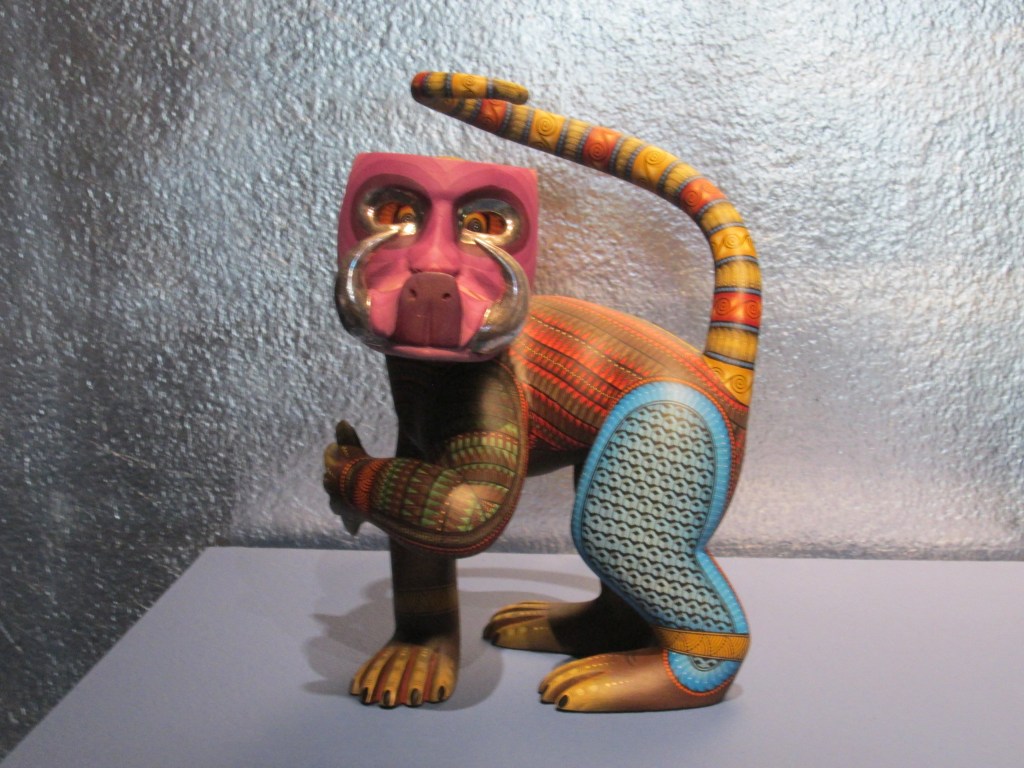
Right on the Zócalo in Mérida is the Casa Montejo, which belonged to the family of conquistadores who conquered Yucatán for Spain. Today, the building is the main local branch of Banamex. Because the bank is a major supporter of traditional Mexican folk art, it maintains a free gallery on the premises. When I visited there in January 2020, there was an exhibit of folk art entitled “Detrás de una Máscara” (“Behind a Mask”) by the husband and wife team of Jacobo and María Ángeles.
Below are some of the exhibits I saw at that show.
Above the main entrance to the gallery is an image of a conquistador crushing the bearded heads of Spain’s enemies. Since the Maya are not known for sporting beards, it does not literally refer to the conquest of the Maya except indirectly. Still, it’s a powerful image:
No, it’s not a garden of plants, but rather a sculpture garden, right near one of the turnoffs from U.S. 395 to Panamint Springs and Death Valley. It’s off the side of the road on the left as one heads north on the highway. I’ve noticed it several times on my trips to and through the Owens Valley as I passed through the town of Olancha, just south of Lone Pine.
As soon as Martine’s broken wrist heals, I hope to spend a little time studying the metal sculptures of Jael Hoffmann and photographing them. Unlike most modern sculptures, which leave me cold, I find that Jael’s work sets off little explosions in my head. Really great art does that: It makes you a different person than the what you were a few minutes earlier.
There is an excellent video on YouTube in which the artist is interviewed and discusses several of her sculptures—including most especially the one illustrated above. It is called “Internal Scapes,” which is an accurate description of how they affect me.
An Interview with Jael Hoffmann
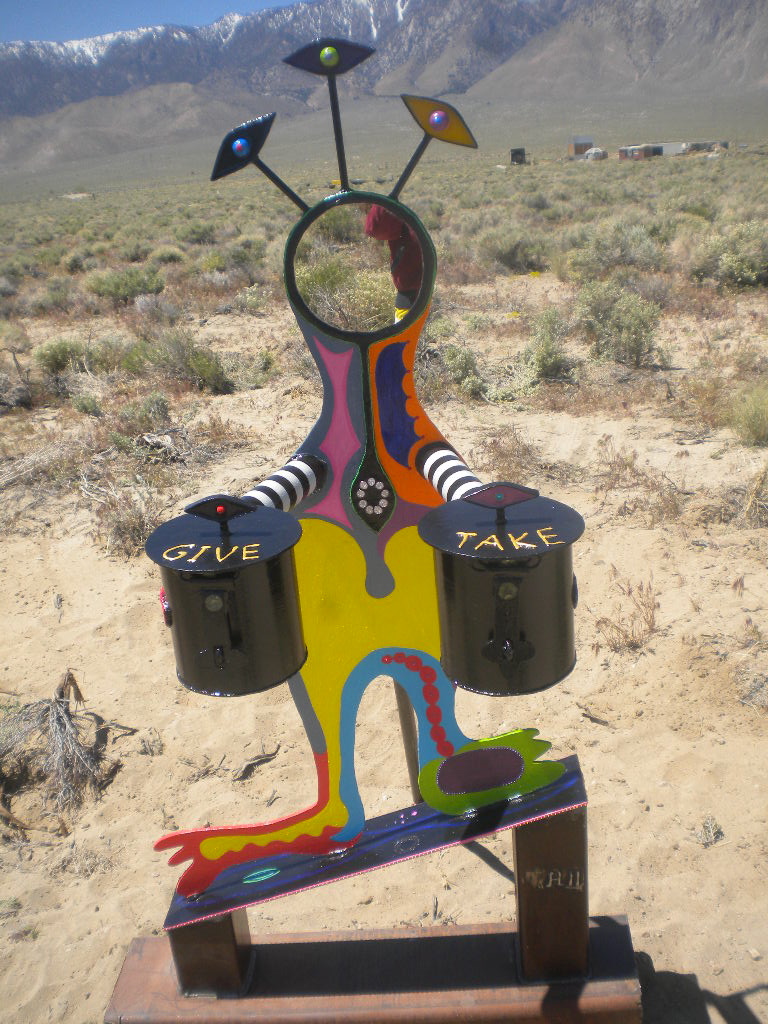
Below is one of her sculptures entitled “Give and Take”: It urges you to donate something in the can marked “Give” and take something from the can marked “Take.” As you examine both cans, your face is reflected in a mirror. Perhaps it will make you feel guilty if you take something without giving.
Jael Hoffmann’s “Give and Take”
Finally, there is another work I like which its creator calls “The Hitchhiker.” All three sculptures shown in this post are discussed in the YouTube video referred to earlier.
Jael Hoffmann’s “The Hitchhiker”
To see more of her work, I suggest you check out Jael’s website at www.jsculpt.com.
On Thursday of last week, I spent several hours at the Fowler Museum at UCLA viewing art that is outside the normal art marketplace. According to their website:
The Fowler Museum at UCLA explores global arts and cultures with an emphasis on Africa, Asia, the Pacific, and the Indigenous Americas—past and present. The Fowler enhances understanding and appreciation of the diverse peoples, cultures, and religions of the world through dynamic exhibitions, publications, and public programs, informed by interdisciplinary approaches and the perspectives of the cultures represented. Also featured is the work of international contemporary artists presented within the complex frameworks of politics, culture and social action. The Fowler provides exciting, informative and thought-provoking exhibitions and events for the UCLA community and the people of greater Los Angeles and beyond.
One gallery presented the work of Amir H. Fallah, a Persian-American, in an exhibit entitled “The Fallacy of Borders.” Then there were a number of Jain embroidered hangings from Indian shrines. There were a few Tanzanian paintings from the Tingatinga school left over from a larger exhibit that closed last month. Finally, there was the ongoing exhibit entitled “Intersections: World Arts, Local Lives” which included the following sculpture group from Mexico:
Calavera Sculpture from Mexico
Most of this art was not created for corporate conference rooms or major art museums. Much of it is folk art created to reflect a local culture. Some of it is commercial, but never for the art market of New York or London. All of it is outside European-American culture (except for some aboriginal American art).
When I visit the Fowler or other folk art museums, such as the Museo Mindalae in Quito, Ecuador, I see art that opens up other cultures to me. I am not just seeing another stale work of abstract expressionism created to make money in the New York market. I am seeing something that speaks for a people or for a religion. The result is utterly refreshing.
I hope in the weeks to come to reprise some of the folk art I have seen on my travels.
You must be logged in to post a comment.