He’ll Probably Get Away With It

Vladimir Putin Shows Us He’s a Man’s Man

Vladimir Putin Shows Us He’s a Man’s Man

As far as the Crime of the Crimea is concerned, Vladimir Putin will probably not only get away with it: He’ll come out ahead in the hearts and minds of the Russian voters. He stood up for the poor Russian majority in the Crimea, where they were being harassed by Ukrainian thugs, such as the notorious Svoboda Party skinheads, who are actually part of the government in Kiev.

We are dealing with a part of the world where good guys are few and far between. All the leaders of the Ukraine, including the somewhat cute Yulia Tymoshenko, were corrupt to varying degrees, with the deposed Viktor Yanukovych bidding fair to be the worst. Admittedly, we’re not talking about people who are as bad-ass as Putin himself. (If you want some background about Putin’s crimes, read whatever you can find by Anna Politkovskaya, the Novaya Gazeta reporter who investigated the Chechen War and who Putin had assassinated at the door of her flat.)

If you go back a few years to the Second World War, you will see some strange things happening: there were guerrillas who were simultaneously fighting Hitler and Stalin, and conducting their own pogroms just for fun. (These are the goons who morphed into the Svoboda Party.)

So was it “right” for Russia to annex the Crimea? Strictly speaking, no. But then, the Crimea was a gift to the Ukrainian SSR from Nikita Khrushchev, himself a Ukrainian, some fifty years ago. Before then? It was a part of Russia. Demographically, it’s heavily Russian; so it was perhaps inevitable. But do I think well of Putin for pulling his strong man act? Not really, he is to my mind a contemptible cur, a murderer at arm’s length, and quite possibly a Dick Tracy villain. (But then, that is true of many of our politicians as well, no?)

One final note: Two days of a run-up in the stock markets of Europe and the United States indicates to me that most of the talk about sanctions is pure swamp gas. It would only strengthen Putin.

Still a Good Investment?

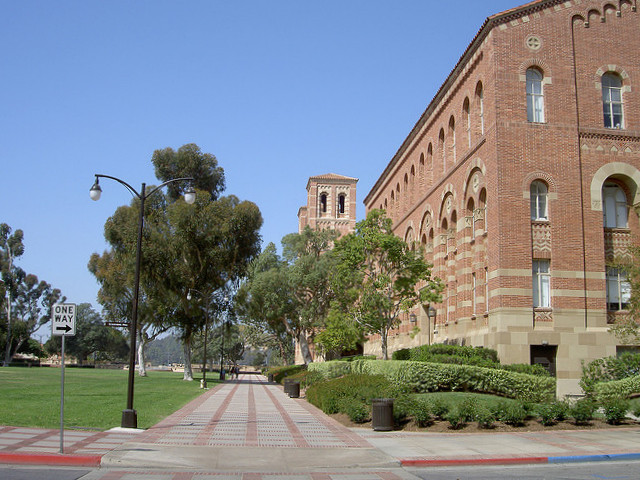
University Buildings at UCLA

University Buildings at UCLA

Over the years since I graduated from college, I’ve seen the cost of a university education climb to stratospheric levels. At the same time, I’ve seen massive unemployment among college graduates, sometimes even those with a postgraduate education. It forces me to think what I would do different if I had a couple of teenaged children to put through school (though in fact I have no children). Would I still at this date recommend that children go to college to improve their chances for the future?

Part of the problem is symbolized by that “One Way” sign in the above photo. It used to be that the object was to get everyone into college: It was a bargain back then. Even if the kids washed out within the first quarter or two, the thinking was that they were given the opportunity.

I went to an Ivy League college for four years—Dartmouth College in Hanover, New Hampshire—whose tuition back in the years 1962-66 was only $1,500 a year. With the dollar as it is today, that would be somewhere between $9,000 (using the CPI) to $27,200 (using the relative share of GDP) in 2012, the most recent year for which this calculation is available. For the academic year 2013-2014, Dartmouth’s tuition is now $45,445. The question I ask is this: Is a Dartmouth education worth twice as much as when I went to school? I think not. It’s still very good, but not at two to five times the cost.

Other related costs have also been skyrocketing. I am particularly incensed by textbooks that run to several hundreds of dollars each. I remember paying something under a hundred dollars for all the textbooks for an entire quarter. Admittedly, textbooks can be gorgeously produced with nice bindings and four-color illustrations, but is that always necessary? I can see where these expensive productions will eventually be replaced by software programs, but even then the temptation will be to charge more than they are worth, even after the production costs for multiple copies have plummeted.

So, what to do? There isn’t much chance that youth between the ages of eighteen and twenty-one will find jobs that at the same time do not require a college education, yet provide a reasonable opportunity for advancement. How does one advance after a job flipping hamburgers or selling tee shirts? A college degree will help, even though it has been devalued over the years. It costs twice as much in real dollars, yet probably isn’t as good as it was when my generation was on campus.

I still urge kids whose intellects are sharp to go to college whenever they can. It doesn’t have to be the best college, but it should be a decent one (and I don’t mean something like the University of Phoenix and its imitators). To get a good job after graduation, some thought has to be put into a good choice of a major. Perhaps it would help to have some kind of certification in certain subjects attesting to a student’s proficiency in, say, writing or mathematics. If instituted, it may even replace the whole notion of a major; and it may help grads with multiple certifications to have different options to choose from when looking for a job.

In 1966, I graduated with a major in English. Then I went on for two years at UCLA in motion picture history and criticism, stopping short of getting my M.A. for mostly political reasons. (The instructor I hated most got himself appointed to head up my thesis committee, upon which I switched over into computer software.) It was a good thing that I had taught myself how to become conversant with computers at Dartmouth, where every student was allowed free time on the Dartmouth Time-Sharing System, the nation’s first. That kind of flexibility to switch among career alternatives is becoming more important than ever.


Back to Bedlam

Title Shot of Val Lewton’s Bedlam (1946)

Title Shot of Val Lewton’s Bedlam (1946)

Originally, it was called Bethlem Royal Hospital or St. Mary Bethlehem. Over the years, the British mental hospital has moved from Bishopsgate to Moorfields to Southwark, where it is now, a reputable institution associated with Kings College London. From its period of notoriety in the 18th century, where the glitterati paid admission to see loonies chained to the wall, it was better known as Bedlam.

There is a wonderful Val Lewton film of the same name, starring Boris Karloff, that was released by RKO in 1946 (see above). In it, a sane young woman is forcibly admitted to the insane asylum when she refuses to odious attentions of a powerful rake. Like almost of all of the Lewton films I have seen, it is a delight. It includes a rebellion of the inmates against the infamous Boris Karloff, who plays the head physician at Bedlam.

Poster for Val Lewton’s Bedlam

Lobby Card for Val Lewton’s Bedlam

The reason that Bedlam the movie comes to mind is my realization that we have little progressed from those bad old eighteenth century days when the mentally ill were mistreated for the amusement of visitors. Now, things are almost worse. Ever since the 1980s, the mentally ill have been on their own.When they receive any attention at all, it is usually by the police and prison guards. Instead of getting the medication that helps keep them on an even keel, the mentally ill are mistreated by guards who punish them for their non-normative behavior.

Recently, several Orange County, California police beat up and killed a mental patient named Kelly Thomas who was living on the street. In their various police academies, the police are trained to deal with malefactors, and not with persons who have a tenuous grip on reality. The police were tried and acquitted by an Orange County jury.

The outlook for the mentally ill who are loose on the streets is not a good one. Perhaps even the old Bedlam would have been an improvement.

South

When Was the Last Time YOU Thought About South America?

When Was the Last Time YOU Thought About South America?

Let’s face it: Most Americans almost never think about South America. Oh, there are a few exceptions, such as when the World Cup comes around and we are reminded how many great soccer football teams there are “down there.”  Also, when Carnival Time in Rio comes close. Also, when we keep hearing about how the forests of the Amazon are gradually being clear-cut.

I think this is a fundamental flaw about being the world’s Number One military power. According to the Stockholm International Peace Research Institute (SIPRI), here are the world’s top ten for 2013:

  1. United States – $682.0 billion
  2. People’s Republic of China – $166.0 billion
  3. Russia – $90.7 billion
  4. United Kingdom – $60.8 billion
  5. Japan – $59.3 billion
  6. France – $58.9 billion
  7. Saudi Arabia – $56.7 billion
  8. India – $46.1 billion
  9. Germany – $45.8 billion
  10. Italy – $34.0 billion

Note that there are no South American countries in the list, though Brazil comes in at 11th place with $33.1 billion. (When was the last time they fought a war?) In other words, there are no major military players in South America. So we don’t have to worry about them, right? And that is the fundamental flaw about being Number One: You tend not to think about smaller countries because they simply don’t impinge on your way of life. In other words, you lay yourself open for a big unpleasant surprise.

I actually remember my first such unpleasant South America surprise. Dwight D. Eisenhower was President from 1952 to 1960. On May 13, 1958, he sent Vice President Nixon to Caracas, where his motorcade was attacked by an angry mob. As a 13-year-old in Cleveland, I was outraged that a no-name country like Venezuela had the nerve to insult the United States. This plus the subsequent insurgency in Cuba and takeover by Castro led to the creation of the Alliance for Progress during the Kennedy Administration. (But we had to undergo a baptism by fire at the Bay of Pigs first.)

Then there was more bad news to come. We were being inundated by cocaine being smuggled in from Colombia and other nearby countries. Then there was this matter of the FARC insurgency in Colombia and the Sendero Luminoso (Shining Path) in Peru. The whole continent appeared to be unraveling like a cheap suit. The Tupamaros in Uruguay and the disappearances in Argentina under Videla didn’t help either, nor did Pinochet in Chile.

At a certain point along the way, a certain positive influence from Argentina turned my life around. It was my discovery of the writer Jorge Luis Borges. Once I started reading his works, I began to see the world through his eyes. There was this battle called Junin that was fought in Peru. Then there were the Unitarios and Federalistas in Argentina. I began to get more interested, and then I actually went to Argentina in 2006 (only to break my shoulder by falling in a blizzard in Tierra Del Fuego) and 2011. Now I want to go to Peru in 2014, if I can swing it financially.

And, of course, I have been reading ever so much more about South America—so much so, in fact, that I look at the globe in an entirely different light. Perhaps South America will gain by all these years of benign neglect. Perhaps not. We still enforce the Monroe Doctrine after a fashion to keep Europe out, but we pretty much leave the continent alone unless our multinational corporations want to cut down their trees or extract their mineral wealth. Eventually, I see the nations down there nationalizing those industries and, with luck, putting the skids on some of the worst abuses. Until then, our corporations will be a stench in their nostrils.


Great for Target Practice

A Floating Tax Haven for the Rich in International Waters?

A Floating Tax Haven for the Rich in International Waters?

We all know that the rich just don’t like the notion of paying taxes. So what if they decided to build a giant floating city with built-in airfield in international waters, where—presumably—they would not be required to pay taxes? I think it’s a terrific idea. Before I give you some of my ideas, read the article on MSNBC that piqued my interest. Then, here’s what I have to add to the concept:

  • Definitely put it right on the hurricane track between Africa and the Caribbean. Extra points for anchoring it in the Sargasso Sea and in the center of the famed (and scenic) Bermuda Triangle.
  • For a flag of convenience, how about the Skull and Crossbones?
  • Since this floating fat man’s paradise would belong to no nation in particular, it might be great for the navies of the world to use it for target practice.
  • If someone were to send letters laced with anthrax and ricin to individuals aboard the ship, who would be responsible? The security guys?
  • For service workers, of which there would be many, I think a ghettoized slum would be just the thing—no windows, poor ventilation, no extra charge for Legionnaires’ Disease. Then we could see how long before class warfare erupts.

I rather hope this fine idea comes to fruition. The possibilities are endless!

False Certitudes

Norman Rockwell’s Homecoming of a U.S. Marine

Norman Rockwell’s Homecoming of a U.S. Marine

Let me begin by saying right off the bat that there is nothing wrong with the illustrations of Norman Rockwell. It’s just that he spoke for a different America, an America that was predominately small-town or even rural. His work belongs with the Judge Billy Priest stories of Irvin S. Cobb, silent films like King Vidor’s Tol’able David (1921), and the paintings of Thomas Hart Benton. Just about everybody you would be likely to meet on Main Street was White, Anglo-Saxon, and Protestant.

Then the Second World War happened, and people started to move around—a whole lot. African-Americans moved up to the industrial cities of the Northern U.S. Mexican farmers started streaming across the border to help bring in the crops.

And people like me started to pop up. When my kindergarten teacher, Mrs. Idell, first saw me in 1950 at Harvey Rice School in Cleveland, it was probably like a portent of the Apocalypse. My friend András and I didn’t speak a work of English. And although she taught at a public school in the heart of the largest Hungarian community outside the Peoples’ Republic of Hungary, she didn’t know a word of Magyar, nor did she feel she had to. When András and I started kicking her in the ankles, I am sure she felt like Joan of Arc among the Barbarian Hordes.

It was just the beginning. In addition to all the black and brown people who were showing up, including a large Puerto Rican neighborhood by Lorain, there were other strange people who came because we chose to fight wars all over the map in places where we had no more inkling of their culture than Mrs. Idell had of mine. I work in Tehrangeles, in a city that has a Thai Town, a Little Seoul, a Little Tokyo, and, of course, “East Los,” a.k.a. East Los Angeles. There are thousands of Armenians, Ethiopians, Hmong, Vietnamese, Arabs, and Chinese—to name just a few. Then, too, there was a whole new type of minority: gays, lesbians, trans-gender individuals.

For many Americans, the odd admixture of cultures leads to a terrible uncertainty. Many people who have been left behind in the “Heartland” feel that America doesn’t belong to them any more. Well it does, and it also belongs to the newcomers. They are or soon will be just as American as any of us. They may be slow to speak our lingo, but their kids’ll pick up on it quickly.

Of one thing I am sure: There is no point in trying to return to the America of Norman Rockwell.

There’s nothing wrong with uncertainty. There is, however, quite a bit wrong with false certitudes. Whatever happens, Norman Rockwell describes an America that is, for the most part, gone. Any attempt to force the Americans of today into a White, Anglo-Saxon, Protestant mold will fail, after causing a lot of hard feelings. Even I get pretty sick and tired of Evangelical posturing and the whole Anglo thing which is 0% of my own heritage. If I keep my mouth shut, I might be mistaken for a WASP; but I have no desire to parade around as one. I have no particular respect for WASPs. Their moment has come and gone. There are a whole lot of different people now.

I can live with that. In fact, I rather like it.

Lydda

The (Former) Palestinian City of Lydda

The (Former) Palestinian City of Lydda (ca. 1900)

It looks idyllic, doesn’t it? And it was, until 1948. At that point, the newly formed Israel Defense Forces expelled the inhabitants of this peaceful city in which Jews and Palestinians had lived side by side for generations. In an article for the New Yorker published in the October 21, 2013 issue entitled “Lydda, 1948,” Ari Shavit writes:

But, looking straight ahead at Lydda, I wonder if peace is possible. Our side is clear: we had to come into the Lydda Valley and we had to take the Lydda Valley. There is no other home for us, and there was no other way. But the Arabs’ side, the Palestinian side, is equally clear: they cannot forget Lydda and they cannot forgive us for Lydda. You can argue that it is not the occupation of 1967 that is at the core of the Israel-Palestinian conflict, but the tragedy of 1948. It’s not only the settlements that are an obstacle to peace but the Palestinians’ yearning to return, one way or another, to Lydda and to dozens of other small towns and villages that vanished during one cataclysmic year. But the Jewish State cannot let them return. Israel has a right to live, and if Israel is to live it cannot resolve the Lydda issue. What is needed to make peace now between the two peoples of this land may prove more than humans can summon.

I sit here in West Los Angeles, within hailing distance of the Gabrielino Indians’ shrine at Kuruvungna Springs on the grounds of the present-day University High School. In June and July of this year, I vacationed in Iceland, where a resurgent Viking population drove out the Irish monks that had originally settled the island. (Now there is no trace of their ever having done so.) If all goes well, my next vacation will be in Peru, where the Spanish looted and destroyed the Inca Empire. Their criollo descendants still control the economy and the political power, leaving the Andean serranos and jungle tribes near the headwaters of the Amazon as second-class citizens.

Unfortunately, with its burgeoning West Bank settlements, Israel is continuing the process it began in 1948 of squeezing out, to the maximum extent possible, the indigenous Palestinian population. I cannot condone Israel’s settlement policy, especially with its Likud Party racist underpinnings; but I cannot afford to be too absolute because I realize there is a faint trace of blood on my own hands and on those of my forebears.


Shooters, Shooters Everywhere

Shooter Paul Anthony Ciancia

Airport Shooter Paul Anthony Ciancia

Just as the Christmas shopping season is about to begin, people are newly afraid to go to shopping centers, airports, and other public places because of the growing trend of what the New Jersey police call “Suicide by Cop.” Some unbalanced person gets a cache of firearms with enough bullets to depopulate a mid-sized town and then goes on a shooting spree until he is felled by the police. In the meantime, a number of innocent people who just had the misfortune of being there at the time lie dead or wounded on the ground.

For this trend, we must thank the members of the National Rifle Association (NRA) for their desire to promote the sale of firearms to certifiable loonies and, in general, to deteriorate the quality of life in America. The pudgy-fingered, middle-aged members of the NRA are accessories to murder and mayhem, which they defend by referring to themselves as a militia per the Second Amendment. Since when are militias created to thin the population of innocent men, women, and children? I am sure that Wayne La Pierre and other gun whores have what they consider to be a perfectly legitimate argument. To which I counter thus: There was a time when this sort of thing didn’t happen. You gun fanciers made it possible and, in fact, easy. Therefore you are responsible.

After November 15, I avoid visiting shopping centers and other places where people congregate to buy gifts. I feel sorry for the so-called brick-and-mortar retail establishments because I feel that their influence on American culture will eventually wane. For years now, I have done virtually all my holiday shopping on the Internet. It is just not worth exposing Martine and myself to well-armed fruitcakes in large target-rich public places. And, besides, the parking has always been a major hassle.

So, is it possible that the shooters will put an end to most public manifestations of Christmas? That’s something to think about. After all, the trend is nowhere near dying down. If there’s one thing the United States is richly endowed with, it’s lunatics.

What’s Happening Here?

Rioting WWU Students Twerks Bellingham Squad Car

Rioting WWU Student Twerks Bellingham Squad Car

This is a story that has received extensive coverage in the Washington State news media, but does not seem to have made a dent in the national media yet. According to a story in the Daily Mail, some four hundred students at Western Washington University threw a party on October 12  that quickly turned into a riot. Bottles were thrown at the police. One coed (above) twerked a Bellingham squad car. Finally, the police went into riot mode and dissipated the crowd with smoke bombs.

The University responded by threatening to discipline the students involved in the riot with expulsion.

Although I am sure it was an unpleasant scene for both the students and the police, I cannot help but wonder what was behind it all. College students around the country must feel that they are getting the short end of the stick. A college education now costs a fortune, and there is no guarantee that a nice plum of a job is waiting for the graduates. At the same time, universities around the country are suffering budget cuts, which in turn affects the quality of the high-priced education that the students are receiving.

From another point of view—that of my generation—these kids are just out of control. They’re spending their parents’ hard-earned money on booze and drugs and going wild at the drop of a hat.

Who’s right?

Rioters in Bellingham

Rioters in Bellingham

Perhaps both are right. I tend to think that the drunk students who are identified to the university’s administration be disciplined, but not expelled with an arrest on their permanent record. I feel that things are grim enough for millennials across the U.S. Some decades ago, I received a great education at an Ivy League college for a small fraction of what the students are paying today for a somewhat less-than-great education. It was a different society then. When we graduated, there were jobs waiting for us. Now what’s waiting for tomorrow’s grads is a return to their parents’ house where they will continue to be infantilized, despite best intentions.

The American education system, like our health care system, is broken. No one knows yet how to fix them. Until such time, we need to understand what is happening and remain flexible in our response.


The Last Days of the American Empire

It Was Nice While It Lasted

It Was Nice While It Lasted

Writing for the Truthdig website, Chris Hedges—America’s very own Cato—has eloquently described the period that we are living through in the United States:

The final days of empire give ample employment and power to the feckless, the insane and the idiotic. These politicians and court propagandists, hired to be the public faces on the sinking ship, mask the real work of the crew, which is systematically robbing the passengers as the vessel goes down. The mandarins of power stand in the wheelhouse barking ridiculous orders and seeing how fast they can gun the engines. They fight like children over the ship’s wheel as the vessel heads full speed into a giant ice field. They wander the decks giving pompous speeches. They shout that the SS America is the greatest ship ever built. They insist that it has the most advanced technology and embodies the highest virtues. And then, with abrupt and unexpected fury, down we will go into the frigid waters.

The last days of empire are carnivals of folly. We are in the midst of our own, plunging forward as our leaders court willful economic and environmental self-destruction. Sumer and Rome went down like this. So did the Ottoman and Austro-Hungarian empires. Men and women of stunning mediocrity and depravity led the monarchies of Europe and Russia on the eve of World War I. And America has, in its own decline, offered up its share of weaklings, dolts and morons to steer it to destruction. A nation that was still rooted in reality would never glorify charlatans such as Sen. Ted Cruz, House Speaker John Boehner and former Speaker Newt Gingrich as they pollute the airwaves. If we had any idea what was really happening to us we would have turned in fury against Barack Obama, whose signature legacy will be utter capitulation to the demands of Wall Street, the fossil fuel industry, the military-industrial complex and the security and surveillance state. We would have rallied behind those few, such as Ralph Nader, who denounced a monetary system based on gambling and the endless printing of money and condemned the willful wrecking of the ecosystem. We would have mutinied. We would have turned the ship back.

The only good thing to note is that it takes a long time for an empire to finally fall. I think of Byzantium, which struggled on for almost a thousand years after Rome fell, only to fall in 1453 to Mehmet II and his Ottoman Turks.

I strongly recommend you read the Chris Hedges article: I feel he is one of the most knowledgeable and moral commentators on today’s national and international politics. While you are at it, you might want to take a look at some of his books, including War Is a Force That Gives Us Meaning (2002), Losing Moses on the Freeway: The 10 Commandments in America (2005), I Don’t Believe in Atheists (2008), and The Empire of Illusion: The End of Literacy and the Triumph of Spectacle (2009). Others are listed in his Wikipedia biography.