Economic Austerity: Who Stands to Benefit?

There’s a Reason Why Republicans Are So Behind This

There’s a Reason Why Republicans Are So Behind This

There is an excellent article by Paul Krugman in the June 6 issue of The New York Review of Books entitled “How the Case for Austerity Has Crumbled.” Paul Ryan and other apologists for economic austerity in the U.S. have been using two studies to bolster their case: Carmen Reinhart and Kenneth Rogoff’s “Growth in a Time of Debt” and a 2009 analysis by the Italian economists Alberto Alesina and Silvia Ardagna. It appears now that both studies are discredited as a result of miscalculations and wild assumptions.

That, however, does not prevent Republicans from pushing austerity measures in Congress irrespective of the reasoning. Their motivation is simply that, once again, they are shilling for the rich:

It’s also worth noting that while economic policy since the financial crisis looks like a dismal failure by most measures, it hasn’t been so bad for the wealthy. Profits have recovered strongly even as unprecedented long-term unemployment persists; stock indices on both sides of the Atlantic have rebounded to pre-crisis highs even as median income languishes. It might be too much to say that those in the top 1 percent actually benefit from a continuing depression, but they certainly aren’t feeling much pain, and that probably has something to do with policymakers’ willingness to stay the austerity course.

There is a widespread attempt to make economics into a “morality play” to make the pain of austerity seem necessary to account for the wretched excesses of the boom times. Krugman recalls how Andrew Mellon advised Herbert Hoover to let the Great Depression run its course so as to “purge the rottenness from the system.”

But where does this rottenness come from? Certainly not from the lower classes who are just trying to survive in tough times. Granted that thousands of people bought into mortgages they couldn’t really afford, but who packaged these mortgages for sale to them and to dim investors who were not in on the joke?

In little Iceland, bankers who made the loans which in 2008 precipitated the country’s financial crash were sentenced to prison terms for fraud. Did we do as much? Why have we exonerated greedy bankers for causing this whole mess?

There is a price to be paid for the U.S.’s financial woes, and I believe that eventually we will turn to prosecuting some of the guilty parties. But, as usual, the most guilty parties will not only get off scot-free: They will have, in the long run, gained from their crimes.


 

The New Meaning of Treason

Edward Snowden

Edward Snowden

On one of his last days in office as President of the United States in 1961, Dwight D. Eisenhower warned us against what he called “the military-industrial complex”:

In the councils of government, we must guard against the acquisition of unwarranted influence, whether sought or unsought, by the military-industrial complex. The potential for the disastrous rise of misplaced power exists and will persist.

We must never let the weight of this combination endanger our liberties or democratic processes. We should take nothing for granted. Only an alert and knowledgeable citizenry can compel the proper meshing of the huge industrial and military machinery of defense with our peaceful methods and goals, so that security and liberty may prosper together.

Akin to, and largely responsible for the sweeping changes in our industrial-military posture, has been the technological revolution during recent decades.

In this revolution, research has become central; it also becomes more formalized, complex, and costly. A steadily increasing share is conducted for, by, or at the direction of, the Federal government.

Today, the solitary inventor, tinkering in his shop, has been overshadowed by task forces of scientists in laboratories and testing fields. In the same fashion, the free university, historically the fountainhead of free ideas and scientific discovery, has experienced a revolution in the conduct of research. Partly because of the huge costs involved, a government contract becomes virtually a substitute for intellectual curiosity. For every old blackboard there are now hundreds of new electronic computers.

Well, we didn’t follow his advice, and so now the military-industrial complex pretty much rules this country. As you can see from the headlines, the United States is involved in all kinds of activities that make us the global bad guys, from the NSA spying on the phone calls of U.S. citizens to drones at home and abroad.

Private Bradley Manning

Private Bradley Manning

A new kind of “traitor” has sprung up—not a traitor to the nation, but a traitor to the military-industrial complex and what it is doing to make us feel as if we were no longer “the city on the hill,” but rather pirates cavorting on the Dry Tortugas. Private Bradley Manning and Edward Snowden are now threatened with dire penalties for the crime of letting us in on what our government is doing.

In my book, that makes them heroes. And I think it will not be long before the rest of the country comes around to my way of thinking. It may take years, even decades, for that to happen; but I think in tomorrow’s history books, they will not be discussed under the same heading as Benedict Arnold or Edward Everett Hale’s Philip Nolan, “The Man Without a Country.”

The Tar Baby and the Dead Zones

The Violence Is Inexorably Spreading

The Violence Is Inexorably Spreading

Around the world, in various locations, there are increasingly more dead zones—places where there is no effective governance, where everyday life is characterized by violence and murder, and where there doesn’t seem to be much hope for improvement.

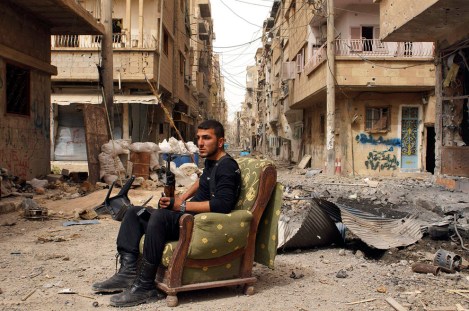
Right now, a distressingly large number of these areas are in North Africa and the Middle East. As recently as a year or two ago, there was hope with the arrival of the Arab Spring. Egypt and Libya look good for a while, but are sinking back into the same old cycle of totalitarian rule accompanied by an increase of Islamic fundamentalism. (Has Islamic fundamentalism ever helped any Muslims—anywhere? at any time?) Somalia continues as a snake pit to be avoided by all, though some light is breaking through. Syria is a basket case that is only getting worse.and threatening to suck in its neighbors.

There are still U.S. legislators (like Senator John McCain of Arizona) who think we should get involved, but I keep remembering the Uncle Remus story of the tar baby:

How to Get Irretrievably Stuck

How to Get Irretrievably Stuck

As you may recall, Br’er Rabbit encounters a stick figure plastered with gooey tar. He asks it some questions. When it doesn’t answer, he gets riled up and starts hitting away at it. But alas, he is hopelessly stuck in the tar and can’t get loose.

Ever since the end of the Second World War, the United States has been getting stuck by such tar babies as Viet Nam, Lebanon, Somalia, Iraq, and Afghanistan. And what do we have to show for it other than fresh plantings at veterans’ cemeteries around the country.

Increasingly, I am becoming a non-interventionist, at least where “boots on the ground” are involved. We can’t alleviate the mess of these dead zones, but we can certainly get stuck in various “Green Zones” such as the one in Baghdad from which we are afraid to venture out without risking being blown to bits.


Too Much Rugged Individualism?

John Wayne and Jeffrey Hunter in The Searchers (1956)

John Wayne and Jeffrey Hunter in The Searchers (1956)

As a nation, we’ve always prided ourselves on our rugged individualism. And I must say that worked pretty well for us—until the world suddenly grew more complicated after World War Two. Costs began spiraling upwards, at times, such as medical care and housing, beyond belief. Suddenly, we found ourselves in a world where there were 300 million rugged individuals, all competing with one another for scarce resources.

Some of us have learned to walk gingerly through this strange new world. Others have continued on as if it still were the Wild West, and as a result failed spectacularly. No matter: They had their guns. It was just a matter of shooting a bunch of innocent strangers and then turning the gun on themselves. This way they were making a point. What exactly that point was, I cannot even begin to guess. But, by golly, as long as they pretended to be a “Militia” as specified in the Second Amendment (the one part of the Constitution that makes me wonder about our Founding Fathers), they could wreak havoc and go down in flames.

Many Americans of a Conservative bent are scornful of what they call Socialism. In a few weeks, I will be spending some time in Iceland, a Scandinavian country with social guarantees that make it less likely that flagrant failures will shoot up their fellow man in spectacular ways. Medical care is far more affordable than in the U.S., though gasoline costs more. (They have to ship it in from the North Sea and other distant locales.)

Even with only 300,000+ people, Iceland has a number of maladjusted individuals who cause mayhem, but their mayhem is more limited and they are more easily captured because, hey, just about everyone is related to everyone else.

With 300+ million people, the United States has far too many rugged individuals. We need to put an ad on Craig’s List for people who are willing to play well with others.

Not that I have anything against John Wayne! The Searchers is probably my favorite film of all time, though I myself probably resemble John Quayle (the Swedish farmer character) more than the Duke.

Stay the Hell Out of Syria

Out of the Frying Pan, Into the Fire

Out of the Frying Pan, Into the Fire

It’s now official: That crazy old man from Arizona, Senator John McCain, is shopping around for another morass for the U.S. military to get stuck in. Let’s look at the possible consequences:

  1. If we align ourselves with the rebels, we are aligning ourselves with Al Qaeda and Wahhabi Sunni Muslim militants.
  2. Fighting against us would be not only Bashar al Assad, but Hezbollah, the Shi’a, and Iran (indirectly).
  3. Russia is supporting Bashar with weaponry, so we will end up with the best that Putin can throw at us.

I can’t see that either side deserves our support. I would not venture a single American life against the whole lot of them. As much as they say they need our help now, what is to keep the rebels from doing a 180° turnabout whenever it suits whoever is in power during a particular fifteen minute slot.

Not only can we not predict who will win, but we can’t figure out what kind of governance would result. My guess is that it would be another Iraq, with sectarian bloodshed lasting for years to come—and with America, once again, identified as the “Great Satan.”

My belief is that we should provide both sides with medical help and sit back with a box of popcorn to see who comes out on top. That would be a refreshing change of pace for once!


Let’s Have a News Orgy!

News Coverage Multiplies Like ... Well ... Kangaroos

News Coverage Multiplies Like … Well … Kangaroos

With so many news channels, whenever a big story breaks, you can be sure that it will be rubbed in your face twenty-four hours a day for weeks at a time. There are so many more types of news media that the effect is like being trapped in a hall of mirrors, like Orson Welles in The Lady from Shanghai.

Let me just name a few names so that you get the idea: O. J. Simpson (several times) … Caylee … Benghazi … Hurricane Sandy … Jodi Arias … Boston Marathon … Fiscal Cliff … IRS … Sequestration … Cleveland Sex Prisoners …  Trayvon Martin … Aurora Shooting … Sandy Hook … Elections … Yada Yada Yada.

It’s rather amusing that programming is always interrupted by “Breaking News Stories” that are nothing more but a repetition of the last 175 “Breaking News Stories,” adding little but possibly some new conjectures and misinformation to what has already been stated. What gets me is that some people stayed glued to their TV sets expecting to hear something new that explains the whole story. But they are never quite satisfied. The news is always breaking, but somehow it never quite breaks.

Probably the smart course is, when one hears the original story, to shut off the set and walk away for a few days, until some perspective emerges. At first, most news sources feel too cagey and inhibited to divulge any real news: You have to wait for a while, sometimes for weeks. In the meantime, there is a steady drumbeat of no news that masquerades as news.

I’m sorry to say that the same goes for newspapers. The story comes blaring at you through oversize headlines. Weeks later, buried on an inside page, is the real story—but by then everyone’s too jaded to care.


We Are the (Third) World

Why Are We Unable to See That Things Have Changed?

Why Are We Unable to See That Things Have Changed?

There is a wonderful sci-fi novel by Stanislaw Lem entitled The Futurological Congress. In it, the author imagines a world in which we think ourselves much better off than we actually are. The plot revolves around the discovery by one attendee at the Congress that everything is grim and broken down, only seeming to appear different because all of us have been drugged to see it that way. For instance, what appeared to be a gorgeous hotel room is actually a rat-trap of a tenement.

I keep thinking of the changes that have occurred over the last forty years. It all atrted in the 1980s, when we decided for some reason that crazy people no longer had to be institutionalized if they didn’t want it. (And really, who wants it?) The streets of Los Angeles started filling up with aggressively demented bums who slept on street corners on assailed everyone for “spare change.”

After that, it all started to plummet. Now America is divided between two political parties that are so far apart that they can only deal with each other across ramparts. Congress has become a joke; the Supreme Court, a haven for troglodytes; and the Executive Branch of government, a penalty for not “making it” in the outside world. Words like “patriotism” and “progressive” are bandied about by people who have lost all sense of irony.

Then there are the streets, such as the one illustrated above showing a pothole from my hometown of Cleveland. I am constantly changing my driving routes to avoid known agglomerations of potholes, steel plates, and construction zones replete with K-rails and orange cones. And alley ways … I don’t think Los Angeles has resurfaced any alleys since Eisenhower was President.

Whenever I visit a foreign country, I feel an acute sense of shame and inferiority. We still think of ourselves as the City on the Hill, a place for other countries to marvel at and emulate. But I guess we’ve all taken that drug that Stanislaw Lem writes about.

It really is a good book: You ought to read it.


Breaking News

Don’t Put Your Trust in the News—Ever!

Don’t Put Your Trust in the News—Ever!

It would appear that the news is always breaking, but what if it is already broken—irretrievably? When something like the Boston Marathon bombing or the ricin mailings occur, our first impulse is to turn on the television and wait on the edge of our seats while we are fed a steady stream of speculation, suppositions, and outright lies.

As I have said on a number of occasions, I don’t watch television news at all, mainly because I don’t trust it. At some point between my childhood and today, the news organizations have been taken over by large corporations who have an interest in making people believe what they want them to believe.

If you want a balanced picture of what is happening, you don’t automatically turn to your favorite news outlet: You try several different media—and not always just from the United States—and compare. You might find that the BBC and Aljazeera have a better handle on things—not in the sense of being more up to date, but being more skeptical of the way that news stories are spoon fed to the media.

Take the Boston Marathon bombings. Here are just some of the false trails the news media followed:

  • The Boston Police said the Tsarnaev brothers were heavily armed. Yeah, with weapons of mass cuisine, e.g., pressure cookers. Oh, and one pistol.
  • When Dzhokhar Tsarnaev was trapped in the boat, the report came that he was firing at officers. Yet he was unarmed when the police finally stormed the boat.
  • Reports said that the brothers held up a Seven-Eleven Convenience Store and shot an MIT officer who intervened. They did not, in fact, rob a Seven-Eleven, and the facts are still not known as to how the MIT officer got involved.
  • Details about the carjacking are incredibly fuzzy, although a number of different alternatives have been floated in the news.

For more information about news miscues regarding the Tsarnaev’s bombing, check out this story from Salon.Com.

It is sad that Americans don’t know when they are being manipulated by the news media. To me, the media have some responsibility to find out the truth, not just provide a plausible cover for people to believe.

Two Wild & Crazy Guys from Dagestan

Not Understanding American Culture Can Be Dangerous

Not Understanding American Culture Can Be Deadly

You may recall those two Wild & Crazy guys from Czechoslovakia, the brothers Yortuk and Georg Festrunk, on Saturday Night Live. As they shimmied across the stage in search of “foxes, ” they displayed an exquisite misunderstanding what the United States was all about. In the case of Steve Martin and Dan Aykroyd, the result was comedy. In the case of Tamerlan and Dzhokhar Tsarnaev, two Chechen brothers from Dagestan, the result was death and disorder.

In the years to come, one of the greatest dangers to America will be the failure of immigrants from cultures vastly different from our own to adapt to the prevailing culture of the U.S. Even the mother returned to Russia, leaving several arrest warrants for shoplifting in her wake. The streets of America are not paved with gold. They are fraught with dangers not understood by people who have been influenced by our popular culture without understanding the particular demons that we in the States have to contend with in our daily lives.

After the Hungarian Revolution of 1956, my parents took in two sets of refugees. The first was a mother and son who thought that, now they were in America, everything would be golden. That ended badly when Feddike, the son, was sent to a juvenile correctional facility. Next was Lászlo, a young man in his twenties, who also quickly fell afoul of the law—whereupon my mother and father resolved not to take in any more refugees from the Mother Country.

I do not mean to imply that immigration is bad, but that American culture sends misleading vibes to the rest of the world. People who are not thoughtful and who think that just being on American soil is the solution to all their problems are more likely to go astray. No, they must be ready to roll up their sleeves and start working long and hard toward their goals.

The Tsarnaev brothers should be an object lesson to American officials that they have to probe more deeply than mere external circumstances when opening the doors of the henhouse to potential predators.

News On Demand

A Horrific Video of Bashar’s Jets Bombing a Village Filled with Refugees

A Horrific Video of Bashar’s Jets Bombing a Village Filled with Refugees

You don’t have to watch Faux News any more to find out what’s going on in the world. Salon.Com has published a link to Ifiles, which contains links to investigative reporting you may not get when you watch rancid sausage being squeezed through Sean Hannity’s lips. I was entranced by two videos currently available:

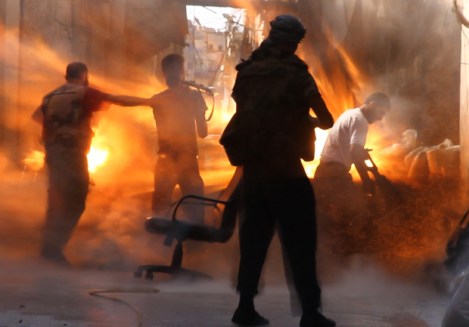
The first is almost half an hour long and shows footage of a bombing raid by Bashar al-Assad’s air force on the village of al-Bara in the north of Syria. Some dozen or two people were buried under rubble when two heavy bombs hit within 400 meters of each other. Typically, the jets make one pass, and loop around and return about 15-20 minutes later, when a crowd has gathered to dig out the victims of the first blast. We owe this frightening footage to FRONTLINE reporter Olly Lambert, who does a great job showing us the panic and the community spirit of people trying frantically to help one another when they don’t have the wherewithal to do so effectively.

The second was an amusing commentary on the failures of international reporters to get to the bottom of one continuing story: Somali piracy on the high seas. Naturally, it’s too dangerous to go to Somalia; so reporters are going to Kenya and interviewing enterprising Africans (some of whom are in fact Somalis) pretending to be pirates. This way the news media get their story, and the “pirates” get some money to support themselves in their nefarious venture. These pretend pirates have probably never even been in a boat.