Usually around the time of the Academy Awards, I write a negative appraisal of the Oscars, if not of all award shows. Here are just some of my negatory yawps in no particular order:
This year I will refrain from casting aspersions on the awards except to say that I have no idea who won what this year, nor do I care.
Instead, I will say that I have not seen any current movies this last year. I am tired of paying an inordinate amount of money to see a bunch of young actors making faces at one another in a vehicle that is devoid of story or cinematic value. The filmmakers I worshiped are all gone: John Ford, Alfred Hitchcock, Howard Hawks, Jean-Luc Godard, Kenji Mizoguchi, Yasujiro Ozu, Akira Kurosawa, Federico Fellini, Ingmar Bergman, Carl Theodor Dreyer, and Luis Buñuel among others. They have been replaced by people from television, video games, and TikTok.
When people watch films on smart phones and other small screens, it’s pretty much game over.
Perhaps this marks me as an old-timer, but I don’t give a damn. I will continue to watch the great films that have meant so much to me, and to boycott the current product unless it shows signs of genius. So far, there haven’t been many films worth watching.
In the picture above, the left half of the building shown was added some time after I graduated from Dartmouth College in 1966. To see the Fairbanks Hall that I knew and loved, put your hand over the left half of the picture.
When I was a freshman at Dartmouth, I paid a visit to Fairbanks Hall in its old location just north of Baker Library. I heard that Dartmouth Films, which occupied the building, was showing free films. One day, I wondered into the small auditorium and saw Carl Theodor Dreyer’s 1943 masterpiece Day of Wrath (Vredens Dag) about witchcraft in the 17th century. The Danish film electrified me. I had seen a handful of foreign films back in Cleveland, but nothing this good.
That year, the Hopkins Center for the Arts had its grand opening, and the Dartmouth Film Society was able to screen films in the center’s large and fancy auditorium. At the time, I was planning on being an English major; but suddenly new possibilities opened up. The Film Society inaugurated the Hopkins Center auditorium with the world premier of John Huston’s Freud.
In my sophomore year, the college lifted Fairbanks Hall from its north campus location and plunked it down in the middle of the parking lot between Massachusetts Hall and the Hanover, New Hampshire cemetery. I started hanging out there, having long conversations with Blair Watson, who headed up Dartmouth Films, and David Stewart Hull, his assistant.
By my junior year, I was an active member of the Dartmouth Film Society; and the next year, I was its assistant director. By that time, my pituitary tumor was causing intense pain, usually in the form of frontal headaches which started just before noon and (for some reason) ended around midnight. In between those hours, I figured I could screen films for myself on the 16mm projector. I dropped in daily to see what films had been received for screening in classes around campus and threaded the projector if any of them looked interesting. There was a small screening booth I could use for the purpose.
Among the highlights of the films I saw that year were the Frank Capra Why We Fight films made to show Americans why we were fighting in the Second World War; Nelly Kaplan’s great documentary about the films of Abel Gance; René Clair’s French musicals Sous les toits de Paris and Le million; and a whole host of other highly miscellaneous films.
While in Fairbanks, I usually ran into my friend Peter, who was busy editing one of the films he had shot. Today, he lives some twenty-five miles south of me.
Fairbanks Hall had a major influence on my choice of graduate school. I had received a citation for excellence in a class on film history; and I decided to apply to the UCLA film school for an advanced degree in motion picture history and criticism.
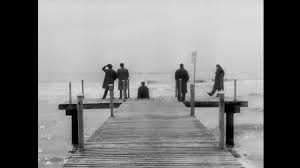
We’ve all been there. In our salad days, we hung out with our buds in the town of our birth. In Federico Fellini’s case, the town was Rimini on the Adriatic Sea, a fading resort town in Emilia-Romagna. We all admired the leader of our band, who married the cute local girl (Miss Mermaid), but whose eyes kept wandering, even when his daughter was born.
Perhaps La Strada was Fellini’s best film, or La Dolce Vita; but my favorite was I Vitelloni, an Italian term that, translated, means “The Layabouts” or “The Slackers.” We see the band slowly break up. The autobiographical Fellini character, Moraldo, leaves Rimini at the end with no specific destination in mind.
I might be going out on a limb when I say this, but I Vitelloni is my favorite film about surviving one’s youth. I, too, hung out with a bunch of slackers. As I was a graduate student in film history at UCLA, the layabouts I hung out with were all film freaks. We used to get together at Canter’s Deli on Fairfax after a movie and engage in what I called “trading bubble-gum cards.” This involved saying which film was great and which wasn’t. There was seldom any agreement.
In the last few years, I lost two of my vitelloni, Norm Witty and Lee Sanders, who were integral parts of the band. But I left the group long before. I marked my departure by writing an article for the UCLA Daily Bruin entitled “Confessions of an Ex-Film-Freak, or: Slow Death Twenty-Four Times a Second.” Some day I’ll find my copy of that article and put a few quotes from it in a blog post.
There is always a big game on TV, so I usually make my escape from the drone of the sports announcers by heading to my brother’s back yard with a book. Fortunately, the book I was reading was a humdinger: Edward John Trelawny’s Records of Shelley, Byron, and the Author.
Unlike me, Dan likes to relax by watching football, basketball, and baseball games on the weekend. Unlike our late father, he is not a dyed-in-the-wool fan of any particular team: He enjoys the game even when the local boys lose, as the Los Angeles Rams did on Sunday against the Seattle Seahawks.
And, as I was with him all weekend, I had to entertain myself part of the day. This last weekend, the mercury in the early afternoons was in the low 70s Fahrenheit (low 20s Celsius). By the late afternoon, however, it started to cool down; so I was exposed to a broad spectrum of televised sports. My favorite was the game between the Denver Broncos and the New England Patriots in a white-out blizzard. All the yard indicators and hatch marks were covered with snow, forcing the stadium maintenance personnel to melt the snow at key points.
Football in the Snow
As always, it was fun to get together with my brother and sister-in-law. We watched several movies on TV, including Bubba Ho-Tep (2003). This was a film all three of us liked twenty years ago. In the intervening years, however, we seem to have changed and now regard the film with some disfavor. The other film we saw was Takeshi Kitano’s Broken Rage (2024), which started great but descended into randomness.
To make up for the sports and bad movies, the food was great, There are some wonderful Mexican restaurants in the Coachella Valley, and my brother’s cooking is superb or better.
Tsutomo Yamazaki (Left) in Kurosawa’s High and Low (1963)
This is an unusual thing to say, but if I were to look at all the great film directors with a point of view of selecting the one that would make the best general on the battlefield, my choice would be Japan’s Akira Kurosawa (1910-1998).
Yesterday evening I did not post here because I was watching Kurosawa’s great noir film High and Low for the third time. The tale follows Toshiro Mifune as a shoe manufacturer whose son is kidnapped and held for ransom. Except it turns out that it is actually his live-in chauffeur’s son who is taken. In paying the ransom anyhow, Mifune impoverishes himself, losing his business, his house, and even his furniture.
Why do I feel that Kurosawa would make an able general? In no other film (except one, that I shall mention later) is there so much intelligently conveyed detail that enables a viewer to follow the police investigation in all its aspects during its 143 minute length without feeling lost. And the film gallops along like a 73 minuter Poverty Row quickie.
During its course, Kurosawa takes us into such a realistic picture of heroine addiction that, even today, would be too much for Hollywood to handle.
The only other film that so capably marshals s vast amount of detail is the same director’s Seven Samurai (1954). This is actually a film about a 16th century military campaign in which seven masterless samurai help farmers fight back an invasion of forty mounted bandits who are after their crops. Throughout the film’s 207 minute length, we are aware of what is happening in every part of the battlefield as the samurai and farmers battle the bandits. As with High and Low, the film zips along at a fast pace despite a vast amount of detail without losing its audience.
Compare these with the average current Hollywood production in which 120 minutes seems like a lifetime and the audience is slogging through a swamp shortly after the opening credits.
Yesterday, Martine and I attended a screening of old cartoons from Walt Disney, the Fleischer Studio, MGM, and United Productions of America (UPA). Much was made of fact that several of the cartoons had won Oscars for animation.
It was at that point that my hackles began to rise. Academy Awards? You mean those awards voted on by industry members who bore grudges against the studio for which they worked or for competing studios. Granted, some Oscar winners deserved their awards. Knowing the film industry as I do, however, many votes are cast based on pure spite.
There is no doubt that the Walt Disney Studio made some great cartoons. But did “The Old Mill” (1937) deserve an Oscar? See your yourself: The Old Mill. There were some very arty effects, but zilch in the way of story or characters.
On the other hand, a controversial Donald Duck cartoon entitled “Der Fuehrer’s Face” (1943) was banned for decades because it showed the Quackster having a dream that he was a Nazi in Hitler’s Germany. It was a fascinating look at American war propaganda. Was it a little racist? Hmm, could be….
In the speaker’s idolization of Disney, he totally left out Warner Brothers’ Looney Tunes and Merrie Melodies. No Bugs Bunny, no Tweety or Sylvester, no Roadrunner, no Porky Pig, and no Daffy Duck. And he said very little about the 1930s productions of Max and Dave Fleischer. I am referring to Popeye, Betty Boop, and a host of great cartoons, such as Poor Cinderella (1934) or Raggedy Ann and Raggedy Andy (1941).
As a low rent film scholar, I am suspicious of awards. I never watch the Academy Awards on television, and I never take awards into consideration when planning my viewing. I may not have the so-called prestige of the Oscars behind me, but I am more likely to see films for other reasons than industry backbiting.
I have always loved the beginning of Tod Browning’s Dracula (1931). It shows Renfield (Dwight Frye) arriving at a Transylvanian village late in the evening at Walpurgis Night, when witches and evil spirits hold sway. Everybody is bemoaning that fact in Hungarian. As a Hungarian-American,I always had a fondness for that scene—rather than for the, I thought, less interesting events in England in the vicinity of Carfax Abbey.
Today I saw bits and pieces of the two original Universal horror classics—Dracula and Frankenstein (both 1931)—on Turner Classic Movies (TCM). There altogether too many large rooms in which too many people, many of them in formal evening attire, confronted one another. I was much happier with James Whale’s The Bride of Frankenstein (1935), which was a much better film than Whale’s original Frankenstein.
I suppose that, in the deepest days of the Great Depression, people had a yearning for actors with British accents dressed in tuxedos. I’ve always thought it was a bit silly.
Still, there were those scenes in which Renfield is working his way to Castle Dracula. They are forever etched in my mind.
This is a re-post from October 20, 2022. I have just sat through four films directed by Jacques Tourneur on Turner Classic Movies (TCM), three of them produced by the great Val Lewton. He is the only producer who deserves to be called great. Most of the others are impediments to greater or lesser degrees.
There are horror films, and there are horror films. They can scare you out of your wits, like Curse of the Demon (1957) and Poltergeist (1982), or they can make you understand that the world is both light and dark in equal measure, like Val Lewton’s great films of the 1940s, such as The Cat People (1942).
Val Lewton, born Vladimir Ivanovich Leventon in Yalta, Russia, was interested in making low budget films to compete with Universal Pictures’ highly successful Frankenstein, Dracula, Mummy, and Wolf Man franchises. The title for The Cat People was assigned to Lewton by RKO, and Lewton went to work on a psychological thriller in which there is no overt violence. Perhaps the greatest scene takes place in a swimming pool in which a young woman is swimming all by herself at night. In the shadows, we imagine there is a black panther, but neither the swimmer nor we the viewers are absolutely sure.
Even though Halloween is just about over, I highly recommend all the following Lewton films:
The Cat People (1942)
I Walked with a Zombie (1943)
The Leopard Man (1943)
The Seventh Victim (1943)
The Ghost Ship (1943)
The Curse of the Cat People (1944)
The Body Snatcher (1945)
Isle of the Dead (1945)
Bedlam (1946)
All are great films worthy of being seen multiple times. They are short, thoughtful, extremely moody, and highly successful. Also available is a Turner Classics biopic about Lewton’s career called Shadows in the Dark narrated by Martin Scorsese. Martine and I watched it last night and recommend you see it.
In all of Hollywood’s history, Lewton was probably the only film producer who controlled his products as if he were the director. Even though Lewton directorial protegés Jacques Tourneur, Robert Wise, and Mark Robson went on to have brilliant careers, when one is watching a Lewton film, one recognizes it as a Lewton film.
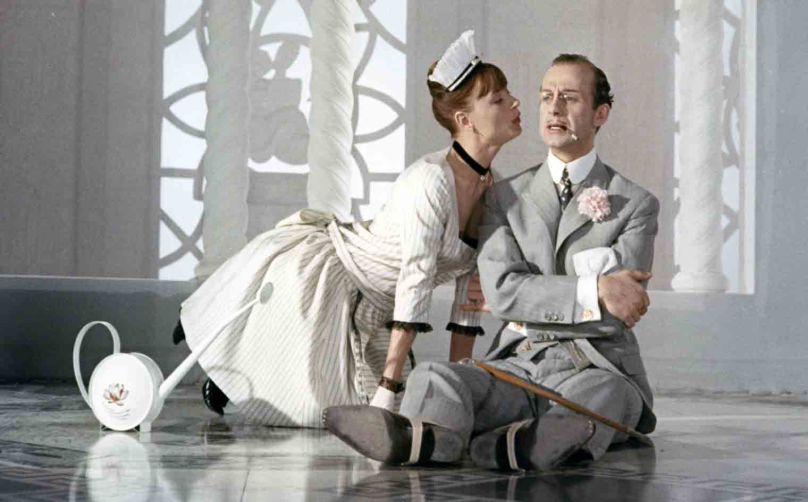
Harriet Andersson and Jarl Kulle in Bergman’s All These Women (1964)
Yesterday I posted about my love for black & white films. Today, I would like to redress the balance by talking about the pros and cons of color film. With the new motion picture and video cameras, color is, for the most part, what the camera is programmed to shoot, especially when the camera is digital.
There was a brief time in the 1960s when film directors made some exciting use of color film stock. I am thinking of such films as Michelangelo Antonioni’s The Red Desert (1964), Ingmar Bergman’s All These Women (1964), and—going back a couple of decades—Michael Powell and Emeric Pressburger’s Black Narcissus (1947).
In fact, the Internet Movie Database (IMDb) has released a list of 275 films “with Amazing Use of Colours.” The list includes some well-known titles as Alfred Hitchcock’s Vertigo (1958), Robert Zemeckis’s Forrest Gump (1994), Jacques Demy’s The Umbrellas of Cherbourg (1964), and Steven Spielberg’s E.T. (1982). Interestingly, there are scores of titles of films of which I have never heard: In each case, some film-maker wanted to make something different and succeeded.
As digital film becomes more prevalent, the temptation is for producers and directors to not attempt anything special. This is particularly true of films released by HBO, Netflix, Hulu, and others in multiple parts. Most of these productions I frankly ignore. Graphically speaking, most are failures.
Even films released as features for the theaters are not necessarily any better. In the old days of the Hollywood Studios, interesting cinematography was a matter of institutional pride. But that was then….
Yesterday as I was watching John Ford’s The Fugitive on Turner Classic Movies (TCM), I was reminded of what Peter Bogdanovich said about black & white vs. color: “Orson Welles says every performance looks better in black and white. It’s the fact that you don’t see blue eyes and blond hair. You focus on the performance, not the look of the people. And it enables you to capture the period better.” And that is why he shot The Last Picture Show (1971) in black and white.
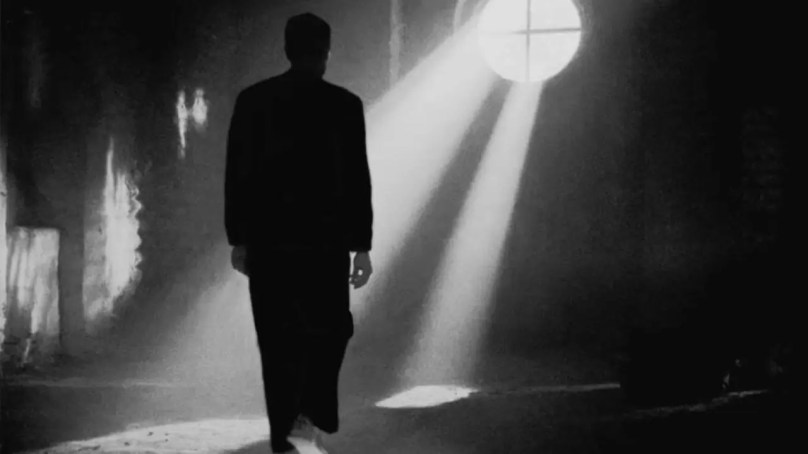
When I was growing up, I preferred color, even though the color at that time was mostly three-strip Technicolor, which, though beautiful in its own right, is not particularly realistic. Then, in 1962, I saw a black & white film that changed me: Carl Dreyer’s powerful study of witchcraft in Denmark, Day of Wrath (1943). I started attending the Dartmouth Film Society’s screenings, and I saw numerous motion pictures that made me appreciate both color and black & white.
In the world of black & white, there are some great cinematographers. They include Gabriel Figueroa (he shot The Fugitive); John Alton, the great noir master; Joseph Von Sternberg and his regulars Lee Garmes and Bert Glennon; Sidney Hickox (the 1946 The Big Sleep); and Gregg Toland. Interestingly, the great B/W photographers could also make great color films—but not always vice versa.
Today, I have no preference between B/W and color. Most of the films I watch on TCM are in black and white, probably because I do not retain my childhood preference for color. Also, I will willingly watch silent films of the 1920s and films of the 1930s, 1940s, and up to the present day. Curiously, if I am prejudiced, it is mostly against recent films, which are overwhelmingly in color.
For balance, I will also write a blog about my favorite color films within the next few days.








 Tarnmoor
You must be logged in to post a comment.