“We Aren’t Serious When We’re Seventeen”

French Poet Arthur Rimbaud (1854-1891)

He looks so young. But, even as a teen, Arthur Rimbaud was something of a devil. After a torrid relationship with fellow poet Paul Verlaine, Rimbaud gave up poetry at the age of twenty and set up in East Africa as a trader. There, he dealt in coffee, guns, and whatever else could turn a profit. At the age of thirty-seven, he died of cancer.

His poetry still resonates, particularly in France, where it is no crime to be transgressive. Here is one of his simpler, less surrealistic poems. (If you want to read more by him, try his long poems “A Season in Hell” or “Illuminations.”)

Novel

I

We aren’t serious when we’re seventeen.
—One fine evening, to hell with beer and lemonade,
Noisy cafés with their shining lamps!
We walk under the green linden trees of the park


The lindens smell good in the good June evenings!
At times the air is so scented that we close our eyes.
The wind laden with sounds—the town isn’t far—
Has the smell of grapevines and beer . . .

II

—There you can see a very small patch
Of dark blue, framed by a little branch,
Pinned up by a naughty star, that melts
In gentle quivers, small and very white . . .


Night in June! Seventeen years old! —We are overcome by it all
The sap is champagne and goes to our head . . .
We talked a lot and feel a kiss on our lips
Trembling there like a small insect . . .

III

Our wild heart moves through novels like Robinson Crusoe,
—When, in the light of a pale street lamp,
A girl goes by attractive and charming
Under the shadow of her father’s terrible collar . . .

And as she finds you incredibly naïve,
While clicking her little boots,
She turns abruptly and in a lively way . . .
—Then cavatinas die on your lips . . .

IV

You are in love. Occupied until the month of August.
You are in love. —Your sonnets make Her laugh.
All your friends go off, you are ridiculous.
—Then one evening the girl you worship deigned to write to you . . . !

—That evening, . . . —you return to the bright cafés,
You ask for beer or lemonade . . .
—We’re not serious when we are seventeen
And when we have green linden trees in the park.
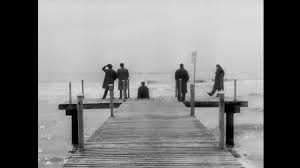

I Vitelloni (1953)

Scene from Fellini’s I Vitelloni (1953)

We’ve all been there. In our salad days, we hung out with our buds in the town of our birth. In Federico Fellini’s case, the town was Rimini on the Adriatic Sea, a fading resort town in Emilia-Romagna. We all admired the leader of our band, who married the cute local girl (Miss Mermaid), but whose eyes kept wandering, even when his daughter was born.

Perhaps La Strada was Fellini’s best film, or La Dolce Vita; but my favorite was I Vitelloni, an Italian term that, translated, means “The Layabouts” or “The Slackers.” We see the band slowly break up. The autobiographical Fellini character, Moraldo, leaves Rimini at the end with no specific destination in mind.

I might be going out on a limb when I say this, but I Vitelloni is my favorite film about surviving one’s youth. I, too, hung out with a bunch of slackers. As I was a graduate student in film history at UCLA, the layabouts I hung out with were all film freaks. We used to get together at Canter’s Deli on Fairfax after a movie and engage in what I called “trading bubble-gum cards.” This involved saying which film was great and which wasn’t. There was seldom any agreement.

In the last few years, I lost two of my vitelloni, Norm Witty and Lee Sanders, who were integral parts of the band. But I left the group long before. I marked my departure by writing an article for the UCLA Daily Bruin entitled “Confessions of an Ex-Film-Freak, or: Slow Death Twenty-Four Times a Second.” Some day I’ll find my copy of that article and put a few quotes from it in a blog post.

Glory Days

There are many possible pathways through a life. For many, the high point of their lives came early, in high school or college. As they settled down into family life, they rarely ever cracked a book or veered in a different direction. When one talks to them, most of their talk is of their glory days—and their present lives are a long comedown.

Although I was a high school valedictorian who was accepted for a four-year scholarship at an Ivy League college, I never felt I had any real laurels upon which to rest. The first seven years of my life were spent in a Hungarian household, where the Magyar language was the only one spoken. This gave me a slightly different outlook from most others. As I learned English and began to see myself as an American, I also saw myself as something of a hyphenated American who had his feet in two cultures.

During my high school and college years, I was walking around with a pituitary tumor that gave me severe headaches as it pressed against the optic nerve. So my glory days of youth were spent mostly in pain. When I was successfully operated on after I graduated in 1966, I looked like an 11-year-old rather than a college graduate. You can imagine how that affected my self-image.

In the intervening years I had two careers: first, as a computer programmer and director of marketing for a demographic data supplier, and then as a computer specialist and office manager for two tax accounting firms. In both professions, I saw myself as a mercenary who was actually after different game.

Now that I am retired, I am coming into my own as a writer here on this WordPress site. Oh, I am no “influencer.” I have no intention of getting you to buy crap, or anything else. If I am selling anything, it is my thoughts and feelings as a human being living in difficult times. I feel good and am considerably happier than I was during my youth.

It looks as if I am now living through my glory days.

Unexpected Angels

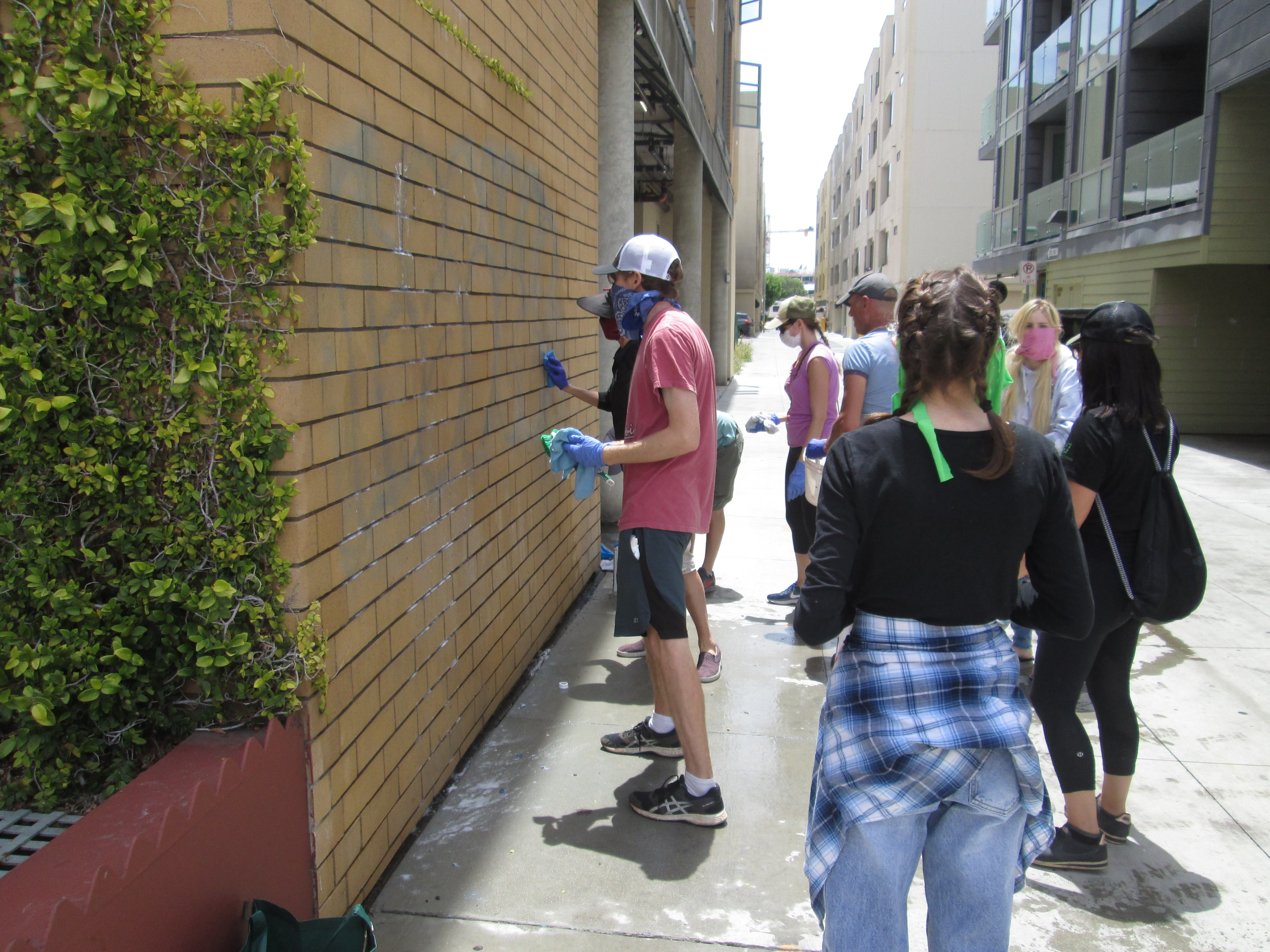
Young Volunteers Removing Graffiti

In general, I am not one to praise the younger generation—probably because they have adopted too many aspects of our culture which I find spurious, including smart phones, e-scooters, and in fact the whole gig economy.

Imagine my surprise when I found many young men and women cleaning up the mess in Santa Monica after the looters and other thugs had their way last Sunday. Okay, I guess I was a little tough on them, but after all they shouldn’t ought to have have stepped on my lawn.

More Graffiti Cleanup

I have always loved the look of Santa Monica. In 1966, when I moved into an apartment on Sunset Boulevard near Barrington Avenue, the first trip I took on my own was by bus to Santa Monica and its beach. After having been raised in grungy Cleveland with its dirty red brick, I saw Santa Monica as a pretty town at the edge of the sea. In Cleveland, we had no beach to speak of along the shores of poor, polluted Lake Erie. For many years, I lived in Santa Monica, until I was squeezed out around 1979 when Proposition 13 was adopted by the voters of California. Still, I live within two and a half miles of the ocean and I like to walk there from time to time.