Heyday Is Over

The Unmarvelous Marvel Universe

When I first came to Los Angeles at the tail end of 1966, it was the beginning of a Golden Era for people like me who loved the cinema and saw it as an art form that would prevail well into the next century.

Only, it didn’t. The great Hollywood directors sputtered out with films that were pale copies of their best work. There was John Ford’s 7 Women (1966) and Howard Hawks’s Rio Lobo (1970). On the plus side, there were the French cinéastes of the Nouvelle Vague, including Jean-Luc Godard, François Truffaut, Jacques Rivette, Claude Chabrol, and Agnes Varda. And, across the Pacific, the Japanese were making great films which I have never tired of watching.

It was in 1968 that Andrew Sarris published The American Cinema:Directors and Directions, 1929-1968. It was a revision and expansion of an issue of Film Culture that came out several years earlier which I had photocopied while I was at Dartmouth College and which I always kept at my side.

But other things were happening. Hollywood was sputtering out like a volcano in its final throes. The film distribution companies were run by yahoos who insisted that people of my frame of mind were out-of-touch elitists and what the filmgoing public really wanted was Thoroughly Modern Millie and the Marvel Universe.

In the course of several decades, there was a dribble of good films from Hollywood and abroad, but mostly an avalanche of mediocrity. At the same time, it was getting harder to see the films I loved. I recorded hundreds of films on VHS videotape—but then videotape died. I switched to DVD, but now I am beginning to encounter “laser rot.”

I have in my library a number of volumes that are over a hundred years old. Unless they are destroyed, they will be readable for at least another hundred years. Such is not the case with films. The media on which they are stored has to be changed every few years because of the rate of change in the digital world.

So I have concluded that it will be difficult to be a film lover. Yet I almost never see current Hollywood film products in theaters. Sometimes on HBO or Showtime, but never at a cinema.

Fortunately, my books are still quite readable; and I am diving into them voraciously.

Two Women Alone in the Wild

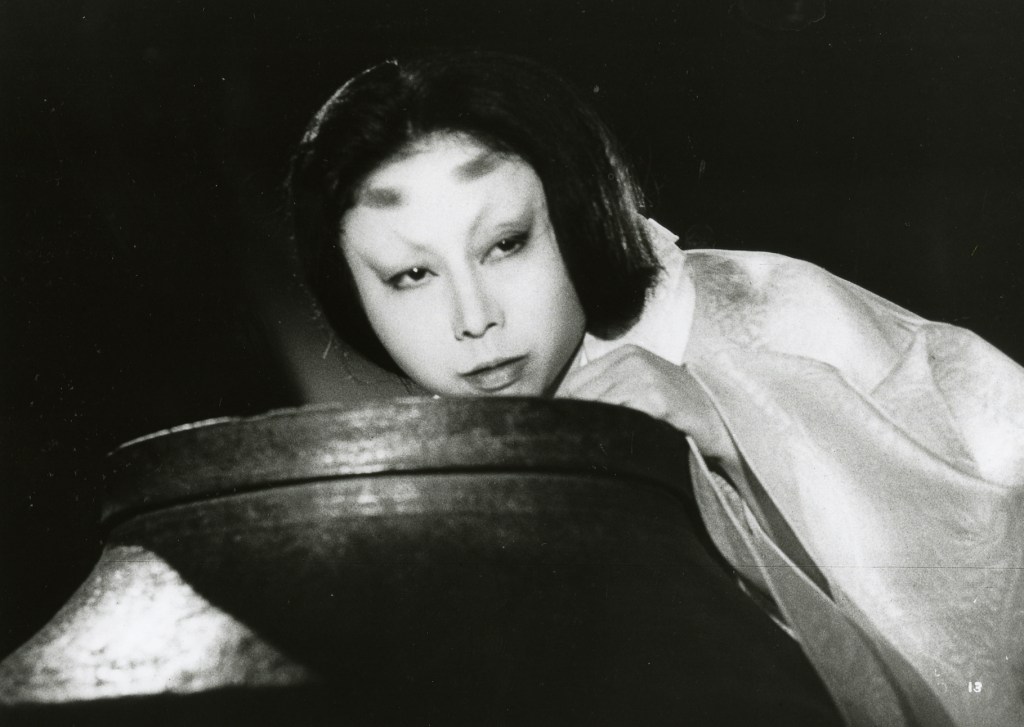
Woman Wearing Demon Mask in Onibaba

Both films begin with the same situation. In Medieval Japan, there is civil war. Men are pressed into one of the competing armies, leaving behind a mother and wife in a hut. The situation is dangerous, what with deserters and roving bands of masterless samurai. And the same actress appears in both films, Nobuku Otawa, who also happened to be the director’s wife.

The two films are Onibaba (1964) and Kuroneko (1968), both by the same director—Kaneto Shindo— and both produced by the Toho Studio. In the former film, the hut is located in a sea of tall reeds; in Kuroneko, in a bamboo forest.

In the 1960s, I believe that the best films produced anywhere in the world were made by a handful of Japanese film studios: Toho, Daiei, Schochiku, Nikkatsu, and Tohei. Although Hollywood pioneered wide-screen films, it was the Japanese who mastered the medium, whether in black and white or in color.

Nobuku Otawa in Shindo’s Kuroneko

Last night I stayed up late watching Onibaba and Kuroneko on the Turner Classic Movies (TCM) channel.

Onibaba is the better of the two films. The tall grass becomes a character in the film, much like the sand dunes in Hiroshi Teshigahara’s Woman in the Dunes (1964). When the daughter runs through the tall grass to tryst with her lover, the viewer feels that anything can happen. And it does: A demon appears in her path blocking the way.

Both films are available from the Criterion Collection.

The Alabama Hills

Hundreds of Hollywood Films Were Shot in the Alabama Hills

If you take California 14 from Los Angeles through the Antelope Valley to the end, you will find yourself on U.S. 395 near China Lake and Ridgecrest. In another hour or so, you will pass the turn-off for Death Valley in Olancha and soon afterwards the little town of Lone Pine.

Just west of Lone Pine, along the road that takes you to the Whitney Portal, are the Alabama Hills, which if you have seen as many films as I have, may be surprisingly familiar to you. That is because literally hundreds of scenes in Hollywood films were shot there, Here is a short list:

  • Gladiator (2000)
  • Django Unchained (2012)
  • Tremors (1990)
  • The Great Race (1965)
  • Bad Day at Black Rock (1955)
  • How the West Was Won (1962)
  • Gunga Din (1939)
  • Around the World in 80 Days (1956)
  • The Ox Bow Incident (1942)
  • High Sierra (1941)
  • Greed (1924)
  • Ride Lonesome (1959)
  • Three Godfathers (1948)
  • Samson and Delilah (1949)

If you should find yourself driving up that lonely Eastern Sierra highway, you might want to spend an hour or two taking the Alabama Hills loop road and seeing the sights. You can find out more if you should eat breakfast or lunch at the Alabama Hills Cafe in Lone Pine, probably the best eatery for a radius of a hundred miles.

Also highly recommended is the town’s Museum of Western Film History, which memorializes the Westerns shot in the Alabama Hills area.

Favorite Films: Morocco (1930)

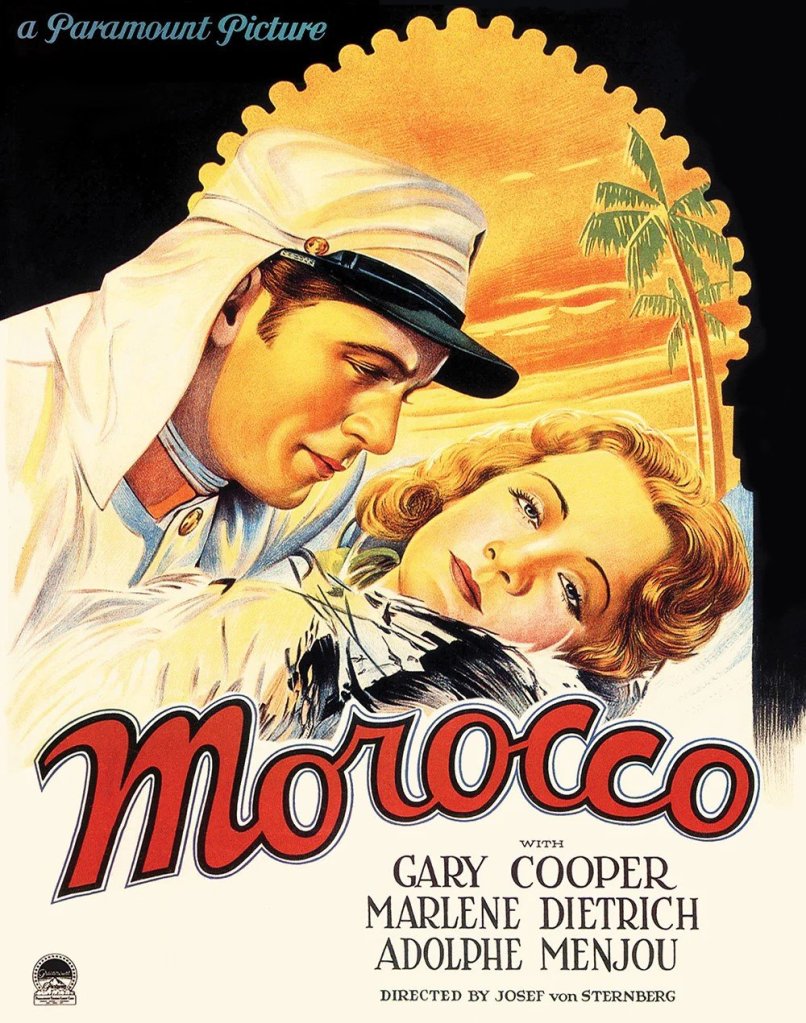
Gary Cooper and Marlene Dietrich in Morocco

It was Marlene Dietrich’s first film in Hollywood, and Gary Cooper’s first co-starring role in a sound film. And the director was none other than Josef von Sternberg, in my opinion one of the greatest filmmakers in the industry. The two co-stars fell in love during the filming, but the relationship between Cooper and von Sternberg was adversarial to say the least.

Nonetheless, Morocco (1930) turned out to be a gem. In its one hour and thirty-two minutes, the unbridled passion between Cooper and Dietrich has few equals in the cinema. Cooper is Private Tom Brown in the French Foreign Legion, and Dietrich is Amy Jolly, a night club singer. Within the first five minutes of the film, the two are obviously entranced with each other.

Poor rich Adolphe Menjou as M. La Bessière tries to hook up with Dietrich, but it’s no go. In the end, the nightclub singer jettisons her high heels in the sand and follows the legionnaires to their next posting along with the camp followers.

Jean Gabin and the Kuleshov Effect

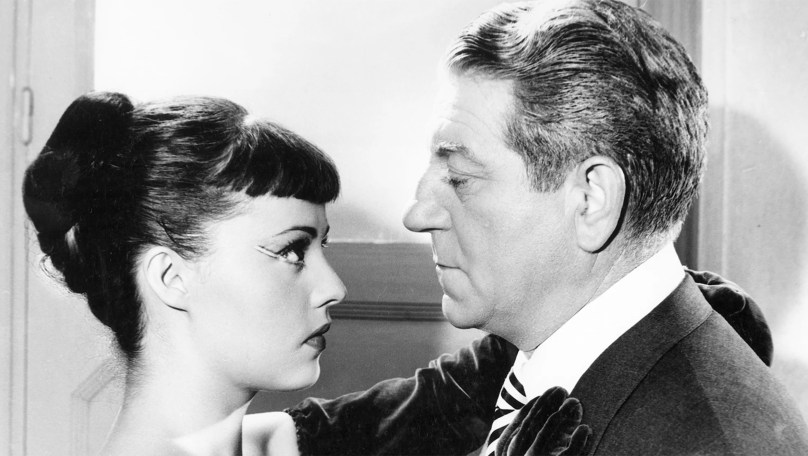
Jeanne Moreau and Jean Gabin in Touchez pas au grisbi

Last week I saw a great film on Turner Classic Movies’ “Noir Alley.” It was Jacques Becker’s 1954 film Touchez pas au grisbi starring Jean Gabin, one of the all-time great actors of the French Cinema. What made him great was the opposite of what makes most American film actors today look cheesy and fake.

It all relates to what is known in cinema as the Kuleshov Effect, an experiment made by Lev Kuleshov and other Soviet filmmakers. Here is how Wikipedia describes it:

Kuleshov edited a short film in which a shot of the expressionless face of Tsarist matinee idol Ivan Mosjoukine was alternated with various other shots (a bowl of soup, a girl in a coffin, a woman on a divan). The film was shown to an audience who believed that the expression on Mosjoukine’s face was different each time he appeared, depending on whether he was “looking at” the bowl of soup, the girl in the coffin, or the woman on the divan, showing an expression of hunger, grief, or desire, respectively. The footage of Mosjoukine was actually the same shot each time. Vsevolod Pudovkin (who later claimed to have been the co-creator of the experiment) described in 1929 how the audience “raved about the acting … the heavy pensiveness of his mood over the forgotten soup, were touched and moved by the deep sorrow with which he looked on the dead child, and noted the lust with which he observed the woman. But we knew that in all three cases the face was exactly the same.”

Kuleshov’s Experiment

In today’s Hollywood, on the other hand, actors tend to overdo the mobility of their facial expressions. Add to that the fact that, when they act the part of a tough guy, they are bearded, scraggly, and tattooed.

Compare that to the acting of Jean Gabin in Touchez pas au grisbi. He always looks the same, dapper and somewhat atone-faced. This is equally true when he is romancing dance hall girls or pumping lead into a rival gangster who wants the gold bars (the grisbi, or loot) he stole in an earlier robbery. One of the reasons, I think, for the popularity of Clint Eastwood is that he acts tough without hamming it up.

Spinach, Hamburgers, and Olive Oyl

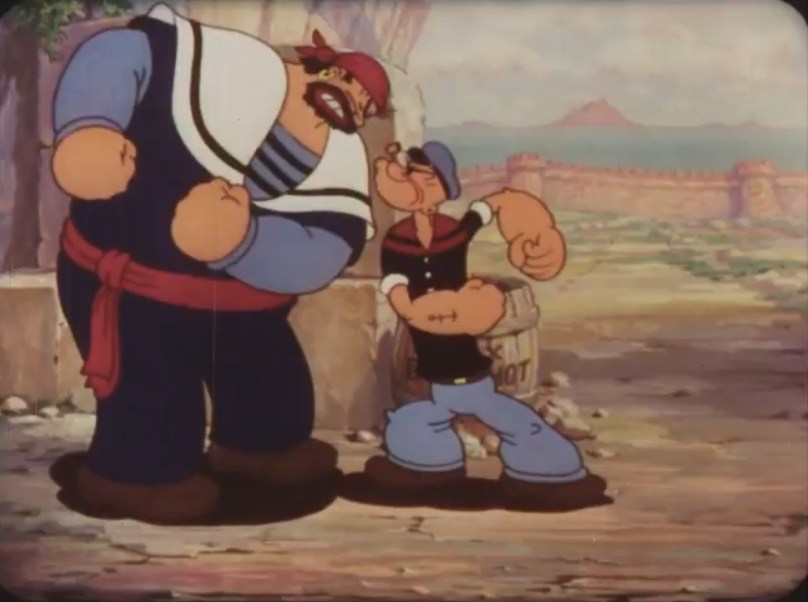
Bluto and Popeye in Popeye the Sailor Meets Sinbad the Sailor

Okay, I know it doesn’t make any sense, but I love it. There’s a sixty-ish grizzled sailor, his beanpole girlfriend, a dark muscle-bound bear of a human, and occasionally this guy who has a voracious hunger for hamburgers (but no cash). The run of the Max and Dave Fleischer Popeye cartoons includes some 108 films from 1933 to 1942.

My favorites are the following three color two-reelers, which have classical Arabian Nights settings:

Of course, I also love all the black and white one-reelers. The usual plot comes down to a fight between Popeye and Bluto, usually over the hand of Olive Oyl, which Popeye wins after he opens a can of spinach and thrusts the contents down his throat. As for Olive, she is typically torn over Popeye and Bluto; but she has no trouble accepting the winner of the fight.

Here is one of my favorite black-and-white cartoons, “The Paneless Window Washer” (1937), which features Popeye and Bluto as duelling window-washers, with Olive the usual prize to the winner:

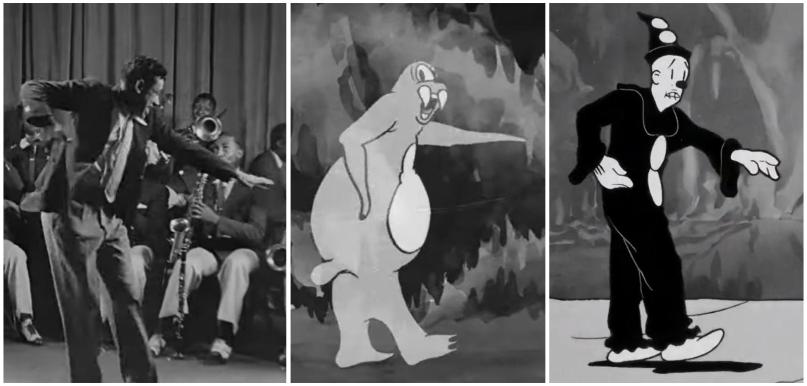
Betty Boop Meets Cab Calloway

Cab Calloway and Cartoon Representations

As I hinted in yesterday’s post, I am not done with posting about the cartoons of Max and Dave Fleischer. Among my favorites were the Betty Boop cartoons with music (and dancing) supplied by Cab Calloway and His Orchestra. In 1832 and 1933, Calloway worked with the Fleischers and three or four Betty Boop cartoons.

These included:

Minnie the Moocher (1932)

Snow-White (1933)

The Old Man of the Mountains (1933)

The reason I say there were three or four cartoons partnering Cab Calloway with Betty Boop was that there is a separately titled segment of Snow-White entitled St James Infirmary Blues.

None of these films could be regarded as suitable for children. (That also goes for Poor Cinderella, about which I posted yesterday, and in which Betty is in the street wearing nothing but bra and panties). In both Snow-White and St James Infirmary Blues, we see Betty in a glass coffin whose pallbearers are the seven dwarves, followed by the evil queen and Ko-Ko and Bimbo.

Even worse is The Old Man of the Mountain, whose villain is a bearded dirty old ogre who chases Betty Boop down the mountain with lascivious intent, at one point ripping off her dress.

On the Public Broadcasting System (PBS) website, there is an interesting article entitled “When Cab Calloway Was Betty Boop’s Co-Star.”

Poor Cinderella

Today we can see all the Walt Disney cartoons (except maybe Song of the South) most any time we want. The same goes for the Warner Brothers classics with Bugs Bunny, Daffy, Porky Pig, Tweety and Sylvester, and Wile E, Coyote. Even Walter Lantz (Woody Woodpecker) and Hanna-Barbera are all around us.

But the cartoons I most love to see were produced by the Fleischer brothers, Max and Dave. They were best known for their Popeye cartoons , but their work included an animated Superman, Betty Boop, Ko-Ko the Clown, and a whole host of other creations. Unlike Disney cartoons, those by the Fleischers included mostly human characters.

One of my favorites is a Betty Boop cartoon called Poor Cinderella (1934)—her only appearance in color. The cartoon was based on a hypnotic song of the same name that recurs through the cartoon. At one point, an animated Rudy Vallee is shown singing it.

Here, for your enjoyment, is the cartoon itself:

In the coming weeks, I will provide links to other Fleischer Brothers products. I have always loved them and delight in sharing them with you.

Perfection?

Poster for Jacques Tati’s Mon Oncle (1958)

It is in many ways the perfect comedy. And it was directed by the grandson of a Czarist Russian general (Dimitri Tatischeff) who married a French circus performer. I have seen Mon Oncle (“My Uncle”) at least twenty times and own a DVD of it and all of Jacques Tati’s other films.

Like Charlie Chaplin, Tati made comedies in which he both directed and starred. During his whole career, he only completed six full-length films over a period of thirty-five years. But in that number are some real gems:

  • Jour de Fête (1947)
  • Monsieur Hulot’s Holiday (Les vacances de M. Hulot, 1953)
  • Mon Oncle (1958)
  • Playtime (1967)
  • Traffic (1971)
  • Parade (1973) – made for Swedish television

M. Hulot Views His Sister’s Modern House

Here’s Looking at You Kid

“Round Up the Usual Suspects”

It was appropriate on this Valentine’s Day to see Warner Brothers 1942 classic Casablanca for the umpteenth time. As TV host Ben Mankiewicz said when he introduced the film for tonight’s Turner Classic Movies (TCM) showing, it was the most perfect film produced by the Hollywood studio system.

As a love story, one is not sure until the end whether Rick (Humphrey Bogart) will give the letters of transit for Lisbon to Victor Laszlo (Paul Henreid) and his wife Ilsa Lund (Ingrid Bergman). And will Captain Renaud (Claude Rains) arrest Rick and turn him over to Major Strasser of the Third Reich (Conrad Veidt)?

I have seen Casablanca so many times in my life that it is almost like Holy Writ. Even when Ilsa Lund pleads, “Victor, please don’t go to the underground meeting tonight,” I forgive the clunky line because it is an integral part of a film that I love as is. I even like all the recurrences of “Here’s looking at you kid.”

Sometimes I think one of the things that makes the film great are all the actors from Mitteleuropa that were in the cast, including Peter Lorre, Conrad Veidt, Leonid Kinsky, S. Z. Sakall, Ludwig Stössel, Hans Heinrich von Twardowsky, Trude Berliner, Ilka Grünig, and Wolfgang Zilzer. And don’t forget Hungarian director Michael Curtiz and Austrian music director Max Steiner. It gives the whole “stuck refugee” theme a major boost, with the daily plane to Lisbon and freedom as its ultimate desideratum.