The 5,000 Fingers of Doctor T

Still from The 5,000 Fingers of Doctor T (1953)

I suppose I could continue to write about the disasters wildfires that savaged Southern California last week, but I decided to take a break from that.

Last night, Martine and I watched The 5,000 Fingers of Doctor T (Columbia) on television last night. I have seen it several times before and regard it as one of the most entertaining movies ever made., mainly because of the creative genius of Doctor Seuss, who designed the production.

The film is about a little boy played by Tommy Rettig who dreams that his piano teacher (played brilliantly by Hans Conreid) has designs on his mother. He is assisted by a friendly plumber to foil Doctor Terwilliger’s megalomaniacal plans of having 500 little boys simultaneously play his compositions on a giant piano.

Particularly good are the scenes in Dr. T’s dungeons, where players of non-standard (i.e., non-piano) instruments are imprisoned and kept in check by hire goons.

A Dying Art?

When I first came to Southern California in 1966, it was with the intention of becoming a college professor specializing in motion picture history and criticism. Now I have to admit that, in the last year, I visited a movie theater to see a current feature only once, and that was a Marvel film that I hated, namely Deadpool and Wolverine.

And yet, over the last seven years, I have seen some 960 films, mostly on television or streamed. I still love the medium, but now I recognize that it is in the act of becoming a dying art form. I don’t think it will disappear altogether. After all, one can still attend operas. There are still examples of hand-carved woodworking, lace-making, hand-written letters, and marquetry. But, as the years pass, so will many art forms.

As much as I love movies, there are fewer American movies I want to see. Part of the problem is that I am on the elderly side, and movies that appeal to the most desired demographic—young males—are, to me, “greasy kid stuff.” Superheroes that wear their colorful Underoos outdoors in public and engage in loads of computer-graphics-enhanced action. Yuck!

Who is to blame? I guess that when an art form is based on a certain technology, it is subject to the prevalence of that technology over time. But old technologies are constantly being replaced. Just in the film world, look at the various delivery systems: nitrate film, safety film, videotape (Betamax and VHS), DVD, and streaming. What’s next? Notched molecules?

I know that many of you reading this are thinking that, no, film is still a viable art form. There are numerous people intent on conserving the medium. Still, I believe it is on the road to nowhere.

All you have to do is look at what was produced in the 1950s, then in the 1960s, then in the 1970s, 1980s, 1990s, 2000s, 2010s, and now. Both statistically and artistically, the movies are dying a slow death.

Nine Christmas Movies

Ralphie (with Glasses) and the Kids from A Christmas Story

Following is a list of the nine Christmas movies I am committed to seeing again and again during the Yule season. It is highly individual and does not contain many of the usual “heartwarming” titles that clog so many lists like atherosclerosis.

They are listed in order of preference:

A Christmas Story (1983)

It is as if this film were deliberately made with me in mind. The opening scenes shot on Cleveland’s Public Square, featuring the toy display at Higbee’s Department Store, were part of my past. And Ralphie’s school resembles Harvey Rice Elementary School, where I spent kindergarten and part of first grade trying to come to terms with the English language.

A Christmas Carol (1951)

This is by far my favorite version, starring Alastair Sim as Ebenezer Scrooge. I never tire of the story, and this is the most complete telling of Dickens’s tale.

Lady in the Lake (1947)

Robert Montgomery as detective Phillip Marlowe attempting to track down the missing wife of a magazine publisher during Christmas. The love story between Marlowe and Publishing Exec Adrienne Fromsett (played by Audrey Totter) is actually believable.

The remaining titles are in random order and are, to my mind, not quite so good as the top three above:

It’s a Wonderful Life (1946) with Jimmy Stewart
The Shop Around the Corner (1940) also with Jimmy Stewart
The Nightmare Before Christmas (1993) – Stop motion animation from Tim Burton
The March of the Wooden Soldiers (1934) with Laurel & Hardy, a childhood favorite
The Curse of the Cat People (1944) by Val Lewton with Simone Simon singing a lovely French carol
The Bishop’s Wife (1947) with Cary Grant

I’m sure that most people’s reaction to this list is, “What about X, Y, and Z?” They might be on your list, but didn’t make it to mine.

Stooges Three

Curly, Moe, and Larry in “Three Little Beers” (1935)

For the last quarter of a century, my favorite part of the four-day Thanksgiving weekend was the Three Stooges festival put on by the Alex Film Society in Glendale. It was Martine who found out about it and got me into going with her on the Saturday afternoon after Turkey Day. In the intervening years, we have attended most of the screenings, except for those few times I was off to Mexico or South America at the time.

Of course, part of Martine’s interest in the festival are two of her favorite chicken restaurants in Glendale: Sevan Rotisserie Chicken and Elena’s Greek Armenian Kitchen. I am not a great lover of chicken, but I do love to see Martine happy.

When I was growing up, I started liking the Stooges; and I distinctively remember owning a 3-D Stooges comic book. But then, as my little brother Dan (who is six years younger than me) started liking the stooges, I decided they were too downmarket for me and disparaged them at every opportunity.

Now I appreciate the comics and marvel at their long career and the fact that they survived several deaths in the troupe. When Curly became ill in 1946, Moe and Curly’s brother Shemp took over without any diminution in the quality of the films. After Shemp died in 1955, he was followed by Joe Besser and Joe DeRita, who were not quite up to the mark.

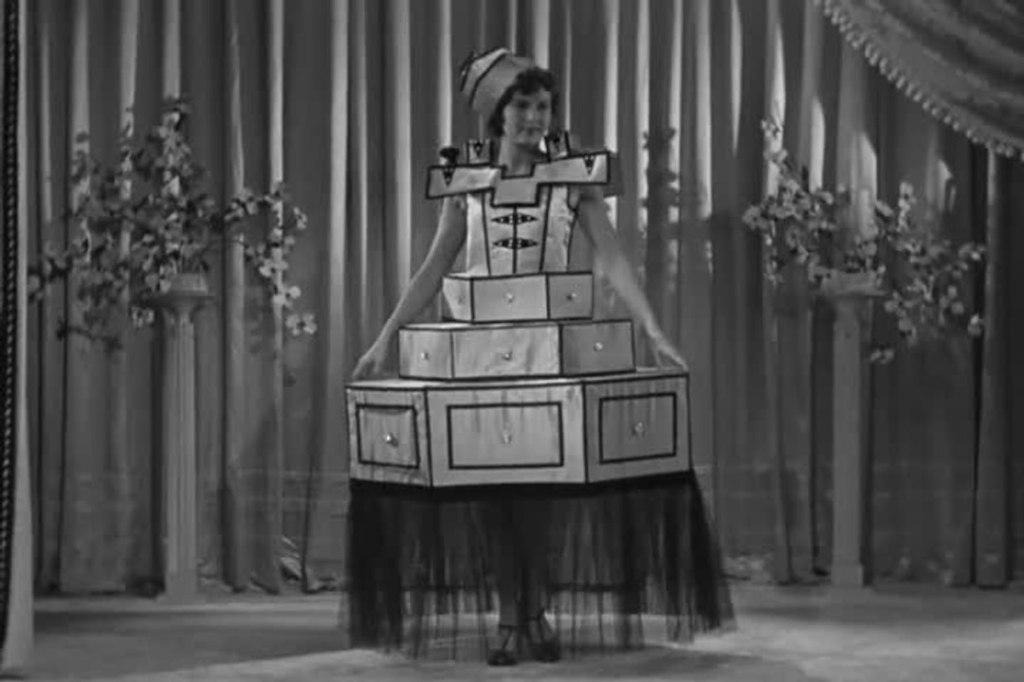
The best of the six Stooges shorts I saw yesterday was “Slippery Silks” (1936) in which the boys inherit a fancy women’s clothing boutique and put on the most cockeyed fashion show imaginable.

Fashion Model in “Slippery Silks”

The still above is explained by the fact that, before inheriting the dress shop, the stooges were carpenters who accidentally destroyed a priceless Chinese antique wooden box. I guess they still had their carpentry background in mind.

In any case, I laughed uproariously throughout the two hour screening.

Smouldering in the Dunes

Zendaya as Chani in Dune 2

To begin with, I am a big fan of Frank Herbert’s novel Dune and the three feature films based on it: David Lynch’s Dune (1984) and Denis Villeneuve’s Dune: Part One (2021) and Dune: Part Two (2024).

Recently HBO has been screening Dune: Part Two almost daily, so I have seen the film a number of times. Although Timothée Chalamet is the acknowledged star of the film, I have been increasingly drawn to Zendaya’s portrayal of Chani Kynes, the Fremen Sayyadina and concubine of Paul Muad’Dib Atreides. In fact, I think the film revolves more around her reaction to Muad’Dib and his assumption of the role of Kwisatz Haderach than to Muad’Dib’s military exploits.

Chani clearly loves Paul, but she doesn’t buy into the myth that is being built up around him. And when Paul decides to take Princess Irulan, daughter of Emperor Shaddam IV, as his bride. She wanders off alone into the desert while her love moves on to an imperial role.

During all of Dune: Part Two, she is seen as smouldering with blazing eyes during all the stages of Paul’s transformations. Chalamet does a good job acting the role of Paul, but Zendaya is almost crazy good, like one of the great silent actresses with her full range of expressions.

This is in marked contrast to Sean Young’s portrayal of Chani in the 1984 Dune, which was one of the major weaknesses of the David Lynch version as released.

Light, Dark and Noir

Still from Joseph H. Lewis’s The Big Combo (1955)

One of the great visual artists of the American film was John Alton (1901-1996), a cinematographer famous for the visual style of some of the best noir films. Born Johann Jacob Altmann in Sopron, Hungary, Alton was instrumental in creating a look across the films of different directors at different studios that became a quintessential characteristic of an entire American genre.

As he wrote in his book Painting with Light:

The director of photography visualizes the picture purely from a photographic point of view, as determined by lights and the moods of individual sequences and scenes. In other words, how to use angles, set-ups, lights, and camera as means to tell the story.

John Payne in Robert Florey’s The Crooked Way (1949)

In an otherwise unremarkable film I saw last night on Turner Classic Movies (TCM), Alton’s work lifted the film up to an entirely different level. United Artists’ The Crooked Way was a tale of a war hero amnesiac who, on investigating his pre-war life, finds he was a criminal. Alton’s images of Los Angeles, including a bail bond shop, a night club, and a war surplus warehouse made the film a feast for the eyes.

Still from Anthony Mann’s T-Men (1947)

Even in a movie shot for a poverty row studio like Eagle-Lion Pictures, Alton was superb. Of course, it helped that the director was Anthony Mann, whose noir credentials are impeccable.

To see a list of the noir films Alton photographed, check out this website and scroll halfway down for a list of eighteen of his noir masterpieces.

And just to demonstrate his versatility, Alton was also superb in working with color, such as in Allan Dwan’s Slightly Scarlet (1958) and Stanley Donen’s musicasl with Gene Kelly, An American in Paris (1951)

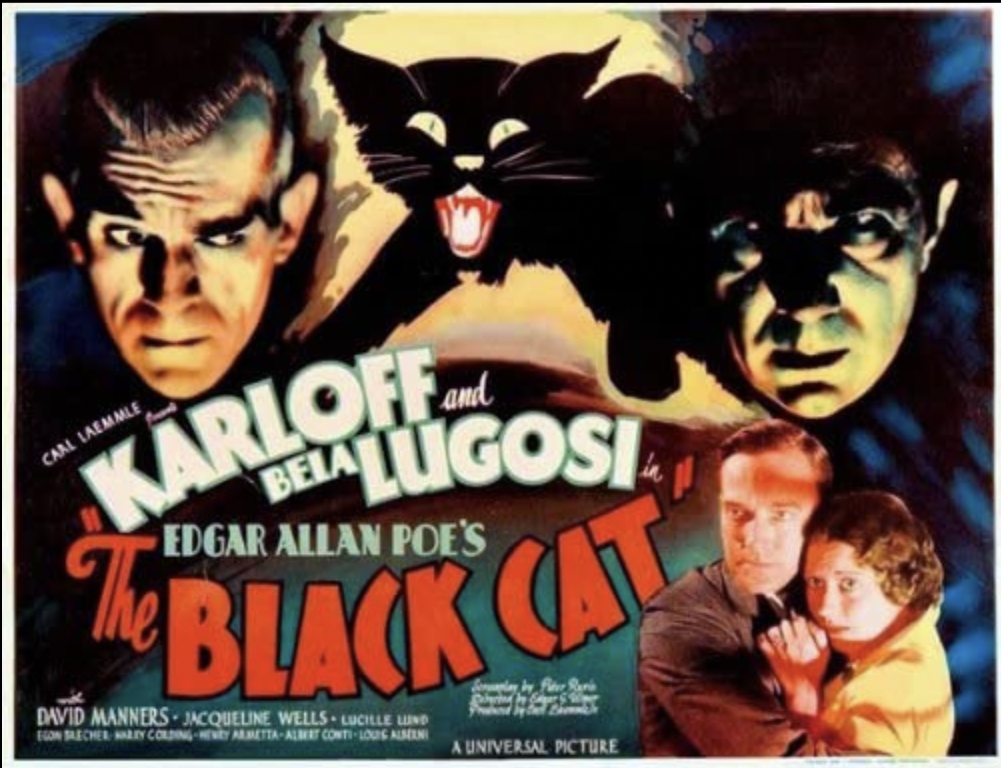
Favorite Films: The Black Cat (1934)

The Best Film Co-Starring Karloff and Lugosi

Everyone thinks they know the classical Universal horror titles of the 1930s, but for some reason they don’t usually include The Black Cat (1934), directed by Edgar G. Ulmer. I think it is not only the best of the Universal horror genre, but one of the greatest American films of the 1930s.

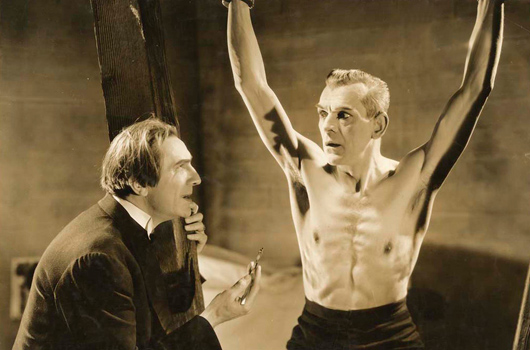
Although Edgar Allan Poe is credited with the story, the only thing of Poe’s that carries into the Ulmer film is Bela Lugosi’s fear of black cats. It’s a 99.9% original story about a young American couple who accidentally horn in on Witus Werdegast’s (Bela Lugosi’s) revenge on Hjalmar Poelzig (Boris Karloff) for:

  • Betraying the fortress of Marmorus to the Russians in World War One
  • Getting Werdegast to a Russian prison camp in Siberia for fifteen years
  • Making off with Werdegast’s wife Karen and daughter, also called Karen
  • Being a devil-worshiping SOB who is the quintessence of evil

The Revenge: Werdegast Proposes to Skin Pjoelzig

The film is set in Pjoelzig’s art deco mansion built on top of the ruins and cemetery of Marmorus, where the evil architect holds black mass soirées for devil worshipers, and where he plans to initiate the young American woman into his strange display of zombies in glass cases.

Check out this film clip from YouTube. Be sure to turn off the subtitles, as they are laughably wrong. The film is in English, anyway:

Edgar G. Ulmer was responsible for two great films. One was The Black Cat. The other was the film noir classic Detour, made in 1945 for the poverty row Producers Releasing Corporation. There are usually some interesting scenes in even his worst films, such as Club Havana, Babes in Bagdad, and Strange Illusion.

Greasy Kid Stuff?

Wolverine Battles Deadpool … Again

Today, with a heat wave beginning, I decided to spend the afternoon in an air-conditioned movie theater watching Deadpool & Wolverine. Martine wisely decided not to join me.

There is something about the whole Marvel Cinematic Universe that is ultimately ho hum, regardless how much action there is. Do I really care about any of the characters? Well, no. Superheroes who can survive what appear to be fatal wounds are ultimately anti-dramatic. There are multiple attempts in the film to make the characters seem interesting, but they inevitably refer to something that was chronicled in some comic book or an earlier film that I hadn’t seen.

Such a pity these characters—apparently immortal—are so uninteresting. To me, anyhow. I heard members of the audience audibly checking boxes when some off-screen event was referred to. But to me, it was ultimately greasy kid stuff.

What sticks out in the Marvel Cinematic Universe is a world of unmotivated action lacking any emotion but unexplained rage in which the characters are just action figures.

Cucoloris

Emil Jannings (Left) and Marlene Dietrich (Center) in The Blue Angel

A cucoloris is defined by Wikipedia as “light modifier (tool, device) for casting shadows or silhouettes to produce patterned illumination…. The cucoloris is used to create a more natural look by breaking up the light from a man-made source. It can be used to simulate movement by passing shadows or light coming through a leafy canopy.”

The films of Josef Von Sternberg with Marlene Dietrich made extensive use of cucolorises. In scenes which other directors would open up, such as a troop of French Foreign Legionnaires marching through town in Morocco (1930) or a Chinese steam locomotive going down the middle of a crowded street in Shanghai Express (1932), Von Sternberg conveys a sense instead of claustrophobia and encroaching shadows.

Included in the series were:

  • The Blue Angel (1930), shot in Germany
  • Morocco (1930)
  • Dishonored (1932)
  • Shanghai Express (1932)
  • Blonde Venus (1932)
  • The Scarlet Empress (1934)
  • The Devil Is a Woman (1936)

Even in the later films, the same lighting technique can be found in The Shanghai Gesture (1941) and Macao (1952).

Cucoloris

It is almost as if all the films were set in Lola Lola’s dressing room in The Blue Angel. In many ways, he is the diametric opposite of John Ford, whose film scenes frequently extended to the far horizon.

The seven Sternberg/Dietrich films listed above are among my favorite films of all time. I have seen all of them multiple times and will continue to do so. When I was a student in UCLA’s Graduate School, I visited Von Sternberg at his house in Westwood (his wife taught in the art department) and knew his son Nicholas.

I own a copy of his rare autobiography, Fun in a Chinese Laundry, and read his hard-to-find 1920s novel Daughters of Vienna.

Favorite Films: Pierrot le Fou (1965)

Jean-Paul Belmondo and Anna Karina in Pierrot le Fou

In the late 1960s, as I was studying graduate film history and criticism at UCLA, I was completely enamored with the films of Jean-Luc Godard. I remember telling my late friend Norm Witty that I was glad that my favorite film director was so young and that he would be making great films for decades to come.

As it turns out, I was only half right. He did continue to make films, but something was gone once he divorced Anna Karina. That happened in 1965, shortly after he made Pierrot le Fou with his wife and Jean-Paul Belmondo.

After Pierrot, Godard came out with two or three films sans Karina, and then descended into a darker period with La Chinoise and Weekend (both 1967). After that, although he was still prolific, I have seen only two of his films. It was as if something was gone forever from his work.

What was gone was that almond-eyed beauty Anna Karina. Godard was clearly in love with her, as I would have been if I were him. Pierrot is a film about the deterioration of their relationship: Belmondo as Ferdinand is a bookworm spouting profundities at every turn, while Karina’s Marianne Renoir is instinctive, emotional, and mysterious.

I love the film because I am a bookworm, and I know full well how that puts me at a disadvantage in relationships. Another director—Orson Welles in Mr. Arkadin (1955)—has the last word about how I feel in the matter:

The Tale of the Scorpion and the Frog in Mr. Arkadin