Favorite Films: The Black Cat (1934)

The Best Film Co-Starring Karloff and Lugosi

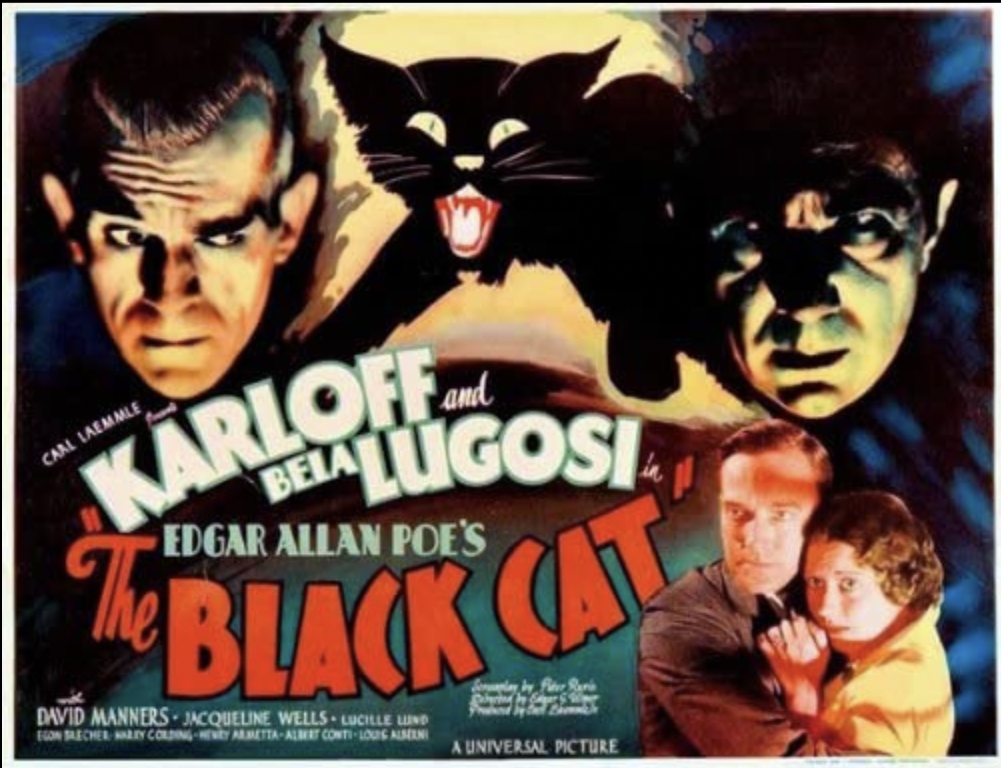
Everyone thinks they know the classical Universal horror titles of the 1930s, but for some reason they don’t usually include The Black Cat (1934), directed by Edgar G. Ulmer. I think it is not only the best of the Universal horror genre, but one of the greatest American films of the 1930s.

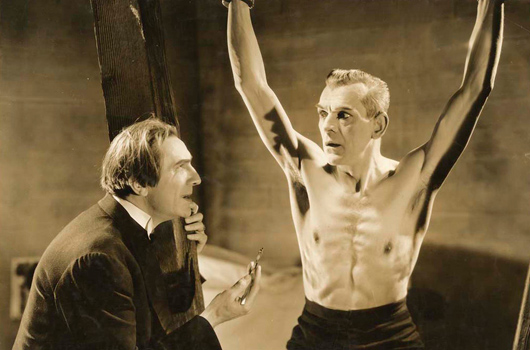
Although Edgar Allan Poe is credited with the story, the only thing of Poe’s that carries into the Ulmer film is Bela Lugosi’s fear of black cats. It’s a 99.9% original story about a young American couple who accidentally horn in on Witus Werdegast’s (Bela Lugosi’s) revenge on Hjalmar Poelzig (Boris Karloff) for:

  • Betraying the fortress of Marmorus to the Russians in World War One
  • Getting Werdegast to a Russian prison camp in Siberia for fifteen years
  • Making off with Werdegast’s wife Karen and daughter, also called Karen
  • Being a devil-worshiping SOB who is the quintessence of evil

The Revenge: Werdegast Proposes to Skin Pjoelzig

The film is set in Pjoelzig’s art deco mansion built on top of the ruins and cemetery of Marmorus, where the evil architect holds black mass soirées for devil worshipers, and where he plans to initiate the young American woman into his strange display of zombies in glass cases.

Check out this film clip from YouTube. Be sure to turn off the subtitles, as they are laughably wrong. The film is in English, anyway:

Edgar G. Ulmer was responsible for two great films. One was The Black Cat. The other was the film noir classic Detour, made in 1945 for the poverty row Producers Releasing Corporation. There are usually some interesting scenes in even his worst films, such as Club Havana, Babes in Bagdad, and Strange Illusion.

Greasy Kid Stuff?

Wolverine Battles Deadpool … Again

Today, with a heat wave beginning, I decided to spend the afternoon in an air-conditioned movie theater watching Deadpool & Wolverine. Martine wisely decided not to join me.

There is something about the whole Marvel Cinematic Universe that is ultimately ho hum, regardless how much action there is. Do I really care about any of the characters? Well, no. Superheroes who can survive what appear to be fatal wounds are ultimately anti-dramatic. There are multiple attempts in the film to make the characters seem interesting, but they inevitably refer to something that was chronicled in some comic book or an earlier film that I hadn’t seen.

Such a pity these characters—apparently immortal—are so uninteresting. To me, anyhow. I heard members of the audience audibly checking boxes when some off-screen event was referred to. But to me, it was ultimately greasy kid stuff.

What sticks out in the Marvel Cinematic Universe is a world of unmotivated action lacking any emotion but unexplained rage in which the characters are just action figures.

Cucoloris

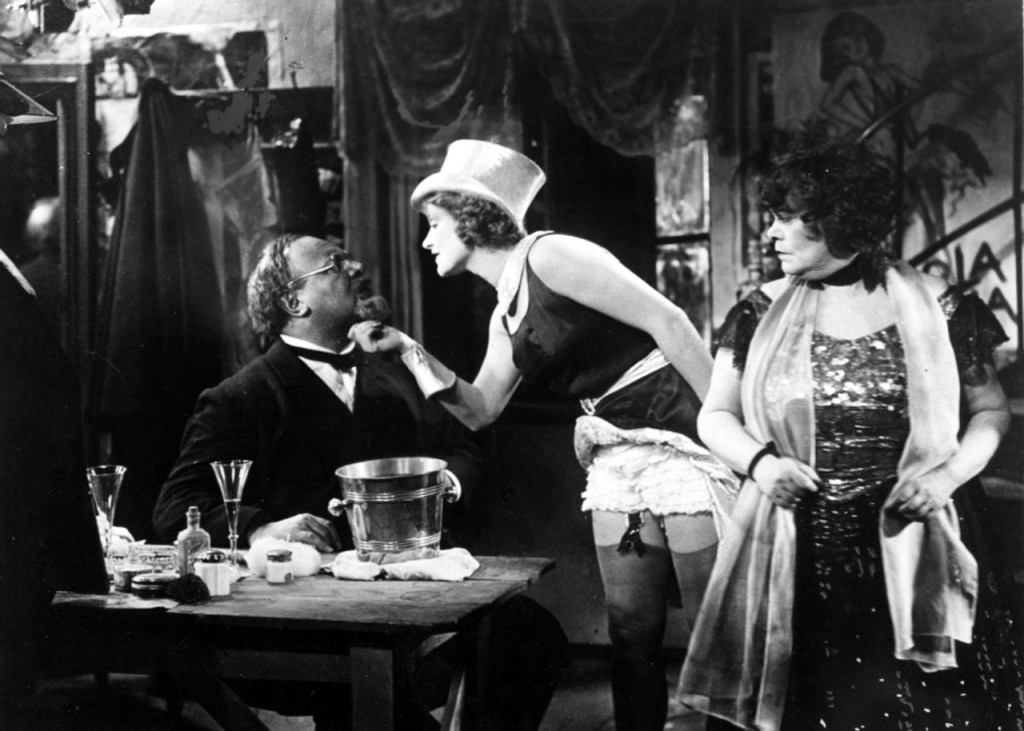
Emil Jannings (Left) and Marlene Dietrich (Center) in The Blue Angel

A cucoloris is defined by Wikipedia as “light modifier (tool, device) for casting shadows or silhouettes to produce patterned illumination…. The cucoloris is used to create a more natural look by breaking up the light from a man-made source. It can be used to simulate movement by passing shadows or light coming through a leafy canopy.”

The films of Josef Von Sternberg with Marlene Dietrich made extensive use of cucolorises. In scenes which other directors would open up, such as a troop of French Foreign Legionnaires marching through town in Morocco (1930) or a Chinese steam locomotive going down the middle of a crowded street in Shanghai Express (1932), Von Sternberg conveys a sense instead of claustrophobia and encroaching shadows.

Included in the series were:

  • The Blue Angel (1930), shot in Germany
  • Morocco (1930)
  • Dishonored (1932)
  • Shanghai Express (1932)
  • Blonde Venus (1932)
  • The Scarlet Empress (1934)
  • The Devil Is a Woman (1936)

Even in the later films, the same lighting technique can be found in The Shanghai Gesture (1941) and Macao (1952).

Cucoloris

It is almost as if all the films were set in Lola Lola’s dressing room in The Blue Angel. In many ways, he is the diametric opposite of John Ford, whose film scenes frequently extended to the far horizon.

The seven Sternberg/Dietrich films listed above are among my favorite films of all time. I have seen all of them multiple times and will continue to do so. When I was a student in UCLA’s Graduate School, I visited Von Sternberg at his house in Westwood (his wife taught in the art department) and knew his son Nicholas.

I own a copy of his rare autobiography, Fun in a Chinese Laundry, and read his hard-to-find 1920s novel Daughters of Vienna.

Favorite Films: Pierrot le Fou (1965)

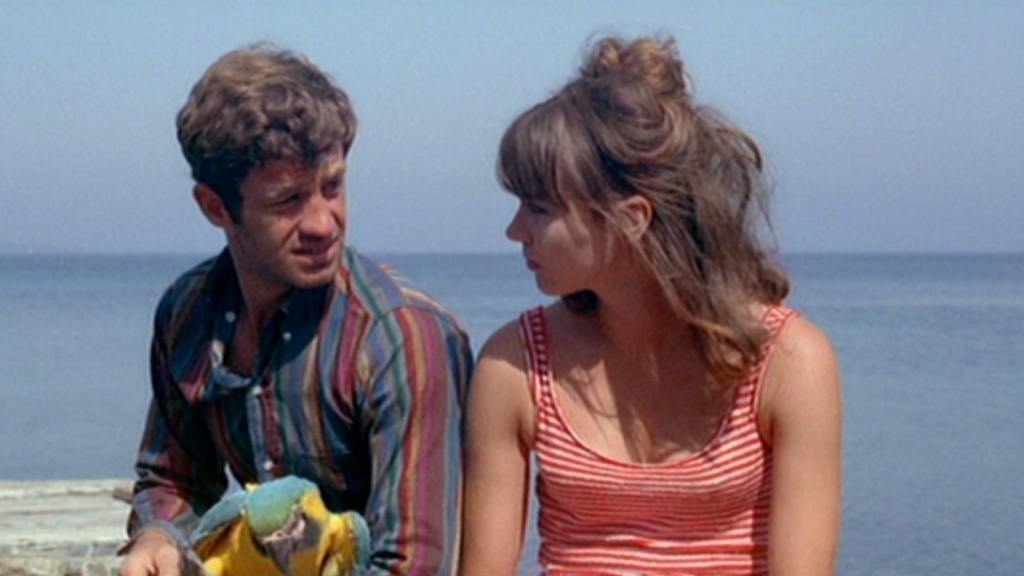
Jean-Paul Belmondo and Anna Karina in Pierrot le Fou

In the late 1960s, as I was studying graduate film history and criticism at UCLA, I was completely enamored with the films of Jean-Luc Godard. I remember telling my late friend Norm Witty that I was glad that my favorite film director was so young and that he would be making great films for decades to come.

As it turns out, I was only half right. He did continue to make films, but something was gone once he divorced Anna Karina. That happened in 1965, shortly after he made Pierrot le Fou with his wife and Jean-Paul Belmondo.

After Pierrot, Godard came out with two or three films sans Karina, and then descended into a darker period with La Chinoise and Weekend (both 1967). After that, although he was still prolific, I have seen only two of his films. It was as if something was gone forever from his work.

What was gone was that almond-eyed beauty Anna Karina. Godard was clearly in love with her, as I would have been if I were him. Pierrot is a film about the deterioration of their relationship: Belmondo as Ferdinand is a bookworm spouting profundities at every turn, while Karina’s Marianne Renoir is instinctive, emotional, and mysterious.

I love the film because I am a bookworm, and I know full well how that puts me at a disadvantage in relationships. Another director—Orson Welles in Mr. Arkadin (1955)—has the last word about how I feel in the matter:

The Tale of the Scorpion and the Frog in Mr. Arkadin

Poe-Pourri

Scene from Roger Corman’s Masque of the Red Death (1964)

One of the most entertaining film series of the 1960s consists of the eight Edgar Allan Poe titles directed by Roger Corman and, for the most part, starring Vincent Price. In order by year, these consist of:

  • The House of Usher (1960)
  • The Pit and the Pendulum (1961)
  • The Premature Burial (1962) starring Ray Milland
  • Tales of Terror (1962)
  • The Raven (1963)
  • The Haunted Palace (1963) actually based on H. P. Lovecraft
  • The Masque of the Red Death (1964)
  • The Tomb of Ligeia (1964)

All the films are very loosely based on Poe originals (except for The Haunted Pa;lace, which is very Poe-like). Last Wednesday, I sat through The Pit and the Pendulum, The Raven, and Masque of the Red Death on Turner Classic Movies’ tribute to Roger Corman, who died earlier this year.

Although some regard him as the ultimate schlockmeister, Corman knew how to make an entertaining film that came in on time and under budget. So what if they were not quite faithful to Poe’s (or Lovecraft’s) originals: They were fun to watch, even if we felt superior to them.

I remember some other likeable Corman classics like Attack of the Crab Monsters (1957), in which the eponymous monsters looked like a crumpled old knapsack, and Creature from the Haunted Sea (1961), in which the creature looked like an overgrown stuffed animal. The first named film is one of Martine’s all-time faves, such that she obtained a signed still from Beverly Garland, the star.

And yet at least two of the titles—The Raven and Masque of the Red Death—are, to my mind, two of the best American films produced in the 1960s.

Comprachicos

Conrad Veidt in Paul Leni’s Film The Man Who Laughs (1928)

It all started in the elevator to the Trader Joe parking lot. Two odd women first commented that I looked like the actor Wilford Brimley, and then asked me why I didn’t smile. That set me off: I don’t particularly like to go around with a smile on my face, and I don’t think much of people who do. Were these frustrated dental assistants to go around accosting strangers for not airing their teeth?

Then I thought of one reason I didn’t like being all smiley. I remembered Victor Hugo’s novel The Man Who Laughs (1869), which was turned into a 1928 silent film by Paul Leni starring Conrad Veidt, better known as Major Strasser “of the Third Reich” in the film Casablanca (1942).

Well, anyway, the novel and film were about people called comprachicos who, as children, were mutilated to look pathetic so that their handlers can could use them for begging:

The Comprachicos, or Comprapequefios, were a hideous and nondescript association of wanderers, famous in the 17th century, forgotten in the 18th, unheard of in the 19th. They traded in children, buying and selling them, but not stealing them. They made of these children monsters. The populace must needs laugh, and kings too. The montebank is wanted in the street, the jester at the Louvre; the one is called a clown, the other a fool. By the artificial production of teratological cases the Comprachicos developed a science and practiced an art. They kneaded the features, stunted growth, and fashioned hunchbacks and dwarfs; the court fool was their specialty.

The Conrad Veidt character in the film was a child who was kidnapped and had a permanent smile carved on his face, which made him look pathetic. And that’s what comes to mind when people tell me to smile. I just don’t care to oblige them.

Wilford Brimley (1934-2020)

By the way, I look almost exactly like Wilford Brimley, except that his mustache was a little bigger than mine. Of course, I would prefer that strangers think I am a dead ringer for Brad Pitt, Robert Redford, Warren Beatty, or some other dolicocephalic heartthrob. But then, so it goes.

From Ghoulardi to Rollergirl

Heather Graham as Rollergirl in Boogie Nights

She’s an attractive young star in the stable of go-to actresses around Burt Reynold’s porn studio in the 1970s and 1980s. Called Rollergirl because she never takes off her inline skates, even during sex, she helps to recruit Mark Wahlberg by seducing him in the nightclub where he works as a bus boy. She is an intriguing presence in Paul Thomas Anderson’s film Boogie Nights (1997).

Decades before the film was made, the director’s father, Ernie Anderson, was a big star on WJW-TV, Channel 8 in Cleveland. He played a character named Ghoulardi who hosted horror films between 1963 and 1966. In between scenes of the films he showed, he made fun of Cleveland¹s Polish population with their polkas and white socks and flamingo lawn ornaments, and particularly when they lived in the southwestern suburb of “PAHR-ma?” His catch phrases were “turn blue” and “stay sick.”

If you were a teenager in Cleveland during the 1860s, you watched Ghoulardi and adopted his mannerisms the next Monday in the school cafeteria.

One final note: If you watched reruns of the Carol Burnett Show, you may recall that in the opening scene, when Carol comes out on stage to answer questions from the audience, she occasionally gave a call-our to Ernie Anderson, who was a frequent member of the studio audience. Ernie typically smiled and gave a little wave to acknowledge. That was Ghoulardi, who had come to Los Angeles and served a number of years as announcer for the show after Lyle Waggoner had left.

It’s a long way from horror films in Cleveland in the 1960s to his son’s explicit study of the emerging L.A. porn scene filmed in 1997.

Hats Off to Eddie Muller!

Turner Classic Movies (TCM) Host Eddie Muller

Most every Saturday around 9 PM Pacific Time, I turn on the television to watch the “Noir Alley” show on TCM hosted by the amiable Eddie Muller. He is one of the reigning experts on film noir, which he defined in an interview hosted by the World Literature Today website as:

A noir story is about people who know what they’re doing is wrong, and they do it anyway. And, typically, there’s hell to pay. We love watching them break the law; we love watching them reap the consequences.

Although in the interview, he is talking about literature, one can easily see how that translate into film. Just think of such Hollywood films as John Huston¹s The Maltese Falcon (1941); Billy Wilder’s Double Indemnity (1944); Howard Hawks’s The Big Sleep (1946); Jacques Tourneur’s Out of the Past (1947); and Robert Aldrich’s Kiss Me Deadly (1955). The genre reached its apogee during the 1940s and 1950s.

Yesterday, Eddie outdid himself. He introduced two great noir films produced in Argentina. However tired I was, I stayed up late to watch two masterpieces by Carlos Hugo Christensen (1914-1999): Never Open That Door (No abras nunca esa puerta) and If I Should Die Before I Wake (Si muero antes de despertar). Both films were produced in 1952.

I particularly liked If I Should Die Before I Wake, a film about a child killer which even today might run into censorship problems. A son of a Buenos Aires detective finds himself identifying and running to ground a child molester who had kidnapped a female classmate whom he had befriended. It’s even more exciting than Fritz Lang’s classic M (1931) with Peter Lorre on the same subject.

By the way, if you want to read a really good book about film noir, I highly recommend Eddie Muller’s Dark City: The Lost World of Film Noir (New York: Running Press, 2021).

What I’m about to say may be counted as heresy, but I think these films out-Hitchcock Hitchcock. Apparently, there is more than one master of suspense, and I am grateful to Eddie Muller for screening these two subtitled films.

Goodnight Sweet Prince

Martine’s Favorite Roger Corman Movie

This is a reprint of a blog posting from May 17, 2016. Martine and I were dismayed to hear of the passing of Roger Corman, who died in Santa Monica at the age of 98 on May 9 of this year. It never ceased to amaze me that one could produce and direct so many interesting films while working in what the film industry has called “poverty row.”

The first time I ever heard of him was when I was a student at Dartmouth. At that time (the mid 1960s) I subscribed to Films and Filming. One issue contained an article entitled “The Crown Prince of Z Films,” referring, of course, to Roger Corman. I was intrigued by what I was hearing of the cheapster director who made so many interesting films for American International Pictures. What I liked most were the Edgar Allan Poe adaptations, usually starring Vincent Price.

Perhaps my favorite was The Masque of the Red Death (1964), about the attempt by a group of dissipated nobles to escape the plague. There were others in the series, including House of Usher (1960), The Pit and the Pendulum (1961), Premature Burial (1962), The Raven (1963), and The Tomb of Ligeia (1964).

When I first met Martine in the late 1980s, I discovered that she was a hard-core Corman addict, liking such films as Attack of the Crab Monsters (1957) and the original The Little Shop of Horrors (1960), which was shot in under a week on a shoestring budget. There are in all about a dozen films he directed that are worth seeing and hold up well over the years. (He also made not a few clinkers, but that’s showbiz!) After he stopped directing around 1970 he continued to produce films and was responsible for some 300+ films over his half century career.

Roger Corman (1926-2024)

Other than the Poe features, I also enjoyed I, Mobster (1958), A Bucket of Blood (1959), The Intruder (1962) starring William Shatner, Tales of Terror (1962), X: The Man with the X-Ray Eyes (1963) starring Ray Milland, The Wild Angels (1966), The Trip (1967), and Bloody Mama (1970).

Corman introduced us to Jack Nicholson, Peter Fonda, Dennis Hopper, and Bruce Dern, to name just a few. In his films were such stars as Boris Karloff and Peter Lorre.

Perhaps I had a misspent youth, but I sure enjoyed it—and continue to do so….

You Freud, Me Jane?

Sean Connery and Tippi Hedren in Hitchcock’s Marnie (1964)

Sometimes it takes years, even decades, for a great film to be recognized. Such is the case with Alfred Hitchcock’s Marnie, which confused and rattled the critics of the period. According to the New York Times, “an inexplicably amateurish script.” The L.A. Times was no more accepting: “As a story it seems naggingly improbable and, as drama, a nightmare from which the spectator constantly pulls away, struggling to wake up in a less disordered universe. No question, though, that it is at least fitfully effective“

Fitfully effective? How about ahead of its time. Both the Sean Connery character (Mark Rutland) and the Tippi Hedren character (Marnie Edgar) are obsessed in different ways. Marnie is a thief who cannot bear to be touched by men. Mark, on the other hand, is obsessed with using the tools of popular psychology to “cure” Marnie. In a way, both characters are equally out of it.

What escaped the 1960s critics was that Marnie was a strikingly beautiful film, perhaps the most beautiful color film ever produced. From the moment we see Marnie from the rear wearing a black wig walking down a train station platform with a yellow bag full of money under her arms, we are hooked. At least, I was.

Even the obvious fakery that Hitchcock seems to throw at us seems to actually add to the story in this instance. When Mark drives Marnie to her mother’s Baltimore row house, we see an obviously painted backdrop of an ocean freighter at the end of the block. In the foreground, several little girls are skipping rope while singing:

Mother, Mother, I am ill
Call for the doctor over the hill.
In came the doctor,
In came the nurse,
In came the lady with the alligator purse.

In the end, Mark and Marnie drive off and take a left just before the painted backdrop, where moments ago it seemed there was no exit.