Spear and Magic Helmet

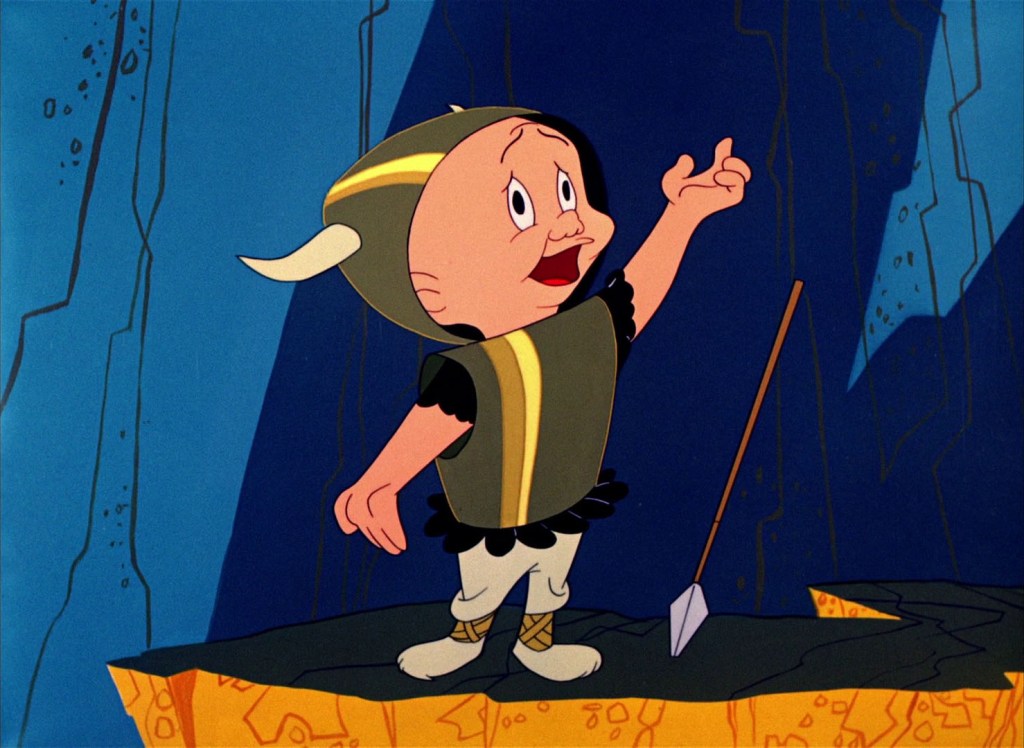
Elmer Fudd in Warner Brothers’ “What’s Opera Doc?”

It was, to my mind, the greatest short cartoon ever made. In 1957, Warner Brothers released a Wagner opera parody (of Die Walküre, no less) featuring Bugs Bunny and Elmer Fudd. You can see it, with commentary, by clicking on:

I have written before about my suspicion that the United States has (d)evolved from a Bugs Bunny nation to an Elmer Fudd nation. Always immaculately garbed in hunting clothes, or in the case of this film spear and magic helme, Fudd nonetheless doesn’t know what he wants. He says he wants to kill the wabbit. But he also, in his strange incel way, loves the wabbit. And Bugs knows it and takes advantage of him.

Of course, in this film Bugs dies. His last line as he is carried off by Elmer is something to the effect that operas always end sadly.

Elmer Carries Off the Body of His Doomed Love/Hate Object

When Elmer first encounters Bugs in the film, he is poking his spear into a rabbit hole shouting “Kill the Wabbit!” while Bugs, standing off to the side, munches on a carrot. Only after a few moments does Elmer realize that Bugs is taunting him. He erupts in rage and uses his magic helmet to conjure up a storm. Whereupon Bugs as Brunhilda rides down a hill from a Greek temple lounging on the back of a fat white horse.

Naturally, Elmer falls immediately in love with Bugs/Brunhilda and his golden braided wig. They dance a pas de deux until—horrors!—Bugs/Brunhilda’s wig falls to the ground. Enraged again, he uses his magic helmet to whip up a storm that kills the object of his hate/love. Remorse follows as Elmer exits carrying the limp Bugs.

The film was directed by Chuck Jones, one of my favorite animators.

Eh, What’s Up, Doc?

I Yearn for the America That Had Bugs Bunny as Its Hero

I love watching old cartoons from Warner Brothers and the Fleischer Brothers. They spoke of a wisecracking America that doesn’t exist any more. It was good to be represented by such originals as Bugs Bunny and Daffy Duck. Alas, now we are more represented by a fearful Elmer Fudd. Oh, he has guns galore, but he always loses in the end.

Bugs is like one of the trickster gods of many cultures around the world, including those of some North American Indian peoples. Take the Norse trickster god Loki, for example:

In Norse mythology, Loki is known as a trickster. He is described in the Prose Edda as a “contriver of fraud.” Although he doesn’t appear often in the Eddas, he is generally described as a member of the family of Odin. His job was mostly to make trouble for other gods, men, and the rest of the world. Loki was constantly meddling in the affairs of others, mostly for his own amusement.

Bugs Bunny and Elmer Fudd

I find my early cartoon heroes such as Bugs Bunny, Popeye, Betty Boop, and even Speedy Gonzales are representative of a country that is comfortable in its own skin. Unlike Elmer Fudd, who always takes the trouble to dress like a bold hunter, but who, in the end, is chicken-hearted.

And I’ll best anything that Elmer has a red MAGA hat in his closet!

Favorite Films: Orphée (1950)

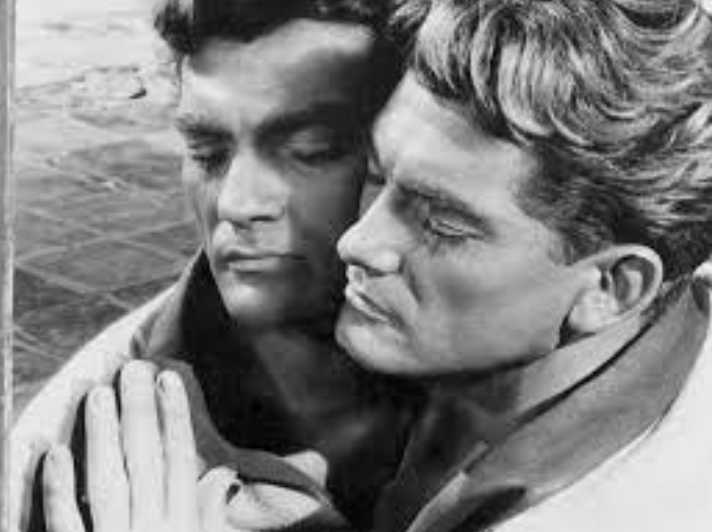
Jean Marais as Orpheus in Jean Cocteau’s Orphée

This is a film I have loved for upwards of sixty years, ever since I first saw it screened by the Dartmouth Film Society. It is the only film I have ever seen that makes a stab at showing us what happens after death—without looking totally silly.

The story is based on the Greek myth of Orpheus the poet and his wife Eurydice, variously mentioned by such authors as Plato, Plutarch, Apollonius of Rhodes, and others. Eurydice dies, and Orpheus, while still alive, goes to the Underworld to get her back. The gods agree, but with the condition that he must never look upon her face again. If he did, her spirit would be instantly wafted back to the Underworld.

Jean Cocteau places the tale in postwar France and adds some interesting touches. Death is personified as “The Princess.” Played by the lovely and elegant Maria Casares, who falls madly in love with Orpheus. Among hr assistants are François Périer as Heurtebise and Édouard Dermit as Cégeste. One enters the underworld by walking through a mirror wearing special rubber gloves, which convert the mirrors to a waterlike substance. The ruins of Saint Cyr Military Academy serve as the Underworld, where Orpheus and Heurtebise go to negotiate with a tribunal in a grimy meeting room.

The Last Shot: The Princess and Heurtebise Go to Meet Their Fate

I have seen Orfée at least a dozen times, and each time was as magical and striking as the first viewing. Along with the same director’s La Belle et la Bête (1946), it is one of the glories of the French cinema, indeed of world cinema.

The Babes of Star Trek

Diana Ewing as Droxine in “The Cloud Minders” Episode of Star Trek

Every once in a while I kick off my shoes and re-watch one of the original episodes of Star Trek. I am always amazed at how many really beautiful women show up in the series. I can only speculate that Gene Roddenberry must have been an incredible lech, but with good taste. I have already written about Marta the green Orion from the “Whom Gods Destroy” episode, played by Yvonne Craig.

Diana Ewing played the lean and strikingly beautiful blonde Droxine in “The Cloud Minders” episode from the same year (1969). She is one of the epicene Stratos cloud dwellers who live lives of idle pleasure while the Troglytes [sic] below mine zenite, which clouds their thinking.

Whereas Marta had a thing for James T. Kirk, Droxine was more interested in the tall Vulcan, Spock. Unlike Marta, Droxine is still alive at the end of her episode. But alas, the Starship Enterprise never returned to Stratos later in the series.

Spending Summer in Middle Earth

The Main Characters from Sir Peter Jackson’s Film Version

I have decided that I will have a J. R. R. Tolkien summer during which I will re-read the Lord of the Rings trilogy and undertake to read The Silmarillion for the first time. And I will see all three films in Sir Peter Jackson’s masterful film version. (I own all three films on DVD). I have already had the same book/film experience last year with The Hobbit.

Less than half an hour ago, I completed my re-reading of The Fellowship of the Ring, probably my favorite novel of the three, because all nine major characters are interacting with one another during much of the length of the story.

It seems that Tolkien’s trilogy never grows old. I cannot but think that it is one of the great literary accomplishments of the Twentieth Century. It is fantasy, but with an eye cocked at the growth of fascism in Europe during the 1930s and its harvest as the Second World War. I wonder if someone even half so good as Tolkien will chronicle our own uneasy times.

A Visit to Asteroid City

A Strange Film Set Near the California-Nevada Border in the 1950s

Yesterday afternoon, I went to see a matinee performance of Wes Anderson’s Asteroid City (2023). I had seen his earlier The French Dispatch (2021), which did the same for France as Asteroid City did for the 1950s American desert.

Is it a great film? Not exactly, but I think it is definitely worth seeing. Wes Anderson has, rattling around somewhere in his head, a great film; and I believe it will eventually be made.

Picture a group of Junior Stargazers and their parents descending on a nowhere town in the Mohave Desert. With a cast that includes Tom Hanks, Scarlett Johansson, Jason Schwartzman, Tom Hanks, Tilda Swinton, Margaret Robie, Steve Carell, and some very talented juvenile actors, the film ranged from riveting to “What the …?”

During the Junior Stargazers awards ceremony, a space alien kidnaps a meteor that was on display and later returns it with various inventory markings. The military proceeds to put Asteroid City on lockdown, with no one able to leave or arrive—until the alien makes his second appearance.

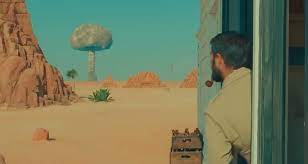
One of Two Nuclear Tests That Occur During the Course of the Film

The most striking thing about the film is its visual style. It all looks like desert postcards of the period. except for a connecting story of a writer and a group of play actors which is not only shot in black and white, but in Academa 4:3 ratio, whereas most of the film is in color and wide screen. In fact, the weakest part of the film is this connecting story.

I remember when I first saw The French Dispatch on TV at my brother’s house. At first, I didn’t know what to make of it. Some of it I loved, some I thought deplorable.

No matter, just hold your nose during the bad parts and enjoy the scenes set in Asteroid City.

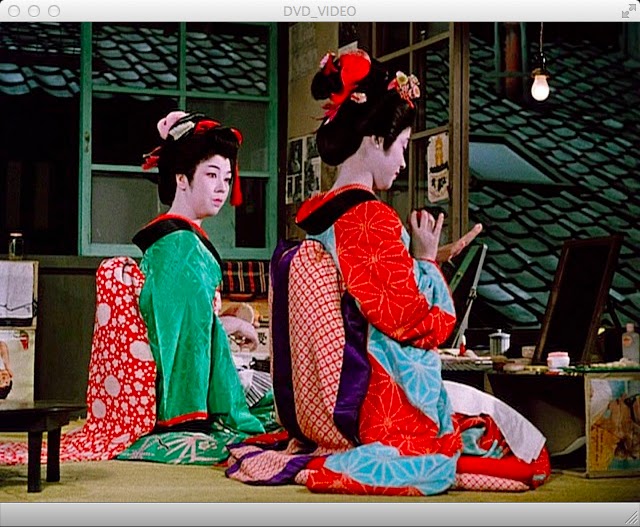
Jidaigeki

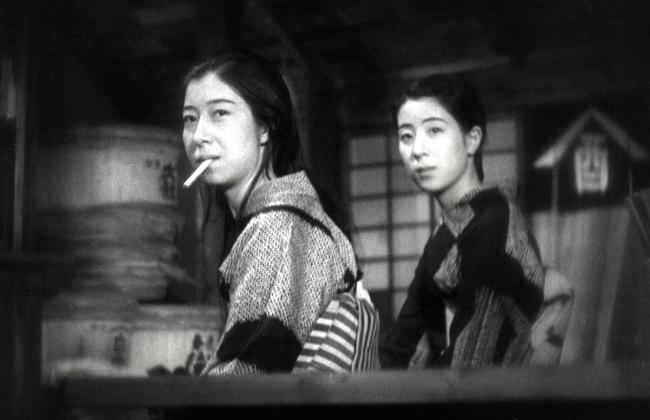
Posters for The Seven Samurai (1954) and Harakiri (1962)

When I first came to Los Angeles in 1967, it didn’t take long for me to fall in love with everything Japanese. That included Japanese films, Japanese food, Japanese literature, and Japanese women. My first long RTD (Rapid Transit District) ride was on the old #83 Wilshire Boulevard route from West L.A. to La Brea Boulevard, where the Toho LaBrea theater was located a couple blocks south. I even remember the film: It was Part One of Hiroshi Inagaki’s Samurai trilogy.

Here I was, a Hungarian kid from Cleveland, finding a kind of home in the Japanese community of L.A. I even moved to Mississippi Avenue in the Sawtelle Japanese district, where there were two Japanese restaurants, the O-Sho and the Futaba Café. They were my first introduction to the cuisine. I was pretty raw at the time: When I had my first cubes of tofu in miso soup, I thought, “I’ll bet these are cut-up shark fins!”

I used to hate seafood. I thought the fish there was picked up from floating debris atop polluted Lake Erie. Now on my own in Southern California, I found myself trying (and loving) sushi after five short years.

What I loved most, however, were Japanese jidaigeki (period films), particularly those set in the samurai era. My friends Alain Silver and Jim Ursini (who collaborated on the first book on samurai films to be published in the U.S.) and I would regularly go to one of the five Japanese movie theaters then existing in Los Angeles:

  • The Toho LaBrea screened films from the Toho Studio
  • The Kokusai and Sho Tokyo theaters played Daiei films—probably my favorite
  • The Kabuki played films from Shochiku
  • The Linda Lea (my least favorite) played films from Tohei

They are all gone now. It’s all part of the growing Americanization of Japanese-Americans.

The Kokusai Theater on Crenshaw South of Adams

In fact, Alain, Jim, an I wrote a column for the UCLA Daily Bruin called “The Exotic Filmgoer.” The articles were all signed Tarnmoor (which, curiously, is the name I go under for this blog). We wrote about the Japanese and other ethnic cinemas that existed back around 1970.

I still love jidaigeki, though they’re not usually to be found around town playing in movie theaters. I have a large collection of DVDs of samurai films, and watch the Japanese films on the Turner Classic Movies (TCM) channel when they are playing.

And I still love Japanese food, though sushi is getting to be priced beyond my means.

Favorite Films: Sunrise (1927)

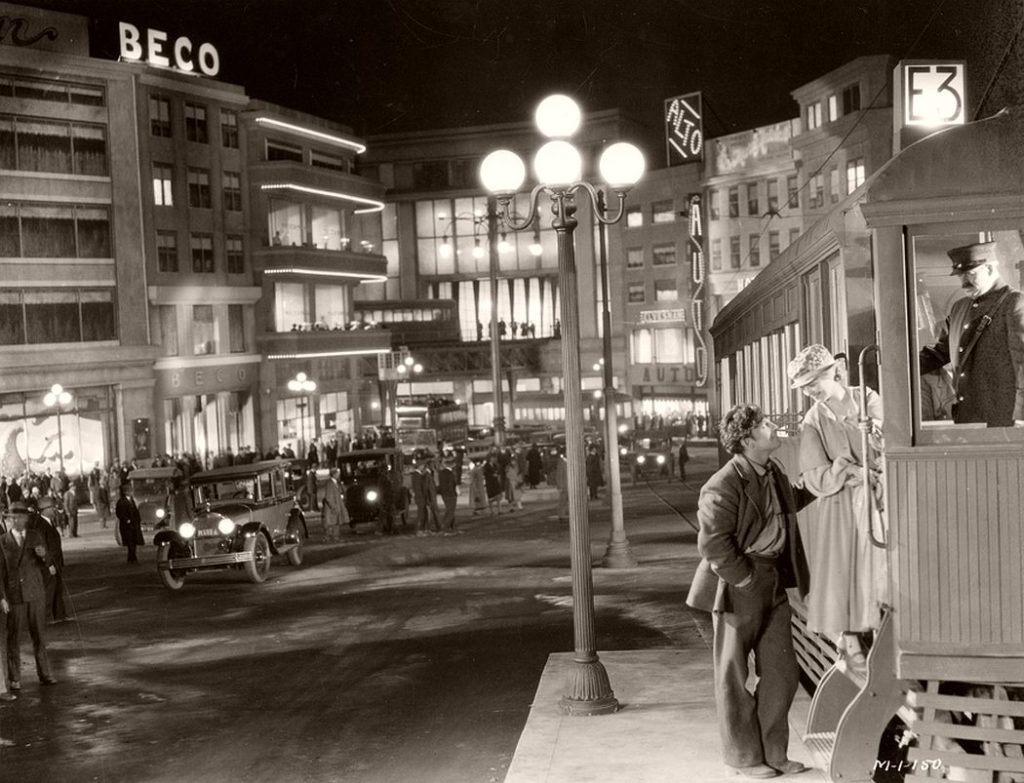
George O’Brien and Janet Gaynor in Sunrise: A Tale of Two Humans

It is difficult to think that the first time I saw F. W. Murnau’s Sunrise: A Tale of Two Humans was some half century after it was produced in 1927. And now I saw it again, almost a century after it was produced. Each time, I thought it was one of the most beautiful films ever made.

None of the characters in the film are named. Unlike most silent films, there were few titles. Murnau had the unique ability to let the visuals speak by themselves, except for a few times when it was absolutely necessary. We begin with a farmer and his wife whose relationship is falling apart because of a girl from the city who is vacationing in their community and who is targeting the farmer for what she can get out of him.

In one of their trysts, the city girl suggests that the farmer take his wife boating and drown her. She even collects bullrushes so that the farmer can save himself by floating on them after he has deliberately swamped the rowboat.

He does take his wife on a boat ride to the city. At one point, he looms over her scaring her. She knows about the relationship and is scared for her life, and for their child, who has been left at home under the care of a maid. The farmer repents of his intention and works at winning her back once they reach the city. These city scenes are by far the best in the film, as he takes her to a restaurant, a photography studio, a church wedding, a barber shop, a carnival, and a dance hall. By the end of the evening, they are obviously still in love with each other. And Murnau’s images of the city are magical.

The Farmer and His Wife in the Magical City Scenes

On the boat ride back to the farm, a storm rises; and the husband and wife are separated as the boat sinks. Has what the farmer planned to do happened by accident? You’ll just have to see the film to find out. And that would definitely be worth your while.

Celebrating the Oscars—Not!

Tomorrow, I will, as usual, NOT watch the Oscars. That should make it about 50 consecutive years of non-participation in the annual awards show. I have nothing against Host Jimmy Kimmel whose weekday show I occasionally watch. Instead, I find that the Academy of Motion Pictures and I disagree most of the time.

If I were a member of the Academy, what films would I have chosen? Actually, I wrote a series of posts about that very subject about ten years ago:

After 1980, I find there are too few American films to merit my attention. In fact, last year I have seen a grand total of two films in theaters—and one of them was a Roger Corman title from the 1960s. The other film was Bullet Train, which I thought was pretty wretched.

Jean-Luc

Jean-Luc Godard (1930-2022) with Wife Anna Karina

Beginning in the 1960s and extending through the early 1970s, I thought that the most exciting filmmaker in the world was Jean-Luc Godard. While I was a film student at UCLA, it seemed that two or three new titles came out every year. All of them enthralled me.

Then, something happened. When La Chinoise came out, I was sorely disappointed. Always sympathetic to revolutionaries, Godard seemed to have turned Maoist. His stars—Jean-Pierre Léaud and Anna Wiazemski—endlessly quoted from Chairman Mao’s little red book. Godard had gone doctrinaire on me. Even though I myself had flirted with the Progressive Labor Party in 1967, as a Hungarian-American I had uneasy feelings about dogmatic Communism.

La Chinoise: Way Too Dogmatic

Still, I thought that most of Godard’s films of the 1960s were exciting. At the time, all my favorite American directors were either dead or dying, and here was a young French director still in his thirties who could be relied upon to produce more masterpieces in the years to come. Alas! It was not to be. I have seen a few of his later productions, which I found not quite up to the standard Godard had set earlier in his career.

Among my favorites of his were:

  • À bout de souffle or Breathless (1960), one of the iconic films of the French New Wave
  • Vivre sa vie or My Life to Live (1962)
  • Le mépris or Contempt (1963), starring Brigitte Bardot
  • Alphaville (1965), a great combo of noir and science fiction
  • Pierrot le fou (1965)
  • Masculin féminin (1966), starring French pop star Chantal Goya
  • Made in USA (1966)
  • Weekend (1967), an apocalyptic satire of the French bourgeoisie

Many of the above films starred Godard’s wife, the lovely Anna Karina, which for me served as an added inducement to see the films.

Godard continued to make films. Between 1968 and 1972, he made political films with the Dziga Vertov Group, none of which I have seen. As late as 2022, he kept releasing films. The exhilaration of the earlier works, however, was gone. I have yet to see more than a handful of them, but I would like to at some point. Many of them are pretty obscure and hard to find.

Last year, at the age of 91, Godard found himself suffering from a series of incapacitating illnesses, such that he committed assisted suicide on September 13, which is allowed by Swiss law. It is an unfortunate end for a great artist whose work influenced my life in so many ways at a time when I was young and alienated. But then, such is life.