Between 1803 and 1805, Napoleon started planning for the invasion of England. His planning was financed by the sale of the Louisiana Purchase to the fledgling American Republic. Yet, the invasion never took place. Why?
According to Louis Antoine Fauvelet de Bourrienne, a French diplomat close to him, when asked why the invasion was called off, Bonaparte replied:
A great battle will be fought, which I shall gain; but I must count upon 30,000 men killed, wounded or taken prisoners. If I march on London a second battle will be fought. I shall suppose myself again victorious. But what shall I do in London with an army reduced three/fourths and without hope of reinforcements. It would be madness.
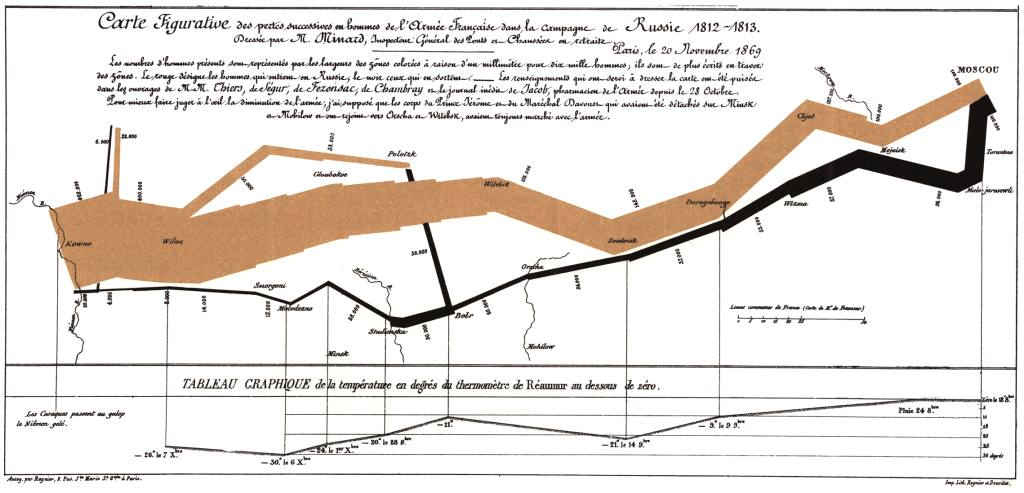
It is unfortunate that Napoleon did not apply the same reasoning in his invasion of Russia a few years later. There is a famous chart which shows graphically what happened to the French forces on the way to Moscow (shown in brown) and during the retreat (shown in black). The thickness of the line graphically illustrates the truth of Napoleon’s decision not to invade Britain.
Charles Minard’s Famous Graph of the Failure of Napoleon’s Russian Invasion
Somehow, over a period of some few years, did Napoleon’s military ability suddenly vanish?
I am one of those strange people who don’t like coffee. Since early childhood, I have been addicted to tea. In my days, I have probably consumed over seventy-five pounds of tea leaves. At the present time, I begin every morning with one large cup of Ceylon, Darjeeling, or Assam tea sweetened with honey and with a squeeze of lime.
Until I read Roy Moxham’s Tea: Addiction, Exploitation, and Empire (2003), I had no idea that the history of the tea trade was so bloody. In the eighteenth century, it even figured in a war fought by the British East India Company and the Empire of China. The Chinese lost and were forced to take Indian opium in trade for their finest tea. (Read Maurice Collis’s Foreign Mud for a fascinating account of the “Opium War.”)
To avoid dealing with the Chinese, the British finally decided to grow their own tea. They began in the northeastern Indian state of Assam and eventually spread to other parts of the subcontinent, Ceylon (now Sri Lanka), and Africa.
I knew that both green tea and black tea come from the same plant, the Camellia sinensis, or Chinese camellia. It is only in the way they are processed that the resulting beverage is green or black.
Fortunately, the early planters found that the tea plant was also native to Assam, and that it was not really necessary to import plants or seeds from China. It is from these plants in Assam that most tea plantings outside of China were derived.
Where the tea trade became particularly bloody was during the nineteenth century. The native populations of the tea-growing areas in India and Ceylon did not care to become indentured agricultural workers at a tea plantation. The result was that the owners of tea plantations had to import coolies from outside the area. The way these coolies were treated by the British tea growers was shameful, resulting in many thousands of deaths.
All so that I could drink a nice cup of tea in the morning!
I was unusually restless today. I started three books and gave up on two of them. The one I continued on was a re-read from fifty years ago, G. K. Chesterton’s All I Survey, first published in 1933. There was a time in the 1970s when I read everything I could find by Chesterton. Today, my shelves hold over a hundred titles of his work, including duplicates. There are few authors whom I enjoy reading so much, probably because he always makes me feel so good.The following is the first paragraph of his essay entitled “On St. George Revivified.”
The disadvantage of men not knowing the past is that they do not know the present. History is a hill or high point of vantage, from which alone men see the town in which they live or the age in which they are living. Without some such contrast or comparison, without some such shifting of the point of view, we should see nothing whatever of our own social surroundings. We should take them for granted, as the only possible social surroundings. We should be as unconscious of them as we are, for the most part, of the hair growing on our heads or the air passing through our lungs. It is the variety of the human story that brings out sharply the last turn that the road has taken, and it is the view under the arch of the gateway which tells us that we are entering a town.
I am currently reading Miklós Vámos’s The Book of Fathers (2000), in Hungarian: Apák Könve. In the notes at the end of the novel, I found this anecdote, which I couldn’t help but share with you. It summarizes more than half a millennium of Hungarian history.
One well-known fact is that Hungary and the Hungarians have lost every important war and revolution since the time of the Renaissance king Matthias Corvinus. He occupied Vienna and became Prince of Austria. He died in 1490. Since then, the nation and its heroes can be found only on the losing side.
A famous, if hoary, joke is instructive.
A Hungarian enters a small shop in New York and wants to buy a hat. But he doesn’t have enough dollars on him, so he asks if he could pay in forints, the Hungarian currency.
“I’ve never seen any forints,” the owner of the shop says. “Show me some.”
“Who’s this guy here?” asks the owner.
“This is Sándor Petöfi, the brightest star of Hungarian poetry. He lived in the nineteenth century. He was one of the March Youth who launched the 1848-49 War of Independence. He was killed in the Battle of Segesvár when the war was crushed by the Austrians and the Russians.”
“Oh my God, what an awful story … And who is this guy on the twenty forint bill?”
“This is György Dózsa, who led in peasant uprising in the sixteenth century. It was crushed and he was executed—actually, he was burned on a throne of fire—”
“OK, OK. And who is that on the fifty?”
“That’s Ferenc Rákóczi II, leader of another war of independence, crushed by the Habsburgs. He was forced to spend his life in exile in Turkey.”
“I should have guessed. And on the one hundred?”
“That’s Lajos Kossuth, leader of the 1848-49 War of Independence, you know. After it was crushed, he had to flee—”
The owner stops him again. “OK, you poor man, just go—you can have the hat for free.”
(Note: these banknotes are no longer in circulation, owing to the ravages of inflation.)
In his novel Dombey and Son (1848), Charles Dickens had a striking passage about the effect that railroad construction was having on parts of London. I remember this passage vividly from when I first read the book decades ago.
The first shock of a great earthquake had, just at that period, rent the whole neighbourhood to its centre. Traces of its course were visible on every side. Houses were knocked down; streets broken through and stopped; deep pits and trenches dug in the ground; enormous heaps of earth and clay thrown up; buildings that were undermined and shaking, propped by great beams of wood. Here, a chaos of carts, overthrown and jumbled together, lay topsy-turvy at the bottom of a steep unnatural hill; there, confused treasures of iron soaked and rusted in something that had accidentally become a pond. Everywhere were bridges that led nowhere; thoroughfares that were wholly impassable; Babel towers of chimneys, wanting half their height; temporary wooden houses and enclosures, in the most unlikely situations; carcases of ragged tenements, and fragments of unfinished walls and arches, and piles of scaffolding, and wildernesses of bricks, and giant forms of cranes, and tripods straddling above nothing. There were a hundred thousand shapes and substances of incompleteness, wildly mingled out of their places, upside down, burrowing in the earth, aspiring in the air, mouldering in the water, and unintelligible as any dream. Hot springs and fiery eruptions, the usual attendants upon earthquakes, lent their contributions of confusion to the scene. Boiling water hissed and heaved within dilapidated walls; whence, also, the glare and roar of flames came issuing forth; and mounds of ashes blocked up rights of way, and wholly changed the law and custom of the neighbourhood.
In short, the yet unfinished and unopened Railroad was in progress; and, from the very core of all this dire disorder, trailed smoothly away, upon its mighty course of civilisation and improvement.
But as yet, the neighbourhood was shy to own the Railroad. One or two bold speculators had projected streets; and one had built a little, but had stopped among the mud and ashes to consider farther of it. A bran-new Tavern, redolent of fresh mortar and size, and fronting nothing at all, had taken for its sign The Railway Arms; but that might be rash enterprise—and then it hoped to sell drink to the workmen. So, the Excavators’ House of Call had sprung up from a beer-shop; and the old-established Ham and Beef Shop had become the Railway Eating House, with a roast leg of pork daily, through interested motives of a similar immediate and popular description. Lodging-house keepers were favourable in like manner; and for the like reasons were not to be trusted. The general belief was very slow. There were frowzy fields, and cow-houses, and dunghills, and dustheaps, and ditches, and gardens, and summer-houses, and carpet-beating grounds, at the very door of the Railway. Little tumuli of oyster shells in the oyster season, and of lobster shells in the lobster season, and of broken crockery and faded cabbage leaves in all seasons, encroached upon its high places. Posts, and rails, and old cautions to trespassers, and backs of mean houses, and patches of wretched vegetation, stared it out of countenance. Nothing was the better for it, or thought of being so. If the miserable waste ground lying near it could have laughed, it would have laughed it to scorn, like many of the miserable neighbours.
Let us say we were seated across the table from an ancient Roman and, say, a Viking. Aside from the obvious language problem, would there be enough commonality to allow for a spirited discussion? I think there would be, primarily because I have read enough Roman and Viking (I should say Icelandic and Norse) literature to vouch for the fact that, when all is said and done, we are not all that different from one another.
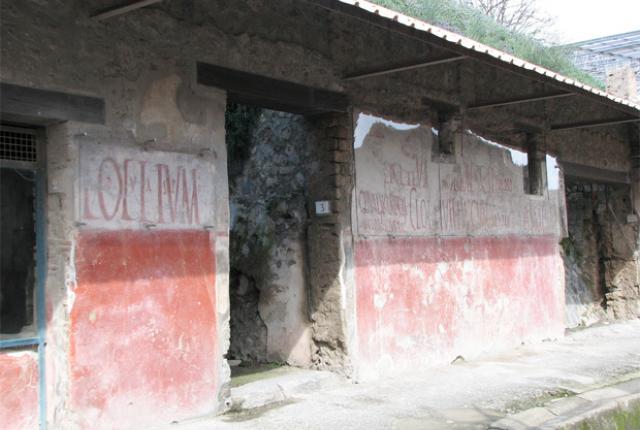
Let me take as a case in point graffiti that has been discovered from the ruins of Pompeii and Herculaneum. You can probably find the equivalent in any nightclub’s restroom wall:
Philiros spado – “Philiros is a eunuch”
Apollinaris, medicus Titi Imperatoris hic cacavit bene – “Apollinaris, physician to the Emperor Titud, had a good crap here”
Oppi, emboliari, fur, furuncle – “Oppius, you’re a clown, a thief, and a cheap crook”
Miximus in lecto. Faetor, peccavimus, hospes. Si dices: quare? Nulla matella fuit – This one was found in an inn: “We have wet the bed. I admit we were wrong, my host, but if you ask why, it is because there was no chamber pot.”
Virgula Tertio su: Indecens es – “Virgula to Tertius: You are a nasty boy.“
Suspirium puellam Celadus thraex – “Celadus makes the girls moan”
Now I have not seen the graffiti of Ancient Rome, but I saw the viking graffiti in the tomb at Maes Howe in the Orkneys. Built over 5,000 years ago, Maes Howe was frequently visited by Viking raiders in the hopes that some buried treasure could be found there. They found none, but left such observations as the following in their Futharc runes:
“Thorni fucked. Helgi carved.”
“Ingigerth is the most beautiful of all women” next to a picture of a slobbering dog.
“These runes were carved by the man most skilled in runes in the Western Ocean.”
You can find more about the Pompeiian graffiti by clicking here. The runes at Maes Howe are explained here.
The more things change, the more they remain the same.
How many letters and journals have come down to us from Ancient Egypt or Classical Greece or Biblical Palestine? None. Consequently, our view of their respective civilizations is an incomplete one. For the last years of the Roman Republic, however, we have a voluminous orator, letter writer, and philosopher who was very much at the center of the action.
Marcus Tullius Cicero was one of the most powerful members of the Roman Senate. From him, we have political orations, speeches for the prosecution or defense of murder trials, essays on the gods and growing old (among other subjects), and letters to friends and political associates. In particular, his letters to his friend Atticus give us a picture of his times such as we do not have from any other ancient civilization.
What is more, his works are eminently readable today. In fact, his oration attacking Mark Antony was so effective that the Roman general promptly sent out an assassin to shut him up permanently.
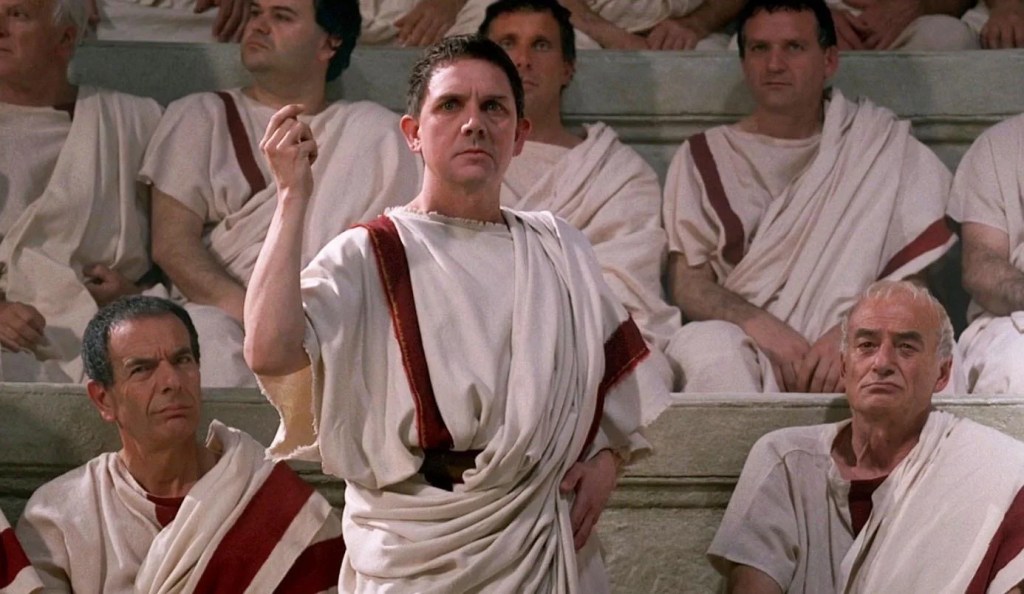
I have just finished viewing the HBO/BBC co-produced mini-series called Rome (2005-2007) which covered the last days of the Roman Republic. The twenty-two episodes include incidents in the life of Julius Caesar, Augustus Caesar, Mark Antony, Pompey the Great, Brutus, Cassius, Cleopatra, and Cicero.
David Bamber as Cicero in the HBO/BBC Mini-Series Rome
Both the mini-series and Cicero’s own writings portray the senator as a deeply divided individual. He was a follower of Gnaeus Pompey and was with him when he lost to Julius Caesar at Pharsalus. Then he sided with Brutus, Cassius, and the other slayers of Julius Caesar and was with them at the Battle of Philippi. That did not sit well with Antony and Octavian (later renamed Augustus), who agreed to his demise.
Even more than two thousand years later, we can see clearly that Cicero was a follower of the old, traditional senate and of Cato the Younger, who committed suicide after Philippi. In 63 BCE, he led the overthrow of the conspiracy of Lucius Sergius Catiline, having several of the participants executed without trial. Ever after, he was disappointed that the people did not express sufficient gratitude. It was clearly a case of, “Yes, but what have you done for us lately?”
I strongly urge you to read some of the excellent Penguin translations of Cicero’s work and, if you have time, view the Rome mini-series, which is still available on HBO.
I have just finished reading Adrian Keith Goldsworthy’s biography, Caesar: Life of a Colossus. While not pertaining directly to the subject of his biography, Goldsworthy includes an amusing anecdote about a consul who dies on his last day in office and the consul-for-a-day who succeeds him:
When Fabius Maximus went to watch a play and was announced as consul, the audience is said to have yelled out, “He is no consul!” He died on the morning of his last day in office. Caesar received the news while presiding over a meeting of the Tribal Assembly, which was going to elect quaestors for the next year. Instead, he had the people reconvene as the Comitia Centuriata and vote for a new consul. Just after midday another of his legates from Gaul was chosen, Caius Caninius Rebilus, whose spell as consul therefore lasted no more than a few hours. A few days later Cicero joked that ‘in the consulship of Caninius nobody ate lunch. However, nothing bad occurred while he was consul—for his vigilance was so incredible that throughout his entire consulship he never went to sleep.’ At the time he is supposed to have urged everyone to rush and congratulate Caninius before his office expired.
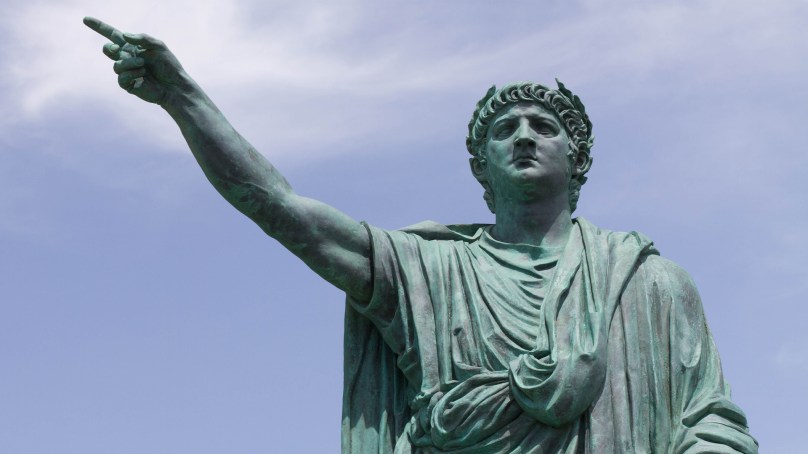
Much as I dislike writing about politics, I have recently noticed some strange resemblances between the current occupant of the White House and the Roman Emperor Nero:
Actors. Nero appeared before the Roman public as a poet, musician, and charioteer; while our president was famed as the actor in a reality TV show called “The Apprentice.”
Wrecking. Nero purportedly burned down a large part of Rome so he could build a gigantic palace for himself called the domus aureus, “The Golden House.” Our president is destroying the institutions of government that he feels do not benefit billionaires like himself.
Praetorian Guard. Nero was murdered by his own Praetorian Guard. Our president, on the other hand, is developing his own Praetorian Guard called ICE. To date, they have not murdered him.
Low-Class Supporters. The provision of “bread and circuses” to the Roman masses made Nero popular among lower class denizens of Rome. Whereas the persecution of various minorities is popular among the red-hatted MAGA supporters of our president.
So far, our current president has not directly ordered any of his family murdered, but if I were Melania, Donald Junior, or Eric, I would not sleep well of nights.
According to his careful calculations, the world was created on “the entrance of the night preceding the 23rd day of October… the year before Christ 4004.” That would make Earth 4,259 years old. And, of course, it had to be true because one couldn’t question the Bible in any particular. It was just a matter of adding up the years of all the “begats” in Genesis, and adding to it the generations of men in the following books of the Old Testament.
I am reading a fascinating book by Loren Eiseley called The Firmament of Time about how the age of the Earth grew by leaps and bounds after discoveries by geologists, astronomers, and other scientists.
There are still people who believe in the literal truth of every word in the Good Book. The Scopes trial took place in Tennessee exactly a hundred years ago. In some corners of the United States, there has been little or no movement since then.




 Tarnmoor
You must be logged in to post a comment.