An Unnecessary Holiday

It Was Leif Eriksson Who Discovered America

It Was Leif Eriksson Who Discovered America

In fourteen hundred and ninety-two
Columbus sailed the ocean blue …

Okay, I’m willing to grant him that. He didn’t “discover” America, though. The original discoverers walked across what is now the Bering Strait (or sailed in from various Pacific islands) and scattered through North and South America thousands of years ago. If you’re looking for a European discoverer, your man is the Icelander Leif Eriksson, aided and abetted by information from one Bjarni Herjulfsson. He started a settlement at L’Anse aux Meadows at the northernmost tip of Newfoundland.

The Viking settlers did not stick around. They faced constant warfare with the Skraelings (i.e. aborigines) and gave it up as a lost cause. But they left behind an archeological record and wrote the experience up in the Vinland Saga, which you can read for yourself. Penguin Books has a good edition, which includes several related sagas bound in the same volume.

In the meantime, we are stuck with this holiday in October commemorating an Italian explorer who is reviled by generations of the people he called Indians. If you want to see what they really thought, read Eduardo Galeano’s Memory of Fire. The Spanish and Portuguese colonial experiences left behind some very pretty churches and millions of tormented Indian slaves, if they were so unlucky as to survive.

Columbus himself was not himself an arrant villain, but he made it possible for real arrant villains like Pedro de Alvarado and Nuño de Guzman to control the lives of thousands of innocents. Okay, so maybe they had human sacrifice—but nowhere on the scale of death practiced by the Iberian newcomers.

The Infamous Shad Bake

Major General George E. Pickett, C.S.A.

Major General George E. Pickett, C.S.A.

He is most famous for leading a spectacularly failed charge against an entrenched elevated position at the Battle of Gettysburg. But he was not to blame for that: The charge was ordered by Lee and executed as ably as possible considering that it was foredoomed to end in disaster.

But that was not the last act of Pickett’s career in Lee’s Army of Northern Virginia. Pickett was commanding general of C.S.A. forces at Five Points, off the right flank of the Petersburg defenses. Lee had given his general direct orders regarding holding his position: “Hold Five Forks at all hazards. Protect road to Ford’s Depot and prevent Union forces from striking the Southside Railroad. Regret exceedingly your forced withdrawal, and your inability to hold the advantage you had gained.” [Italics mine]

The tone of this order did not sit well with General Pickett. Whereupon, feeling that he had covered his bases adequately in case Sheridan should attack, Pickett accepted an invitation from a fellow officer to join in a picnic of shad that had been caught in the Nottoway River. Both he and Fitzhugh Lee left their forces to subordinates and indulged in a nice shad bake.

Unfortunately, Sheridan picked that point to attack Five Forks and stage one of the most decisive victories of the long Siege of Petersburg, sending the defenders scampering for their lives.

Needless to say, that did not sit well with Robert E. Lee, who terminated Pickett’s command a few days later.


In at the Finish

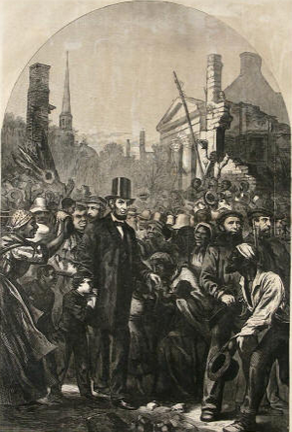
Abe Lincoln Walking he Streets of Richmond in April 1865

Abe Lincoln Walking he Streets of Richmond in April 1865

It is not generally remembered that Abraham Lincoln was visiting the Union lines during the final breakthrough of the siege of Petersburg. Once  General Sheridan crushed the Confederate resistance at Five Points, there was no more holding back of the Grant’s army: Richmond would have to be abandoned.

Even before it was entirely safe to do so, Lincoln had Admiral Porter sail up the James River and land him in the Rebel capital. On April 4, 1865, he walked around what remained of the city (part of which was still in flames). At first, he was accompanied only by a few Naval officers and men, until General Weitzel, who controlled the Union forces in the city, provided an adequate guard for him.

It is a pity that Matthew Brady was not there to take photographs of the lanky President being approached by Black Virginians, who recognized him at once and sang hymns of thanksgiving. Of course, he received a much less welcoming response from most White residents.

I am close to finishing Volume III of Shelby Foote’s great The Civil War: A Narration, which covers the period from the Red River Campaign of 1864 to Lee’s surrender at Appomattox. Since the beginning of the month, I have read little else, and my mind is full of Civil War battles and the awful destruction of thousands of Americans of both sides. To this day, the butcher’s bill for the Civil War dwarfs the sum total of casualties of all other wars in which the U.S. has participated since its inception in 1776.

Marching Through Georgia

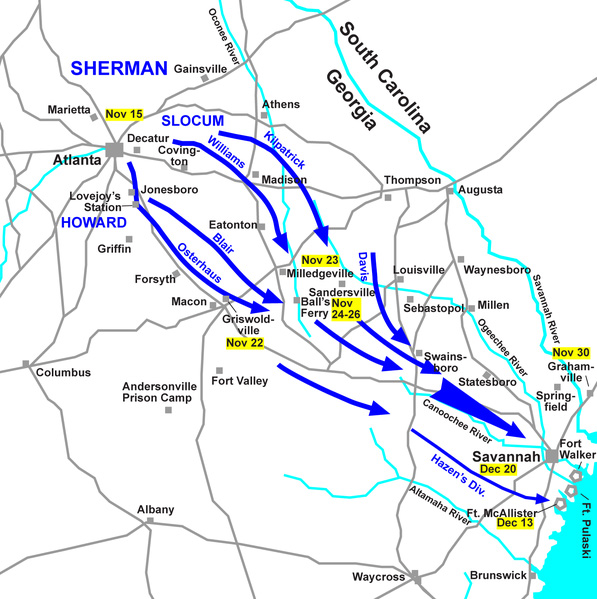
The Route of Sherman’s March to the Sea

The Route of Sherman’s March to the Sea

Much has been written about William Tecumseh Sherman’s March to the Sea in terms of its savagery—but almost nothing in terms of its ingenuity. After Atlanta was destroyed by Sherman’s forces, Confederate General John Bell Hood decided to attack toward Tennessee, destroying Sherman’s supplies.

But what Sherman had decided instead was to avoid Hood’s army altogether and march to Savannah, where he could be resupplied with Union ships waiting near the harbor. So he divided his army into two columns and, while marching, supplied his army with provender hijacked from plantations in the rich farm land along the route. In fact, Sherman arrived in Savannah with more cattle than he started from in Atlanta. And his men were well fed with turkeys, hogs, sweet potatoes, molasses, and corn that they were able to commandeer enroute.

William Tecumseh Sherman - 1893 Stamp Issue

William Tecumseh Sherman – 1893 Stamp Issue

It had been always been the Union Army’s strategy to fight and defeat the enemy’s army. Even Ulysses S. Grant, besieging Petersburg on the outskirts of Richmond, had doubts about the plan, but finally decided to give his approval. Sherman wasted no time in disappearing from the scene, fighting no battles until he re-emerged at Savannah.

The Confederates were thoroughly confused. Hood was marching his army into Tennessee, where it ran into George Thomas’s forces at Franklin and Nashville. Other Confederates thought that Sherman’s goal was Macon or Augusta, which they dutifully reinforced, only to be avoided by Sherman’s columns as they attacked no city larger than Milledgeville, which was until 1868, the State Capitol.

I am currently reading Shelby Foote’s The Civil War: A Narrative, Red River to Appomatox, which provides a Southern view of the end of the Civil War. Even Foote does not accept that Sherman’s soldiers were particularly brutal, though there was a considerable amount of agricultural theft, freeing of slaves, and destruction of property. It seems to have been under control, however, and Foote makes no claims of murder or rapine.


Dunhuang

Bodhisattva and Guardian God

Bodhisattva and Guardian God

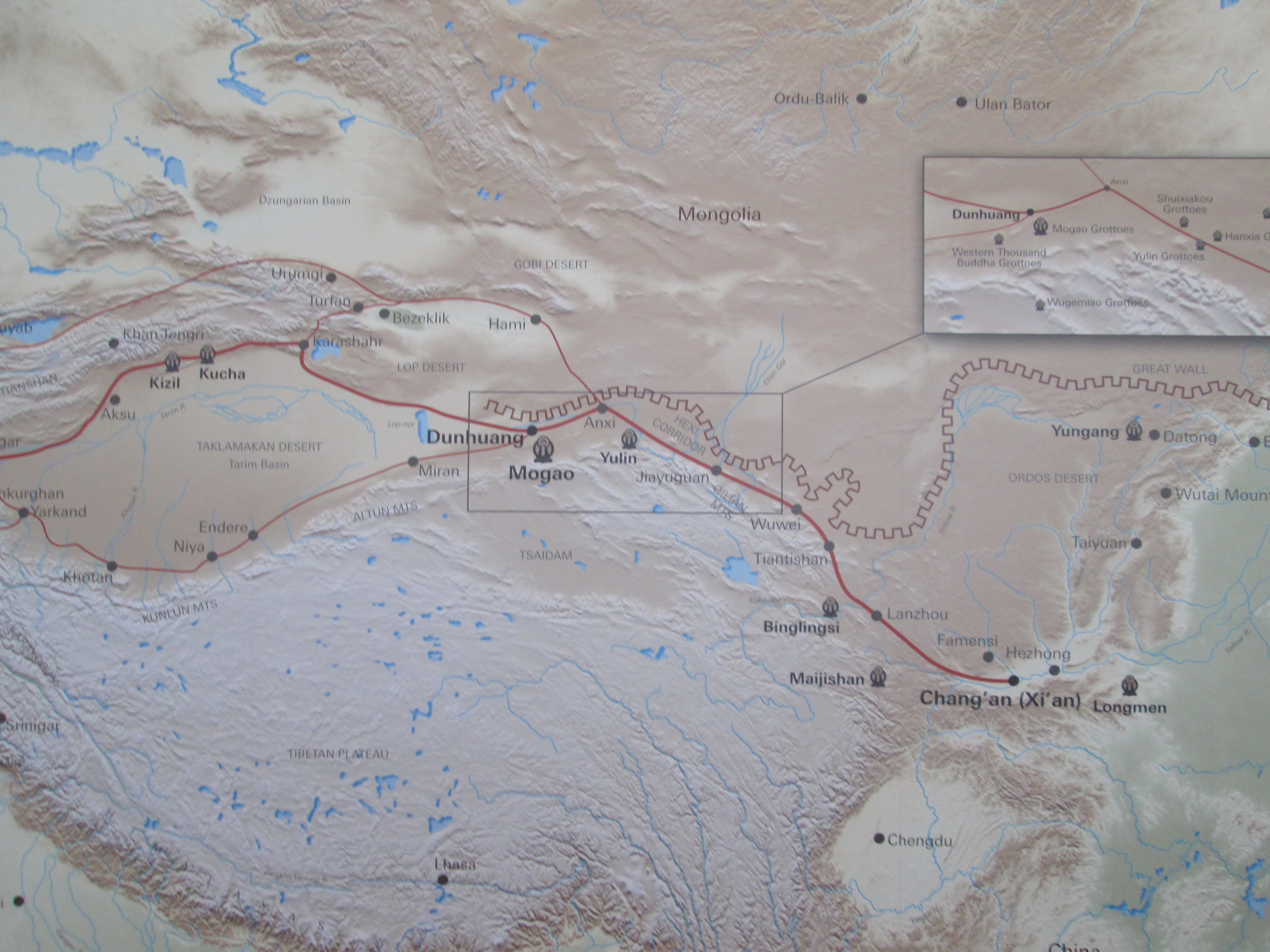
It is over a thousand years ago. Caravans with goods from Europe and the Middle East are about to enter China, right near where the Great Wall sputters to an end near Mogao and Dunhuang. There, at an oasis wedged between the sand dunes of the Lop Desert and the Qilian Mountains, is a series of caves which have been hollowed out and converted into Buddhist temples.

Although Buddhism was the predominant religion of the time, works have been found among Dunhuang’s treasures that included scrolls about Christianity and Judaism, not to mention the oldest printed work on the planet, a scroll of the Buddhist Diamond Sutra.

Notice the western edge of the Great Wall in the map below.

Dunhuang Is Located North of Tibet in Chinese Turkestan

Dunhuang Is Located North of Tibet in Chinese Turkestan

The Getty Center in Los Angeles is running a major exhibit of items from Dunhuang and replicas of the most impressive Buddhist temple caves, including 3-D images. Today, when we visited, the Dunhuang exhibit halls were thronged primarily with Chinese tourists. Still, it was the most interesting of the traveling exhibits now at the Getty Center. Fortunately, the caves at Dunhuang have not been vandalized by jihadist thugs such as were the giant Buddhist sculptures at Bamiyan in Afghanistan.

We tend not to think much about the Silk Road, because it was so thoroughly shut down by Western European naval exploration and the new markets that were created by it. But as long ago as the Roman Empire, silk and spices and other goods from the East were being traded to Europe via camels on the Silk Road that extended from China to the Middle East.


The Man Who Destroyed Yugoslavia

Slobodan Milošević

Slobodan Milošević

He was the 3rd President of the Federal Republic of Yugoslavia (1997-2000), 1st President of Serbia (1991-1997), and the 14th President of the Presidency of the Socialist Republic of Serbia (1989-1991). I am referring to Slobodan Milošević, the leader who took his country down a rat hole, was responsible for thousands of deaths by genocide (which he called “ethnic cleansing”), and died while awaiting trial at the International Criminal Tribunal at the Hague.

Although he initially ruled a nation of Serbs, Croatians, Slovenians, Albanians, Macedonians, Muslim Bosnians, and Hungarians, in the end he was only interested in changing diverse Yugoslavia into a Greater Serbia. Most of his crimes involved his preferential treatment of his fellow Serbs, mostly in the Yugoslavian Republics of Croatia, Bosnia, and Kosovo, where forces under him or allied to him committed devastating massacres of men, women, and children, including large scale rape and torture.

I am currently reading Yugoslavia: Death of a Nation by Laura Silber and Allan Little (New York: Penguin, 1997). Although twenty years have passed since the first edition came out in 1996, the book still reads like today’s headlines.

It shows what can happen when the elected leader of a democracy decides to take sides on behalf of a particular population and, at the same time, act prejudicially against others. (That’s one of the reasons I am so against a political party being responsive only to, say, angry white males.)

The United States is a diverse country very like the old Yugoslavia. It wouldn’t take much effort to break the country into warring fragments. That’s what happened in Cambodia when the Khmer Rouge under Pol Pot decided to persecute or kill city dwellers. Also Hitler’s Germany with its antisemitism and the Ayatollah Khomeini’s persecution of Christians and Baha’i. And, needless to say, ISIS/ISIL/Daesh’s attacks on Christians, Yezidis, and non-Sunni Muslims of the approved flavor.


The West Cork Flying Column

Military Re-Enactors at Old Fort MacArthur

Military Re-Enactors at Old Fort MacArthur

This year marks the 100th anniversary of the start of the Irish War of Independence. In April 1916 a group of volunteers took over the Dublin Post Office, were captured and executed by the British. Yesterday, I went by myself (Martine not feeling well) to the Old Fort MacArthur days in San Pedro.

Present was a group of military re-enactors modeled on the West Cork Flying Column commanded by Thomas Barry (as described in his excellent Guerilla Days in Ireland: A Personal Account of the Anglo-Irish War). I have run across this group before and admire their knowledge of their country’s history and their adherence to verisimilitude. Also, they have the best music by far of any group at the show.

The Irish War of Independence went on until December 1921 when the signing of the Anglo-Irish Treaty created the Irish Free State.

The Crusade Against the Christians

The 4th Crusade Was Christians vs. Christians

The 4th Crusade Was Christians Against Christians

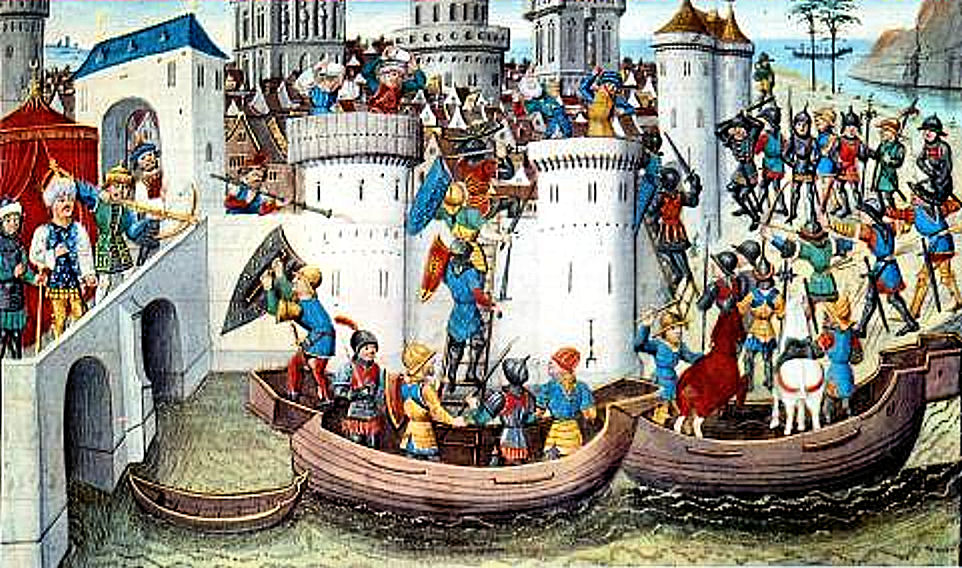
Pope Innocent III didn’t plan it that way, but the 4th Crusade (1202-1204) was mostly Christians fighting Christians.When the knights involved in that crusade decided to go to the Holy Land by sea, they contracted with the Venetians to carry 30,000 bodies and associated horses and supplies to retake Jerusalem.

There was only one little problem. Although the Venetians spent a year building a fleet to carry the 30,000 crusaders, only about a third of that number showed up. Oops! That didn’t sit well with Enrico Dandolo, the 90-year-old blind Doge of Venice—but no pushover when it came to negotiations.

Venice was upset that the Adriatic port of Zara (now called Zadar) now belonged to Hungary. The Doge negotiated with the leaders of the crusade to stop and capture Zara “on the way” to the East. Unfortunately, Zara was not only Christian: It was Roman Catholic. And King Emico of Hungary wore the crusaders’ cross himself. A deal was a deal, and the crusade did not want to start on in debt to the Venetians. So, they attacked and took Zara, returning it to the Venetians.

That was only the beginning of their problems. A Byzantine prince named Alexius Angelos offered to pay a fortune to the crusade and to their Venetian transport … if only they would see fit to returning him to the throne of Constantinople. His father, Isaac II Angelos, has been the emperor; but his elder brother Alexius III Angelos, had him blinded and deposed him.

It looked like a good deal. Although Prince Alexius had been drumming up support for his cause among the crowned heads of Europe, he was pretty much ignored. Too flighty, it seems. But the crusaders were committed, and the idea of all that loot turned their heads.

So off to Constantinople they sailed. They besieged the city from the Golden Horn side, and after a number of attacks finally prevailed. Prince Alexius was set up as Alexius IV Angelos. And now it was time for payback. Except, Alexius IV was unable or unwilling to pay what he had promised. So the crusaders not only took the city, but looted and burned it, raping and killing at will. And, um, they never did get to the Holy Land.

Pope Innocent III was furious. If you can’t trust 10,000 crusaders wearing crosses over their armor to do what they promised, whom can you trust?

The story is well told in Jonathan Phillips’s The Fourth Crusade and the Sack of Constantinople, complete with extensive notes, a large bibliography, and an alphabetical index.


Antioch 1097-1098

One of the Most Horrendous Battles in History

One of the Most Horrendous Battles in History

It is generally known that the First Crusade attained its goal, the capture of Jerusalem. But what happened along the way left a taste of ashes in the mouths of its survivors. I have just finished reading Thomas Asbridge’s The First Crusade: A New History. What stuck in my mind was what happened along the way to Jerusalem, at Antioch.

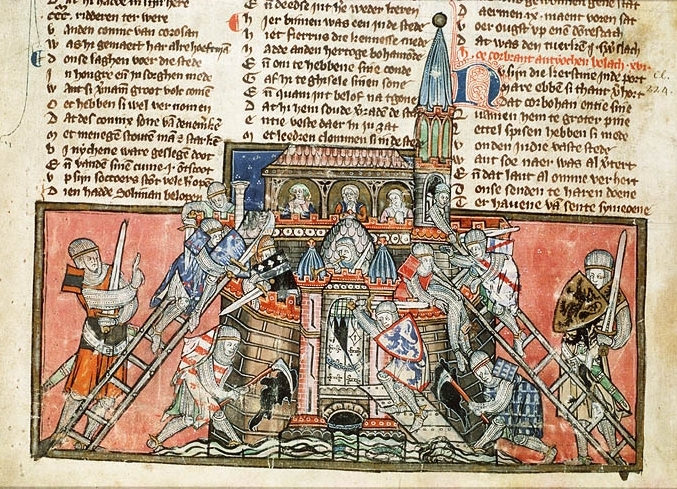
Antioch was one of the great cities of Jerusalem, but it was under the firm control of the Turks. It was a huge city, well fortified, and incorporating portions of two mountains and a powerful citadel. The Crusaders set up for a protracted siege, and protracted it certainly was: It lasted for a year and a half. It was only when Bohemond of Taranto managed to persuade a traitor to let the Latins into the city that the first stage of the siege was ended.

Yes, there was a second stage. After the Crusaders were ensconced within the walls, they were in turn besieged by the huge army of Kerbogha, the Atabeg of Mosul (the same Mosul that is now under the control of ISIS/ISIL/Daesh). Asbridge thinks that he commanded some 35,000 fighters (some said as many as 300,000, which is unlikely), which at that time far exceeded the diminished ranks of the Crusaders.

However greedy and petty the Crusade leaders may have been, they did not lack for bravery. There was some mummery about the lance with which the Roman centurion Longinus had pierced the side of the crucified Christ being found buried in a church. The discovery of this relic raised the spirits of the besieged, such that they sallied forth from the walls of Antioch and routed the Turks, raising the second siege and clearing the way to Jerusalem.

We don’t think much about the Crusades, but the memory of them has not faded from the Muslim man in the street. Are we destined forever to be Crusaders in the Middle East?


“They Stomped the Floor”

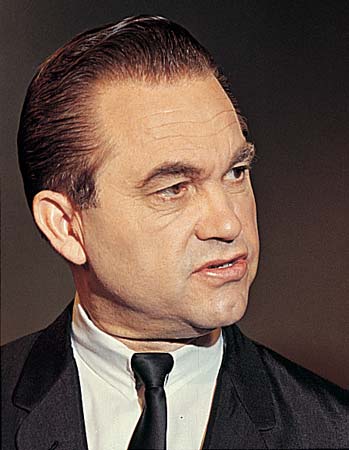
Alabama Governor and Presidential Candidate George C. Wallace (1919-1998)

Alabama Governor and Presidential Candidate George C. Wallace (1919-1998)

Politically speaking, I come from a very divided family. My brother and I were Liberal Democrats, my mother was an independent (she loved John B. Anderson in 1980), and my father was a staunch follower of segregationist Alabama Governor George C. Wallace.

Actually Wallace was not always a segregationist. He started out as a circuit judge of the Third Judicial Circuit in Alabama, where he was known for his fairness, irrespective of race. He even called Black attorneys “Mister” rather than patronizingly referring to them by their first names.

When he ran for governor of Alabama in 1958, he was defeated by John Malcolm Patterson, who ran with the support of the Ku Klux Klan, against which Wallace had spoken on occasion. (in fact, the NAACP had supported Wallace.) This loss wrought a change in the candidate: “You know why I lost that governor’s race? … I was outniggered by John Patterson. And I’ll tell you here and now, I will never be outniggered again.” And he wasn’t.

From this point on, Wallace adopted an wavering segregationist policy. “You know, I tried to talk about good roads and good schools and all these things that have been part of my career, and nobody listened. And then I began talking about niggers, and they stomped the floor.”

Alas, my poor father was also anti-integration. As an uneducated factory worker, he was afraid that Southern Blacks were coming to take away his job. So he thought Wallace was the man to stem that tide. Today, he would probably vote for Trump.